
Postbiotic Powders and Lysate Materials: A Supplement R&D Shortlist
Postbiotic Powders and Lysate Materials: A Supplement R&D Shortlist
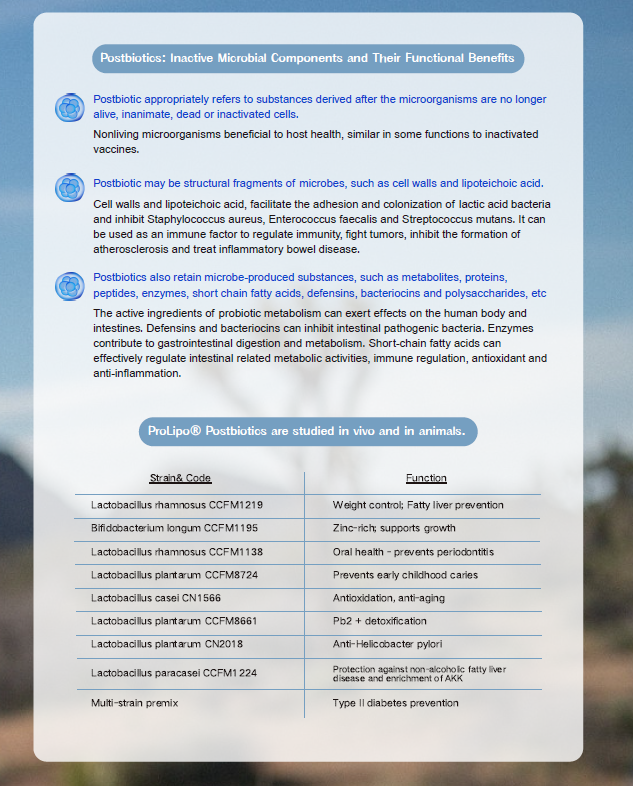
ProLipo® Postbiotics — a lysate-based postbiotic material built on a phospholipid liposome wall system.
Postbiotics are no longer a fringe term in supplement development. For R&D teams, the practical question has shifted from “what is a postbiotic?” to “which postbiotic raw material actually fits our formula, our process, and our label?” This shortlist guide looks at two material directions — a phospholipid liposome lysate (ProLipo® Postbiotics) and a heat-inactivated postbiotic biomass (Postbiotics Powder, UNI-POST-POW) — both supplied by Shanghai Unibio Lab Co., Ltd, and explains how composition, excipients, and documentation differ.
What Counts as a Postbiotic Raw Material
A postbiotic raw material is a non-living probiotic derivative. It is prepared from probiotic biomass, but the final ingredient does not rely on viable, reproducing cells to deliver its function. That single distinction drives most procurement decisions, because it affects shelf-life logic, storage requirements, and how the material behaves inside a finished product.
Within this category, suppliers generally follow one of two production routes:
Route 1 — Lysate materials
Cells are intentionally disrupted so that intracellular components are released, then stabilised with a carrier and, in some designs, an encapsulation or wall system. ProLipo® Postbiotics (model ProLipo-POST) sits in this group. Its material composition is listed as a postbiotic lysate, a phospholipid liposome wall material, and a food-grade carrier.
Route 2 — Inactivated biomass
Whole cells are heat-inactivated, meaning the strain is no longer alive but the cell envelope structure is largely retained. Postbiotics Powder (model UNI-POST-POW) is described as a heat-inactivated postbiotic raw powder, composed of inactivated probiotic biomass and a maltodextrin carrier. Its documentation notes that it contains no live bacteria.
Both routes are non-living. They differ in what the finished powder physically contains — released cell fractions versus intact, non-viable cells — and that difference matters for taste masking, dispersion, and the excipient list on a supplement label.
Why R&D Teams Are Reviewing Postbiotics Now
The surrounding market context is sizeable enough to justify dedicated formulation work. The global probiotics market was valued at approximately USD 72.1 billion in 2024 and is projected to reach USD 165.1 billion by 2034, according to Global Market Insights. Within that broader figure, probiotic dietary supplements alone reached a market size of USD 10.60 billion in 2026, with a forecast CAGR of 9.5% through 2031 (MarketsandMarkets).
These numbers describe the live-culture market, not the postbiotic segment specifically, and should be read as context rather than a postbiotic forecast. What they do show is scale: brands already building probiotic portfolios are the same teams now asking whether a non-living derivative belongs on the label.
The Shortlist at a Glance
The two materials below are not interchangeable SKUs. They address different formulation briefs, and the table is intended as a first-pass filter before sampling.
| Parameter | ProLipo® Postbiotics (ProLipo-POST) | Postbiotics Powder (UNI-POST-POW) |
|---|---|---|
| Material route | Postbiotic lysate | Heat-inactivated postbiotic biomass |
| Carrier / wall system | Phospholipid liposome wall material + food-grade carrier | Maltodextrin carrier |
| Live bacteria | Non-living derivative | No live bacteria contained |
| Active content spec | Defined by supplier specification | Active postbiotic content ≥ specified value |
| Storage | Well-closed container, away from moisture and direct sunlight, at room temperature | Well-closed container, away from moisture and direct sunlight, at room temperature |
| Shelf life | 24 months | 24 months |
| Positioned applications | High-end dietary supplement, luxury skincare, premium functional beverage | Functional food, dietary supplement, skincare raw material, beverage |
Source: Shanghai Unibio Lab Co., Ltd product specifications (ProLipo-POST, UNI-POST-POW).
Profile 1: ProLipo® Postbiotics
ProLipo® Postbiotics is defined by its wall material rather than its viable count. The specification lists postbiotic lysate, phospholipid liposome wall material, and a food-grade carrier. The phospholipid component is an excipient choice: it forms a liposomal wall structure around the lysate, which is a delivery-system decision rather than a strain decision.
For R&D purposes, this places the material in the premium formulation zone. The supplier positions it for high-end dietary supplements, luxury skincare, and premium functional beverages — categories where a liposomal delivery story on the label and a smooth mouthfeel in the finished product both carry commercial weight.
Storage is straightforward at the warehouse level: keep it in a well-closed container away from moisture and direct sunlight at room temperature, with a stated shelf life of 24 months. For a non-living material, that shelf-life profile is one of the practical advantages over live cultures.
Profile 2: Postbiotics Powder (UNI-POST-POW)
Postbiotics Powder is the more conventional of the two routes. It is a heat-inactivated postbiotic raw powder — inactivated probiotic biomass carried on maltodextrin. The specification states that no live bacteria are contained and that active postbiotic content must meet a specified value, which is the primary quality metric to agree on with the supplier rather than a CFU figure.
Maltodextrin is a common, cost-efficient carrier in powder blending. It disperses well, is broadly accepted in food and supplement manufacturing, and does not add a novel excipient to the label. The stated application range is wider than the lysate: functional food, dietary supplement, skincare raw material, and beverage.
Storage and shelf life mirror the lysate: a well-closed container, away from moisture and direct sunlight at room temperature, 24-month shelf life.
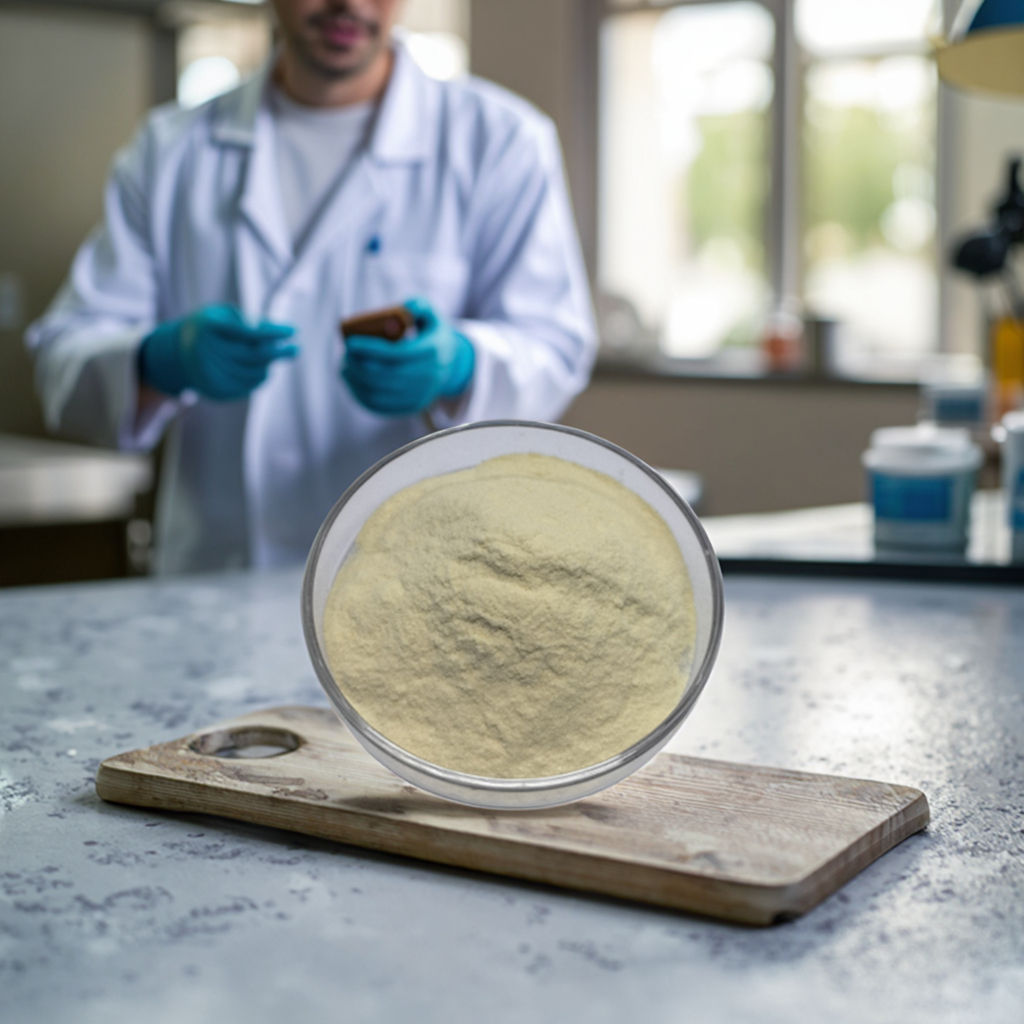
Postbiotics Powder (UNI-POST-POW) — heat-inactivated postbiotic biomass on a maltodextrin carrier.
Lysate vs Inactivated Biomass: The Composition Difference
The two materials are often grouped together because both are non-living, but the physical difference is significant.
What a lysate contains
A lysate is produced by breaking the cells open. The resulting material is a mixture of released intracellular fractions rather than intact cell bodies. Because the cell structure is no longer whole, the material typically needs a carrier and a stabilising wall system — which is why ProLipo® Postbiotics pairs the lysate with a phospholipid liposome wall material. The liposome structure can be positioned as both a protective shell and a delivery aid.
What inactivated biomass contains
Heat inactivation kills the strain without deliberately disassembling it. The cell envelope remains, so the powder carries intact but non-viable cell bodies on a carrier. This is closer to a “whole-cell” postbiotic concept and often suits formats where a simpler excipient list is preferred.
Applications and Formulation Fit
Choosing between the two often comes down to the finished format and the story the brand intends to tell.
Capsules & tablets Both materials are relevant. A lysate with a liposomal wall system is primarily a positioning choice in capsule formats, where delivery claims are harder to substantiate visually, while inactivated biomass is a straightforward fill for standard supplement matrices.
Functional beverages The lysate is positioned for premium functional beverages, where a liposomal dispersion narrative fits liquid formats. Inactivated biomass is listed for beverage use as well, and its maltodextrin carrier is generally compatible with dry-blend beverage systems.
Skincare Both materials list skincare relevance — the lysate under luxury skincare, the inactivated powder as a skincare raw material. This reflects the broader move of postbiotic concepts into topical and beauty-adjacent products.
Functional food Inactivated postbiotic biomass is the better-matched option where the material is blended into food matrices and a neutral carrier is preferred.
Documentation and Parameters Buyers Should Verify
Because this is a constraint-driven category, most evaluation risk sits in paperwork and specifications rather than in performance claims. A structured checklist helps.
Material and specification checks
Confirm the material route (lysate or inactivated biomass), the carrier identity, and, where a wall system is used, the wall material type. For inactivated biomass, confirm the stated minimum active postbiotic content. For both, confirm storage conditions and the 24-month shelf-life statement in writing on the specification sheet that accompanies the batch.
Facility and certification checks
Shanghai Unibio Lab Co., Ltd holds a documented international qualification set. The relevant facts a buyer can verify against certificates include:
| Certificate | Reference / Number | Issuing body | Scope note |
|---|---|---|---|
| FDA Facility Registration | Shanghai Unibio Lab Co., Ltd: 19635371796; Shanghai Helplifes Technology Co., Ltd: 12494588438 | U.S. Food and Drug Administration (FDA) | Probiotic raw materials, probiotic finished dietary supplements production & sales |
| GRAS independent conclusion | No. CIRS-GRAS-AH39-20250422 | CIRS GROUP USA Inc. (Independent GRAS Expert Panel) | Pasteurized Akkermansia muciniphila AH39 raw material & AH39-containing finished products |
| HALAL Certificate | Registration No. 3100/11080; Certificate No. 1821240000 | SHANDONG HALAL CERTIFICATION SERVICE (SHC), recognized by JAKIM | Listed probiotic strains and related raw materials & finished products |
| GMP Certificate | CN22/00003036 | SGS-CSTC Standards Technical Services Co., Ltd. | Production of probiotic solid beverages (screening, mixing) |
| FSSC 22000 | CN22/00000434 | SGS United Kingdom Ltd | Production of probiotic solid beverages; ISO 22000:2018, ISO/TS 22002-1:2009, FSSC 22000 Version 6 |
| ISO 22000 | CN22/00000437 | SGS-CSTC Standards Technical Services Co., Ltd. | Production of probiotic solid beverages (screening, mixing); ISO 22000:2018 |
Certification details as issued to Shanghai Unibio Lab Co., Ltd and its affiliated facility. Buyers should confirm scope coverage for the specific material ordered.
Two cautions belong here. First, several of these certificates are scoped to the production of probiotic solid beverages (screening and mixing), so a buyer should confirm that the specific postbiotic material falls within the stated scope rather than assuming blanket coverage. Second, the GRAS document applies specifically to the pasteurized Akkermansia muciniphila AH39 raw material and AH39-containing finished products — it is not a general GRAS statement covering every item on the portfolio. Verifying scope, not just the existence of a certificate, is the point of a constraint-stage review.
The company also operates under a documented quality-control routine: 100% in-house lab testing for viable count, microbial safety, and heavy metals, with third-party SGS/Intertek inspection available on client request. For postbiotic powders specifically, the meaningful test set is different from live cultures — the viable-count test is not applicable to a material that contains no live bacteria, so buyers should agree on which identity and content assays apply to the postbiotic material in question.
Comparison With Live Probiotic Powders — and Where Postbiotics Fall Short
Postbiotics are frequently framed as a simpler alternative to live cultures. In several respects they are: as non-living materials, they remove cold-chain storage obligations, sidestep end-of-shelf-life viability loss, and tolerate formats that would challenge a live strain. The 24-month room-temperature shelf life stated for both ProLipo® Postbiotics and Postbiotics Powder is a practical example of that advantage.
That said, postbiotics are not a universal upgrade, and R&D teams should weigh the trade-offs honestly.
- No colonisation claim. Because the material is non-living, it cannot establish or colonise in the gut the way a live strain can. Positioning must stay within postbiotic boundaries.
- Different evidence base. Live strains such as Lactobacillus rhamnosus GG carry long-standing recognition, and the company's clinically studied live strains (for example Akkermansia muciniphila AH39) have specific documentation such as a GRAS independent conclusion. Postbiotic materials are generally supported by a different — and often newer — evidence set, so brands should not assume equivalence.
- Supply maturity. The postbiotic raw-material segment is less standardised than the live probiotic segment. Specifications can vary between suppliers, which is precisely why a structured shortlist and documentation review is worth the effort.
- Processing boundaries. While non-living materials are more robust than live cultures, they are still subject to the carrier's and wall system's limits. A phospholipid liposome wall and a maltodextrin carrier behave differently under heat and moisture, and each format should be validated in the actual process.
For context, the company's live-culture side uses VPro® 5-layer micro-encapsulation, a food-grade polysaccharide and protein composite coating that provides an acid- and bile-resistant barrier and extends strain shelf life. That platform belongs to the live-probiotic portfolio; it is relevant here only as evidence of the supplier's encapsulation capability, not as a claim about the postbiotic materials.
Future Outlook
Two forces are likely to shape postbiotic sourcing over the next product cycles. The first is technical: microencapsulation and delivery-system research — including the use of materials such as alginate and chitosan to protect active ingredients — is a recognised trend in the wider probiotic field, and the same engineering mindset is being applied to non-living derivatives through carriers and wall systems like phospholipid liposomes. The second is regulatory: as postbiotic claims move onto labels, buyers will increasingly ask for documentation that is scoped to the specific postbiotic material, not inherited from a live-culture certificate.
For supplement brands, the practical implication is that postbiotic supply will be evaluated less as a novelty and more as a standard raw-material category — with specification sheets, carrier declarations, and scope-accurate certification as the deciding documents.
FAQ
What is the difference between a postbiotic lysate and heat-inactivated postbiotic biomass?
A lysate is produced by disrupting probiotic cells so intracellular fractions are released, and it typically relies on a carrier and a wall system — ProLipo® Postbiotics, for example, uses a phospholipid liposome wall material and a food-grade carrier. Heat-inactivated biomass keeps the cell envelope intact while rendering the strain non-viable; Postbiotics Powder is composed of inactivated probiotic biomass on a maltodextrin carrier and states that no live bacteria are contained.
Do postbiotic powders carry a viable count specification?
Not in the same sense as a live probiotic powder. Postbiotic materials are non-living, so viable count is not the applicable metric. Postbiotics Powder instead specifies a minimum active postbiotic content. Buyers should confirm which identity and content assays apply to the specific material rather than assuming a CFU-style specification.
What storage conditions and shelf life apply to these two materials?
Both ProLipo® Postbiotics and Postbiotics Powder state a 24-month shelf life and should be kept in a well-closed container away from moisture and direct sunlight at room temperature. This room-temperature profile distinguishes them from many live-culture powders that require cold-chain handling.
Which certifications are relevant when sourcing these materials?
Shanghai Unibio Lab Co., Ltd holds FDA Facility Registration (numbers 19635371796 and 12494588438), a GRAS independent conclusion for Akkermansia muciniphila AH39 (No. CIRS-GRAS-AH39-20250422), a HALAL certificate (No. 1821240000), a GMP certificate (CN22/00003036), FSSC 22000 (CN22/00000434), and ISO 22000 (CN22/00000437). Two points should be verified: the GMP, FSSC 22000, and ISO 22000 certificates are scoped to the production of probiotic solid beverages, and the GRAS document applies specifically to AH39 rather than to the full portfolio.
Can postbiotic powders be used in formats that a live probiotic cannot tolerate?
Because they are non-living, postbiotic materials avoid the viability constraints that limit live cultures in certain beverage, food, and topical formats. However, they remain subject to the limits of their carrier and wall system — a maltodextrin-carried powder and a phospholipid liposome-walled lysate behave differently under heat and moisture — so process validation is still required.
Additional technical and documentation detail on the postbiotic and probiotic portfolios is available in the company brochure: Shanghai Unibio Lab Co., Ltd — product and capability brochure.