
Powder Coating for Office Interiors: A Finish-Matching Guide
Specifying powder coating for an office interior is not a single decision. A partition frame, a workstation pedestal and a ceiling-mounted luminaire housing sit in three different wear environments inside the same building, and the finish that performs best on one will not necessarily be the right choice for the other two.
The practical question for specifiers, fit-out contractors and furniture OEMs is therefore narrower than 'which powder coating is best': it is which coating chemistry and surface texture belongs on which part. This guide matches three finish families — wrinkle, TGIC-free and glossy polyester — to partitions, furniture and fixtures, and explains what the published performance data (adhesion grade 0, hardness ≥H, 500-hour salt spray resistance) actually tells a buyer.
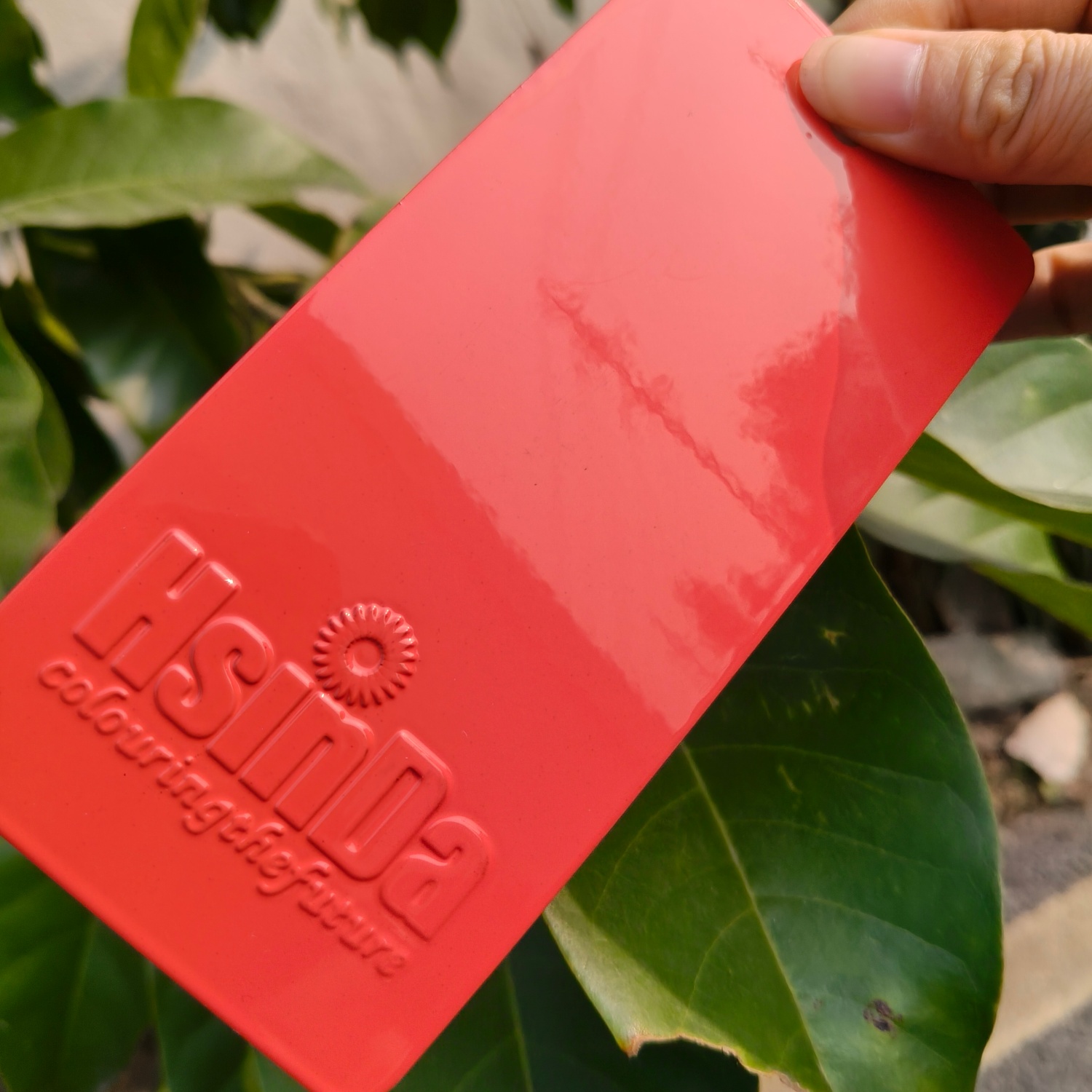
Why office interiors divide into three coating zones
Commercial office fit-outs concentrate metal in three functional groups, and each group is exposed to a different combination of touch, abrasion and cleaning chemistry.
Zone 1 — Partitions and screens
Partition frames, capping rails and glazed screen surrounds are the most visible metal in the fit-out and are touched far more often than their appearance suggests. They are also the components a facilities team cleans most aggressively, usually with general-purpose detergents and degreasers. Appearance retention and uniform colour across long runs matter more here than mechanical abuse resistance.
Zone 2 — Furniture
Desks, chairs, filing cabinets, shelving units and storage lockers take the opposite load profile: frequent edge contact, trolley impacts, stacked objects and constant abrasion at drawer fronts and seat frames. Appearance matters, but so does the ability of the film to absorb impact without chipping to bare metal.
Zone 3 — Fixtures
Luminaire housings, cable trays, electrical enclosures, radiator covers and door hardware are rarely looked at closely but are frequently cleaned, occasionally bumped, and in some cases required to combine appearance with insulating or corrosion-protection functions. Here the coating is doing a job first and a decorative job second.
The specification principle: match the finish to the dominant failure mode of the part, not to the room it sits in. A partition that is never touched (a fixed glazed screen with an aluminium cap) and a partition that is touched hourly (a demountable screen with a steel frame) should not automatically receive the same finish.
Three finishes, three roles
Wrinkle powder coating: texture as a working surface
Wrinkle powder coating is a polyester-based coating whose surface is deliberately textured rather than smooth. In the reference specification set it is positioned for home and office furniture, industrial machinery, electronics and construction components, and for hardware and tools. It resists general acids and oils with average alkali resistance, cures at 180–200 °C for 10–15 minutes, is applied at a nominal film thickness of 70 μm, and records impact resistance of 50 kg/cm under ISO 6272-1:2017. Weathering data shows no powdering and light retention above 50% after 500 hours under ISO 11341:2004.
In an office context, the textured surface is most useful where a component is handled, stacked or abraded and where minor surface marking would otherwise read as damage: cabinet bodies, machine and equipment housings, distribution boxes and electrical cabinets, and steel-and-wood furniture frames. The texture also changes how light behaves on a large flat panel, which is why it is frequently chosen for storage walls where a high-gloss reflection would be unwelcome.
TGIC-free powder coating: the indoor furniture default
TGIC-free powder coating in this range is an HAA-cured polyester system — polyester resin with a hydroxyalkyl amide curing agent, pigment and additives — and is classified as an indoor, VOC-free powder coating. Its published application scope extends explicitly to office and residential furniture: office desks and chairs, filing cabinets, shelving units and storage lockers, described as producing a smooth, uniform, highly abrasion-resistant film able to withstand high-frequency use.
That positioning is the reason it functions as the default for the furniture zone. Where a specification or client sustainability policy rules out TGIC-cured chemistry, the HAA alternative delivers the same measurable film properties in the reference data: adhesion grade 0 under ISO 2409:2020, hardness ≥H under ISO 15184:2020, and 500-hour salt spray performance under ISO 7253:1996 with single-side corrosion at the cross-section ≤2 mm.
Glossy powder coating: for surfaces that are meant to be seen
Glossy powder coating is a polyester coating positioned for construction components — aluminium doors and windows, curtain walls, railings and outdoor furniture — as well as furniture manufacturing, where it covers outdoor metal tables and chairs, shelving units, filing cabinets and metal lockers, and industrial machinery housings. Its job in this set is appearance-led: a smooth, reflective surface with strong colour and gloss retention.
Applied to office interiors, this is the finish for high-visibility partitions, reception-facing screens, exposed structural framing and feature railings, where the finish is part of the visual specification rather than a protective afterthought. It shares the same measured film properties as the other polyester systems in the range, including gloss adjustable from 5% to 95% under ISO 2813:2014 — which means the 'glossy' designation is a starting point, not a fixed number.

Matching finish to part: a working table
| Office component | Recommended finish family | Reason in the reference data |
|---|---|---|
| High-visibility partition frames, reception screens, feature railings | Glossy polyester powder coating | Positioned for construction, furniture and industrial machinery; smooth, appearance-led film with gloss adjustable 5–95% (ISO 2813:2014) |
| Demountable screen frames, cabinet bodies, equipment housings | Wrinkle polyester powder coating | Textured surface positioned for office furniture, electrical cabinets and machinery; impact 50 kg/cm (ISO 6272-1:2017) |
| Workstations, task chairs, pedestals, filing cabinets, lockers | TGIC-free (HAA) polyester powder coating | Specified for office desks, chairs, filing cabinets, shelving and storage lockers; smooth, uniform, abrasion-resistant film |
| Luminaire housings, cable management, electrical enclosures | Wrinkle or matte polyester, depending on heat exposure | Wrinkle grade is used for distribution boxes and electrical cabinets; matte grades reduce glare on lighting equipment |
| Radiator covers, door hardware, ancillary metalwork | Polyester, gloss or texture by location | Polyester chemistry in this range is specified for hardware and construction metalwork with 500 h salt spray resistance |
The table reflects published application scope for each finish family in the reference set. Final selection should be confirmed against a physical sample on the actual substrate and film build.
Reading the datasheet: what each number means for a fit-out
Powder coating datasheets are frequently compared by headline gloss or colour alone. For office interiors, four measurements carry more procurement weight.
Adhesion, grade 0 (ISO 2409:2020)
Grade 0 in a cross-cut adhesion test means the coating shows no detachment from the substrate when the film is cut through in a lattice pattern and tape is applied. For office furniture, this is the property that decides whether a chipped edge stays a chip or becomes a spreading peel. It is the single most useful predictor of how a finish will behave at cut edges and fixing points, which is where coated furniture usually fails first.
Hardness ≥H (ISO 15184:2020)
A pencil hardness of H or harder describes resistance to indentation and scratching under a defined load. In practice it sets the threshold for how much abrasion a desk edge or cabinet corner tolerates before the surface sheen changes. It does not by itself describe impact resistance — which is why the impact figure below should be read alongside it, not instead of it.
Salt spray resistance, 500 hours (ISO 7253:1996)
The reference data states that after 500 hours of salt spray exposure the coating film remains unchanged, with single-side corrosion at the cross-section ≤2 mm. For interior office work this figure should be read as corrosion insurance rather than as an outdoor specification: it covers the condensation, cleaning-chemical exposure and occasional moisture that metal furniture meets in service, particularly in kitchens, canteens, washrooms and near entrances. It is not a substitute for a heavy-duty anti-corrosion system where the part genuinely sits in a corrosive exterior environment.
Impact 50 kg/cm (ISO 6272-1:2017), bending ≤2 mm (ISO 1519:2002), cupping ≥6 mm (ISO 1520:2006)
These three describe how far the film can deform with the substrate before cracking. Together they explain why coated steel furniture can be formed and assembled after coating without the finish failing at bends and punched features — a practical requirement in knocked-down furniture programmes where flat panels are coated first and fabricated afterwards.
Film build and curing window
All three finish families in this reference set share a nominal film thickness of 70 μm, an average particle size of 32–42 μm, coverage of 8–10 m² per kg at 30–90 μm film thickness, and a curing schedule of 180–200 °C for 10–15 minutes. Application is by tribo or electrostatic spray gun.
Where the specification breaks: honest limits
A finish-matching guide that lists only advantages is not useful to a specifier. Four limits belong in the tender documentation.
Chemical resistance is good, but not universal. The wrinkle grade in this range is described as providing good resistance to general acids and oils with average alkali resistance. Office cleaning regimes built around strong alkaline degreasers should therefore be checked against the selected grade rather than assumed.
The TGIC-free furniture grade carries an indoor positioning. Its published data set covers adhesion, hardness, impact, bending, cupping, salt spray and humidity resistance; it does not list an ISO 11341 weathering result. That makes it a strong interior specification and a weak basis for exterior joinery or sun-exposed metalwork, where a polyester grade with published weathering data is the more defensible choice.
The curing window constrains substrate choice. A 180–200 °C cure for 10–15 minutes is well suited to steel and aluminium, but it rules out genuinely heat-sensitive materials unless a low-temperature curing system is specified separately.
500-hour salt spray is an interior envelope, not a coastal one. Buyers who read the figure as an all-purpose corrosion rating will over-specify interior furniture and under-specify exterior structures. The two decisions should be separated.
Market context: why finish specification is moving earlier in the project
Powder coating is no longer a downstream finishing decision made after the metalwork is designed. Commercial research published by Fortune Business Insights places the global powder coatings market at USD 16.12 billion in 2025, with Asia Pacific holding a 63.10% revenue share in the same year. Grand View Research reports that the polyester segment accounted for 48.2% of market share in 2025, attributing that position to weatherability and UV resistance.
The same sources should be read with care: alternative commercial estimates of the 2025 market differ materially because publishers define the powder coating category differently, so the figures above are best used as directional context rather than as a basis for procurement budgeting.
On the demand side, the Associated General Contractors of America reported more than 919,000 construction establishments in the United States in the first quarter of 2023 — a reminder of how fragmented the downstream fit-out market is, and why finish specifications that can be applied consistently across many small contractors and fabricators have commercial value.
Three structural trends follow from this for office interiors. First, polyester chemistry dominates because it balances interior performance with the option of exterior use in the same product family. Second, colour and gloss customisation is now a specification input rather than an afterthought: the reference range supports RAL and Pantone matching, with gloss classified as high gloss above 80%, semi-gloss between 40–79%, and matte between 5–39% on a 60° gloss meter. Third, sustainability language has moved from marketing to specification — VOC-free powder systems and TGIC-free curing chemistry are increasingly written into fit-out tenders as requirements rather than preferences.
Powder coating versus liquid paint in a fit-out programme
The comparison that matters to a fit-out contractor is not abstract; it is about what happens on site and in the factory.
Powder coating is applied as a dry film and cured in an oven, so film build is achieved in a single pass at the 70 μm nominal thickness used across this range, with no solvent to flash off and no open pot life to manage. A Hsinda case record for a Colombian industrial shelving project reports that the powder-coated film's impact resistance is more than three times that of traditional liquid paint, that the epoxy-polyester electrostatic process generates zero VOC emissions, and that colour and gloss can be matched across the RAL chart. That record is a single customer project report rather than an independent benchmark, and should be treated accordingly.
The honest counterweight is process flexibility. Liquid paint can be touched up on site, applied to fully assembled items, and cured at ambient temperature. Powder coating cannot: it requires factory application, oven cure and either disassembly or pre-finishing of components. For a refurbishment where existing installed metalwork is being recoated in place, powder is simply the wrong process. For a new-build or off-site manufactured fit-out, that constraint disappears and the durability and VOC advantages usually dominate.
Supply side: what to verify before locking a finish
Chengdu Hsinda Polymer Materials Co., Ltd is a powder coating manufacturer based in Chengdu, Sichuan, China, founded in 2015, producing thermoset powder coatings for construction, furniture, appliance and industrial applications. The company reports a 10,000 m² factory with eight production lines and three sample lines, annual output of approximately 5,000 tons, an R&D team of 11, and exports to more than 70 countries representing around 70% of its business.
For an office fit-out programme, three supplier attributes matter more than brand claims. The first is colour and gloss control capability: the range supports RAL and Pantone matching plus texture options including smooth, sand, wrinkle, hammer tone, metallic and special-effect finishes, which is what allows a single project to run glossy partitions, textured cabinets and smooth furniture from one colour standard. The second is order flexibility: the company lists a 300 kg minimum order quantity with 15–20 day lead time for customised ODM work, and a 6-ton MOQ with 20-day lead time for OEM packaging and logo programmes — the two commercial models suit very different project sizes. The third is testing discipline: 100% inspection is stated, with ISO 2409 adhesion, ISO 15184 hardness, ISO 6272-1 impact, ISO 7253 salt spray and ISO 11341 weathering among the referenced methods.
Two verification steps are worth building into any specification. Ask for test reports on the specific grade and colour being supplied, not on the product family in general — adhesion and salt spray results are grade-specific. And confirm the curing schedule against the actual substrate and oven available at the coating plant, because a datasheet cure window that the applicator cannot reproduce is not a specification.
Future outlook
Office fit-out cycles have shortened, and with them the expectation that a finish will survive one tenant rather than three. That pushes specification toward measurable film properties — adhesion, hardness, impact, salt spray — and away from descriptive language. It also favours finishes that can be re-specified quickly in new colours across a standard platform, which is where RAL and Pantone matching capability becomes a programme management tool rather than a design nicety.
A second direction is functional finishing inside the office envelope. Antibacterial powder coatings, described in the reference material as partially inhibiting bacterial growth for environments such as hospitals and kitchens, are already used where hygiene requirements are explicit. Whether they become standard in general office furniture is a commercial and regulatory question rather than a technical one, and buyers should treat claims in this area as requiring documentation specific to the grade supplied.
The most likely near-term change is not a new chemistry but tighter linkage between the finish specification and the maintenance regime. Once a facilities team's cleaning chemicals are known at specification stage, the choice between glossy, textured and matte finishes stops being purely aesthetic — and the alkali-resistance note on the wrinkle grade becomes a line item rather than a footnote.
Frequently asked questions
Which powder coating finish should be specified for office partitions?
High-visibility partitions, reception screens and feature railings are normally specified in glossy polyester powder coating, which in this range is positioned for construction components and furniture and offers gloss adjustable from 5% to 95% under ISO 2813:2014. Partitions that are handled heavily or where surface marking would be conspicuous are more often specified in a textured wrinkle grade, which is positioned for office furniture and electrical cabinets and records 50 kg/cm impact resistance under ISO 6272-1:2017.
Is TGIC-free powder coating suitable for office furniture?
Yes. The TGIC-free grade in this range is an HAA-cured polyester system classified as an indoor, VOC-free powder coating, and its published application scope explicitly covers office desks and chairs, filing cabinets, shelving units and storage lockers. It is described as producing a smooth, uniform, highly abrasion-resistant film intended to withstand high-frequency use, with adhesion grade 0 under ISO 2409:2020 and hardness ≥H under ISO 15184:2020.
What do adhesion grade 0 and hardness ≥H actually mean?
Adhesion grade 0 under ISO 2409:2020 means that after a lattice-pattern cross-cut and tape removal, no coating detaches from the substrate — the best result on that scale. Hardness ≥H under ISO 15184:2020 means the cured film resists indentation by a pencil of H or harder under the defined test load. Together they indicate how the film behaves at cut edges and under surface abrasion, which are the two failure points most relevant to office furniture.
Can one finish be used across all metalwork in an office fit-out?
It can be, but the specification then accepts compromises. A single finish family will meet the corrosion and adhesion requirements across partitions, furniture and fixtures, because the polyester grades in this range share adhesion grade 0, hardness ≥H and 500-hour salt spray resistance. What it will not do is optimise each zone: a glossy film is more visually demanding on large flat cabinet panels, and a textured film is not the natural choice for a reception screen where uniform reflectivity is the design intent. Splitting the specification by zone, while keeping one colour standard, is the more common approach.
What film thickness and curing conditions apply?
Across the wrinkle, TGIC-free and glossy polyester grades referenced here, nominal film thickness is 70 μm, average particle size is 32–42 μm, coverage is 8–10 m² per kg at 30–90 μm film thickness, and curing is 180–200 °C for 10–15 minutes. Application is by tribo or electrostatic spray gun. Substrates that cannot tolerate that cure window require a separately specified low-temperature curing system.
Does 500-hour salt spray resistance make these coatings suitable for exterior use?
Not on its own. The 500-hour salt spray result under ISO 7253:1996, with single-side corrosion at the cross-section ≤2 mm, describes a film that resists moisture and chemical exposure well in interior and sheltered conditions. Exterior and coastal applications should be assessed against a grade with published weathering data — the wrinkle and glossy polyester grades in this range include ISO 11341:2004 results, while the TGIC-free furniture grade does not list a weathering figure and is positioned for interior use.
Reference
Product data, application scope and case records cited in this article are drawn from Hsinda's published product specifications and application records. Market size and share figures are attributed to Fortune Business Insights and Grand View Research; construction establishment data is attributed to the Associated General Contractors of America. Full product documentation is available in the Hsinda powder coating brochure.
Have Questions or Need More Details?
Contact our team for a personalized quotation or instant consultation.
Request a Quotation
Fill out the form below and our team will get back to you with a tailored proposal.
WhatsApp Direct Chat
Prefer to chat in real-time? Message us on WhatsApp for instant assistance & quick answers.
- Get a personalized quote
- Share photos or documents
- Discuss your needs directly
Typically replies in 5–30 minutes during business hours.