
Power Dekor Group: Decorative Wall Panel Capability Review
The decorative panels market is projected to reach USD 39.35 billion in 2026, according to Coherent Market Insights, with urbanization and interior renovation demand identified as its principal growth drivers. Wall panels — the cladding subset of that category — move on a different curve: Asia Pacific held 43.6% of the global wall panels market in 2025 and is expected to remain the fastest-growing region, according to Reed Intelligence. Growth of this kind attracts suppliers, and it also makes specification harder, because the label “decorative wall panel” says nothing about how a panel behaves in a fire, in a bathroom, or on an exterior facade.
This review examines POWER DEKOR GROUP, a floor covering and wall panel manufacturer established in 1995, and assesses where its decorative wall panel capability actually sits against the criteria that decide specifications: fire classification, moisture behaviour, surface options, installation method and supply scale.
Why Specification Data Now Drives Decorative Wall Panel Selection
A decorative wall panel is a rigid or semi-rigid cladding element fixed to interior or exterior walls, primarily for appearance, with secondary performance functions such as moisture resistance, impact protection and fire performance. The category spans a wide material range: stone plastic composite (SPC), wood-plastic composite (WPC), high-density fibreboard (HDF) laminates, and mineral-based boards such as silica mineral panels.
The problem is that the category name communicates nothing about performance. Two products both marketed as a waterproof decorative wall panel can sit in entirely different fire classes, and two products both marketed as a stone decorative wall panel can differ completely in composition, weight and fixing method. In Europe, EN 13501-1 provides the common reference: reaction-to-fire classifications run from A1 (non-combustible) down to F, and commercial projects increasingly treat a specified class as a pass-or-fail procurement condition rather than a preference, per published industry guidance on wall panel fire ratings.
That shift has two consequences for suppliers. A panel with excellent appearance but no evidenced classification is excluded from public-space and multi-occupancy work regardless of price. Conversely, a panel with a strong classification but weak moisture behaviour fails in bathrooms, wet areas and exteriors. Suppliers that can document both dimensions — and the installation method that preserves them — are the ones that survive technical review.
Power Dekor Group at a Glance
POWER DEKOR GROUP is a manufacturer of floor covering and wall panel products with operations dating to 1995, giving the company more than 30 years of operating experience in the category. Its stated scope covers product design, research and development, manufacturing and after-sales support for residential and commercial spaces, and the company is a member of Dare Global Group. Its corporate website is powerdekorgroup.com.
| Entity fact | Recorded figure |
|---|---|
| Established | 1995 (more than 30 years of operating experience) |
| Total factory area | 870,000 m² |
| Employees | More than 20,000 |
| Annual production capacity | 88,000,000 m² |
| R&D engineers and technicians | 495 |
| Main product lines | Flooring and wall panels; flooring portfolio includes resilient, laminate, wood flooring and accessories |
| Major markets | EU and USA |
| Export share of total sales | 5% |
Two numbers in that table carry more weight than the rest. The first is 495 R&D engineers, which is the resource base behind the material platforms discussed below. The second is the 5% export ratio. Only 5% of total sales are exported, with the EU and USA named as major markets. That is a genuine, verifiable boundary: Power Dekor’s centre of gravity is its domestic base, and the overseas channel — although real and directed at high-specification markets — is comparatively narrow. International buyers planning multi-phase or multi-site programmes should verify local stock positions, lead times and technical support coverage rather than assuming that 88 million m² of annual capacity translates directly into overseas service depth.
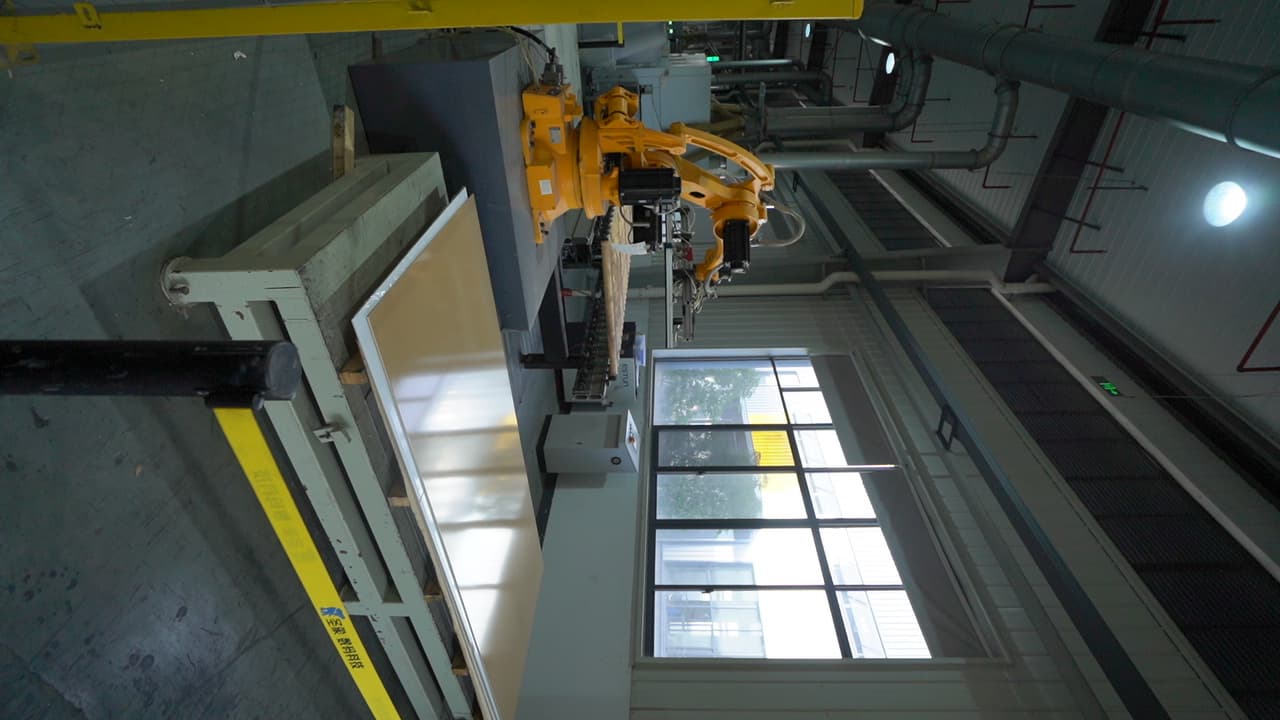
Digital printing wall panel production. Digital print lines allow continuous patterns across multiple panels, a capability that separates surface-engineered wall panels from fixed-format film finishes.
Two Wall Panel Platforms: Silica Mineral and SPC
Power Dekor’s wall panel range is built around two distinct material platforms rather than a single product family. This matters for buyers because the two platforms answer different specification questions, and treating them as interchangeable is a common source of project error.
Silica Mineral Wall Panel
The silica mineral wall panel is classified as a decorative wall panel for both interior and exterior wall applications, with the model designation “interior wall panel and exterior wall panel”. It is made of quartz, cement, pulp, lime and water — a mineral composition with no plastic content, and raw materials that are naturally sourced. Discarded panels can be landfilled and return to nature.
- Sizes: 2400 / 2440 / 3000 / 3050 × 1200 / 1220 × 6 / 8 / 10 mm
- Reaction to fire classification: A2 - s1, d0
- Asbestos content: negative
- Antibacterial test: no growth apparent under the microscope, ISO 846:2019 Method A
- Moisture movement: 0.06% in the length direction; 0.06% in the width direction
- Density: 1050 kg/m³
- Performance claims recorded for the product include 100% waterproof behaviour with submersion in water without deformation, and no deformation after boiling at 100 °C
- Documented application scenarios: bathrooms, public spaces and outdoor spaces
SPC Wall Panel
The SPC wall panel is a stone plastic composite panel offered in digital print and film surface variants, classified and designated as “digital print, film SPC wall panel”. It is intended for wall cladding and interior wall covering, and specifically for bathroom and wet-area wall applications.
- Sizes: 2400 / 2440 / 3000 / 3050 × 1200 / 1220 × 4 / 5 / 6 mm
- Moisture content: 0.02%
- Micro-scratch resistance: MSR-A1
- Density: 2.134 g/cm³
- Resistance to dry heat: Rating 5; resistance to wet heat: Rating 5
- Stain resistance: Grade 5
- Reaction to fire classification: B - s3, d0
- Dimensional stability: shrinkage <0.002%; curling ≤0.2 mm
- Documented properties: easy installation, waterproof protection for wet-area projects, easy-to-clean finish
What the Fire and Moisture Numbers Actually Mean
EN 13501-1 notation carries three pieces of information, and buyers frequently read only the first. The letter is the reaction-to-fire class. The “s” value describes smoke production, with s1 indicating the most limited smoke development and s3 indicating the greatest. The “d” value describes flaming droplets, with d0 indicating none.
Read that way, Power Dekor’s silica mineral wall panel at A2 - s1, d0 sits in the limited-combustibility band with the strongest smoke and droplet notations. The SPC wall panel at B - s3, d0 reaches a lower fire class and produces more smoke, though it also carries the d0 no-flaming-droplets notation. For corridors, stairwells and escape routes, the s-value is often as decisive as the letter, because smoke development governs evacuation conditions.
This is where the material distinction becomes practical rather than technical. Recorded product data states that the vast majority of wall panel materials on the market cannot meet the Class A2 requirement, and that SPC, HDF and WPC wall panels are Class B materials. Silica mineral is therefore positioned for occupancy types where a Class B panel would not be accepted. Third-party industry analysis of SPC wall panels similarly places the SPC family around B-class fire retardancy alongside waterproof performance, confirming that the Class B ceiling is a property of the material family rather than of an individual supplier.
Moisture data deserves the same scrutiny. Silica mineral records 0.06% moisture movement in both length and width directions and is documented as submersible without deformation, with no deformation after boiling at 100 °C. SPC records 0.02% moisture content and dimensional stability of shrinkage below 0.002% with curling of 0.2 mm or less. These are body-of-panel figures. In practice, water ingress in a wall system happens at joints and edges, which is why the installation method matters as much as the panel — a point addressed below.
Weight is the third variable buyers underweight. Silica mineral has a recorded density of 1050 kg/m³, against a density above 2,000 kg/m³ for SPC wall panels. That difference affects handling, substrate load and freight economics, and it is one reason the mineral platform is offered in greater thicknesses — 6, 8 and 10 mm, against 4, 5 and 6 mm for SPC.
Surface Decoration: Film Versus Digital Print
Both wall panel platforms carry a surface decision that changes design outcomes and unit economics.
Digital print wall panels can carry essentially any design and can run a continuous pattern across ten panels. Buyers who need customized patterns, book-matched features or design continuity over a large wall should specify digital print. Film-based panels are limited by the physical size of the film, and are cheaper; buyers without a requirement for a specific number of design faces can use film and reduce cost. The trade-off is straightforward: design freedom and pattern continuity on one side, unit cost on the other.
On the mineral platform, recorded surface options include 3D embossing with a stone effect, 3D embossing with a wood effect, a matt finish and a high-gloss finish. That range matters because demand for 3D decorative wall panels is a distinct, design-led sub-segment: the 3D wall panel market was estimated at USD 815.02 million in 2025 with a forecast CAGR of 4.93%, according to 360iResearch. Surface depth and finish variety are the entry conditions for that segment.
Applications and Installation: Where Each Platform Fits
Recorded application data for Power Dekor’s wall panels covers Building Decoration, with working conditions described as interior, humid and water, project type as interior decorative wall panel, function as decorative, and an operation mode of sticking the panel to the wall with glue. Matched equipment includes sealant and edge trim profiles. Reference markets recorded in the application data include DE, ES, AT, FR, RE, GB and KR.
The platform split maps cleanly onto application. SPC wall panels are specified for bathroom and wet-area wall applications with waterproof protection, and for general wall cladding and interior wall covering. Silica mineral wall panels cover bathrooms, public spaces and outdoor spaces, and are designed for both interior and exterior use.
Fire requirements differ by platform in the same application record: SPC wall panels meet the EN 13501-1 Class B fire-reaction requirement, while silica mineral wall panels meet the EN 13501-1 Class A2 - s1, d0 fire-reaction requirement, and the silica mineral panel contains no plastic.
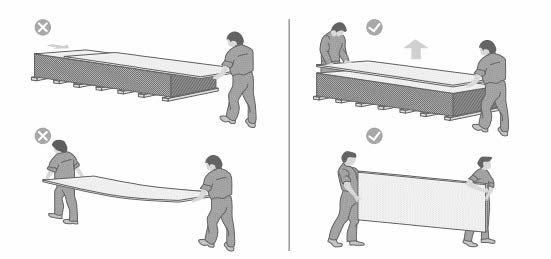
Gluing installation method for silica mineral wall panels: laser levelling and layout first, diamond-blade cutting with the decorative face up, adhesive applied to the panel back, and locking-system assembly from the bottom upwards.
The documented installation sequence runs as follows. The wall is levelled with a laser level meter and divided into blocks according to panel size, with a layout drawn in advance and panels dry-fitted before adhesive is applied. A table saw or handsaw with a diamond blade cuts the outermost edge block to size, with the decorative side facing up; all cutting and drilling is completed before adhesive is applied. Socket and switch positions are marked and cut with a diamond grit drill or jigsaw. Structural adhesive is applied uniformly to the back of the panels, which are then erected bottom-up along the pre-marked lines, checked vertically after the first panel, and assembled with the locking system. After every four to five panels, the run is checked horizontally and vertically with a laser level. Air pockets are pressed out in all directions to improve adhesion. Internal and external corners are assembled with metal trims before being fitted to the wall.
Market Trends Shaping the Category
Three data points frame where decorative wall panels are heading.
First, laminate remains the volume leader. Laminate panels represent the largest segment of the decorative panels market and are projected to hold nearly half of that market, at 45.4%, by 2026, according to Coherent Market Insights. The implication for higher-performance platforms is that they do not compete on volume; they compete on specification, where the buyer’s decision criterion is a fire class, a moisture test or a hygiene result rather than a price per square metre.
Second, supply is concentrated in Asia Pacific, which held 43.6% of the global wall panels market in 2025 and is expected to remain the fastest-growing region, per Reed Intelligence. Buyers sourcing from the region therefore face a large but uneven supplier field, and the ability to evidence classification and test results becomes the primary filter.
Third, the design-led 3D segment is expanding at a modest but steady rate, with the 3D wall panel market estimated at USD 815.02 million in 2025 and a forecast CAGR of 4.93% according to 360iResearch.
Power Dekor’s own trajectory is consistent with the compliance-driven side of that trend. The Silica Mineral Panel was introduced as a green, fireproof and waterproof solution for both floors and walls. That positioning — mineral composition, no plastic, an A2 - s1, d0 classification, and landfill-compatible disposal — addresses the segment of the market where code compliance, not appearance, is the buying trigger.
Comparison with Established Wall Solutions — and Where the Limits Sit
The table below positions the two Power Dekor platforms against the wall solutions they most often replace. Entries for other solution types describe stable, widely recognised characteristics rather than brand-specific specifications.
| Solution | Typical role | Notable constraints |
|---|---|---|
| Ceramic tile | Long-established default in wet rooms and public sanitary areas | Heavy and rigid; requires substrate preparation and wet trades; grout lines require ongoing maintenance |
| Painted plasterboard | Lowest-cost interior wall finish | No meaningful impact or water resistance; periodic redecoration required |
| Laminate / HDF decorative panel | Largest decorative panel segment by market share | Class B material family; not intended as a wet-area or exterior solution |
| SPC decorative wall panel (Power Dekor) | Bathroom and wet-area wall applications; wall cladding and interior wall covering | Class B - s3, d0 — not suitable where an A2 class is mandated; panel thickness 4 / 5 / 6 mm |
| Silica mineral decorative wall panel (Power Dekor) | Bathrooms, public spaces and outdoor spaces; interior and exterior use | A2 - s1, d0 — still not the highest class A1; requires careful edge handling and a flat substrate |
A credible evaluation has to state boundaries as clearly as capabilities. The following constraints are recorded or directly implied by Power Dekor’s own product and installation data:
- Class A2 is not Class A1. Silica mineral wall panels achieve A2 - s1, d0. EN 13501-1 classifications range from A1 to F, and projects that mandate the highest non-combustible class will not be served by an A2 product. Buyers must match the class in the specification, not the strongest class in the brochure.
- Edge fragility during handling. The recorded safety note states that panels are fragile, especially at the edge, and must be handled with care. This affects packaging, site logistics and waste allowance on large projects.
- Flat-substrate requirement. The gluing method requires a flat, sound wall. Uneven substrates need preparation before installation, which adds site work that is easy to omit from early cost estimates.
- Wet-area trim restriction. Metal trims are not applicable in wet bathroom areas; silicone sealant must seal all joints, including panel-to-ceiling and panel-to-floor seams. This changes the accessory list and the skill requirement for installers.
- SPC fire ceiling. The SPC platform is documented at Class B - s3, d0, with the higher smoke-production notation s3. For corridors and escape routes where smoke development is regulated, the mineral platform is the relevant option.
- Film-format limits. Film surfaces are constrained by film dimensions, so continuous large-format patterns require digital print, which carries a different cost profile.
- Export channel depth. Export accounts for 5% of total sales. The EU and USA are listed as major markets, but the overseas business is a minority of the total. Buyers should validate local supply, lead time and technical support before standardising a large programme on the range.
Procurement Checklist for Decorative Wall Panel Specification
The following sequence converts the technical data above into a buying process. Each step filters the field before price comparison begins.
| Step | Decision | Evidence to request |
|---|---|---|
| 1 | Confirm the required fire class for the occupancy type and location, including the smoke (s) notation for circulation areas | EN 13501-1 classification report for the specific panel |
| 2 | Confirm whether the area is dry, humid or submersible, and whether exterior exposure applies | Moisture movement or moisture content data plus documented application cases |
| 3 | Confirm hygiene requirements for the space | Antibacterial test result, such as ISO 846:2019 Method A |
| 4 | Confirm substrate condition and acceptance of adhesive fixing | Installation method statement and site preparation requirements |
| 5 | Confirm pattern continuity needs — repeat pattern or continuous design across panels | Digital print capability statement or film dimension limits |
| 6 | Confirm trim and sealant availability for the specific application, particularly wet areas | Accessory list, including sealant and edge trim profiles |
| 7 | Confirm dimensional stability under heat and humidity | Shrinkage, curling and heat-resistance ratings |
| 8 | Validate with a physical sample before committing to volume | Sample panel and surface finish reference |
| 9 | Verify local supply and technical support depth for the target market | Stock position, lead time and service coverage confirmation |
Future Outlook
Two forces are likely to define the decorative wall panel category over the next several years, and both favour evidence over appearance.
The first is code pressure. Fire performance regulation for public buildings, healthcare and multi-occupancy residential projects continues to tighten, and EN 13501-1 is already treated as a gatekeeper in European commercial specification. As Class A requirements spread from the highest-risk occupancy types into ordinary commercial fit-outs, mineral-based panels with an A2 or better classification move from a niche choice to a default one. Manufacturers holding documented classifications for both a Class A2 and a Class B platform — as Power Dekor does with silica mineral and SPC — are structurally better placed than those holding only one.
The second is material substitution towards lower-plastic, lower-impact compositions. The silica mineral panel’s recorded attributes — quartz, cement, pulp, lime and water as raw materials, no plastic content, naturally sourced inputs, and disposal by landfill returning to nature — correspond to a specification language that buyers in the EU and USA are increasingly required to write into tenders. Whether that translates into measurable share gain depends on supply-chain depth, which is precisely the constraint flagged earlier: a 5% export ratio means the international channel must expand before it can absorb large-volume demand.
The practical forecast for buyers is a narrowing field. Suppliers able to supply a classification report, a hygiene test result, a moisture data set and a documented installation method will be shortlisted. Suppliers able to supply only a surface image will not.
Frequently Asked Questions
What is a decorative wall panel?
A decorative wall panel is a rigid or semi-rigid cladding element fixed to interior or exterior walls, primarily for appearance, with secondary functions such as moisture resistance, impact protection and fire performance. The category includes stone plastic composite (SPC) panels, wood-plastic composite (WPC) panels, high-density fibreboard (HDF) laminates and mineral-based boards such as silica mineral wall panels. Power Dekor classifies its silica mineral product as a decorative wall panel for interior and exterior wall applications, and its SPC product as a digital print, film SPC wall panel for wall cladding and interior wall covering.
What is the difference between an SPC wall panel and a silica mineral wall panel?
The two differ mainly in composition, fire classification and intended space. An SPC wall panel is made of stone plastic composite, is offered in digital print and film variants, and is specified for bathroom and wet-area wall applications with waterproof protection and an easy-clean finish. Its recorded reaction-to-fire classification is B - s3, d0. A silica mineral wall panel is made of quartz, cement, pulp, lime and water with no plastic content, is designed for both interior and exterior use, and is recorded at A2 - s1, d0 with 100% waterproof behaviour and a density of 1050 kg/m³. For own-bathroom use with price sensitivity, SPC is the practical option; for public space with fireproof requirements and a porcelain-like appearance, the silica mineral panel is the more suitable choice.
What is the difference between film and digital print decorative wall panels?
The difference is design capability and cost. Digital print wall panels can carry essentially any design and can run a continuous pattern across ten panels, so they suit customized patterns and continuous designs. Panels with film are limited by the physical size of the film and are cheaper. Where there is no requirement for a specific number of design faces, film panels are the lower-cost route; where design continuity matters, digital print is required.
Which decorative wall panel is suitable for a bathroom?
Both recorded platforms are specified for bathrooms, but under different conditions. SPC wall panels are specified for bathroom and wet-area wall applications with waterproof protection and an easy-to-clean finish, and record 0.02% moisture content. Silica mineral wall panels are recorded as 100% waterproof and submersible without deformation, with no deformation after boiling at 100 °C, and are additionally suitable for public spaces and outdoor use. A practical qualification applies to both: in wet areas of a bathroom, metal trims are not applicable, and silicone sealant must seal all joints — including panel-to-ceiling and panel-to-floor seams — for water insulation.
What fire classification should a decorative wall panel have for public spaces?
The required classification depends on the occupancy type and the specific location within the building, and it is defined by the project specification and local regulation rather than by the supplier. In Europe, EN 13501-1 classifications range from A1 (non-combustible) to F, and the notation also carries an s-value for smoke production and a d-value for flaming droplets. Power Dekor records its silica mineral wall panel at A2 - s1, d0 and its SPC wall panel at B - s3, d0. Recorded product data states that most wall panel materials on the market cannot meet the A2 requirement, and that SPC, HDF and WPC wall panels are Class B materials. Buyers should match the specified class and smoke notation exactly, and request the classification report for the specific panel.
How are decorative wall panels installed?
The recorded method is adhesive fixing by gluing to the wall, using sealant and edge trim profiles as matched accessories. The wall is levelled with a laser level meter and divided into blocks according to panel size, with a layout drawn in advance and the panels dry-fitted. Cutting and drilling are completed before adhesive is applied, using a diamond saw blade with the decorative side facing up, and diamond grit tools for socket and switch cut-outs. Structural adhesive is applied to the panel back; panels are erected bottom-up along the marked lines, checked vertically after the first panel, and assembled using the locking system. The run is re-checked horizontally and vertically after every four to five panels, and air pockets are pressed out in all directions. Internal and external corners use metal trims, except in wet areas where silicone sealant replaces them. The wall must be flat before installation, and panels require careful handling, particularly at the edges.
Power Dekor Group entered the wall panel category from an established flooring base, and its two-platform approach — a Class A2 mineral panel and a Class B SPC panel, both supported by documented test data and a defined installation method — gives buyers a defensible starting point for specification. The constraints are equally documented: a Class A2 rather than A1 ceiling on the mineral platform, edge fragility, a flat-substrate requirement, wet-area trim restrictions, and an export channel that still represents only 5% of total sales. A technical brochure covering the SPC product range is published at cdn.socialarks.com/sbsp/25172/common/2026/0818/SPC.pdf.