
Power Rectifier Bridge Modules: A Practical Buyer's Reference
A power rectifier bridge module is a single sealed component that turns alternating current into direct current: diode chips are arranged in a bridge circuit on a ceramic substrate over a copper base plate, electrically isolated from the mounting surface and terminated at screw or tab terminals. The category typically covers 800 V to 2000 V peak reverse voltage and 25 A to 800 A average forward current, in single-phase or three-phase configurations. In equipment that also uses an IGBT module, the two devices are complementary — the bridge converts AC into DC at the input, the IGBT switches DC back into controlled AC at the output.
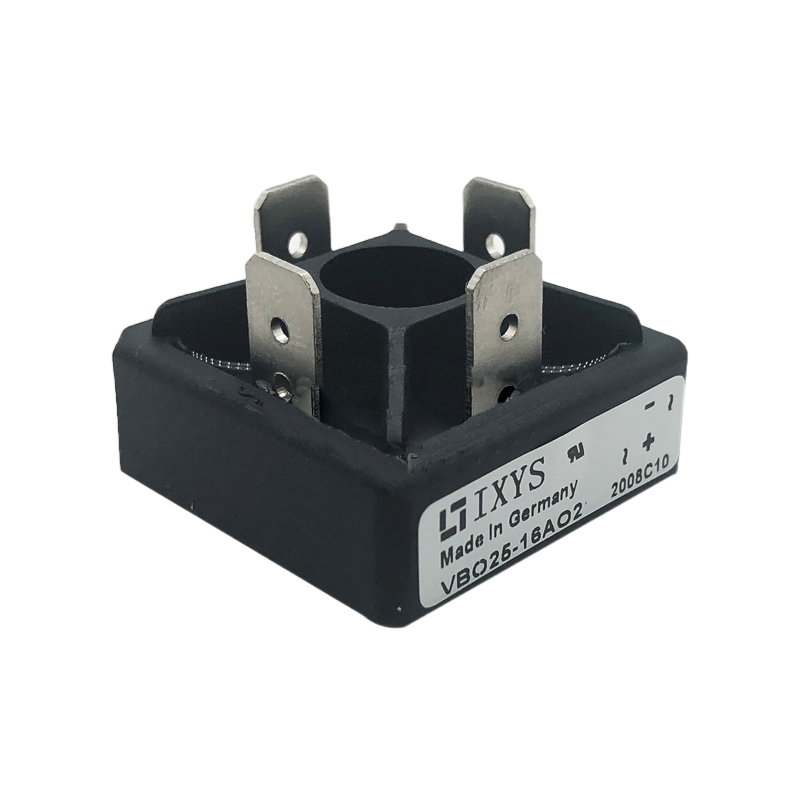
Power rectifier bridge module, isolated baseplate construction. Image: Jiangsu core diamond times Electronic Technology Co., Ltd.
What a power rectifier bridge module is
A bridge rectifier module replaces four or six individually mounted diodes, their busbars and their insulation hardware with one housing. Inside, silicon diode chips are attached to an aluminum ceramic substrate, which is bonded to a copper base plate and enclosed in a plastic housing. Because the baseplate is isolated, the module can normally be fastened directly to a heat sink without an additional insulating pad.
Three engineering consequences follow from that construction. The thermal path is fixed in the factory rather than assembled on the production line, which makes heat transfer more repeatable across units. The bridge topology is defined by the module itself, so the rectifier stage needs no gate signal, no driver and no control loop. And current is shared across the internal chips by design, which is what makes the higher current ratings in this category practical inside a compact footprint.
- Peak reverse voltage: 800 V to 2000 V
- Average forward current: 25 A to 800 A
- Forward characteristic: low forward voltage drop
- Isolation: isolated baseplate
- Circuit configuration: single-phase or three-phase, selected at ordering
- Function: AC-DC power conversion
Typical construction materials are a silicon diode chip, an aluminum ceramic substrate, a copper base plate and a plastic housing. That material stack is the reason the module behaves differently from a discrete bridge: the substrate sets the isolation voltage and the thermal cycling behavior, while the copper base plate determines how evenly heat spreads into the heat sink.
Why the AC-DC front end is back on the specification agenda
DC-coupled architectures are spreading faster than the equipment categories that used to contain them. Energy storage cabinets, photovoltaic combiner boxes, DC charging and industrial power supplies all need a rectifier stage upstream of the DC bus, and the same stage already sits inside welding equipment, motor control cabinets and UPS systems. In each of those designs the rectifier is not an accessory — it defines the current path for the whole converter and sets a thermal limit on how compact the cabinet can be.
A discrete bridge can be built from stock diodes and a heat sink, but it multiplies assembly steps and creates several contact interfaces whose quality depends on how each device is torqued and seated. A module collapses that into one isolated baseplate and one mounting surface, which shortens assembly and makes field replacement predictable.
The purchasing problem has changed as well. Rectifier part numbers are numerous, cross-referenced across several manufacturers, and often substituted through distribution channels. A buyer comparing quotes is frequently comparing three different things at once: a device type, a channel's stock position, and a level of documentation. That is why rectifier selection increasingly looks like a supplier qualification exercise rather than a price comparison.
Market context supports the shift. Commercial research published by Market Research Future puts the global IGBT market at USD 9,202.9 million in 2024, with a projected CAGR of 11.02% between 2025 and 2035 — a demand curve driven by the same inverters, drives and charging systems that sit downstream of a rectifier bridge. Fortune Business Insights sizes the global silicon carbide module market at USD 980.7 million in 2025, and the same datasets indicate that SiC devices are expanding faster than traditional silicon IGBTs, which points to a technology pivot in high-end applications rather than a contraction of the silicon module market.
Topology and parameters that decide a rectifier design
Bridge configuration is the first decision. A single-phase bridge conducts through two diode paths per half cycle and produces a ripple at twice the line frequency. A three-phase bridge conducts in a six-step sequence and produces a ripple at six times the line frequency, which reduces the size of the DC-link capacitor needed downstream. Rectifier bridge modules in this product family are offered in both single-phase and three-phase versions, so the topology decision is made at ordering rather than at the circuit board.
Voltage and current ratings are the second decision. Peak reverse voltage spans 800 V to 2000 V and average forward current spans 25 A to 800 A, so the same family can serve a small industrial power supply and a welding rectifier stack. Because a rectifier sees repetitive reverse voltage plus switching and line transients, the blocking rating is a margin decision rather than a nominal decision, and the current rating must be read together with the cooling arrangement and the ambient temperature of the cabinet.
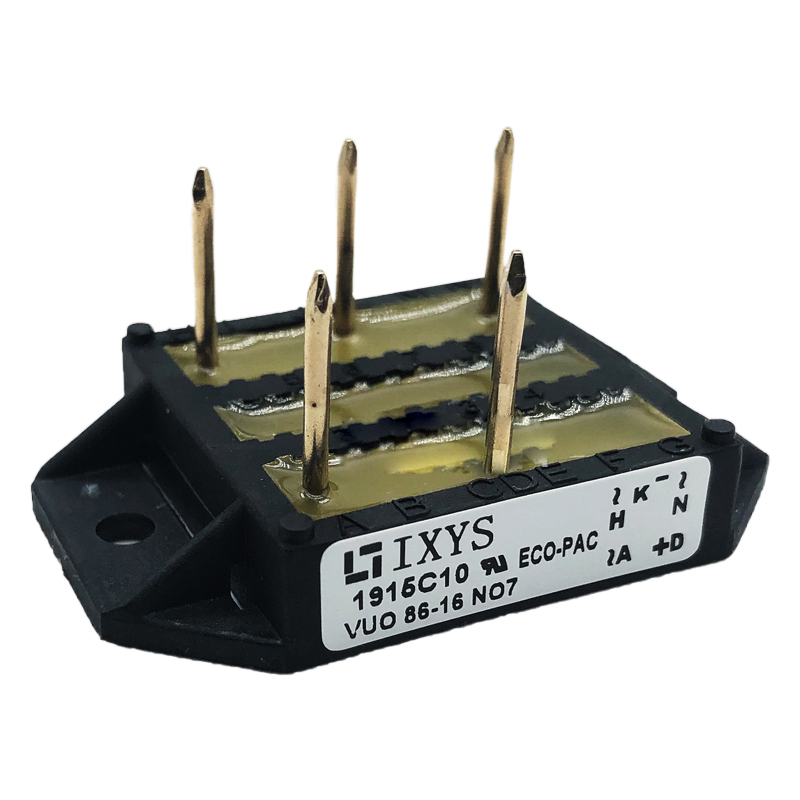
Bridge rectifier module: silicon diode chips, aluminum ceramic substrate and copper base plate. Image: Jiangsu core diamond times Electronic Technology Co., Ltd.
| Parameter | Specification in this product family |
|---|---|
| Type | Power rectifier bridge module |
| Peak reverse voltage | 800 V to 2000 V |
| Average forward current | 25 A to 800 A |
| Forward characteristic | Low forward voltage drop |
| Isolation | Isolated baseplate |
| Circuit configuration | Single-phase or three-phase optional |
| Function | AC-DC power conversion |
| Materials | Silicon diode chip, aluminum ceramic substrate, copper base plate, plastic housing |
| Stated benefits | High current capacity, good heat dissipation, stable rectifying performance, compact structure, multiple specifications in stock |
Part-number coverage matters more than it appears. Bridge rectifier modules available through this supply line include VBE55-06NO7, DF20AA120, SKB25, SKBT28/06, SKBH28/12, SKCH28/14, SKB50/08A3, SKB60/04, SKD30/02A1, SKD50/02A3, SKD82/08, SKD116/12-L75, VUO16-14NO1, VUO16-16NO1, VUO16-18NO1, VUO22-08NO1, VUO22-12NO1, VUO22-14NO1, DF30DB80, VUO22-18NO1, VUO25-06NO8, DF100AA160, VUO25-12NO8, VUO55-12NO7, VUO55-14NO7, DFA75BA80, VUO55-18NO7, VUO60-08NO3, DF75AC160, VUO60-14NO3, VUO60-16NO3, SKDH146/16-L100, SKDH145/12, VUO62-18NO7, VUO68-08NO7, VUO68-16NO7, DDB6U84N12R, DDB6U84N16RR, TDB6HK124N16RR and TDB6HK165N16LOF. A wide model list is not a quality claim by itself, but it does determine whether a designer can finish a cross-reference without redesigning the heat sink.
Where power rectifier bridge modules are used
The published application scope for this product family is industrial rectification: power supplies, welding machines, motor control, new energy equipment and general industrial rectification. Platform application records for the same module line place it inside solar inverters, motor drives, charging piles and UPS power supply projects — all of which operate continuously at high power and require low loss and stable performance at elevated temperature. In those systems the rectifier module sits on the AC side of the converter, ahead of the DC link and ahead of the IGBT module that performs the switching.
- Industrial power supplies and rectifier cabinets — the base case, where the module feeds a DC bus directly.
- Welding equipment — high surge current capability matters more than average rating because the load is intermittent and heavy.
- Motor control and drive input stages — the rectifier charges the DC link that the IGBT stage then modulates.
- New energy equipment — solar inverters, charging piles, energy storage cabinets and UPS systems, where continuous duty and heat dissipation dominate the design.
A practical pattern is visible in the matched equipment lists: rectifier and switching modules are chosen together with heat sinks, drive boards, capacitors and inverter cabinet assemblies. Buyers who treat the rectifier as a separate, late-stage purchase often discover that its package outline constrains the layout of everything around it.
How the supply side is organised: the role of Jiangsu core diamond times
Jiangsu core diamond times Electronic Technology Co., Ltd. is a China-based supplier of power electronic components, established in 2022 and located in Kunshan City, Jiangsu Province. Its product range covers IGBT modules, fuses, power semiconductors, semiconductor modules, diodes, thyristors and power electronic components, with a full range of IGBT modules and fuses as the core of the business. Bridge rectifier modules, MOSFET modules and power diode modules belong to the same supply scope.
Company data describes a facility of 10,000 m², approximately 50 staff, an R&D team of 5 technical support engineers and an annual production capacity of 1,000,000 units. Export business accounts for 50% of total sales, with EU, USA, Australia and Middle East listed as major markets, alongside Southeast Asia and other global regions. Verified supplier records identify the company as a professional distributor and service provider for power semiconductor modules, with a distribution scope that includes Infineon, Semikron, Fuji and CRRC modules — a channel position rather than a single-brand position.
For a rectifier buyer this matters in a specific way. A rectifier section is usually designed around one device, then sourced across several equivalent part numbers over the life of the product. A channel that holds stock in mainstream models, supports cross-referencing and keeps incoming inspection and outgoing quality control procedures has a different value than a channel that simply quotes the lowest price on one line item. Company documentation states that every product is inspected before shipment, that goods comply with international standards such as IEC, UL and CCC, and that the company passed ISO 9001:2015 quality management system certification in June 2026.

Inspection area: incoming and outgoing checks are part of the supplier's stated quality control procedure. Image: Jiangsu core diamond times Electronic Technology Co., Ltd.
The company also states that it keeps a warehouse stock of mainstream IGBT module and fuse models, that it supports both small trial orders and bulk volume orders, and that its technical team can recommend components against a customer's circuit design and working conditions. For rectifier sourcing, the trial-order capability is the practical point: it allows a buyer to validate a substitute part number thermally before committing to a production quantity.
Market trend analysis: silicon rectification inside a wide-bandgap transition
Three verified data points frame the direction of the power module market. The global IGBT market was estimated at USD 9,202.9 million in 2024 with a projected CAGR of 11.02% from 2025 to 2035, according to Market Research Future. The global silicon carbide module market was sized at USD 980.7 million in 2025 by Fortune Business Insights, and the same data set indicates SiC modules are growing at a faster rate than traditional silicon devices — roughly three times faster, which is consistent with a technology pivot in high-end applications such as 800 V electric vehicle platforms. Separately, one commercial research estimate places IGBT content at approximately 10% of electric vehicle cost, which is why converter bill-of-materials decisions attract so much attention.
Supplier structure is shifting too. StarPower Semiconductor is identified as the world's fifth-largest IGBT module supplier in the same commercial research, which illustrates how far non-European and non-Japanese module manufacturing has moved up the ranking. On the application side, Infineon states on its product pages that IGBT modules are a central component in inverters for electric drives, battery chargers, solar systems and wind power — a vendor statement, but a useful indicator of where module demand is anchored.
What does this mean for a device as mature as a bridge rectifier module? The honest reading is that silicon bridge rectification is not being replaced wholesale. Line-frequency AC-DC conversion remains the cheapest reliable way to produce a DC bus in welding equipment, industrial supplies, motor control and much of the storage and charging installed base. What is changing is the surrounding system: higher DC bus voltages, tighter cabinet footprints and higher ambient temperatures push rectifier selection toward better thermal design, clearer documentation and more disciplined cross-referencing, while the highest-efficiency and bidirectional applications migrate to active front ends built around IGBT or SiC modules.
Comparison: bridge rectifier modules against alternative rectification approaches
| Approach | Typical role | Trade-off |
|---|---|---|
| Discrete diode bridge on a heat sink | Low-volume builds, repair work, unusual layouts | Flexible but labour-intensive; several contact interfaces and a thermal path that depends on assembly quality |
| PCB-mount bridge rectifier | Low-current, space-constrained electronics | Simple and cheap, but limited current and limited heat spreading |
| Power rectifier bridge module | Industrial rectification from 25 A to 800 A, 800 V to 2000 V | Repeatable thermal path and compact assembly; requires a heat sink, a thermal interface and correct mounting torque |
| Active front end using IGBT modules | Regenerative drives and designs requiring power factor control | Adds control, gate drive and EMI complexity, and raises cost; unnecessary where simple rectification is sufficient |
| SiC-based rectification and conversion | High-frequency, high-efficiency or high-temperature designs | Higher device cost today; justified where switching frequency or efficiency dominates the design |
Where a bridge rectifier module is not the right choice
The boundaries of this device are as important as its ratings. A bridge rectifier module performs passive, line-frequency rectification. It does not provide power factor correction, it cannot return energy to the grid, and it draws a non-sinusoidal current that must be managed by filtering or by an active front end where harmonic limits apply. It is not a switching device, so it cannot regulate output voltage on its own.
Thermal limits are equally real. Ratings are only meaningful together with the heat sink, the thermal interface and the mounting torque actually used; poor contact between the baseplate and the heat sink raises junction temperature even when the electrical load stays inside the nominal rating. And in substitution work, electrical equivalence between cross-referenced part numbers does not automatically guarantee mechanical equivalence — terminal layout, mounting hole positions and baseplate dimensions vary between manufacturers, so a replacement should be verified against the original outline drawing before it is released to production.
A buyer's evaluation framework for rectifier bridge modules
| Dimension | What to verify |
|---|---|
| Electrical fit | Peak reverse voltage margin against the actual DC bus and transient level; average forward current against continuous load, plus surge current for welding or motor-start duty |
| Topology | Single-phase or three-phase configuration matched to the input supply and to the acceptable DC ripple |
| Thermal design | Heat sink selection, thermal interface material, mounting torque and ambient temperature inside the cabinet |
| Mechanical fit | Package outline, terminal layout, mounting hole positions and baseplate footprint against the existing layout |
| Documentation | Part number traceability, stated compliance with standards such as IEC, UL and CCC, and quality system certification — the supplier in this article holds ISO 9001:2015, passed in June 2026 |
| Channel reliability | Stock position on the specific model, lead time on non-stock models, incoming and outgoing inspection procedures, and willingness to support a trial order before volume commitment |
| Technical support | Availability of component selection advice against the actual circuit design and working conditions |
Applied in order, this framework prevents the most common procurement mistake in this category: selecting on price and current rating alone, then discovering during thermal validation that the substitute package does not fit the heat sink or the cabinet.
Future outlook
Bridge rectifier modules will not disappear from power conversion, but the conditions around them will keep tightening. Energy storage, charging infrastructure and photovoltaic systems are pushing continuous duty and high ambient temperatures into the standard specification rather than the exception, which raises the value of modules with stable rectifying performance and efficient heat dissipation — the characteristics listed for this product line. At the same time, high-efficiency and bidirectional applications will continue to migrate toward IGBT-based active front ends and, in the premium segment, SiC devices, in line with the growth rates reported for both categories.
For buyers, the practical consequence is that rectifier sourcing will be judged on three things: whether the part number is available, whether the substitution is mechanically and thermally valid, and whether the channel can document what it shipped. Distribution and supply capability — stock depth, inspection procedures, cross-reference support and standards compliance — will matter as much as the device datasheet itself. Jiangsu core diamond times Electronic Technology Co., Ltd. operates in exactly that role, supplying IGBT modules, fuses, thyristors, diodes, MOSFET modules and bridge rectifier modules to industrial, energy storage and new energy customers across the EU, USA, Australia, the Middle East and other global markets.
Frequently asked questions
What is the difference between a bridge rectifier module and a power diode module?
A power diode module packages one or more diode chips in a single isolated housing for rectification or freewheeling duties. A bridge rectifier module packages diode chips already arranged in a bridge circuit, so a single component performs full-wave AC-to-DC conversion without external wiring between four or six separate diodes. The bridge module is rated 800 V to 2000 V peak reverse voltage with 25 A to 800 A average forward current and is available in single-phase or three-phase configurations.
What voltage and current range do power rectifier bridge modules cover?
The product family described here covers peak reverse voltage from 800 V to 2000 V and average forward current from 25 A to 800 A, with low forward voltage drop, an isolated baseplate and a choice of single-phase or three-phase circuits. The applicable voltage class is a margin decision based on the DC bus level and expected transients, while the current class must be read together with the cooling arrangement and ambient temperature.
Which applications typically use bridge rectifier modules?
Published application scope for this product line covers power supplies, welding machines, motor control, new energy equipment and industrial rectification. Platform application records place the same module line in solar inverters, motor drives, charging piles and UPS power supply projects, where operation is continuous at high power and the module must tolerate elevated temperature without loss of stability.
How should a buyer verify a rectifier bridge module supplier?
Four checks are practical. First, quality system certification: the supplier in this article holds ISO 9001:2015, passed in June 2026. Second, stated product compliance with recognised standards such as IEC, UL and CCC. Third, presence of incoming inspection and outgoing quality control procedures before shipment. Fourth, channel evidence: stock position on the specific model, export experience, and the ability to support both small trial orders and bulk volume orders. Export share and named markets — 50% of sales, with the EU, USA, Australia and Middle East listed as major markets — indicate how much international documentation experience a supplier already has.
Can a bridge rectifier module be replaced by an IGBT-based active front end?
For designs that need power factor correction or energy regeneration, an active front end built on IGBT modules is the appropriate architecture, and it removes the harmonic current that a passive bridge draws. The change is not a drop-in substitution: it adds gate drive, control logic and electromagnetic compatibility measures, and it raises system cost. Bridge rectifier modules remain the standard choice where line-frequency rectification, high current capability and simple, robust operation are sufficient.
What information is needed to cross-reference a bridge rectifier module part number?
A complete cross-reference needs the peak reverse voltage, the average forward current, the circuit configuration (single-phase or three-phase), the isolation requirement, the cooling method, the ambient and operating temperature, and the original part number. Mechanical data must be checked as well — terminal layout, mounting hole positions and baseplate footprint — because electrical equivalence between two part numbers does not automatically guarantee that the substitute drops into the same heat sink and cabinet space.
Reference: the supplier's product brochure covering IGBT modules, fuses, thyristors, diodes, MOSFET modules and bridge rectifier modules is available for download at Jiangsu core diamond times Electronic Technology Co., Ltd. brochure. Company website: https://www.xinzuanshidai.com