
Pre-Insulated Pipe Procurement FAQ: Technical Checks Before Ordering
Pre-Insulated Pipe Procurement FAQ: Technical Checks Before Ordering
Pre-insulated pipe has moved from a specialty line item into a mainstream industrial procurement category. Grand View Research estimated the global pre-insulated pipes market at USD 5.97 billion in 2024 and projected USD 10.4 billion by 2030, a compound annual growth rate of 9.7%. Behind that headline sits a less visible trend: the volume of requests for quotation has grown faster than the precision of the requests themselves.
That gap shows up in the same place every time. A directly buried hot water main and an above-ground chilled water run end up in the same RFQ template, both described as "Insulated Pipe." Suppliers then fill the blanks with their own assumptions, and the assumptions never appear on the quotation. By the time the discrepancy surfaces, the purchase order is already signed and the production schedule is already committed.
This article is written for buyers who have already selected the category and are close to execution. It covers the technical questions worth settling before a pre-insulated pipe RFQ goes out, the way to read supplier responses on a like-for-like basis, and the checks that keep order documentation aligned with the actual project scope.
Why "Insulated Pipe" Requests for Quotation Drift
The single term "insulated pipe" covers product families that are not interchangeable. Directly buried hot water pre-insulated pipe, PU foam pre-insulated pipe, galvanized iron jacket pre-insulated pipe, PUR pre-insulated pipe, pre-insulated PPR pipe, pre-insulated pipe for chilled water, pre-insulated steam pipe, pre-insulated black steel pipe and above-ground pre-insulated pipe each carry different service pipe materials, different insulation cores, different outer jackets and different jointing methods.
When an RFQ uses the generic term, each supplier optimizes against a different mental model of the job. One quotes a steel pipe with a rigid polyurethane core and an HDPE jacket for burial. Another quotes a galvanized iron jacket for above-ground routing. The numbers look comparable in a spreadsheet, but the scope behind them is not.
A second source of drift is project structure. A district heating network built in three phases is not one procurement event; it is three, spread across years, often with different pipe diameters and different tie-in points. If the first order is written without a view of the later phases, the second and third orders inherit specifications that were never designed to cover them.
Twelve Technical Questions to Settle Before the RFQ Goes Out
The questions below are grouped by decision area rather than by product type, because that is the order in which a specification usually becomes unambiguous. Each one has a short answer that belongs in writing before quotations are requested.
Group A — Service Conditions and Installation Context
Q1. Is the line directly buried, in a trench or gallery, or above ground?
Installation method determines the structure of the pipe, not just its finish. Directly buried lines carry soil load and groundwater exposure, and once backfilled they are difficult and expensive to reopen. Above-ground routing places a different demand on the outer jacket, since UV exposure and mechanical impact replace soil chemistry as the dominant risk. When both conditions appear in one RFQ without being separated, suppliers quote the version they think is dominant, and the comparison stops being meaningful.
Q2. What medium does the line carry, and is service continuous or intermittent?
Hot water, chilled water, steam, gas and petroleum products sit in different product families. Polyurethane foam systems are widely used for both heating and cooling service, but the operating envelope differs. The typical temperature ceiling for PU foam insulation in EN 253 bonded pipe systems is about 120°C (250°F). Above that ceiling, the medium specification needs to be stated explicitly in the RFQ rather than left for the supplier to infer.
Q3. What are the design temperatures, the delta-T, and the seasonal operating profile?
Supply temperature, return temperature and design temperature differential set the insulation thickness calculation. Annual operating hours and the coldest or hottest ambient condition determine whether the line runs near its limit for a short peak or for months at a time. A network that operates intermittently also has a thermal cycling profile that belongs in the inquiry, because repeated expansion and contraction is a design input, not a maintenance afterthought.
Group B — Material and Construction
Q4. Is the insulation core rigid PU foam, PUR, or a PPR system?
PU and PUR foam cores are the mainstream construction for steel pre-insulated pipe. Pre-insulated PPR pipe is a separate family built around a plastic service pipe. The two are not substitutes, and the difference in unit cost, jointing and acceptable pressure range is large. An inquiry that says only "insulated pipe" can return one quote per family, and there is no defensible way to rank them against each other.
Q5. What is the service pipe material and standard?
Black steel, pre-galvanized steel, galvanized steel and stainless steel are all in routine use. For steel service pipes, ASTM A53 is a primary American standard covering seamless and welded black and hot-dipped galvanized steel pipe. The specification should state the standard, grade, wall thickness and nominal diameter together, because the service pipe dimensions govern both the insulation thickness and the finished outside diameter of the assembly.
Q6. What outer jacket material is required?
Jacket choice is tied to installation environment. Galvanized iron jacket constructions are commonly specified for above-ground runs where impact resistance matters. HDPE jackets are the norm for buried networks where soil chemistry and groundwater are the main concerns. This decision has to be visible on the RFQ, because the jacket changes the finished outside diameter, the jointing method and the unit price all at once.
Group C — Dimensions, Lengths and Joints
Q7. What are the pipe diameters, total length, and single-length requirement?
Diameter and total length drive the production batch. Single-length requirement drives transport and the number of field joints. Longer factory lengths reduce field labour and reduce the number of joints that can leak, but they increase transport constraints and may require special handling equipment at the site. This trade-off should be decided during procurement, not by the logistics provider later.
Q8. How are bends, tees, reducers and anchors handled?
Straight pipe is the simple part of a pre-insulated pipe order. Bends, tees, reducers, anchor sections and drainage fittings are where scope disputes originate. Before quotations are compared, the buyer needs a written answer to three things: who fabricates the fittings, what tolerances apply, and how the fittings are insulated and jacketed at the junction with straight pipe.
Group D — Inspection, Testing and Documentation
Q9. What acceptance criteria apply, and at what point are they executed?
Pre-shipment testing is the acceptance basis recorded in the procurement reference for pre-insulated pipe supply. The practical questions are narrower: which properties are tested, on what sample basis, who records the results, and whether the buyer or a nominated third party may witness the test. Agreeing this before the order is placed is considerably cheaper than negotiating it after production.
Q10. What documentation accompanies each batch?
Written acceptance is only as good as the records behind it. Incoming raw material inspection and full-batch product performance testing are the two control points most frequently described by manufacturers. The buyer should agree in advance what evidence travels with each batch, how the batch is marked, and what photographic or written record is retained for packaging and loading.
Group E — Commercial Terms and Long-Term Supply
Q11. What are the minimum order quantity and the delivery terms?
The procurement reference for pre-insulated pipe supply records a minimum order quantity of 500 metres and delivery terms of FOB or CIF. Both directly affect phased projects. A maintenance or replacement requirement of a few hundred metres may not reach the minimum on its own, which pushes the buyer toward consolidating it into a larger order or accepting a different price basis. Delivery terms must also match across quotes before prices are compared.
Q12. How are payment and warranty structured?
The recorded payment structure is 30/70. The useful check is whether the payment milestones align with verifiable production and shipping events, since a schedule that front-loads payment without matching inspection points removes the buyer's main lever. Warranty terms should be read against the design life of the network, not against the delivery date.
Reading Supplier Responses on a Like-for-Like Basis
Once quotes are in, the comparison usually fails for structural reasons rather than pricing ones. The table below lists the dimensions that must match before a price difference means anything.
| Comparison dimension | What a complete response states | What an incomplete response hides |
|---|---|---|
| Installation context | Buried, gallery or above ground, stated per section | Jacket and coating assumptions applied uniformly across a mixed route |
| Service pipe | Material, standard, grade, wall thickness | Substituted wall thickness or grade that shifts the unit price |
| Insulation core | Foam type and density basis | Thickness quoted without reference to the temperature differential |
| Outer jacket | Material, thickness and jointing method | Jacket treated as a finish rather than a structural element |
| Fittings scope | Named list of fabricated fittings and tolerances | Fittings excluded, appearing later as variation orders |
| Acceptance and documents | Pre-shipment testing scope, records, witnessing rights | Acceptance deferred to arrival, where remedy options are limited |
| Commercial basis | Minimum order quantity, FOB or CIF, payment milestones | Mixed delivery terms or minimums that quietly change unit economics |
The purpose of this table is not to rank suppliers. It is to make two quotations answer the same question. Where a response leaves a row blank, the correct action is to ask, not to assume the most favourable reading.
Keeping Order Documentation Aligned with Project Scope
Most procurement disputes on pre-insulated pipe projects are not about capability. They are about the gap between what was discussed and what was written. A short documentation check before the purchase order is released closes most of that gap.
- Specification sheet. Service pipe standard, grade, wall thickness, diameter, insulation core and jacket material all appear as explicit values, not as references to a drawing that is not attached.
- Section schedule. Total length broken down by diameter, by installation condition and by delivery phase, so that partial shipments can be verified against the schedule.
- Fitting list. Bends, tees, reducers, anchors and drainage components itemized with quantities and fabrication responsibility.
- Acceptance clause. The pre-shipment test scope, the sampling basis, the record format and the witnessing rights, written as an obligation and not a preference.
- Documentation list. The material inspection and batch performance records that travel with each delivery, with the batch marking convention.
- Commercial terms. Minimum order quantity, delivery term, payment milestones and warranty period, consistent with the terms used in the original inquiry.
- Scope boundary. A plain statement of what the supplier is not providing, so that field jointing, site coating repair and commissioning support are assigned to a named party.
Running this list takes an hour. Discovering the same gaps after production has started takes considerably longer, and the remedy is almost always commercial rather than technical.
What Supplier Capability Means in Practice
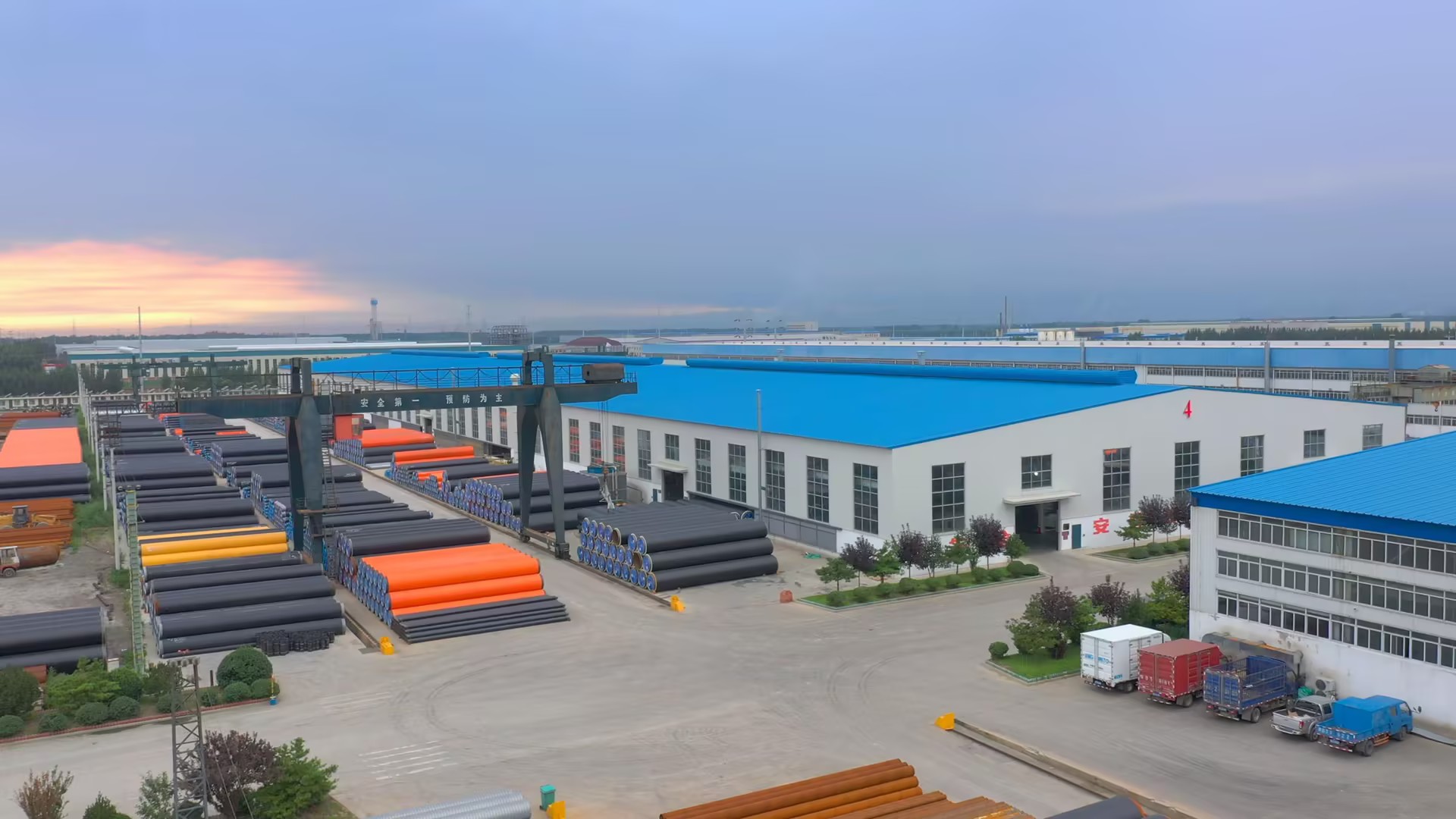
Pre-insulated pipe production is a factory process, which means specification accuracy is settled before material is cut rather than during installation.
Tangshan Xingbang Pipeline Engineering Equipment Co., Ltd is a pre-insulated pipe manufacturer based in Houhu Industrial Park, Yutian Economic Development Zone, Hebei Province, China. Its stated main product is directly buried hot water pre-insulated pipe, and its stated service fields include central heating, central cooling, petroleum, chemical, LNG, gas and water conservancy.
For buyers working through the questions above, several elements of the company's stated profile are relevant to procurement rather than to promotion. The company states that it participates in the formulation of China's national standard for directly buried insulated pipes, and that it is a member unit of the heating standardization technical committee under China's Ministry of Housing and Urban-Rural Development. It reports a plant area of 310,000 square metres, 231 employees, a 30-engineer research and development team, an export share of 30%, and main markets in Europe, North America and the Middle East.
Those figures are self-reported by a single source. Used correctly, they belong in the supplier screening stage, where they help a buyer decide which suppliers are worth sending a detailed RFQ to. They are not a substitute for project-specific evidence, and no buyer should treat a factory profile as proof that a particular specification will be met.
On the risk side, the company describes controls that map directly onto the failure modes most relevant to buried networks. Thermal stress damage, high-temperature overheating, pipe corrosion and excessive heat loss are the four risks it names. The corresponding controls include real-time temperature monitoring, anti-corrosion coating protection, insulation protection and stress-relief structural design. Specific measures cited include built-in optical fibre temperature sensors, 3PE anti-corrosion treatment, a high-density polyurethane insulation layer, an online monitoring system for directly buried pipelines, incoming raw material inspection and full-batch product performance testing. Each of these is worth asking a supplier to confirm against a specific project, because a control method is only meaningful if it is applied to the pipe being ordered.
Market Context Behind the Procurement Checklist
The volume of pre-insulated pipe moving through industrial supply chains explains why a standardised inquiry process matters. Regional distribution is concentrated: Asia Pacific held a 39.96% revenue share of the pre-insulated pipes market in 2024, while Europe accounts for approximately 38% of the pre-insulated pipe systems market. Within the segment mix, flexible pre-insulated pipes represented 72.2% of global revenue share in 2024.
Demand-side growth is coming from the networks themselves. The global district heating market was valued at USD 209.34 billion in 2024, and the combined district heating and cooling market is projected to grow at a CAGR of 5.7% from 2024 to 2032. The cooling side is moving faster than the heating side: pre-insulated pipes for district cooling are projected at a CAGR of 9.48%, driven in part by smart city programmes.
One caveat belongs in any procurement discussion. Published market size estimates for this category vary considerably between research institutions, because the definitions of what is counted differ. That variance does not weaken the case for buying pre-insulated pipe; it means category-level totals are a poor input to a project decision. Project-specific specifications, acceptance criteria and documented supplier capability are the inputs that matter.
Pre-Insulated Pipe Compared with Conventional Onsite Insulation
The comparison that most industrial buyers actually run is between factory pre-insulated pipe and conventional onsite insulation. The recorded comparison data lists a performance gap of 0.4°C/km, a cost difference of 10% lower, less maintenance and higher efficiency, with central heating supply identified as the best-fit application.
Those are favourable numbers, and they come with boundaries that should be stated as plainly as the advantages.
- Application specificity. The 10% cost difference and the 0.4°C/km performance gap are recorded against central heating supply. Extending them directly to chilled water, steam or process piping is not supported and would need separate evaluation.
- Temperature ceiling. PU foam insulation in bonded pre-insulated pipe systems typically withstands temperatures up to about 120°C. Above that range, the pre-insulated pipe format may not be the right construction at all.
- Order size threshold. The recorded minimum order quantity of 500 metres can make pre-insulated pipe uneconomic for small maintenance or partial replacement work, where onsite insulation imposes no minimum.
- Upfront engineering cost. Pre-insulated pipe requires dimensions, routing and fitting schedules to be fixed before production. Onsite insulation tolerates decisions being made during installation. That flexibility has a cost in labour and consistency, but it is a real difference.
- Joint dependence. A factory-insulated system shifts the critical work to the joints. If field jointing quality is not controlled, the theoretical performance advantage does not appear in service.
The practical conclusion is that pre-insulated pipe is the stronger default for large, well-defined networks, and the weaker choice for small, uncertain or high-temperature scopes. Both statements are useful to a buyer; only the first one usually appears in supplier marketing.
Future Outlook
Two directions are visible in the available data. The first is geographic and application shift: Asia Pacific is the fastest-growing region for pre-insulated pipes, and district cooling is expanding faster than district heating, which means procurement teams will increasingly be specifying the same product family for cooling duty where heating was previously the default.
The second is insulation technology. Next-generation insulation such as aerogels is emerging as a route to ultra-low heat loss in pre-insulated pipe, although it remains an emerging option rather than a mainstream replacement for PU and PUR foam. For buyers, the implication is procedural rather than technical: specifications should be written with enough precision that a new insulation core can be evaluated against the same criteria as an established one, rather than forcing a fresh comparison exercise every time a supplier proposes an alternative.
Company documentation covering the pre-insulated pipe range is available for reference: Xingbang company brochure (PDF).
FAQ
What is the most important technical question to settle before buying pre-insulated pipe?
It is the installation context combined with the service medium. Directly buried, gallery and above-ground installations impose different jacket and coating requirements, and hot water, chilled water and steam occupy different temperature envelopes. Neither question can be answered by the product description alone, and both change the pipe construction rather than only its finish. Settling them first makes every subsequent specification decision simpler.
Why can two quotations for "insulated pipe" not be compared directly?
Because the term covers non-interchangeable product families. A rigid PU foam steel pipe with an HDPE jacket for burial and a pre-insulated PPR pipe are different products with different service pipe materials, pressure ranges and jointing methods. Even within steel construction, a quotation built on a thinner wall thickness, a different jacket material or an excluded fittings scope will show a lower number without offering the same deliverable. Comparison is only valid when service pipe standard, insulation core, jacket material, fittings scope, acceptance basis and delivery terms match.
What should a buyer verify in order documentation before the order is released?
The specification sheet, the section schedule, the fitting list, the acceptance clause, the documentation list, the commercial terms and the scope boundary. Each of these has a specific failure mode. Missing fitting scope becomes a variation order. A vague acceptance clause defers testing to arrival, when remedy options are limited. Mixed delivery terms distort unit price comparison. A written scope boundary that assigns field jointing and site coating repair to a named party prevents the most common handover dispute.
How does minimum order quantity affect a phased project?
The recorded minimum order quantity for pre-insulated pipe supply is 500 metres, with delivery terms of FOB or CIF and a 30/70 payment structure. On a multi-phase network, a minimum order quantity can align well with phase one and poorly with a later maintenance requirement of a few hundred metres. Buyers managing phased schedules generally get better outcomes by forecasting total requirement across phases early and structuring deliveries against that forecast, rather than issuing each phase as an independent inquiry.
Why does long-term supply continuity matter for district heating and cooling networks?
Because these networks are designed to operate for decades and are expanded incrementally. A pipe ordered in year five has to be compatible with pipe installed in year one, particularly at joints and fittings, where dimensional and material matching determines whether the connection performs as designed. Supply continuity is therefore a specification issue as much as a commercial one: buyers benefit from knowing that the same construction, jacket material and jointing system will remain available across the project's expansion cycle.
What risks do pre-insulated pipes face in service, and how are they controlled?
The four risks most commonly named are thermal stress damage, high-temperature overheating, pipeline corrosion and excessive heat loss. The corresponding control methods are real-time temperature monitoring, anti-corrosion coating protection, insulation protection and stress-relief structural design. In practical terms these appear as built-in optical fibre temperature sensors, 3PE anti-corrosion treatment, a high-density polyurethane insulation layer, an online monitoring system for directly buried pipelines, incoming raw material inspection and full-batch product performance testing. Buyers should confirm which of these controls apply to the specific pipe being supplied, since a control method listed at company level is not automatically applied at project level.