
Pre-Insulated Pipe Purchasing: A Prioritized Terms and Acceptance Shortlist
Pre-Insulated Pipe Purchasing: A Prioritized Terms and Acceptance Shortlist

Cooling and heating supply projects show the same pattern repeatedly: the terms agreed before production decide what can still be corrected later. Project reference: Xingbang, Cambodia.
A pre-insulated pipe order is usually lost on paper before it is lost in the ground. The shortlist below ranks twelve purchase terms and acceptance criteria by the damage they prevent: five that fix what is actually delivered, three that fix the evidence supplied with it, and four that fix how a consignment is accepted, rejected or changed. Each item is written so it can be pasted into an RFQ or an order confirmation and then checked again at delivery — which is the point of a shortlist rather than a clause library.
Why twelve terms, and why they are ranked
A bonded pre-insulated pipe is a three-material assembly, not a single product line. The scope of DIN EN 253:2015, as described in the standard listing reviewed for this article, covers straight lengths of prefabricated thermally insulated pipe-in-pipe assemblies for directly buried hot-water networks, comprising a steel service pipe, rigid polyurethane foam insulation and an outer casing of polyethylene, for continuous operation up to 120°C with an occasional peak up to 140°C. That definition is useful in procurement because it shows exactly where ambiguity enters: service pipe, foam, casing and joint are four separate commitments, and every one of them can be written loosely.
The commercial backdrop explains why the paperwork deserves this much attention. Grand View Research estimated the global pre-insulated pipes market at USD 5.97 billion in 2024, with Asia Pacific accounting for roughly 39.96% of revenue, and projected a 9.7% CAGR from 2025 to 2030 toward USD 10.4 billion. Those are commercial research estimates rather than official statistics, and published forecasts for the same period differ partly because they include different end-use sectors, so they are best read as directional. The direction still matters to a buyer: more projects, more intermediaries and more mixed sourcing mean the specification that travels with the goods counts for more than the relationship that opened the enquiry.
One constraint shapes the whole shortlist. The evidence reviewed for this article contains no comparable public price, MOQ or lead-time benchmark for these assemblies across suppliers, which means comparability cannot be outsourced to the market. It has to be built into the terms. That is why the list below is ranked rather than exhaustive, and why every item is phrased as something a buyer can write into the RFQ and check again on arrival.
Three tests decide whether a term earns a place on the shortlist:
- It changes the delivered article — the pipe that arrives, not the brochure that describes it.
- It can be evidenced by a document, record or inspection, so acceptance is a check rather than an opinion.
- It cannot be fixed cheaply after shipment — burial, jointing and customs entry all close options quickly.
A term that fails all three can stay in the contract template. It does not need to be on the shortlist of things a buyer argues about before signature.
Tier 1 — Terms that fix what is delivered (1–5)
The first tier answers a single question: after the order is placed, what exactly is being manufactured? These five items are written first because a mistake here cannot be corrected by goodwill at delivery.
- Service pipe identity and size basis. Fix the service pipe material and standard designation, the nominal diameter, the wall-thickness series, and whether quantities are stated per size or as a mixed total. In a bonded assembly the service pipe sets the pressure envelope, so an offer for “DN200 pre-insulated pipe” without material grade or wall thickness is not yet comparable to anything. State the size basis explicitly and require it to be repeated on the order confirmation.
- Duty envelope. Record the medium, the design continuous temperature, the occasional peak temperature and the design pressure as separate numbers. The standard scope described above distinguishes continuous operation up to 120°C from occasional peaks up to 140°C, which is precisely the distinction a vague “up to 140°C” line erases. The term should also state whether the line carries hot water, chilled water or steam, because those are different specifications, not one specification with different labels.
- Insulation and casing build-up. Fix the foam type used in the bonded system, the insulation thickness for each ordered size, and the casing material and grade. Buried sections and exposed sections usually need different outer protection; where a galvanized iron jacket is specified for above-ground runs, the term should say which portions of the route use which jacket and how the transitions are sealed.
- Joints, fittings and dimensional continuity. Most acceptance disputes surface at the joint rather than in the straight length. Define who supplies bends, tees, reducers and transitions; whether joint insulation is factory-supplied or site-applied; who carries responsibility for joint insulation quality; and what tolerance is accepted at cut ends. A pipe order that leaves fittings undefined tends to become a second, unplanned order later.
- Installation condition and corrosion class. State the condition per route segment — directly buried, in culvert, in concrete trench or above ground — together with the required anti-corrosion grade and, where relevant, groundwater or soil conditions. Where a route mixes conditions, the term should map each segment rather than allow the most convenient condition to represent the whole project.
Tier 2 — Terms that fix the evidence (6–8)
The second tier determines whether the supplier can prove conformity for the consignment, not only for the company. Certificate collection is common; certificate matching is not.
6. Certificate match, not certificate presence
A certificate belongs on the shortlist only when five details line up with the order: the holder matches the contracting supplier, the standard and edition are the ones the project specifies, the covered diameter range contains the ordered size, the product scope matches what is being bought, and the validity date covers the shipment date. Supplier documentation in this category is usually a set rather than a single document. The certificate set supplied by Xingbang illustrates the check: an ISO 9001 certificate (number 02807Q10270R6M, issued by Beijing Zhong'an Quality & Environment Certification Center Co., Ltd., against GB/T 19001—2016 / ISO 9001:2015, scope covering production of pre-insulated pipes DN1600mm and below, valid to 2027-02-10); an EU CE verification of conformity (ICR Polska/VC/HS220608, issued by ICR Polska Co. Ltd, citing EN 448:2019 and EN 253:2019 for polyurethane pre-insulated pipes DN20mm–DN1800mm, valid to 2027-06-23); and a Russian conformity certificate (РОСС CN.MJI10.H13406, issued by Erri-test, against GOST 30732-2020 for DN20mm–DN1800mm, valid from 2026-01-28 to 2031-01-27).
Two lessons follow. First, the ranges are not identical: the quality-management scope stops at DN1600mm while the CE and GOST scopes extend to DN1800mm, so a buyer ordering in that band should ask which document governs the quality system for that size rather than assuming one certificate covers everything. Second, the CE document cites two standards, EN 253:2019 and EN 448:2019; the RFQ should confirm which line item — pipe or fitting assembly — each standard is being applied to, instead of accepting a single compliance statement for a mixed basket.
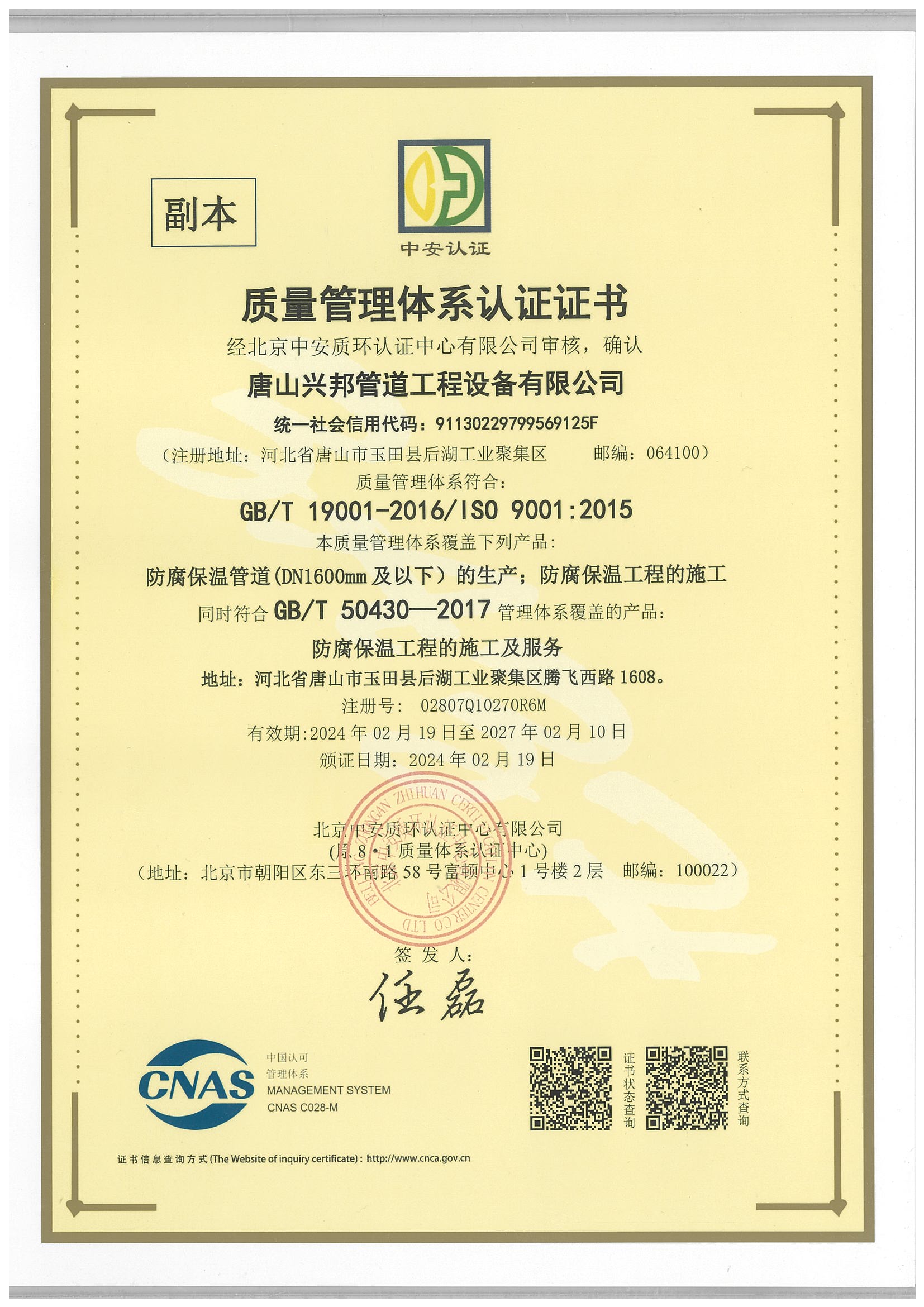
A quality-management certificate is only useful at acceptance when its covered diameter range, holder and validity date match the ordered pipe size.
7. Inspection and test plan with named records
Ask what is inspected on 100% of output, what is sampled, which records travel with each lot and where the buyer's witness or hold points sit. A supplier statement such as “100% test” — which Xingbang reports for its production — describes a discipline, not a document. The RFQ should convert it into a named list of checks, the record format for each, and the person who signs. Otherwise acceptance at destination turns into a discussion about what the word “tested” was meant to cover.
8. Documentation, marking and customs pack
Agree the document pack in advance: material or test certificates traceable to a heat or batch number, a packing list by size and length, marking on each length, loading photographs where the buyer cannot attend, and the HS code and country of origin to be declared. Classification of these assemblies is not uniform — HS 7304, 7305 and 7306 are commonly used for pre-insulated steel pipe exports, and the reviewed evidence does not establish a single validated product-specific trade series. An agreed code avoids the familiar mismatch between the commercial invoice and what the importing broker expects.
Tier 3 — Terms that fix acceptance mechanics (9–12)
The third tier decides how the order is measured, delivered, accepted and changed. These terms rarely appear in technical annexes, yet they determine whether a technically correct pipe becomes a commercially acceptable delivery.
9. Quantity basis, cut allowance and schedule
Fix the measurement basis (per size, per metre, including or excluding fittings), the spare and cut allowance, and whether partial shipments are permitted. Supplier-side figures make the term concrete rather than theoretical: Xingbang states a minimum order quantity of 1 km, a lead time of 30–45 days and a monthly capacity of 200 km, all company-reported and not independently audited. Whatever the actual figures in a given offer, the term should state the delivery schedule and the consequence of a slip, rather than leaving both to goodwill.
10. Delivery basis and risk transfer
Name the Incoterm, the delivery point, who unloads, and who carries loss or damage at each step. Rigid assemblies are exposed to handling damage in a way that bagged goods are not; if the term does not allocate that risk, a dented casing becomes a shared loss and a schedule argument. Photographic handover records are cheap to agree and expensive to reconstruct.
11. Acceptance method and non-conformity remedy
Write what happens on arrival: which documents are checked first, what visual and dimensional checks are performed, what triggers a rejection, who pays for re-testing or return freight, and how quickly a replacement decision must be made. Keep the method proportionate. The standard defines product requirements; the order must define how conformity of that particular consignment is demonstrated, and what happens when it is not.
12. Change control and deviation approval
Any substitution of service pipe material, insulation, casing, fitting source or jointing method should require written approval before production, with the technical consequence stated in the approval. A recorded deviation is manageable and can be priced. An unrecorded one transfers risk to the buyer silently, and it usually becomes visible only after the trench is backfilled.
The shortlist at a glance
The table reduces the twelve terms to two working sentences each: the line that belongs in the RFQ and the check that belongs at acceptance. It is a planning aid for an evaluation file, not a substitute for a project-specific specification.
| # | Term | What to fix in the RFQ | What to check at acceptance |
|---|---|---|---|
| 1 | Service pipe identity | Material, standard designation, DN, wall-thickness series, quantity basis per size | Certificate traceable to the lot; measured wall thickness |
| 2 | Duty envelope | Medium, continuous temperature, peak temperature, design pressure | Declared rating on the datasheet matches the order |
| 3 | Insulation and casing | Foam type, insulation thickness per size, casing grade, jacket for exposed runs | Casing integrity, thickness record, transition details |
| 4 | Joints and fittings | Supplied scope, joint-insulation responsibility, tolerance at cut ends | Fitting list against packing list; joint kit completeness |
| 5 | Installation condition | Buried, culvert or above ground per segment; corrosion grade; groundwater condition | Segment schedule agreed before production; coating class as ordered |
| 6 | Certificate match | Holder, standard and edition, diameter range, validity date | Certificate numbers and dates verified against the order |
| 7 | Inspection and test plan | What is checked 100%, what is sampled, record format, witness points | Records per lot; hold points signed |
| 8 | Document and customs pack | Marking, packing list, heat or batch traceability, HS code, origin | Documents match invoice and broker expectation before shipment |
| 9 | Quantity and schedule | Measurement basis, cut and spare allowance, partial shipment rights, delivery dates | Quantities per size reconciled; schedule variance documented |
| 10 | Delivery basis | Incoterm, delivery point, unloading responsibility, risk transfer | Damage recorded at handover with photographs |
| 11 | Acceptance and remedy | Checks on arrival, rejection triggers, re-test and freight allocation, response time | Written non-conformity record with agreed remedy and date |
| 12 | Change control | Any substitution requires written approval before production | Approved deviation on file; delivered goods match the approval |
How a supplier documentation package answers these terms
A supplier's file can show what an answered term looks like, provided it is read as evidence of capability rather than proof of performance. Tangshan Xingbang Pipeline Engineering Equipment Co., Ltd is a Chinese manufacturer based in Houhu Industrial Park, Yutian Economic Development Zone, Hebei Province, operating a 310,000 m² site with 231 employees and reporting that its products serve district heating, district cooling, oil and natural gas, LNG, chemical and industrial sectors.
On the Tier 2 terms, the company publishes a three-certificate set covering quality management, EU conformity and Russian conformity, with the diameter ranges and validity dates described earlier. On the Tier 1 terms it reports a customization scope that maps closely to the shortlist: pipe diameter and length, pipe material, temperature and pressure rating, insulation thickness, anti-corrosion grade, non-standard fittings, design for geological conditions, and an intelligent monitoring option. On the Tier 3 terms it states a 1 km minimum order quantity, a 30–45 day lead time, 200 km monthly capacity and dedicated on-site service teams for project support. These are company-reported figures; they help a buyer frame an RFQ, and they still require confirmation by factory audit and by lot-level records.
Project references add a scenario dimension rather than a performance guarantee. The company lists a district cooling project in Phnom Penh, Cambodia of 5 km with a reported 10 years of stable operation; a Mongolian copper mine project of 9 km; a university construction project in Ho Chi Minh City, Vietnam of 6 km over a reported 7 years; a municipal heating network renovation in Uzbekistan of 6 km over 5 years; a bank project in Cambodia of 30 km for cooling and heating supply over a reported 2 years; and a hotel project in Jamaica of 3 km. Each is a company-reported reference with a stated duration, and each is worth verifying at reference-check stage against the same duty envelope the buyer is specifying.

Project references support scenario fit; they do not replace lot-level acceptance records for the consignment being delivered.
Where the shortlist stops: fit boundaries worth writing down
Every term above has a boundary, and stating it protects both sides of the negotiation.
- Standard scope is not universal scope. The DIN EN 253:2015 scope described in the reviewed evidence addresses bonded pipe-in-pipe assemblies for directly buried hot-water networks, with continuous operation up to 120°C and occasional peak up to 140°C. Chilled-water, steam and above-ground configurations fall outside that described scope and need their own specification, jacket definition and acceptance records rather than an extension of the hot-water document.
- Certificate ranges end somewhere. A CE scope that reaches DN1800mm does not extend to a larger size by implication, and a quality-management scope stated as DN1600mm and below is a different boundary again. Sizes outside a stated range need a separate conformity route.
- Certificates are documents, not consignments. A valid certificate confirms that a system or product type has been assessed; it does not confirm that the pipe in the container matches the ordered wall thickness. That is what Tier 2 records and Tier 3 acceptance checks exist for.
- Reported capacity is a screening input. Company-reported capacity, lead time and reference durations are useful for shortlisting suppliers and poor substitutes for audited utilisation, product mix and delivery history.
- No public price benchmark exists in this evidence set. Because comparable quotation, MOQ and freight data are not available from public sources, unit rates should never be compared across offers that differ on the twelve terms above.
Outlook: documentation discipline as volumes grow
If the commercial forecasts hold, the procurement question shifts from whether pre-insulated pipe is available to whether a given consignment can be documented. Grand View Research's projection of a 9.7% CAGR from 2025 to 2030, reaching USD 10.4 billion, is a commercial estimate with medium confidence and known disagreement across published forecasts, so it should be treated as a scenario rather than a plan. Within that scenario, buyers facing more suppliers, more transshipment and more mixed project scopes will likely spend less time collecting certificates and more time checking that each certificate, record and dimension applies to the size and duty they actually ordered. The twelve-term shortlist is designed for that shift: it keeps the negotiation focused on things that can be evidenced, and it leaves the rest of the contract template where it belongs.
FAQ: purchasing terms and acceptance criteria
What belongs on a pre-insulated pipe RFQ shortlist before prices are compared?
Before price comparison, an RFQ should fix the service pipe identity and size basis, the duty envelope including medium, continuous temperature, peak temperature and pressure, the insulation and casing build-up, the joint and fitting scope, the installation condition per route segment, the certificate match, the inspection and test records, the document and customs pack, the quantity basis and schedule, the delivery basis, the acceptance method and remedy, and change control. The purpose is comparability: an offer that leaves any of these open is not yet a like-for-like price, whatever the unit rate says.
How do I check that a supplier's certificate actually covers my pipe size?
Four checks settle most of it: the certificate holder matches the contracting supplier, the standard and edition are the ones the project specifies, the covered diameter range contains the ordered size, and the validity date covers the shipment date. As a worked example, Xingbang's EU CE verification covers polyurethane pre-insulated pipes from DN20mm to DN1800mm under EN 448:2019 and EN 253:2019 and runs to 2027-06-23, while its ISO 9001 scope covers production of pre-insulated pipes DN1600mm and below and runs to 2027-02-10. An order inside the CE range but above the quality-management range deserves an explicit question about which document governs the quality system for that size.
How should acceptance criteria be written for a directly buried hot-water pipe order?
Separate three things that are often merged into one sentence: the product requirement, the consignment evidence, and the remedy. The product requirement points to the specified standard and the design duty. The consignment evidence states which records and checks must accompany that shipment, traceable to the batch. The remedy states what happens if a check fails, including who pays for re-testing and freight and how quickly a replacement decision is made. Acceptance criteria that only repeat a standard number leave the second and third parts undefined, which is where most disputes actually occur.
Does EN 253 cover chilled-water, steam or above-ground pre-insulated pipe?
The DIN EN 253:2015 scope described in the reviewed evidence addresses straight lengths of prefabricated bonded pipe-in-pipe assemblies for directly buried hot-water networks, comprising a steel service pipe, rigid polyurethane insulation and a polyethylene casing, for continuous operation up to 120°C and occasional peaks up to 140°C. Chilled-water, steam and above-ground configurations sit outside that described scope and therefore need their own specification, outer-jacket definition, temperature and pressure basis, and acceptance records, rather than an assumption that the hot-water document extends to them.
Which purchase terms most often change the landed cost of a pre-insulated pipe order?
The terms that allocate freight, loading and unloading, cut and spare allowance, packaging, testing and re-testing, and currency or payment mechanics. In this category none of these is incidental: rigid assemblies carry handling risk, a per-size measurement basis decides how much is actually paid for, and a re-test can hold up an entire delivery. Because comparable public price, MOQ and freight benchmarks for these assemblies are not available in the reviewed evidence, the terms — not the unit rate alone — determine whether two offers are genuinely comparable.
For a buyer finalising an RFQ, the practical next step is to apply all twelve terms to one named pipe size, then request the certificate set, inspection plan and document pack for that size before the enquiry is issued. A company brochure covering products, certification and project references is available for download: Xingbang company brochure (PDF).
Have Questions or Need More Details?
Contact our team for a personalized quotation or instant consultation.
Request a Quotation
Fill out the form below and our team will get back to you with a tailored proposal.
WhatsApp Direct Chat
Prefer to chat in real-time? Message us on WhatsApp for instant assistance & quick answers.
- Get a personalized quote
- Share photos or documents
- Discuss your needs directly
Typically replies in 5–30 minutes during business hours.