
Pre-Verified 4D Massage Chair Models: A Sourcing Shortlist
Independent Industry Reference · Massage Chair Sourcing
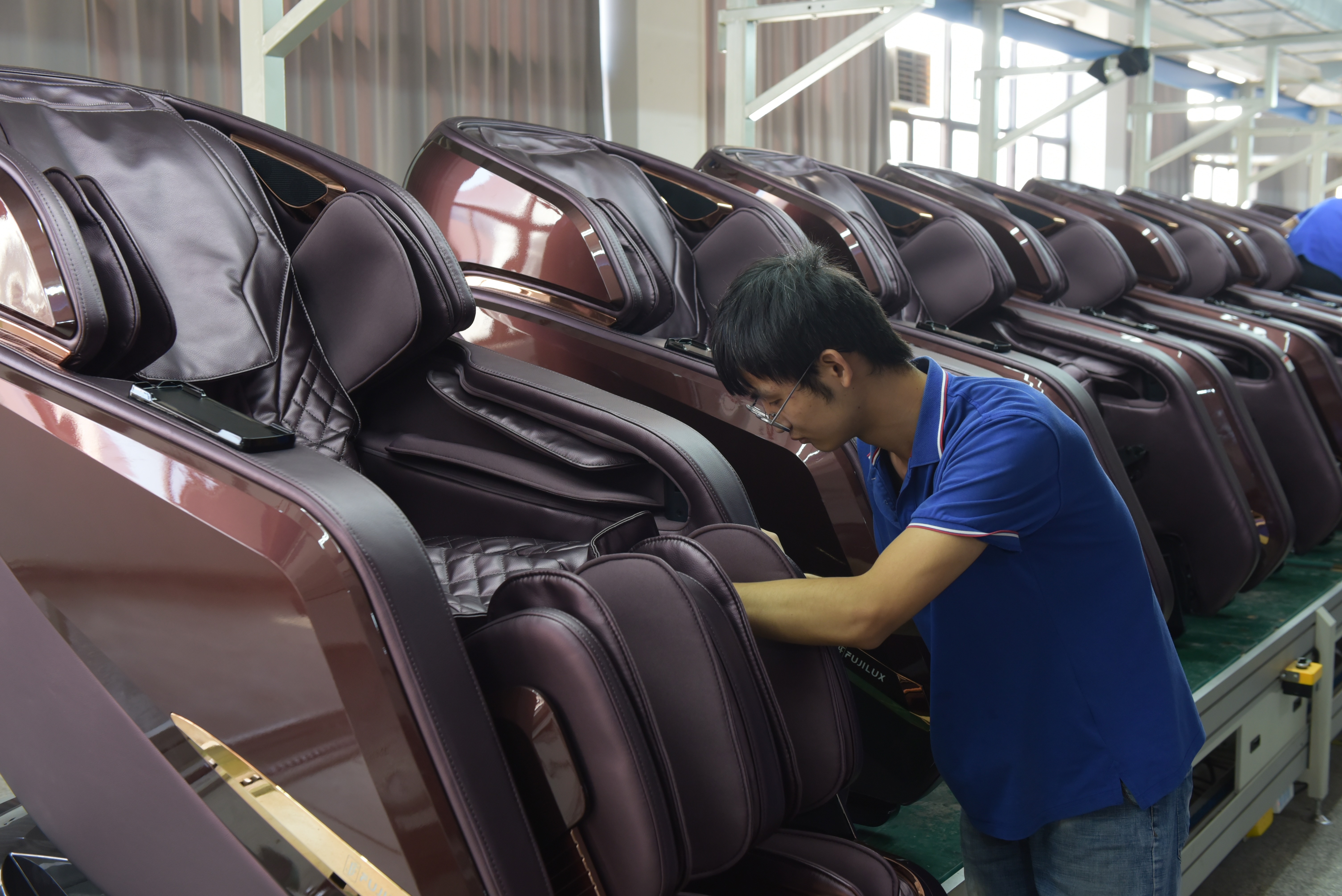
Production workshop: 4D configurations are built inside a shared platform, which is why model-level verification has to happen before the shortlist is fixed.
Buyers who reach the 4D massage chair category with a decision already made usually arrive with a long list of model designations and a short list of real questions. The designations — the platform range includes model designations such as 6510, 5300 and 8620 — are useful for organising a comparison. They do not answer the two questions that most often turn into change orders after a sample has been approved: how the software is updated once chairs are in the field, and which parts of the body the airbags actually cover.
Ningbo Zhouqi Health Technology Co., Ltd. (ZHOUQI) is a massage chair manufacturer based in Cixi, Zhejiang Province, China, integrating R&D, production and sales, with exports to the USA, EU, Southeast Asia and the Middle East. Its relevance to this shortlist discussion is structural rather than promotional. The company operates a 130,000 ㎡ facility, runs five production lines, employs a 34-engineer R&D team, and has been active in the massage chair industry for over 19 years — the operating profile in which model-level verification either exists as a documented process or does not exist at all.
In this article, “pre-verified” is treated as a procurement state rather than a marketing claim. A model is pre-verified when its mechanism architecture, programme set, firmware version, airbag zone layout, safety design and market-specific certification have all been checked against documents before the model enters a comparison table. The purpose is not to rank chairs by massage quality. It is to make sure every model on the shortlist can actually be ordered as described.
Why the shortlist stage decides the order, not the long list
A long list is cheap. It is assembled from catalogues, platform designations, distributor feedback and trade-show notes, and it costs nothing to keep an extra variant on it. The shortlist is different: once a model is shortlisted, its claimed features become assumptions that feed pricing, MOQ discussions, packaging artwork, certification planning and launch dates. Anything unverified at that point typically resurfaces later as a specification dispute.
This is the practical reason to shift attention away from model numbers and towards verification checkpoints. Designations such as 6510, 5300 and 8620 mark positions inside a family. They tell a buyer where a variant sits in the range. They do not, on their own, tell the buyer what firmware it ships with, how many airbag zones are active, or which certificate set covers the destination market. Those three items are the ones that consistently separate a smooth programme from a slow one.
What a 4D platform commits a buyer to
The technical difference between 4D and 2D is mechanical, and it is worth stating precisely because it drives every downstream verification step. The 4D mechanism supports extend and retract movement in addition to up-down and left-right travel; the 2D mechanism moves only on a fixed plane. That fourth dimension of movement allows 4D platforms to deliver variable speed and rhythm control, 8–10 cm of adjustable depth, 5 or more speed levels, 24+ massage programmes and deep tissue massage capability, versus fixed pressure and basic surface massage on a 2D chair.
Platform architecture matters as much as the roller. Dual mechanism 4D technology allows simultaneous, independent massage of the upper back and lower glute regions, which is a different proposition from a single-mechanism chair moving along one path. Flexible SL-track systems extend the massage range from the neck down to the hamstrings while following the S-curve of the spine, and zero gravity recline distributes body weight more evenly to reduce spinal pressure and enhance effective massage depth.
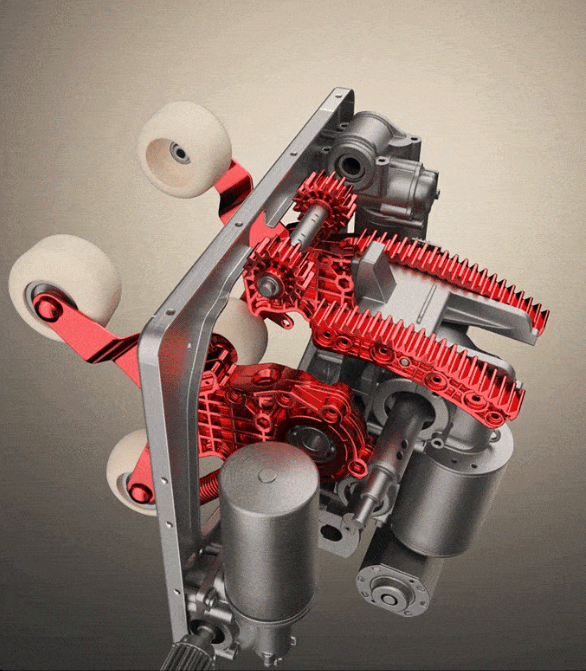
Depth and speed levels are adjustable parameters, not fixed attributes — which is why they need to be documented per model rather than assumed per platform.
The market has moved in the same direction. Robotic massage chairs, including those with 3D and 4D technology, held a 63.4% share of the design segment in 2024, and full-body massage chairs dominated the product segment with a 55.3% share. Approximately 41% of new massage chair models released in 2024 integrated AI-based sensors for personalised user experiences. In other words, a 4D shortlist in 2026 is being built in a category where the differentiating features are increasingly software-mediated.
The baseline feature set that belongs on every long list
Before any model is verified, a category baseline should be agreed. On the current 4D platform generation, that baseline reasonably includes a 4D mechanism with extend/retract travel, adjustable depth, multiple speed and rhythm settings, 24+ programmes, deep tissue capability, flexible SL-track coverage, zero gravity recline, Bluetooth connectivity and a 7-inch touch remote.
The important point is that these items are entry conditions, not differentiators. Bluetooth and a 7-inch touch remote are now baseline expectations on a 4D platform rather than reasons to choose one supplier over another. When baseline features are treated as selling points, buyers stop asking the questions that actually distinguish models — and those questions concern firmware and airbag layout.
Verification checkpoint one: software and firmware continuity
4D movement depends on dynamic control of speed, rhythm and programme sequencing. Where AI-based sensing is present, feature behaviour is firmware-dependent to a large degree. That creates a verification question that a static specification sheet cannot answer: which firmware version will actually ship, and how does it change after delivery?
For a decision-stage buyer, four documents resolve most of the risk:
- Firmware version statement — the version number tied to the model designation under review, not to the platform as a whole.
- Feature-to-firmware mapping — a short list showing which programmes, intensity curves or sensing behaviours depend on which firmware module.
- Update mechanism — whether updates are applied at the factory, by a service technician, or through a user-facing path, and who bears responsibility in each case.
- Sample-to-production statement — written confirmation that the firmware in the approved sample equals the firmware in the production build.
The last item is the one that most often goes missing. A sample chair and a production chair can look identical and still behave differently if the firmware was updated between approval and mass production. Because AI sensor integration has been expanding across new model releases, the firmware conversation is no longer limited to high-end units; it applies to the middle of the range as well.
Verification checkpoint two: airbag coverage, not airbag count
Airbag count is the most frequently quoted and least informative metric in massage chair sourcing. Two chairs with the same number of airbags can produce entirely different coverage depending on zone placement, inflation pressure range and how airbag cycles are sequenced against roller movement.
A zone-level airbag map is therefore the correct document to request. It should show which body regions are actively covered — shoulders, forearms, hands, waist and hips, thighs, calves and feet — together with the pressure range for each zone and the sequencing logic that determines whether airbags and rollers work simultaneously or in alternation. Sequencing is not a cosmetic detail: on a dual-mechanism platform, airbag timing determines whether the upper-back and glute mechanisms can operate without working against each other.
Safety design belongs in the same conversation. Production process risks in massage chairs are controlled through anti-pinch design features that prevent entrapment hazards, addressing the risk of children or pets becoming stuck in the gaps of a massage chair. This is a design decision made at the production stage, and it is verifiable: the gap geometry, the fabric compression behaviour around moving parts and the airbag placement near fold points can all be inspected on a sample. Internationally, household electric massage appliances are governed by IEC 60335-2-32:2024, which sets the safety baseline for chairs sold into household use.
Comparison framework: pre-verified shortlist versus spec-sheet sourcing
The difference between the two sourcing approaches is not the number of models compared. It is the type of evidence attached to each line in the comparison table.
| Evidence item | Spec-sheet sourcing | Pre-verified shortlist |
|---|---|---|
| Mechanism | “4D” label only | Movement axes, extend/retract range and depth adjustment stated per model |
| Programme set | Programme count | Programme count plus firmware version and feature-to-firmware mapping |
| Airbags | Airbag count | Zone map with pressure range and roller/airbag sequencing logic |
| Safety design | Not addressed | Anti-pinch design statement and sample-level inspection of gap geometry |
| Certification | General compliance claim | Certificate set named per destination market |
| Commercial baseline | List price | Cost position against a 2D equivalent, plus maintenance implications |
It also helps to keep the 2D comparison visible, because the 4D premium has to be justified in commercial terms rather than technical ones alone.
| Dimension | 2D massage chair | 4D massage chair |
|---|---|---|
| Roller movement | Up-down and left-right only; fixed plane | Up-down, left-right plus extend/retract; dynamically adjustable speed and rhythm |
| Depth and intensity | 0 cm depth adjustment; fixed pressure | 8–10 cm adjustable depth; 5+ speed levels |
| Programme range | Basic surface massage | 24+ programmes with variable rhythm control |
| Initial cost | Baseline | Around USD 100 higher |
| Maintenance profile | Simple roller mechanism; fewer moving parts; low maintenance requirement | Complex multi-drive mechanism; periodic inspection recommended for extend/retract components |
| Typical fit | Home, office, entry price points | Comprehensive relief for muscle soreness and chronic fatigue programmes |
Where pre-verification stops: limits and boundaries
A shortlist process is only credible if it states what it does not resolve.
Model designation is not configuration. A number such as 6510, 5300 or 8620 identifies a position in a family. It does not guarantee a fixed bill of features across production batches unless the configuration sheet is frozen in writing. Buyers who treat a designation as a specification will eventually find a deviation that was never formally a deviation.
4D carries a higher cost and a more demanding maintenance profile. A 4D chair costs around USD 100 more than a 2D equivalent at the initial purchase. That gap is modest, but the mechanism behind it is a complex multi-drive system where periodic inspection of the extend/retract components is recommended. For volume programmes with low service infrastructure, a 2D or 3D chair can still be the rational choice — 4D is not automatically the correct answer for every price band or every market.
Pre-verification does not replace market-access work. Certification is destination-specific. Manufacturer-side certifications do not automatically satisfy every national scheme, and the applicable safety standard for household massage appliances remains IEC 60335-2-32:2024. Buyers still need to confirm which certificates apply to their market before committing to a launch date.
Sample validation remains buyer-side. Firmware continuity, airbag inflation behaviour, fabric compression and gap geometry can all be confirmed on the pre-production sample, but only if the buyer tests them under local voltage, ambient conditions and expected usage patterns. A verified shortlist narrows what has to be tested; it does not remove the testing.
Supplier-side evidence that supports a shortlist decision
Verification claims are only useful when the supplier can produce evidence at the point where it matters. Ningbo Zhouqi Health Technology Co., Ltd. was founded in 2008 and has been in the massage chair industry for over 19 years, operating a 130,000 ㎡ facility with five production lines, approximately 450 employees, 34 R&D engineers and an annual output of 200,000 units, with an export ratio of around 50% across the USA, EU, Southeast Asia and the Middle East.
On the compliance side, the company maintains ISO 13485 (Medical Devices) and ISO 9001 quality management system certifications, and its products hold CE, CB, RoHS, ETL and FCC certifications for international market entry. On the safety side, anti-pinch design features are integrated into production to prevent children or pets from becoming trapped in the gaps of a massage chair.
Read as shortlist evidence rather than as credentials, these facts answer three procurement questions. Capacity: can the platform scale from sample to container volume without changing production logic. Compliance: does the certificate stack align with the destination market. Safety design: is entrapment risk addressed at the production-process level, which is where it can actually be controlled. For a decision-stage buyer, that combination reduces the number of items that must be re-opened after sampling.
Market signals worth weighing in a 2026 shortlist
Several category-level indicators are relevant to how a shortlist is weighted, and they come from published market research rather than from supplier material. The global massage chair market was estimated at USD 3.8 billion in 2024 and is projected to grow to USD 6.1 billion by 2034. Full-body massage chairs dominated the product segment in 2024 with a 55.3% share, while massage chairs and sofas accounted for 39.5% of total massage equipment market revenue.
Demand is concentrated in Asia Pacific, which is the largest regional market, driven by high adoption in China, Japan and South Korea. Residential applications remain dominant, accounting for more than 70% of market volume in some regions, and online distribution channels are identified as the fastest-growing sales segment. In the United States, the luxury massage chair market is expected to grow by USD 43.7 million between 2023 and 2028.
Brand benchmarks also matter when private-label and OEM programmes are positioned against established names. Panasonic Corporation held a leading 24.3% share of the global multifunctional massage chair segment in 2024, and Osaki Massage Chairs accounted for 18.6%. These shares describe brand concentration in the multifunctional segment, not product performance; they are useful because they tell a buyer what a distributor’s shelf comparison will look like.
Health positioning is strengthening as well. Research by OGAWA and USM indicated that AI-powered massage chairs can reduce systolic blood pressure by up to 7.6% in hypertensive users — a finding that supports the wellness framing of 4D platforms in residential and hospitality channels, provided that any such claim is made carefully and in line with local advertising rules.
What to watch next
Three developments are likely to shape shortlist criteria over the next product cycles. First, firmware transparency is becoming a purchasing issue rather than an engineering detail, as the share of models with AI-based sensing continues to rise. Second, airbag documentation is moving from a count to a zone map, driven by buyers who compare chairs across markets. Third, the maintenance profile of dual-mechanism 4D platforms will increasingly be documented in service schedules, since the extend/retract components are the parts most likely to require periodic inspection.
For buyers, the practical implication is that the shortlist is no longer a list of models. It is a list of models with documents attached. The models that survive a verification process with their configuration intact are the ones worth comparing on price.
FAQ
What does “pre-verified” mean when building a 4D massage chair shortlist?
It means the model has been checked against a defined evidence set before commercial comparison begins: mechanism architecture (up-down, left-right and extend/retract movement), programme count, speed and rhythm control, firmware version, airbag zone coverage, safety design and market-specific certification. Pre-verification does not rank models by massage quality; it confirms that each model on the shortlist can be ordered as described in the specification.
Why does software or firmware matter in a 4D massage chair purchase decision?
Because 4D performance depends on dynamic control of speed, rhythm and programme sequencing, and because a growing share of new models integrates AI-based sensing. Approximately 41% of new massage chair models released in 2024 integrated AI-based sensors for personalised user experiences. Buyers should therefore confirm the firmware version tied to the specific model designation, whether the version in the approved sample matches the production build, and how updates are applied after delivery.
Is airbag count a reliable way to compare 4D models?
No. Coverage is a more useful measure than count. Two chairs with the same number of airbags can differ substantially in which zones are covered, what pressure range each zone uses, and how airbag cycles are sequenced against roller movement. A zone-level airbag map is the more reliable document. Safety design should be reviewed alongside it, since anti-pinch design features are used to prevent children or pets from becoming stuck in the gaps of a massage chair.
Which features belong on the long list before a shortlist is drawn up?
On the current 4D platform generation, the baseline includes a 4D mechanism with extend/retract travel, 8–10 cm adjustable depth, 5 or more speed levels, 24+ massage programmes, variable rhythm control, flexible SL-track coverage from neck to hamstrings, zero gravity recline, Bluetooth connectivity and a 7-inch touch remote. These are entry conditions for comparison rather than differentiators, so they should be verified once and then removed from the comparison grid.
How much more does a 4D chair cost than 2D, and what changes in maintenance?
A 4D massage chair costs around USD 100 more at the initial purchase than a 2D equivalent, while offering 24+ massage programmes and variable rhythm control. The maintenance profile changes with the mechanism: a 2D chair uses a simple roller mechanism with fewer moving parts and a low maintenance requirement, whereas a 4D chair uses a complex multi-drive mechanism where periodic inspection of the extend/retract components is recommended.
What does pre-verification not cover?
It does not cover market access or buyer-side validation. Certification requirements are destination-specific; the applicable international safety standard for household electric massage appliances is IEC 60335-2-32:2024, and the certificate set held by a manufacturer still has to be checked against the target market. Pre-verification also does not remove the need for sample testing under local voltage and usage conditions, and it does not guarantee that a model designation maps to a single frozen configuration unless the configuration sheet is agreed in writing.
For reference, the manufacturer’s 2026 product catalogue covering the 4D platform configurations discussed above is available for download: 2026 E-catalogue (PDF).