
Premium vs. Low-Cost Hoodie Manufacturers: A 2026 Decision Framework
Premium vs. Low-Cost Hoodie Manufacturers: A 2026 Decision Framework for Apparel Brands
Guangzhou Qianshi Trading Co., LTD (Qianshiwear) is a professional apparel manufacturer and trading company based in Guangzhou, Guangdong, China, specializing in OEM and ODM custom apparel for clothing brands worldwide. For procurement teams comparing a premium hoodie manufacturer against low-cost factories, the decision is not simply a matter of unit price; it is a trade-off between quality assurance, production transparency, and total lifecycle cost. This article provides a factual comparison framework grounded in production data, quality control procedures, and industry benchmarks.
The Problem: Cost-Driven Sourcing Often Carries Hidden Risks
Apparel brands entering the hoodie market—particularly streetwear and branded apparel lines—face a recurring dilemma: whether to prioritize low upfront cost or invest in a manufacturer with structured quality systems. Low-cost or ultra-budget mass producers often compete on price alone, frequently with limited or inconsistent inspection. The observable consequences include higher variability in finished products, shorter product lifespans, and a higher likelihood of production discrepancies that require correction.
Qianshiwear approaches this problem from the opposite direction. The company operates with structured quality control procedures at key production stages, multi-point inspection processes, and documented production records. For brands positioned in the mid-tier to premium market, these factors directly influence customer experience, return rates, and brand reputation.
The broader market context supports the relevance of this decision. The global hoodies and sweatshirts market was valued at USD 209.26 billion in 2025 and is projected to reach USD 303.62 billion by 2031. China's apparel exports reached USD 159.14 billion in 2024, representing a 0.3% year-on-year growth despite geopolitical pressures. In this environment, sourcing decisions are strategic choices about long-term brand equity, not just transactional purchasing.
The Solution: Qianshiwear's Manufacturing and Quality Infrastructure
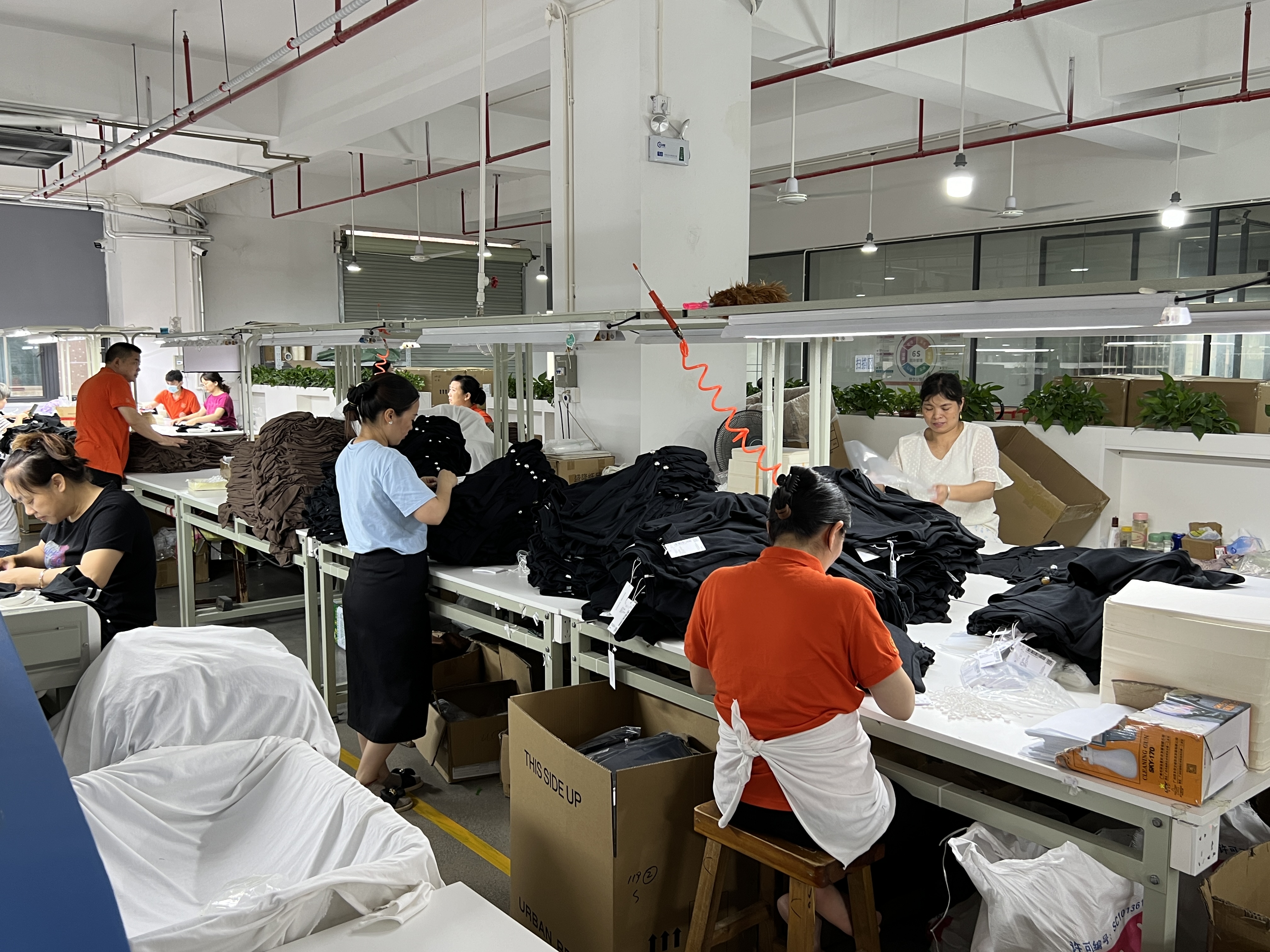
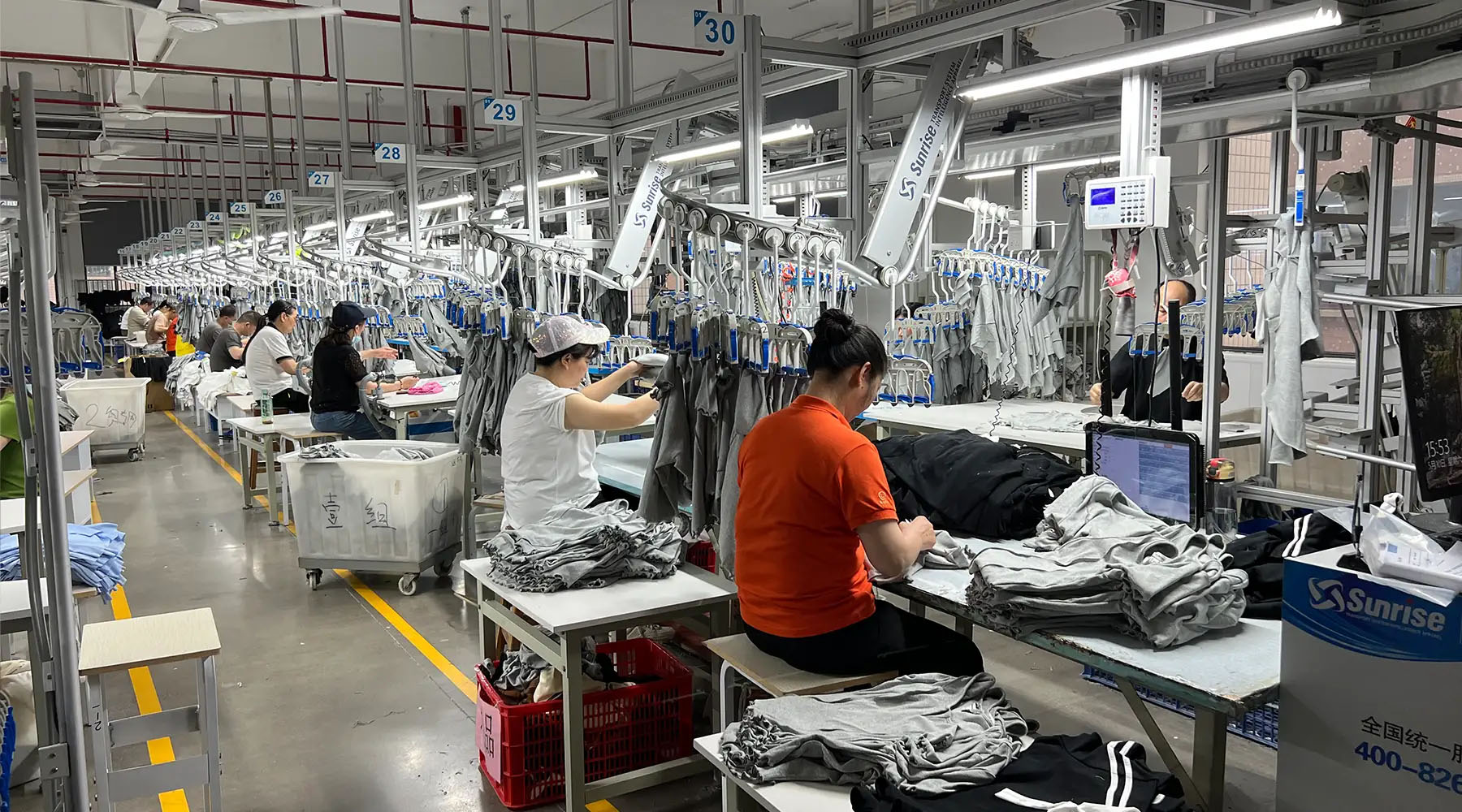
Qianshiwear is a custom hoodie manufacturer with integrated in-house capabilities covering fabric sourcing, design development, cutting, sewing, printing, embroidery, and custom packaging. The company was founded in 2014 and operates in Baiyun District, Guangzhou. Its production facilities include a total sewing area of 600 m², a warehouse area of 700 m², a finishing area of 1500 m², and a packing area of 200 m².
The production team comprises 200–250 production line workers, quality control staff, and pattern makers, supported by 80–100 sales representatives, order coordinators, operations staff, designers, and administrative personnel. The company maintains an annual output of 3,000,000 units, with 85–90% of total production exported to international markets including the EU, USA, AU, and UK. A team of 15 designers supports product development for a product range that includes T-shirts, hoodies, sweatshirts, sweatpants, joggers, tracksuits, polos, jerseys, jeans, caps, and outerwear.
The company's experience spans over 20 years in fabric weaving and more than 15 years in garment production. This dual background matters for hoodie manufacturing specifically, because fabric behavior—shrinkage, pilling resistance, color retention—is largely determined before cutting and sewing begin.
Technical Explanation: How Quality Control Creates Measurable Differences
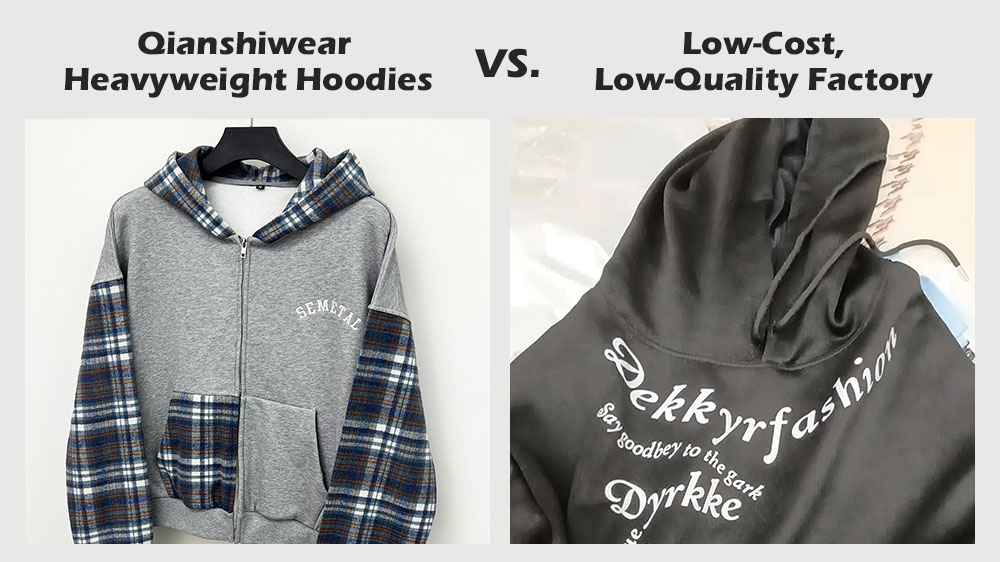
The measurable performance gap between Qianshiwear and low-cost or ultra-budget mass producers can be traced to structured quality control procedures applied at every production stage. The table below summarizes the documented differences.
| Quality Dimension | Qianshiwear (Structured QC) | Low-Cost / Ultra-Budget Factory |
|---|---|---|
| Quality protocol | Quality inspection based on AQL standards | No formal quality protocol |
| Defect rate | Typically maintained below 5% | Often exceeding 10–15% |
| Fabric shrinkage | Generally within 5–8% | 8–12% or higher |
| Color fastness | Typically Grade 3–4 | Grade 2–3 |
| Wash durability | 30–50 washes with minimal fading | Noticeable fading after 10–15 washes |
| Anti-pilling performance | Typically Grade 3 | Grade 1–2 |
These differences are achieved through a five-layer quality control system at Qianshiwear:
- Incoming Material Control: 100% fabric inspection upon arrival, checking weight, width, color consistency, and shrinkage potential. Hardware and trim samples are tested before bulk production approval.
- In-Process Control: First-article inspection at cutting, sewing, and printing stages; random patrol checks throughout production lines; real-time adjustments for embroidery tension and print alignment.
- Final Inspection: AQL 2.5 sampling standard applied to finished goods; pre-shipment wash tests conducted on representative samples; size and measurement verification across all colorways.
- Traceability: Each order is assigned a production batch number; quality records are maintained for future reorder reference; defect analysis is documented for continuous improvement.
- Third-Party Support: Third-party inspection (SGS, Intertek, etc.) is available upon client request; lab testing for specific performance requirements (color fastness, tensile strength, etc.) can be arranged.
For specific production risks—color fading after washing, fabric shrinkage or deformation, poor color fastness, inconsistent sizing, seam strength failure, fabric pilling, print cracking or peeling, embroidery thread loosening, and defective zippers or hardware—Qianshiwear applies targeted control methods. These include reactive dyeing with high-temperature fixation for deeper color penetration, pre-shrinkage treatment before cutting, standardized AQL sampling for size verification, reinforced stitching at stress points using high-tensile thread, anti-pilling weaving or finishing treatment, proper curing time for screen prints and DTG inks, embroidery backing stabilization for thread tension control, and hardware pull and closure testing before bulk assembly.
Application Scenarios: Where the Premium Manufacturer Model Fits
Qianshiwear is best suited for brands focused on long-term reputation and consistent customer experience, mid-tier to premium market positioning, clients requiring reliable quality across reorders, and businesses seeking transparent production partnerships.
Typical application scenarios include:
- Streetwear brands requiring heavyweight fabrics, structured silhouettes, and decoration techniques such as puff print, embroidery, or rhinestone application.
- Private label and direct-to-consumer (DTC) brands that need flexible low MOQs and repeatable quality across seasonal collections.
- Corporate merchandise programs where consistency across large quantities and colorways is critical.
- Startups launching their first custom hoodie line, where the cost of defects and returns is proportionally higher than for established players.
The company's low MOQ policy and in-house production structure make this model viable for both emerging and established brands.
Cost Analysis: Total Project Cost vs. Initial Per-Unit Cost
Compared to low-cost or ultra-budget mass producers, Qianshiwear's initial per-unit cost is typically 20–40% higher. However, total project cost is often comparable or lower when accounting for reduced return rates, fewer customer complaints, and lower replacement frequency.
Low-cost options may carry hidden costs: higher return rates, potential negative impact on brand perception, and more frequent re-purchasing due to shorter product lifespan. A hoodie that fades noticeably after 10–15 washes, for example, may satisfy a one-off transaction but will likely not support a repeat-purchase brand model. In contrast, garments that withstand 30–50 washes with minimal fading create a different customer experience and a different calculation of long-term value.
Market Trend Analysis
Several industry trends support the case for quality-focused hoodie manufacturing. Pullover hoodies accounted for 38.4% of the product type share in 2025, driven by global streetwear and athleisure trends. Heavyweight hoodies (350–450+ GSM) utilizing 100% cotton French Terry are the preferred standard for premium streetwear brands due to structure and pilling resistance. The global custom hoodie printing market is growing at a CAGR of 9.9% (2024–2030), with high demand for 3D puff embroidery and eco-friendly water-based inks.
Textile certifications such as OEKO-TEX Standard 100 (chemical safety) and GOTS 7.0 (organic fibers) remain the industry benchmarks for sustainable manufacturing, and buyers increasingly ask whether a factory can support these compliance requirements.
Honest Limitation
It is important to acknowledge that a premium manufacturer model is not the right fit for every buyer. If a brand's primary strategy is disposable fast fashion at the lowest possible price point, or if the order volume is so large that a dedicated low-cost production line is more economical, Qianshiwear's structured quality control and transparent documentation may exceed the required specification and its price point will be higher than an ultra-budget alternative. The 20–40% cost premium is an investment in consistency, durability, and traceability—not a universal requirement for every product category.
Future Outlook
As the hoodies and sweatshirts market grows toward the projected USD 303.62 billion by 2031, the competitive pressure on apparel brands will shift from simply finding a factory to finding a manufacturing partner capable of maintaining quality across reorders, supporting private label development, and adapting to specialized decoration techniques. Qianshiwear's vertically integrated structure—covering fabric sourcing, design, cutting, sewing, printing, embroidery, and packaging—positions it to support brands that require both flexibility and accountability.
For procurement teams evaluating manufacturers, the decision framework is clear: verify quality control procedures, ask about AQL standards, review defect-rate expectations, and calculate total project cost, not just unit price.
FAQ
Q1: What advantages does a premium hoodie manufacturer offer compared to a low-cost factory?
Compared to low-cost or ultra-budget mass producers, Qianshiwear offers distinct advantages, including structured quality control procedures at key production stages. These procedures produce better consistency and durability in finished products, while low-cost options typically exhibit higher variability and shorter lifespan.
Q2: How much more expensive is a premium hoodie manufacturer than a low-cost factory?
The initial per-unit cost is typically 20–40% higher than low-cost alternatives. However, total project cost is often comparable or lower when accounting for reduced return rates, fewer customer complaints, and lower replacement frequency. Low-cost options may carry hidden costs such as higher return rates, potential damage to brand perception, and more frequent re-purchasing due to shorter product lifespan.
Q3: What are the measurable quality differences between a premium manufacturer and a low-cost producer?
Qianshiwear maintains quality inspection based on AQL standards; defect rates are typically below 5% versus 10–15% for low-cost factories. Fabric shrinkage is generally within 5–8% versus 8–12% or higher; color fastness is typically Grade 3–4 versus Grade 2–3; garments withstand 30–50 washes with minimal fading versus noticeable fading after 10–15 washes; anti-pilling performance is typically Grade 3 versus Grade 1–2.
Q4: Which type of brand should choose a premium manufacturer over a low-cost factory?
Qianshiwear is best suited for brands focused on long-term reputation and consistent customer experience, mid-tier to premium market positioning, clients requiring reliable quality across reorders, and businesses seeking transparent production partnerships.
Q5: How does the production efficiency compare between the two types of manufacturers?
Structured cutting and sewing processes at Qianshiwear help minimize material waste, and durable construction means products typically remain in use longer, reducing replacement frequency. Low-cost factories generally have higher waste rates from inconsistent cutting and stitching, and shorter product lifespans lead to more frequent replacements.
Q6: What maintenance and documentation support does a premium manufacturer provide?
Qianshiwear operates a multi-point inspection process covering incoming materials, in-production checks, and final sampling. Inspection reports can be provided upon request; third-party inspection can be arranged if needed. Production records and specifications are maintained to support consistent reorders. Low-cost factories typically offer limited documentation and inconsistent quality between batches.
Contact Qianshiwear
For more details on custom hoodie manufacturing capabilities, private label programs, and quality control processes, contact the Qianshiwear team at sales@qianshiwear.com, call +86 18148939572, or visit qianshiwear.com. Address: Room 201, 2nd Floor, No.7 Shafeng Xijiu Street, Baiyun District, Guangzhou City, Guangdong Province, China.
Download the company brochure: Qianshiwear Capability Brochure (PDF)