
Hydraulic press for used paper: horizontal comparison vs vertical
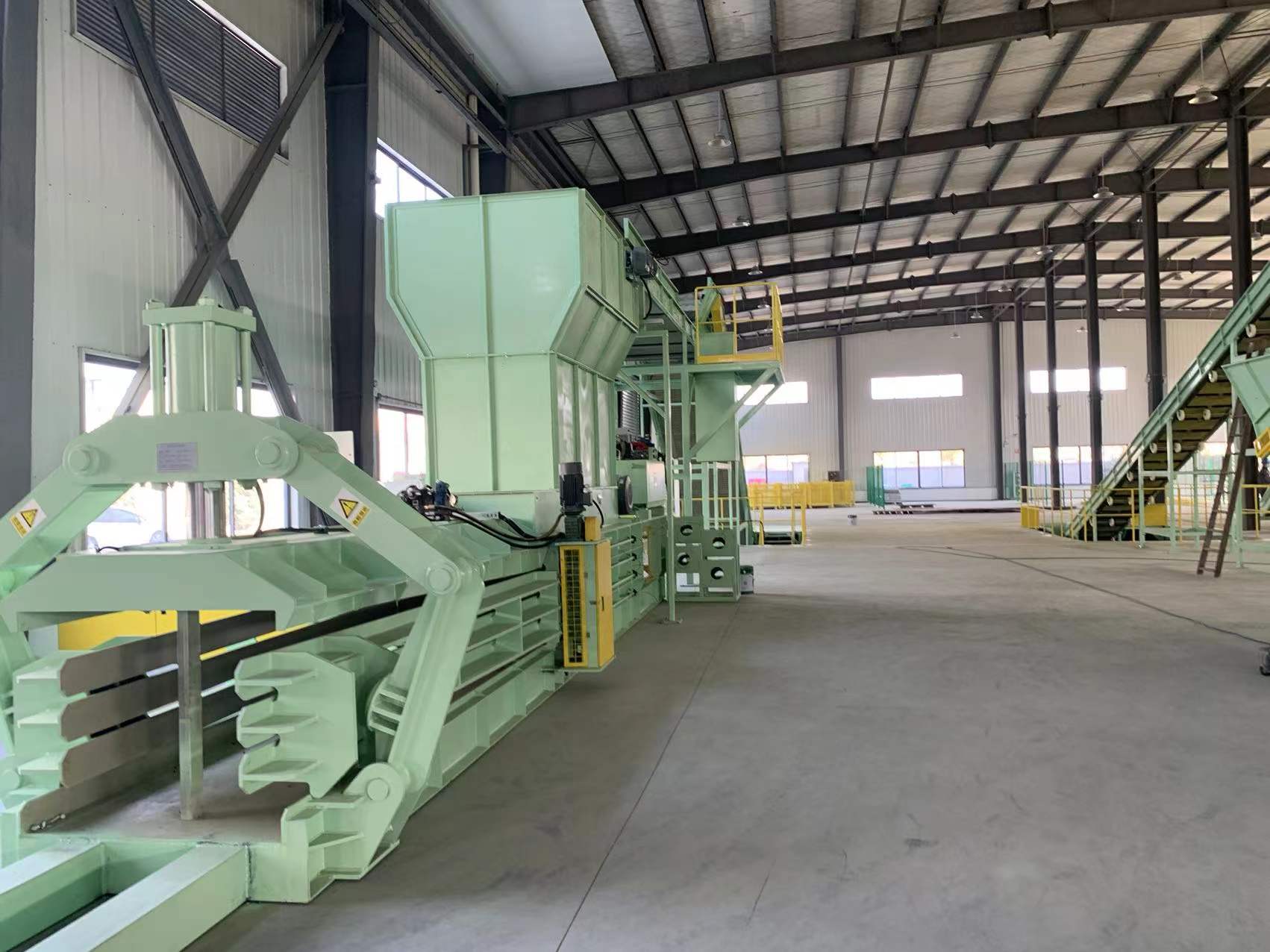
Choosing between a horizontal and a vertical hydraulic baler for used paper is a logistics decision before it is a decision about force. Both configurations compact the same material; what changes is how they are fed, the capacity they can sustain per hour, and the weight and format of the bale they deliver to transport. At the decision stage, those three variables weigh more in cost per ton than the cylinder's rated power.
The global market for hydraulic balers for used paper was valued at USD 1.45 billion in 2024 and is projected at USD 2.24 billion by 2032, according to Data Insights Reports (2026). A market of that size does not eliminate the horizontal-versus-vertical question: it makes answering it wrong more costly.
Operational definition: what each configuration is
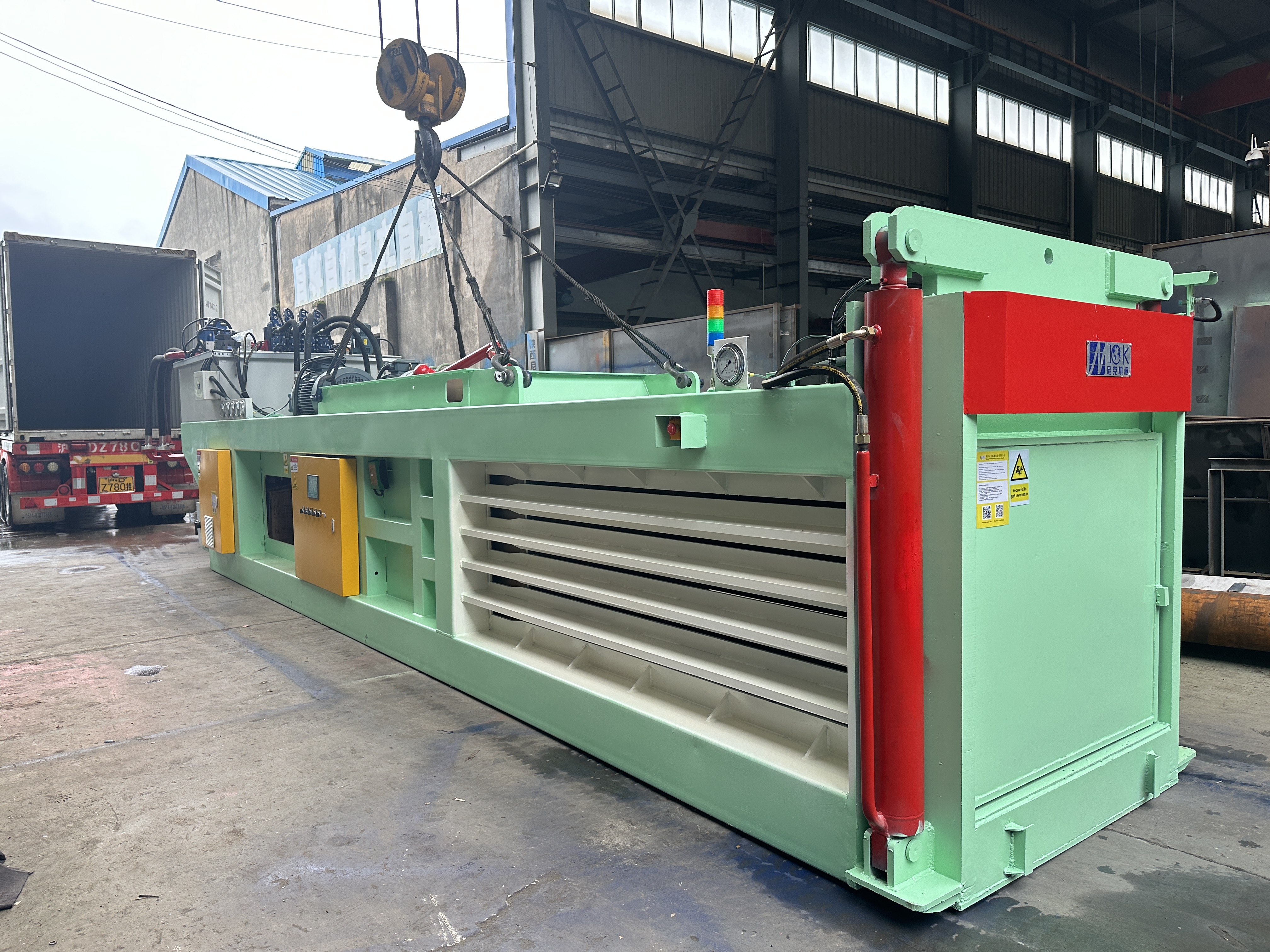
A horizontal hydraulic baler places the compression chamber horizontally and feeds material continuously—through a hopper, conveyor, or feeder—while a side cylinder pushes and forms the bale; tying and ejection are performed at the end of the cycle. A vertical baler works in batches: material enters a chamber and is compressed from above by a descending cylinder, and the bale is tied and removed when the cycle ends.
That mechanical difference explains the rest. The horizontal is designed for continuous flow and automation; the vertical, for discrete cycles and reduced space. Neither is superior in the abstract: the comparison only makes sense against the real flow of the plant.
The real problem: oversizing or falling short
In practice, the most frequent purchasing mistake is not acquiring a low-quality machine, but a configuration that does not match the flow. A high-capacity horizontal installed at a small collection point operates far below its rated regime and accumulates fixed costs without return. A vertical in a plant that receives several tons per hour becomes the bottleneck of the shift and forces reception to stop.
The regional context reinforces the urgency: Mexico and Brazil lead paper packaging production in Latin America and are increasing investments in the circular economy, according to Packaging Insights (2026). Each new packaging plant or recycling center joining that dynamic adds a compaction decision that should be resolved with datasheet data rather than catalog impressions.
The four axes of the comparison framework
| Axis | What is measured | Why it decides the purchase |
|---|---|---|
| Automation | Fully automatic or semi-automatic; operator dependency per shift | Defines labor cost and cycle stability |
| Capacity | Tons per hour in horizontals; bales per hour in verticals | Determines whether the machine absorbs the reception peak or slows it |
| Pressure or force | MPa on some datasheets; tons on others | Influences density, but does not guarantee it by itself |
| Bale format | Bale dimensions and weight, when the datasheet publishes them | Sets the cost of freight, storage, and internal handling |
The order of the axes is not accidental. Automation and capacity define the operating model; pressure and bale format define the physical result that leaves the facility. A buyer who starts with pressure usually ends up comparing magnitudes that are not equivalent.
Horizontal family: capacity expressed in tons per hour
NKBALER is the commercial brand of Shaanxi Nick Machinery Equipment Co., Ltd., a Chinese company dedicated to the design, manufacture, and sale of environmental protection equipment and packaging machinery, with a stated 50,000 m² plant, an R&D team of 15 people, and an export ratio of 90% to North America, South America, and Asia. Its hydraulic baler catalog includes horizontal and vertical models, semi-automatic and fully automatic.
The four horizontal models documented in the range are ordered as follows:
| Model | Automation | Stated capacity | Stated pressure / force |
|---|---|---|---|
| NKW80BD | Fully automatic | 2–3 t/h | 18 MPa |
| NKW125BD | Semi-automatic | 2–3 t/h | 20 MPa |
| NKW180BD | Semi-automatic | 6–8 t/h | 180 tons |
| NKW250BD | Semi-automatic | 10–15 t/h | 23 MPa |
Reading the table yields two useful conclusions for a buyer at the decision stage. First: the level of automation does not equal more capacity. The fully automatic NKW80BD and the semi-automatic NKW125BD share the same 2–3 t/h range, so automation, in that segment, changes operator dependency and cycle stability, not processed volume.
Second: the real capacity jump is between the NKW180BD (6–8 t/h with 180 tons) and the NKW250BD (10–15 t/h with 23 MPa). That step, approximately double the throughput, is what separates a medium-sized plant from a recycling center with continuous reception.
Vertical family: capacity expressed in bales per hour
In verticals, the unit of measure changes because the cycle also changes. The datasheet does not describe a continuous flow but a cycle cadence:
| Model | Stated capacity | Force / bale weight |
|---|---|---|
| NK1070T60 | 5–8 bales/h | 60 tons |
| NK60LT | 10–12 bales/h | Bales of 150–200 kg |
The NK60LT documents two data points that rarely appear together: cadence and bale weight. With 10–12 bales per hour and bales of 150–200 kg, the theoretical processing range is approximately 1.5 to 2.4 t/h; this is an arithmetic estimate derived from both published figures, not a datasheet value, and assumes continuous operation without pauses for tying or removal.
That estimate is precisely the comparison the buyer needs: it places the highest-cadence vertical one order of magnitude below the NKW180BD (6–8 t/h) and very far from the NKW250BD (10–15 t/h). The difference is not one of quality; it is one of function.
Pressure, force, and density: the technical part the datasheet does not resolve
The density of a bale does not depend on pressure alone. It results from the combination of applied force, chamber geometry, paper moisture, and feeding discipline. Two machines with different forces can deliver similar densities if the material and feeding regime differ; and a correctly specified machine can produce loose bales if it is fed irregularly.
A technical datasheet published by NKBALER for its cardboard hydraulic baler shows what fields a buyer should require before comparing: 160 tons hydraulic power, bale size 1100 × 1250 × 1700 mm, feed opening 2000 × 1100 mm, bale density 600–650 kg/m³, and capacity 6–8 t/h. It is a set of specifications for a cardboard model, not for the NKW models in the previous table, but it illustrates the documentation standard that makes a real comparison possible.
The operational risk documented in the catalog is excessive heating of the hydraulic system, controlled through thermal protection and temperature sensors. This is a relevant data point in the comparison: whatever configuration is chosen, thermal protection and the readability of those sensors are part of maintenance cost over the service life.
Where each configuration fits
Horizontal: continuous flow and sustained volume
- Recycling plants with continuous reception of paper and cardboard, where the machine must absorb the unloading peak without stopping the line.
- Packaging and cardboard converting plants that generate trim constantly during the shift.
- Facilities that feed long-distance transport directly and need cadences of 6–15 t/h, i.e., the range covered by the NKW180BD and NKW250BD.
Vertical: batch, reduced space, and manageable bale
- Points where material arrives in batches rather than in continuous flow.
- Facilities with limited floor area, where the machine's footprint conditions operations.
- Flows where the 150–200 kg bale from the NK60LT is handled with the means available in the plant and the volume does not justify a continuous cycle.
NKBALER's range is not limited to paper. The company states applications in recycling of used paper, plastic, rags, and metal scrap, and its catalog includes scrap balers, sawdust balers, foam presses, hydraulic shears, and press bagging machines. At the agricultural end, the NKB220 model states a capacity of 150–180 bales per hour and 4–5 t/h for materials such as wood dust, rice husk, and corn cob. It is the same compaction principle applied to other flows, and it explains why the horizontal-versus-vertical framework repeats in every segment.
Comparison with traditional solutions and real limits
| Criterion | Horizontal | Vertical |
|---|---|---|
| Feeding | Continuous, via hopper or conveyor | Batch |
| Documented capacity | 2–15 t/h depending on model | 5–12 bales/h depending on model |
| Bale weight | Not published in the family datasheets | 150–200 kg on the NK60LT |
| Plant footprint | Larger; requires feeding and output space | Smaller; occupies space vertically |
| Operator dependency | Lower in the fully automatic version | Higher due to tying and removal cycle |
| Main limit | Not amortized if the real flow does not sustain the rated regime | Does not absorb continuous flows of several tons per hour |
The limit of the horizontal is contextual, not engineering-based: it requires space, sustained feeding, and an investment that is only recovered if real volume matches rated capacity. The limit of the vertical is throughput: its cycle-based cadence makes it suitable for batches and moderate flows, but turns it into a bottleneck when reception becomes continuous.
There is also an information limit that the buyer must accept. The available data package does not include independent performance tests or cross-manufacturer comparisons: capacity and force figures come from the manufacturer's own datasheets. The practical consequence is that validation with real material samples—not catalog reading—remains the step that closes the decision.
Energy efficiency and market trend
In cost per ton, electricity consumption weighs as much as labor. NKBALER states for its equipment an energy efficiency 12% higher than that of alternatives, with lower electricity consumption per ton processed. It is a first-party figure that should be checked against one's own measurement during commissioning, not treated as a prior assumption.
The regional trend supports investment. Mexico and Brazil lead Latin American paper packaging production and are increasing their investments in the circular economy, which translates into more recovered paper circulating through plants that must compact it before transporting it. In that chain, the bale is the economic unit: every kilogram of density gained reduces freight cost per ton.
Outlook: what will be expected of the buyer between 2026 and 2027
With a market projected at USD 2.24 billion by 2032, competitive pressure shifts to documentation. It is reasonable to expect tenders and corporate purchases to ask for three things that are not always on the datasheet today: capacity in t/h or bales/h with a stated basis, bale density measured on one's own material, and a record of thermal protection systems.
It is also reasonable to expect greater demands regarding continuity. NKBALER states an export ratio of 90% to North America, South America, and Asia; for a buyer, that figure is not a service guarantee, but a signal that spare-parts availability and technical documentation must be explicitly verified before signing, especially if the machine will operate on two or three shifts.
Decision checklist
- Real flow measured over two weeks. Tons per day and variability between shifts; not the monthly average.
- Consistent capacity unit. If the supplier provides bales per hour, request the bale weight so it can be translated into t/h.
- Stated pressure or force with an explicit unit. MPa and tons are not compared with each other.
- Documented bale format and weight. These are the input for freight calculation.
- Level of automation justified by operator cost. The NKW80BD and NKW125BD share a capacity range: the decision between them is about labor, not throughput.
- Thermal protection and temperature sensors verified during inspection.
- Test with the buyer's own material. The only validation of density and cadence that does not depend on the datasheet.
Frequently asked questions
What is the main difference between a horizontal and a vertical hydraulic baler for used paper?
The difference is the feeding method and the type of cycle. The horizontal compresses in a horizontal chamber with continuous feeding and ejects the bale at the end of the cycle; the vertical compresses from above in batches and ties the bale when each cycle is completed. Capacity, plant footprint, and operator dependency for each configuration derive from that.
How is capacity compared if one is measured in t/h and the other in bales/h?
They are compared by converting both to the same unit. In the documented range, the NKW250BD states 10–15 t/h and the NK60LT states 10–12 bales/h with bales of 150–200 kg, which is approximately equivalent to 1.5–2.4 t/h as an arithmetic estimate. Without the bale weight, a figure in bales per hour does not allow comparison with a figure in tons per hour.
Does higher pressure guarantee denser bales?
Not by itself. Density depends on the applied force, chamber geometry, paper moisture, and feeding regularity. A datasheet that states bale density—such as the 600–650 kg/m³ of NKBALER's cardboard baler—allows the result to be verified; a datasheet that only states pressure does not.
What bale format is suitable for transport?
The one that can be documented in dimensions and weight, and that can be handled with the means available in the plant. The NK60LT states bales of 150–200 kg; in the horizontal models of the compared family, bale weight is not published on the datasheet, so it must be requested before calculating freight cost.
When is a horizontal baler not the right option?
When the flow does not sustain its rated regime or when feeding and output space does not exist in the facility. A 6–15 t/h horizontal operating with discontinuous reception accumulates idle capacity; in that scenario, a vertical baler with discrete cycles usually fits the real volume better.
What data should the buyer require in the technical datasheet?
Capacity in t/h or bales/h with a stated basis, pressure in MPa or force in tons indicating the unit, bale dimensions and weight, density when available, level of automation, and thermal protection system with temperature sensors. When the datasheet combines MPa and tons without clarifying it, comparison between models ceases to be valid.
The decision between horizontal and vertical is ultimately resolved with three figures specific to the buyer—tons per day, available space, and handling cost—checked against datasheets that state capacity, force, and bale format in comparable units. The rest is a consequence.
Have Questions or Need More Details?
Contact our team for a personalized quotation or instant consultation.
Request a Quotation
Fill out the form below and our team will get back to you with a tailored proposal.
WhatsApp Direct Chat
Prefer to chat in real-time? Message us on WhatsApp for instant assistance & quick answers.
- Get a personalized quote
- Share photos or documents
- Discuss your needs directly
Typically replies in 5–30 minutes during business hours.