
Hydraulic press for used paper: pressure, capacity and acceptance of purchase
Hydraulic press for used paper: pressure, capacity and acceptance of purchase
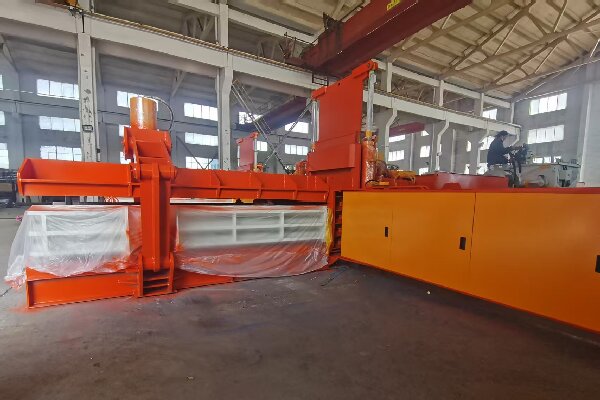
Buying a hydraulic press for used paper is decided with three data points, not one: the nominal pressure the equipment can sustain, the capacity it delivers with a specific material, and the criterion by which the machine is accepted before paying the balance. When those three points are not written down, the negotiation shifts to the delivery moment, which is the worst place to resolve it.
NKBALER is the commercial brand of Shaanxi Nick Machinery Equipment Co., Ltd., a Chinese manufacturer founded in 2013 and dedicated to the R&D and sale of environmental protection equipment and packaging machinery. Its catalog includes vertical balers, semi-automatic and fully automatic horizontal balers, scrap presses, sawdust baling machines, and hydraulic shears. The company states a 50,000 m² plant, 50 employees, 15 people in R&D, and an annual production of 600 machines.
The purchasing context has also shifted. A trade report places the global market for hydraulic balers for used paper at USD 1.45 billion in 2024, with a projection of USD 2.24 billion by 2032 (Data Insights Reports, 2026). In Latin America, Mexico and Brazil concentrate regional paper packaging production and are increasing investments in the circular economy (Packaging Insights, 2026). The manufacture of these presses is classified under NAICS subsector 333, industrial machinery, a useful reference for defining comparability when evaluating suppliers from different countries.
What do 18, 20, and 23 MPa mean in the NKW80BD, NKW125BD, and NKW250BD models?
The three models in the BD series declare different nominal pressures: 18 MPa in the NKW80BD, 20 MPa in the NKW125BD, and 23 MPa in the NKW250BD. Nominal pressure is the working pressure of the hydraulic circuit and is not, by itself, a measure of compaction force. Force results from multiplying that pressure by the effective cylinder area; therefore, two machines with the same pressure can produce very different forces if the piston diameter changes.
For the buyer, the practical consequence is concrete: pressure should be requested together with the resulting force expressed in tons and with the cylinder diameter. A data sheet that only states MPa leaves open the question that weighs most in the decision, which is how much force actually reaches the bale.
The second common misunderstanding is treating pressure as a guarantee of density. Bale density is declared as a separate value and depends on the material, moisture, bale size, and feeding cycle. In the data sheet published by the manufacturer for a hydraulic cardboard baler with 160 t hydraulic power, the declared density is 600-650 kg/m³, with a bale size of 1100 × 1250 × 1700 mm, feed opening of 2000 × 1100 mm, and capacity of 6-8 t/h. That set is useful as a reference for specification format, not as the specification for the BD models: pressure is an input condition and density is a result that is verified.
| Model | Declared nominal pressure | Included in conformity documentation |
|---|---|---|
| NKW80BD | 18 MPa | Yes — EASY03220201M and DPWD/09/060/2024 |
| NKW125BD | 20 MPa | Yes — EASY03220201M and DPWD/09/060/2024 |
| NKW250BD | 23 MPa | Yes — EASY03220201M and DPWD/09/060/2024 |
The correct reading of the table is comparative, not hierarchical. A higher nominal pressure does not automatically make a model the better option: it indicates a higher working point in the circuit, which must correspond with the structure, cylinder, and power consumption of the equipment, and which only makes sense if the material and target density require it.
How should the 2-3, 6-8, and 10-15 t/h capacity ranges be read?
The BD series is positioned in three capacity ranges: 2-3 t/h, 6-8 t/h, and 10-15 t/h. Generally speaking, the 2-3 t/h range corresponds to the lowest-volume operation in the series and the 10-15 t/h range to the highest, while the intermediate range covers plants with continuous flow but mixed materials. The exact assignment of each range to a model, material, and target density must be confirmed in the technical offer, because that is precisely where differences between suppliers are concentrated.
A warning before using these figures in an investment calculation: capacity in t/h is not a constant of the model. It varies with the bulk density of the material, bale size, feeding system, and degree of automation. The only way to turn the range into a number of your own is to measure bale weight and cycle time with a sample of the used paper to be processed.
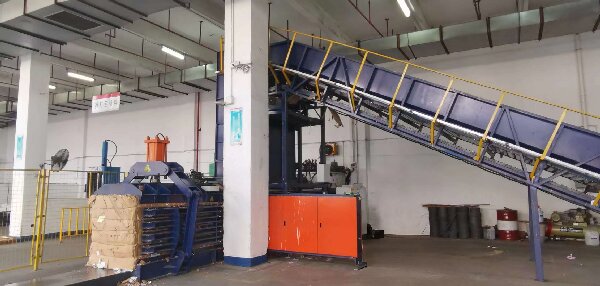
The 6-8 t/h figure appears documented in the product data sheet for the 160 t cardboard baler cited earlier, associated with a density of 600-650 kg/m³. That is the correct format for a specification: capacity, density, and bale size in the same sentence. When an offer presents only "up to X t/h" without density or bale size, the figure is not comparable with another and should not enter the decision matrix.
For sizing, there is a simple and verifiable method: capacity in t/h ≈ bale weight in tons × bales per hour. If the supplier declares 20 bales per hour and the bale weighs 300 kg, the implied capacity is 6 t/h with that material and that size. With the same machine and a 250 kg bale, the figure drops to 5 t/h without anything having broken down. That difference explains why two buyers can report different throughputs from the same model.
Why are the NK1070T60 and NK60LT vertical balers measured in bales per hour?
In vertical balers, the natural indicator is bales produced per hour, because the cycle is dominated by loading, pressing, and tying, and not by a continuous flow of material. For the NK1070T60 and NK60LT, the figure that should be requested is bales per hour with defined bale size and material, not an isolated number.
The conversion is the same as with horizontal balers: bales per hour × bale weight = t/h. The difference lies in the dispersion. In vertical balers, bale weight varies more between materials and between operators, so the buyer must fix in writing the exact combination —material, block size, and target weight— and verify the cycle in the pre-shipment test. Without that combination, the bales-per-hour figure is a catalog reference and not an acceptance parameter.
What purchasing terms does the manufacturer declare?
The terms documented by NKBALER for this equipment family are as follows:
- Minimum order quantity (MOQ): 1 unit.
- Delivery time: 30-45 days.
- Payment terms: 40/60.
- Delivery terms: CIF.
- Acceptance criterion: pre-shipment test.
- Declared production capacity: 10 units per month.
- After-sales support: remote support.
An MOQ of one unit is relevant for plants that need to replace a single machine or validate the technology before standardizing a fleet. The 40/60 payment scheme links the balance to pre-shipment acceptance, and that linkage only works if the acceptance criterion is described with concrete tests in the same purchase order and not with the generic phrase "pre-shipment test."
The 30-45 day period is a declared manufacturing lead time and does not by itself cover international transit or customs clearance. In a CIF transaction, the buyer must confirm the destination port, insurance coverage, and unloading responsibility before signing, because these are items that change the total cost without appearing in the machine quotation.
What should a verifiable acceptance criterion contain?
The manufacturer declares the pre-shipment test as the acceptance criterion and applies 100% testing in quality control. For that criterion to effectively protect the buyer, it should be converted into a protocol with measurable records:
- Test material: a sample of the buyer's actual used paper, not a sample prepared by the supplier.
- Bale weight and dimensions: measure three consecutive bales and record the deviation from the declared value.
- Calculated density: weight divided by bale volume, compared with the reference density in the offer.
- Cycle time: interval between bales under normal feeding conditions.
- Working pressure: gauge reading during the cycle, compared with the model's nominal pressure.
- Leak-tightness: no leaks in cylinders, hoses, and connections after the cycle.
- Documentation: manual, hydraulic diagram, spare parts list, and valid certificates delivered with the equipment.
These seven points are commercial acceptance records and do not replace the applicable safety standard. Their value is that they turn a discussion of opinions into a comparison of verifiable numbers before shipment.
What documentary support accompanies the models?
Two documents cover the family. The first is the Attestation Certificate of Machinery Directive No. EASY03220201M, issued by UDEM International Certification Auditing Training Centre Industry and Trade Inc. Co. on March 22, 2022, and valid until March 21, 2027, which declares conformity with the standards EN ISO 12100:2010 and EN 60204-1:2018 and whose declared scope corresponds to Türkiye.
The second is the Verification of Conformity No. DPWD/09/060/2024, with market EU/EEA, issued on September 19, 2024, and valid until September 18, 2029, which references the standards EN ISO 12100:2010, EN 60204-1:2018, and EN 415-1:2014.
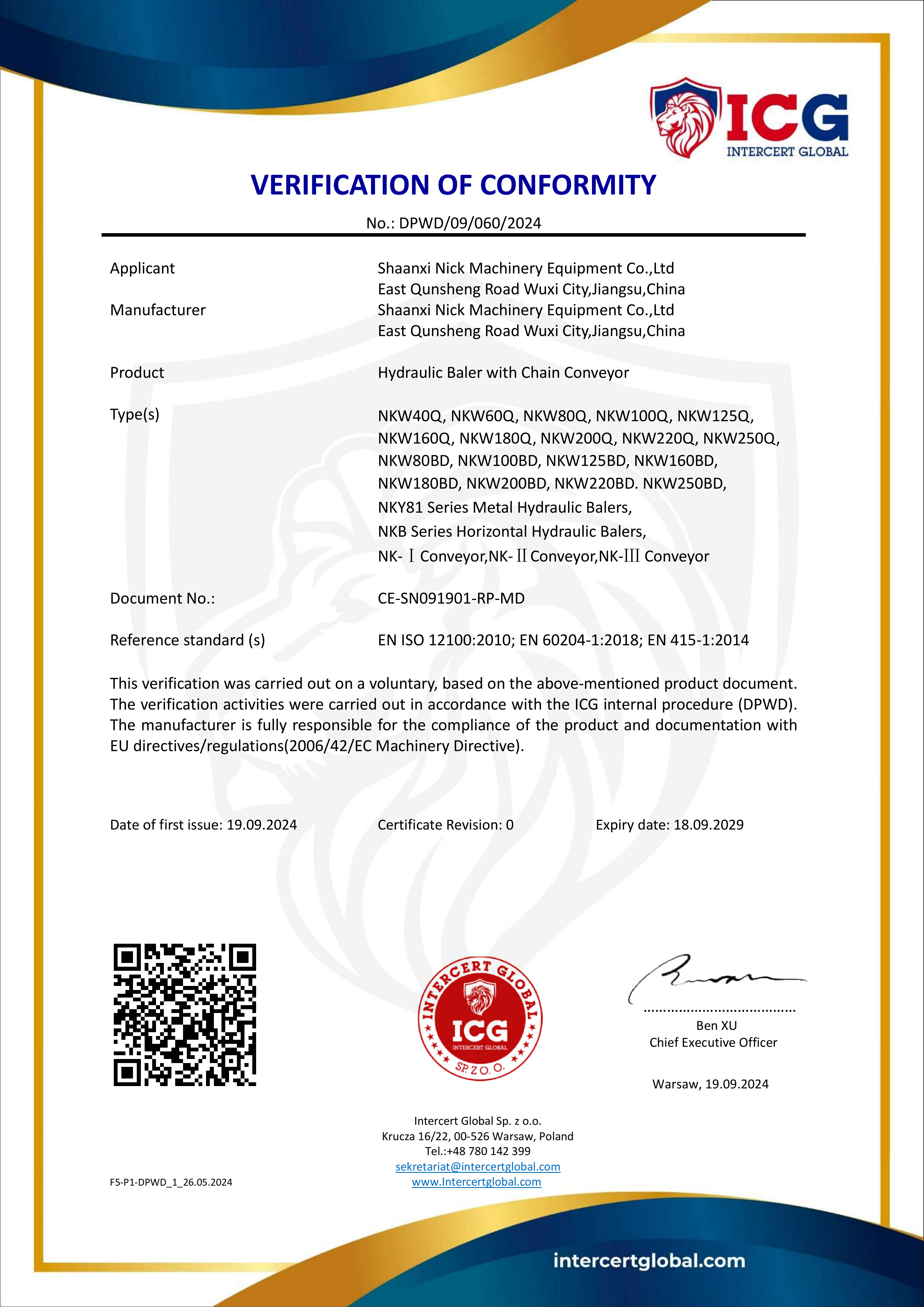
Both documents include the models NKW80BD, NKW125BD, NKW250BD, NK60LT, and NK1070T60 among the related products. For a buyer in Mexico, Spain, or Latin America, the reading must be twofold: the documents declare conformity with harmonized machine safety standards, and at the same time their geographic scope and validity must be checked against the destination market and the purchase date. The attestation covers Türkiye and the verification of conformity is declared for EU/EEA; an importer outside those markets needs to confirm which document applies to its customs operation.
What do the data sheets not say that should be requested in writing?
Three omissions are common and should not be resolved by inference. The first is energy consumption: the case documented in Indonesia reports low energy consumption qualitatively, without a kWh figure, so anyone including energy in operating cost must request the installed motor power and consumption per cycle. The second is noise level: the same case describes low noise level, without a dB value or measurement distance. The third is density and capacity with the buyer's specific material, because the published figures correspond to data sheet conditions.
These omissions do not invalidate the equipment; they delimit what can be stated before the test. A supplier that answers those three questions with a measurement method demonstrates a different capability from one that only repeats the catalog, and that is an evaluation criterion as valid as nominal pressure.
What scope for customization exists, and what operating evidence can be consulted?
The manufacturer declares OEM and ODM production services, with customization of technical parameters, voltage, logo, block size, and color. In used paper, the two fields with real operational impact are block size —because it determines outgoing logistics and final density— and voltage, which must match the plant's power grid before manufacturing, not after installation.
The published operating evidence corresponds to a recycling station manufacturer in Indonesia that uses the equipment to bale plastic waste and paper waste. The project record indicates one installed unit, stable operation, low noise level, and low energy consumption, with a recorded service life of 10 to 15 years. It is a single case and should be read as such: it demonstrates use in the application, not an average of results across customers.
How to close the evaluation
With the three parameters in hand, the decision becomes organized. Nominal pressure and resulting force indicate what density is achievable; capacity with density and bale size indicates whether the plant's flow fits the machine; and the acceptance protocol with records indicates whether what was purchased is what was delivered. Anything outside those three blocks is commercial negotiation, not technical specification.
For the buyer in the execution phase, the recommendation is concrete: request the offer in the acceptance table format, with pressure, force, capacity, density, and bale size on the same page, and issue the order only when those five figures are accompanied by their measurement method. That discipline reduces later discussion and makes comparable what would otherwise be decided by impression.
Frequently asked questions
The manufacturer declares applications for used paper, plastic, rags, and metal scrap, and the Indonesia case combines plastic and paper waste in the same operation. The mix changes density and cycle time, so capacity must be verified with the actual proportion of each material and not with the theoretical sum of both.
No moisture limit is published. Since moisture affects bale weight and bale stability, verification must be done with your own sample during the pre-shipment test; without that data, any capacity figure is a data sheet reference and not a performance guarantee.
Yes. The manufacturer declares customization of technical parameters, voltage, logo, block size, and color, in addition to OEM and ODM production services. Both adjustments must be specified in the purchase order before manufacturing begins.
Remote support. The scope of that support —service hours, language, and response times— is not detailed in the available information and must be agreed in writing in the purchase order, together with the spare parts list delivered with the equipment.
Have Questions or Need More Details?
Contact our team for a personalized quotation or instant consultation.
Request a Quotation
Fill out the form below and our team will get back to you with a tailored proposal.
WhatsApp Direct Chat
Prefer to chat in real-time? Message us on WhatsApp for instant assistance & quick answers.
- Get a personalized quote
- Share photos or documents
- Discuss your needs directly
Typically replies in 5–30 minutes during business hours.