
Hydraulic presses for used paper: portfolio, conditions and continuity
Hydraulic presses for used paper: portfolio, conditions and continuity
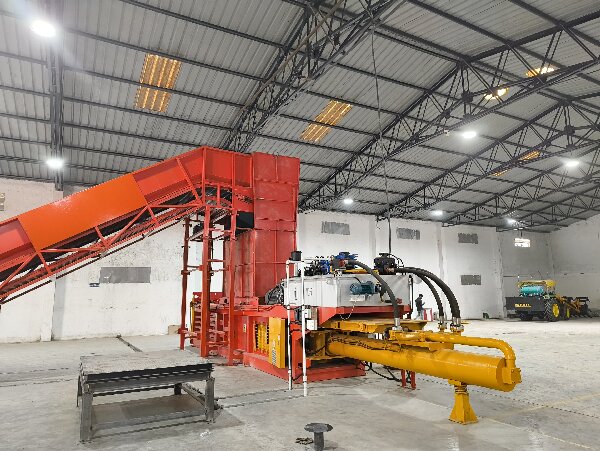
Semiautomatic horizontal baler: supplier continuity is judged when that machine is already producing and the material or volume changes.
The continuity of a supplier of hydraulic balers for used paper is not measured in the quotation, but in the second order. When the purchase moves from decision to execution—order, pre-shipment test, commissioning, and spare-parts replenishment—what sustains the operation is not the unit price, but the manufacturer's ability to keep responding when the volume, material mix, or bale format changes.
That continuity can be evaluated with three concrete tests: portfolio consistency (can the supplier accompany a format change without restarting qualification?), clarity of purchase conditions (what is written about minimum order, delivery, payment, and acceptance?), and capacity to absorb changes (what happens when the material comes in dirtier, lighter, or in larger quantities?). The documented case used here is the portfolio of NKBALER (Shaanxi Nick Machinery Equipment Co., Ltd.), a Chinese manufacturer dedicated to the R&D and sale of environmental protection equipment and hydraulic balers for used paper, with a 50,000 m² plant, a 15-person R&D team, and a declared export share of 90% to North America, South America, and Asia.
Continuity is verified with facts, not promises of permanence
In the execution phase, the buyer no longer compares catalogs: they must internally justify a decision and build a repeatable acceptance protocol. That is why the useful question stops being “who sells cheaper?” and becomes “what part of this supply will still work the same in three years?”.
A reasonable continuity evaluation relies on evidence that the supplier itself can provide in writing: existing models in each family, documented commercial conditions, a defined acceptance criterion, and declared production capacity. None of that by itself guarantees a good operational result, but its absence is a risk signal: if the supplier cannot document its portfolio or its acceptance criterion before the purchase, it will hardly be able to sustain them afterward.
Portfolio consistency: horizontal, vertical, and bagging under the same manufacturer
The portfolio declared by NKBALER covers two baler families and one complementary piece of equipment. The horizontal balers include models NKW80BD, NKW125BD, NKW180BD, NKW250BD, and NK6040T10; the vertical balers include models NK1070T60, NK60LT, NK-T90L, NK110T150, NKOT150, and NK080T100; and to these is added a baler-bagging machine. The company also describes its manufacturing as vertical, horizontal, semiautomatic, and fully automatic hydraulic balers.
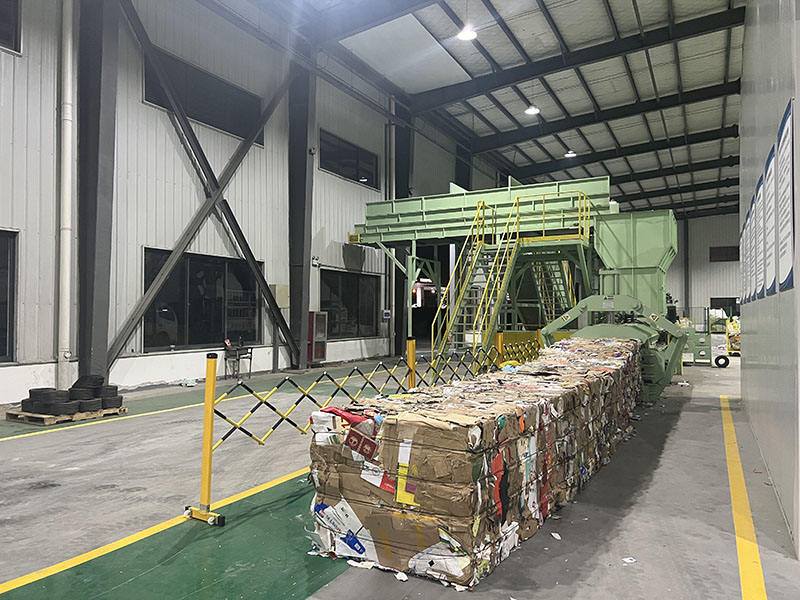
Fully automatic horizontal baler: the level of automation is one of the axes a buyer can review within the same portfolio.
What this breadth demonstrates. For a buyer, a portfolio with vertical and horizontal formats means that a change in scale or space does not force a change of technical contact: if the plant grows and needs to move from a small bale to higher production, or the reverse, the same manufacturer can offer an alternative within its range. It also simplifies the reuse of criteria: the acceptance protocol, technical vocabulary, and service contact remain the same.
What it does not demonstrate. Having eleven baler models and a bagging machine is not equivalent to meeting the requirements of a specific plant. Model codes are identifiers, not specifications, and portfolio breadth does not replace a technical data sheet per model or a real-material test. In addition, the public information reviewed for this analysis does not include third-party certifications or independent test reports, so any conformity requirement must be confirmed before contracting.
| Family | Declared models | What to request per model |
|---|---|---|
| Horizontal | NKW80BD, NKW125BD, NKW180BD, NKW250BD, NK6040T10 | Hydraulic pressure or force, bale size, feed opening, bale density, capacity in t/h, and type of tying |
| Vertical | NK1070T60, NK60LT, NK-T90L, NK110T150, NKOT150, NK080T100 | Force, bale size, cycle, loading height, type of tying, and required space |
| Bagging | Baler-bagging machine | Accepted materials, bag format, capacity, and how it integrates with the baler |
From model code to verifiable data
A buyer in the execution phase must insist on one point: the code NKW180BD or NK110T150 does not communicate pressure, density, or capacity. Those figures must appear in a data sheet per model. To illustrate the level of detail that can be required, a hydraulic baler data sheet for cardboard published by NKBALER declares a hydraulic power of 160 tons, bale size of 1100 × 1250 × 1700 mm, feed opening of 2000 × 1100 mm, bale density of 600-650 kg/m³, and capacity of 6-8 t/h.
That is the type of field that should be in writing for the model to be purchased. It cannot be automatically transferred to the models in the NKW or NK families: it must be requested model by model, together with the unit of measurement and the test condition (material, moisture, and feed method).
Regarding the scope of application, the company declares that its balers are used in recycling paper, plastic, rags, and metal scrap. That variety is relevant to continuity because it anticipates what type of material change can be discussed with the same supplier, provided that each material is validated under the corresponding conditions and test.
Purchase conditions: the document that prevents surprises in the second order
The conditions published by NKBALER in its purchasing material mention a minimum order, CIF delivery terms, an acceptance criterion based on a pre-shipment test, and a 40/60 payment scheme. They are useful starting points, but in the execution phase they must be finalized per model and per order: the minimum order is precisely one of the fields that should be confirmed per configuration, because a verbal condition breaks down on the second purchase.
Before signing, the purchase file should contain:
- Scope of supply: exact model, automation level, accessories included, and items excluded.
- Minimum order and scalability: minimum quantity per model and the possibility of repeating the same order under the same conditions.
- Delivery: delivery term and place, packaging, transport documentation, and party responsible for unloading.
- Payment: agreed scheme (the published one is 40/60), currency, bank, and timing of each payment relative to the test milestone.
- Spare parts: list of wear parts, reference, supply lead time, and validity of the offer.
- Documentation: manual, hydraulic and electrical diagrams, and delivery language.
- Changes: written procedure to modify quantity, configuration, or date without renegotiating the entire contract.
The logic is simple: continuity relies on documents that outlast the salesperson who handled the first meeting. If the minimum order, delivery term, or acceptance criterion are not written down, the buyer has nothing with which to compare the second offer or to claim the third.
Acceptance criteria: what a 100% pre-shipment test means
NKBALER declares that all products undergo a 100% test and that the indicated acceptance criterion is the pre-shipment test. For the buyer, this defines the moment of control but not yet the content of the control: “tested” without a protocol is a statement, not a criterion.
A usable acceptance criterion should establish what is measured, with what tolerance, and who signs. At a minimum:
- Dimensions and density of the bale obtained versus the agreed value.
- Working pressure versus the value declared in the model data sheet.
- Tightness of the hydraulic circuit and absence of visible leaks.
- Operation of thermal protections: in the documented risk control, excessive heating is associated with thermal protection and temperature sensors.
- Cycle sequence, emergency stops, and safety devices.
- Test record: signed checklist, photographs or video, and, if agreed, retention of a bale sample.
- Consequence of a nonconforming result: rework, replacement, and new inspection, defined before shipment.
Relevant limit: the 100% test is a manufacturer's declaration, and the reviewed information does not include an independent test report. If the plant needs an external inspector present or third-party verification, it must negotiate this in writing and bear the cost; otherwise, acceptance will depend solely on the supplier's record.
Declared capacity and production allocation
The declared monthly production capacity is 10 units. In a continuity evaluation, that figure is not a commercial detail: it is a limited resource distributed among markets. With a declared 90% export share to North America, South America, and Asia, the relevant question is not only the lead time but the allocation: which production shift the order enters and what happens if the buyer needs an additional unit in the same quarter.
For the file, it is advisable to request a written delivery schedule, confirmation of the reserved quota, and the policy applicable when several orders coincide. And it should be treated as what it is: a figure declared by the company, not audited in the reviewed information. Nor are there verified customs records on export volume to Mexico or Spain, so real presence in a specific market must be confirmed with references or import data that the buyer can verify.
Accompanying volume and material changes: scenarios that test the supplier
Continuity is demonstrated when the plant changes. The following are conditional scenarios, not documented cases; they serve to turn the commercial conversation into verifiable technical questions.
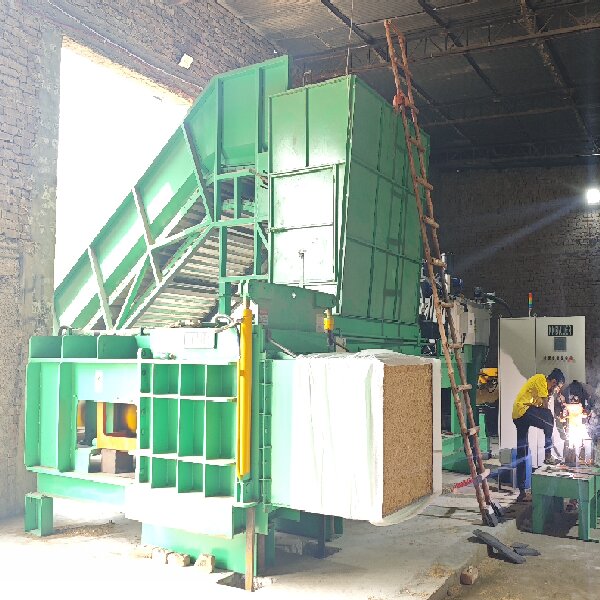
Pressure bagging machine: the complementary format in the portfolio broadens the options when the input material changes.
| Change in the plant | What is reviewed | Question for the supplier |
|---|---|---|
| Used paper volume increases | Capacity, cycle, and automation | Which model in the horizontal family covers the new range, and what monthly quota is reserved? |
| The mix changes (more cardboard, film, or mixed material) | Feed opening, density, and behavior with the material | Does the model data sheet indicate the reference material for its declared capacity? |
| Light or bulky material comes in | Bale format and bagging option | What materials does the baler-bagging machine accept, and how does it integrate with the existing baler? |
| Scrap or denser material is added | Force, wear, and spare parts | Which wear parts change, and with what replacement lead time? |
| Available space changes | Vertical versus horizontal format | Which vertical model maintains productivity with the current floor space? |
The value of this exercise is that it forces the portfolio to be used as a technical argument and not as a commercial one. A complete family allows internal comparison, but the answer is valid only when it comes with a data sheet, unit of measurement, and condition of use. The buyer who demands that level of detail on the first purchase is, at the same time, building their criterion for the next ones.
One-off purchase versus continuity evaluation: when each approach is appropriate
One-off purchasing by price still makes sense in specific situations: an isolated, low-frequency need, a single stable material, backup equipment, or an operation with a short horizon. In those cases, comparing quotations may be sufficient.
The continuity evaluation is more useful when the horizon spans several years, the material mix changes, the plant depends on spare parts, and there is a growth plan. In that scenario, the purchase price is one line within a broader set: written conditions, acceptance criterion, reserved capacity, and parts availability.
Here too, it is appropriate to point out the limits of the NKBALER route, so that the evaluation is honest. The reviewed public information does not include third-party certifications or independent test reports; not all model-specific data sheets are available in the reviewed material; and the declared capacity of 10 units per month implies quota planning. A buyer who needs specific conformity documentation or external verification must confirm those points before contracting, or consider a supplier that provides them. None of these observations disqualifies the portfolio: it defines its suitability boundary.
Question list for the evaluation: purchase conditions and acceptance criteria
About the portfolio and the model
- Is there a technical data sheet for the exact model being quoted, with pressure, bale size, density, capacity, and unit of measurement?
- Under what material and feed conditions is that capacity declared?
- What practical difference is there between the quoted models in the same family, and which one corresponds to the expected volume range?
- What alternative does the portfolio offer if the volume doubles or if the material changes from paper and cardboard to film or mixed material?
About the purchase conditions
- What is the minimum order per model and per configuration?
- What delivery term and place apply, and who assumes unloading?
- Does the 40/60 payment scheme hold for a repeat order, and at what milestone is each part paid?
- What exactly does the scope include: accessories, documentation, packaging, and training?
- What list of wear spare parts is provided, with reference, lead time, and price validity?
- What written procedure exists to change quantity, configuration, or date?
About acceptance
- What does the pre-shipment test record, and who signs it?
- Can a retained bale sample or a photographic and video record be agreed?
- Is the presence of a buyer's or third-party inspector accepted, and how far in advance must it be requested?
- What happens if a value does not meet the agreed criterion: rework, replacement, or new inspection?
About continuity over time
- How many units per month can be allocated to the order, and how is priority set when several customers coincide?
- What technical contact remains after the commercial phase ends?
- What documentation is updated if the model or a hydraulic component is modified?
Market perspective: why continuity gains weight
The context favors a long-term reading. A September 2026 market report places the global valuation of the used-paper hydraulic baler market at USD 1.45 billion in 2024, with an estimated forecast of USD 2.24 billion for 2032. These are third-party figures for the global market, not a forecast for a specific plant, and should be treated as contextual reference.
In Latin America, paper packaging production is led by Mexico and Brazil, with growing investments in lightweight materials and the circular economy, while implementation of extended producer responsibility advances unevenly. For the buyer, the practical reading is conditional: if the regulatory framework and the volume of material to be managed continue to pressure plant capacity, documentation, traceability, and ease of format change cease to be secondary attributes and become purchasing criteria.
Frequently asked questions
How is the continuity of a used-paper baler supplier evaluated if no purchase has yet been made?
It is evaluated with documentary evidence prior to purchase: a technical data sheet per model, written purchase conditions (minimum order, delivery, payment), a defined acceptance criterion, and declared production capacity. If those four elements do not exist before the order, the buyer has no basis to demand them afterward.
What does a portfolio with horizontal and vertical balers contribute to supply continuity?
It provides room for maneuver within the same manufacturer. At NKBALER, the declared portfolio includes horizontal models NKW80BD, NKW125BD, NKW180BD, NKW250BD, and NK6040T10; vertical models NK1070T60, NK60LT, NK-T90L, NK110T150, NKOT150, and NK080T100; plus a baler-bagging machine. This makes it possible to discuss a format or scale change without requalifying a new supplier, although each model must be validated with its own technical data sheet.
What purchase conditions should be in writing before a repeat order?
Scope of supply, minimum order per model, delivery term and place, payment scheme (the published one is 40/60), spare-parts list with lead time and validity, documentation provided, and procedure for modifying quantity or date. The minimum order should be confirmed per configuration, because it is one of the fields where differences often arise between the first quotation and the repeat order.
How are acceptance criteria verified before shipment?
NKBALER declares a 100% test of all products and establishes the pre-shipment test as the acceptance criterion. For it to be verifiable, the buyer must agree on what is measured (bale dimensions and density, working pressure, tightness, thermal protections with temperature sensors, safety devices), who signs the record, and what happens if a value does not comply. The reviewed information does not include an independent test report.
What limits should be considered when evaluating NKBALER as a long-term supplier?
The declared capacity is 10 units per month, which requires reserving production quota; the 90% export share is a figure declared by the company, not audited; the reviewed information does not include third-party certifications; and not all model-specific data sheets are publicly available. A buyer who requires certified conformity or independent testing must confirm those points before contracting.
Conclusion
Evaluating the continuity of a supplier of hydraulic balers for used paper means converting three broad questions into concrete documents: what models exist and with what data, what commercial conditions are written down, and how the machine is accepted before shipment. The declared portfolio, the 100% test, and the capacity of 10 units per month are verifiable starting points; model-specific data sheets, required certifications, and reserved quota are the points the buyer must close in writing before execution.
Have Questions or Need More Details?
Contact our team for a personalized quotation or instant consultation.
Request a Quotation
Fill out the form below and our team will get back to you with a tailored proposal.
WhatsApp Direct Chat
Prefer to chat in real-time? Message us on WhatsApp for instant assistance & quick answers.
- Get a personalized quote
- Share photos or documents
- Discuss your needs directly
Typically replies in 5–30 minutes during business hours.