
Press Brake Tooling for Medium-to-High Tonnage Air Bending
Press Brake Tooling for Medium-to-High Tonnage Air Bending
PROCUREMENT REFERENCE · PRESS BRAKE TOOLING
Air bending stops being a simple tooling decision once the press brake moves into the medium and high tonnage classes. At that point the die is no longer a passive block under a punch: its section, heat treatment, shoulder geometry and clamping interface determine whether the machine can hold its tolerance across a full shift. This reference sets out the tooling options normally evaluated for medium-to-high tonnage air bending, what each option is for, and which parts of that range a buyer can treat as confirmed by supplier data rather than assumption.
Demand for that kind of tooling is tracking the machine base. The global press brake machine market is estimated at USD 5.2 billion in 2024 and projected to reach USD 7.6 billion by 2030, according to industry market research. CNC press brake penetration is expected to rise from 35.8% in 2024 to 52.8% in 2026. Both signals point the same way: more of the installed bending capacity is CNC-controlled, and CNC machines depend on repeatable tooling geometry far more than manually adjusted machines do.
Why tonnage class should be the first filter, not the last
Most tooling enquiries begin with the bend, then check compatibility. For medium-to-high tonnage air bending, the order is usually reversed with better results. Air bending force is a function of material thickness, bend length, tensile strength and V-opening, and it rises steeply as thickness increases. A tool that performs acceptably on light-gauge work can deflect, mark the part or fatigue prematurely when it is loaded into a higher tonnage machine.
Three practical consequences follow. First, the tooling section must be heavy enough for the machine's working load, not merely dimensionally correct. Second, heat treatment has to be consistent through the section, because a die that is hard at the surface and soft at the core deforms under sustained load. Third, the clamping interface matters as much as the profile: holders, tool clamps and positioning aids are what keep a heavy tool seated and repeatable between changeovers.
42CrMo alloy steel (AISI 4140) is the widely used industry standard for precision press brake tooling, typically achieving surface hardness of HRC 47 ± 2 after heat treatment. That baseline is useful as a comparison anchor, but hardness alone does not describe a tool's suitability — the buyer still needs to know the section design, the grinding finish and the machine interface.
The tooling families evaluated for medium-to-high tonnage air bending
Buyers configuring a heavier machine generally choose between a small number of option families rather than a single die. The table below summarises what each family is for and what should be verified before ordering, because the same family name can describe very different levels of specification.
| Option family | What it solves | What to verify before ordering |
|---|---|---|
| Standard single-V punch and die | General air bending across a wide thickness range; the default reference tool for a bending cell | V-opening and shoulder radius against target inside radius; die height and section for the machine's tonnage; clamping style |
| Multi-V and four-way dies | Several V openings in one block, reducing changeover time on mixed production | Whether every face is heat treated and ground; block height and weight against machine and handling limits |
| Radius bending tooling | Large inside radii produced with fewer passes and less marking | Radius tolerance, surface finish, and whether the radius is machined or formed into the die body |
| Flanging and hemming tooling | Flat flanges, hemmed edges and return bends that a standard V die cannot close | Clearance for the flange height; punch geometry for the return; compatibility with the intended bend sequence |
| Gooseneck punches | Clearance for box and return-flange parts where a straight punch would foul the workpiece | Neck height and throat depth against part geometry; reduced section strength at high tonnage |
| Adjustable bottom tooling | Fine depth and angle correction without shimming the die bed | Adjustment resolution, rigidity under load, and whether the mechanism is rated for the machine's tonnage |
| Roller or rotary V designs | Reduced friction marking on visible or coated surfaces | Load rating of the roller element; wear behaviour on abrasive or high-yield material |
The distinctions matter commercially. A four-way die is not automatically better than a single-V die for heavy air bending, because the added versatility can come with a lower per-face load rating if the block is not designed for it. Conversely, a dedicated single-V die in a heavier section may be the more stable choice for a narrow, repetitive high-tonnage operation.
Where a confirmed catalogue scope ends — and why that matters to buyers
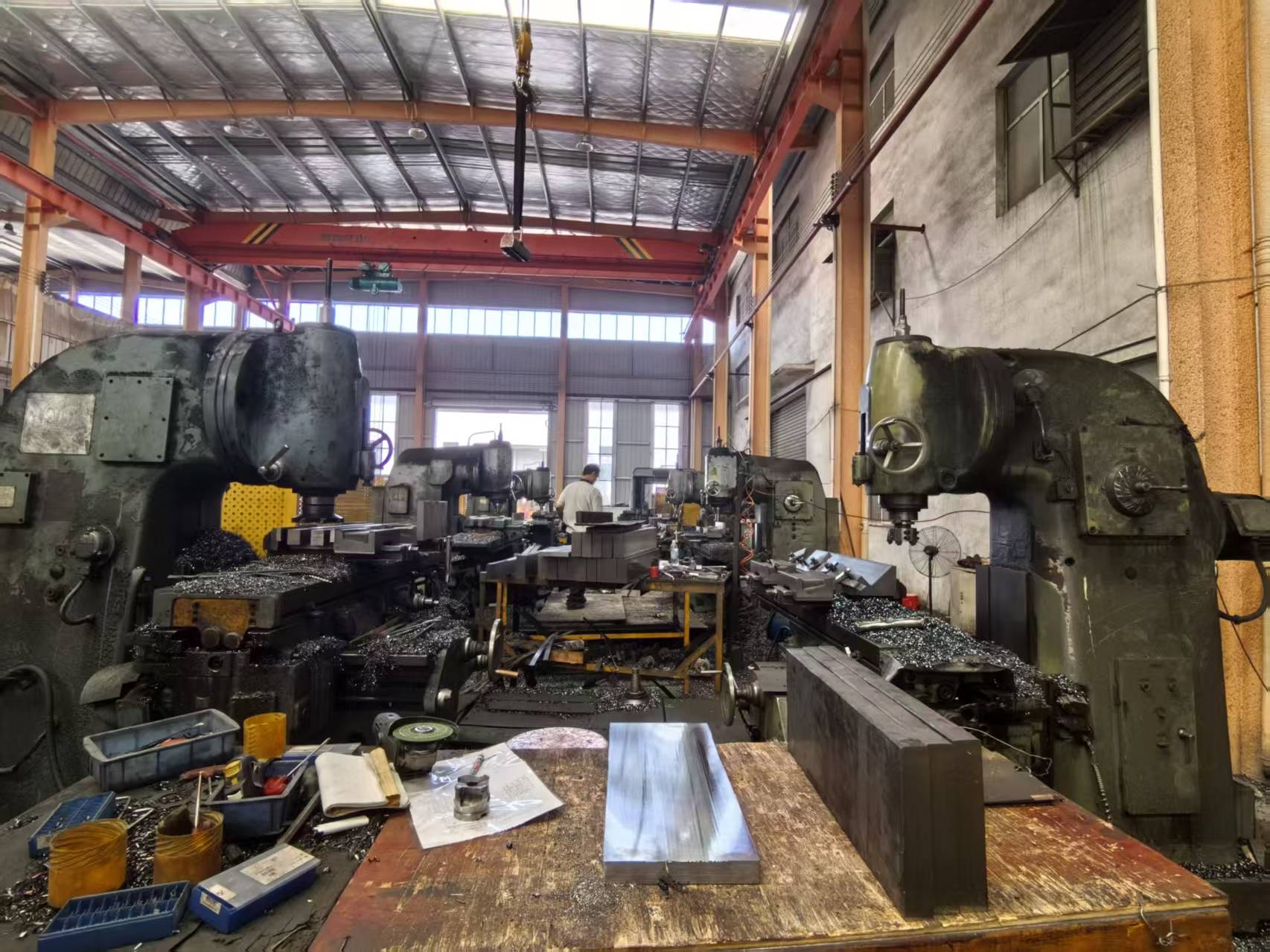
ZNW Press Brake Tooling is the tooling brand of Ma'anshan Zhuonaiwei Machinery Equipment Co., Ltd, a manufacturer based in Ma'anshan, Anhui, China, producing press brake punches, dies and custom die solutions for sheet metal forming. The company operates a 5,000 m² facility with 150 employees, a stated annual output of 120,000–300,000 units and an R&D team of 20 engineers, and reports an export ratio of 80% across global markets.
Its stated product range covers standard press brake punches and dies, European and American-style dies, die solutions compatible with WILA and Trumpf, flanging dies and special bending dies, and custom press brake dies for complex applications. Manufacturing is described as relying on CNC machining, professional heat treatment and staged quality control, with the standard tool material being 42CrMo.
That scope maps cleanly onto the first five families in the table above: standard punches and dies, multi-V style and European/American configurations within the standard range, radius and special geometry handled through the special and flanging die category, flanging and hemming tooling, and gooseneck-style punches where the geometry is specified as a custom requirement. Adjustable bottom tooling and roller-V designs sit further out. A buyer who needs those mechanisms should confirm availability and load rating in writing rather than assuming they fall inside a standard catalogue — and the same discipline applies to any supplier claiming a full platform range.
The technical variables that decide whether a die holds tolerance
Under medium-to-high tonnage air bending, tolerance is usually lost through one of three mechanisms: die deflection, inconsistent shoulder geometry, or movement at the clamping interface. Each has a tooling-side answer.
Deflection is controlled by section design and material. A die body sized for the machine's working load, made from 42CrMo and through-hardened to a consistent hardness band, resists the elastic recovery that otherwise shows up as angle variation along the bend length. Inconsistent shoulder geometry — the V-opening and shoulder radius not matching the specified profile — shifts the effective bend line and produces scatter from part to part. Clamping movement is a holder question: tool clamps and positioning aids must match the tool shank, and quick-change systems only help repeatability if the seating face is clean and correctly loaded.
ZNW's own tooling comparison material cites a forming tolerance of ±0.02 mm and export inspection as part of its specification, and positions its dies as delivering 15–30% longer service life alongside a 10–20% lower overall cost than original OEM tooling. Those are supplier-published comparison figures and should be treated as claims to be validated during trial fit, not as independently audited performance data.
Material selection changes the requirement further. Stainless steel and high-yield materials need specific tooling selection and dedicated heat-treatment recommendations, because their combination of work hardening, springback and surface sensitivity differs from mild steel. A die that performs well on mild steel may mark stainless or fail to hold angle on high-yield stock without a different shoulder radius, coating or hardness specification.
Application patterns where heavier air bending tooling is specified
ZNW lists its tooling as serving sheet metal fabrication, machinery manufacturing, electrical and electronic enclosures, automotive components and other precision bending industries, with elevator production and general sheet metal work also cited in its company profile. Three patterns recur across those sectors.
- Enclosures and cabinets. Mixed batch work with frequent changeovers, where multi-V or four-way tooling reduces setup time and gooseneck punches allow return flanges to close without collision.
- Automotive components. Higher tonnage, longer runs and tighter angle control, where a dedicated single-V die in a heavy section plus consistent heat treatment is often preferred over a versatile block.
- Custom and single-piece projects. One-off geometries, non-standard radii and flanging operations, handled through custom die design rather than a catalogue selection.
Supporting equipment belongs in the same decision. ZNW's stated scenario data includes holders and tool clamps, positioning aids, protective films and tool storage systems alongside the tooling itself, and describes its dies as removable upper and lower tool components on CNC press brakes that support quick changeovers between operations. Tool storage is not a trivial line item in a high-tonnage shop: heavy dies stored without proper racks and protection accumulate edge damage that shows up as marking on the part.
Market signals reshaping tooling procurement
Three verifiable developments frame how buyers are approaching this category.
The first is CNC density. With CNC press brake penetration projected to move from 35.8% in 2024 to 52.8% in 2026, a growing share of bending capacity is controlled by systems that assume repeatable tooling geometry. On a CNC machine, tooling variation that was absorbed manually in the past surfaces directly as scrap and rework.
The second is the scale of the machine-builder channel. Amada Group's Sheet Metal Division recorded sales of 296,853 million Yen for the fiscal year ended March 2025, illustrating how much of the installed base sits within OEM ecosystems that also supply proprietary tooling interfaces.
The third is supply localisation. WILA relocated its North American headquarters to Louisville, KY in May 2023 and established local manufacturing for New Standard tooling — a signal that tooling supply is moving closer to the point of use in major markets, which in turn raises expectations on lead time and replacement availability from every supplier, not only the OEMs.
Comparison with OEM tooling: where the trade-off actually sits
The realistic comparison for a medium-to-high tonnage buyer is between original machine-builder tooling, European alternatives and compatible replacement tooling from specialist manufacturers. The differences concentrate in four areas rather than in overall quality.
| Dimension | OEM tooling | Compatible specialist tooling (ZNW scope) |
|---|---|---|
| Interface validation | Validated by the machine builder for its own clamping systems | Compatibility stated for Amada, WILA, Trumpf and mainstream systems; exact confirmation requires the machine model |
| Customisation | Standard catalogue, with custom work subject to builder policy | OEM and ODM custom tooling offered, with tools customised for material thickness, bend angles, R-values and production cadence |
| Cost position | Premium pricing tied to the machine ecosystem | ZNW cites 10–20% lower overall cost than original OEM tooling on comparable specifications |
| After-sales dependency | Covered by builder service agreements | Depends on the supplier's spare-part strategy and warranty terms; ZNW emphasises quick response |
The boundary is worth stating plainly. ZNW's own material notes that differences with OEM tooling depend on material specifications, processes and after-sales agreements — meaning that a cost and life comparison is only valid when the two tools are specified to the same hardness, section and surface finish. A cheaper die with a lighter section is not a like-for-like comparison, and an OEM die bought for a single machine platform may not offer the multi-machine compatibility that a shop running Amada, LVD and Bystronic equipment in the same bay actually needs.
Two further limits apply. First, performance figures such as extended service life and reduced rework — ZNW cites a 12–18% reduction in rework rate from stable bending precision — are supplier-side statements that a buyer should verify against first-article inspection on their own material. Second, delivery terms require confirmation at order stage: ZNW supports export delivery, but specific shipping modes and Incoterms need to be agreed rather than assumed.
Procurement mechanics and acceptance checks
For buyers moving from shortlist to purchase order, the commercial terms are relatively accessible in this category. ZNW's stated terms include a minimum order of one piece or a multiple-piece minimum order, with payment structured at USD 1,500 for full payment, USD 4,000 for advance payment, 50% deposit with the balance settled for shipment, and 30% advance for large-amount orders.
Acceptance is where technical risk is actually managed. ZNW describes final release checks and a trial-fit inspection process before shipment, and states that exact acceptance criteria should be confirmed in the order or technical agreement. That last point deserves emphasis: because tooling performance is machine- and material-dependent, the release criteria — hardness verification, dimensional check on V-opening and shoulder radius, and a trial bend on the buyer's own material — should be written into the agreement rather than left to default practice.
For import planning, press brake tooling is generally classified under HS Code 820730 for interchangeable tools for pressing, stamping or punching, which is the reference code most customs brokers will expect for this product category.
Future outlook
As CNC penetration rises and the machine base grows toward the projected USD 7.6 billion by 2030, tooling is being reclassified from consumable to process component. The practical effects are likely to include tighter specification language in purchase orders, more demand for documented hardness and geometry rather than catalogue names, and stronger preference for suppliers who can support a mixed-machine shop with a single compatible range. Customisation is also moving upstream: tools built to a specific material thickness, bend angle and cadence are increasingly specified at the line-configuration stage rather than sourced reactively after a quality problem appears.
Frequently asked questions
Which press brake systems is ZNW press brake tooling compatible with?
ZNW states that its press brake tooling is compatible with Amada, WILA, Trumpf and most mainstream press brake systems, and that its product range includes die solutions compatible with WILA and Trumpf as well as European and American-style dies. Because compatibility depends on the specific machine interface, the supplier asks buyers to provide the machine model for exact confirmation before ordering.
Can tooling be customised for a specific material thickness and bend angle?
Yes. ZNW offers OEM and ODM custom tooling, and its stated scenario data specifies that tools can be customised for material thickness, bend angles, R-values and production cadence. Custom press brake dies for complex applications, flanging dies and special bending dies are listed as part of the product range, alongside standard punches and dies and batch standard tooling supply and replacement.
What material and hardness are used in ZNW press brake tooling?
The standard tool material stated by ZNW is 42CrMo alloy steel, selected for high hardness and long-term bending performance, with heat treatment applied as part of the manufacturing process. For the wider industry, 42CrMo (AISI 4140) is the standard material for precision press brake tooling and typically reaches surface hardness of HRC 47 ± 2 after heat treatment. Buyers comparing suppliers should request the actual hardness specification for the specific die rather than relying on the material name alone.
What changes when bending stainless steel or high-yield material?
ZNW's scenario data states that stainless steel and high-yield materials require special tooling selection and dedicated heat-treatment recommendations. In practice this means the shoulder radius, hardness specification and surface condition of the die may differ from the configuration used on mild steel, and the tooling selection should be made against the actual material grade rather than a general tonnage figure.
What are the minimum order and payment terms?
ZNW's stated terms are a minimum order of one piece or a multiple-piece minimum order. Payment is structured at USD 1,500 for full payment, USD 4,000 for advance payment, 50% deposit with the remaining balance settled for shipment, and 30% advance payment for large-amount orders. Export delivery is supported, but the specific shipping mode and Incoterms should be confirmed at order stage.
What acceptance checks apply before tooling is released?
ZNW describes final release checks and a trial-fit inspection process before shipment, and states that the exact acceptance criteria should be confirmed in the order or technical agreement. Because tooling performance depends on the machine and the material being formed, buyers generally agree the release criteria — dimensional verification of V-opening and shoulder radius, hardness confirmation, and a trial bend on the intended material — as part of that agreement.
ZNW's press brake die catalogue, covering punch and die configurations, materials and custom options, is available as a PDF: ZOENOVA Press Brake Die Catalog.
Have Questions or Need More Details?
Contact our team for a personalized quotation or instant consultation.
Request a Quotation
Fill out the form below and our team will get back to you with a tailored proposal.
WhatsApp Direct Chat
Prefer to chat in real-time? Message us on WhatsApp for instant assistance & quick answers.
- Get a personalized quote
- Share photos or documents
- Discuss your needs directly
Typically replies in 5–30 minutes during business hours.