
Pressed Housing vs. Solid Iron: Pillow Block Durability Review
Two mounted units can carry identical precision and speed ratings and still not be interchangeable on the same machine. In the FKD BEARING range, the pressed steel housing units SAPP205, SAPFL205, SAPF205 and SBPFL205 and the solid QT450 cast iron housings are both listed at P5 ZV3 quality and a 3000 RPM speed rating — on the rotating element, they are the same class of component. What separates them is the housing: its mass, its rigidity and the way it seats on the machine frame. That is where a durability decision is actually made.
This review compares the two housing routes on the terms a buyer can verify: published grade and speed, housing material, mounting behaviour, duty environment, and the evidence a supplier can produce before a volume order. It is written for buyers at the research-to-evaluation stage, where the question is no longer what a pillow block bearing is, but which housing construction belongs in a specific machine.
FKD BEARING is the registered brand of Hebei Hailan Bearing Manufacture Co., Ltd, a pillow block bearing manufacturer founded in 1988 and based in Linxi County, Hebei Province, China, producing pillow block bearing units, insert bearings and bearing housings for industrial, agricultural, textile and mining machinery markets.
Where the difference actually sits
On paper, the two families converge. Both are catalogued at P5 ZV3 quality. Both are rated to 3000 RPM. Both use chrome steel GCr 15 (AISI type 52100) insert rings, and the UC insert range is documented with G10 steel balls and P5 ZV3 quality. A buyer comparing data sheets alone would reasonably conclude that the units are equivalent and that the cheaper or lighter one is the better purchase.
That conclusion is where expensive mistakes start, because the data sheet answers a different question. Grade, clearance and speed describe the rotating element. They say nothing about how the housing behaves when a conveyor frame flexes under load, when a harvester passes over uneven ground, or when a fan runs continuously in a plant with heavy airborne dust. Those are housing questions, and housing questions are answered by construction, not by grade.
This is why the pressed-versus-cast decision has moved from a purchasing detail to a specification decision. When two products share a grade and a speed rating, the only remaining variables are the ones the buyer has to interpret.
The pressed housing family: light, formed, and model-specific
Reference 5878 in the FKD range covers the pressed housing group: SAPP205, SAPFL205, SAPF205 and SBPFL205. The housing material is pressed steel, the insert is chrome steel GCr 15, quality is P5 ZV3 and the speed rating is 3000 RPM. The four models do not represent four quality levels — they are different mounting formats built on one housing technology. A buyer should confirm the mounting drawing for the exact model rather than assume a footprint carries across from a cast unit or from another pressed model.
A pressed housing is formed from steel sheet rather than cast from iron. That single manufacturing choice explains most of what follows: less material per unit, lower housing mass, a thinner wall section, and a final geometry that depends on stamping accuracy and on the insert seating rather than on a machined casting.
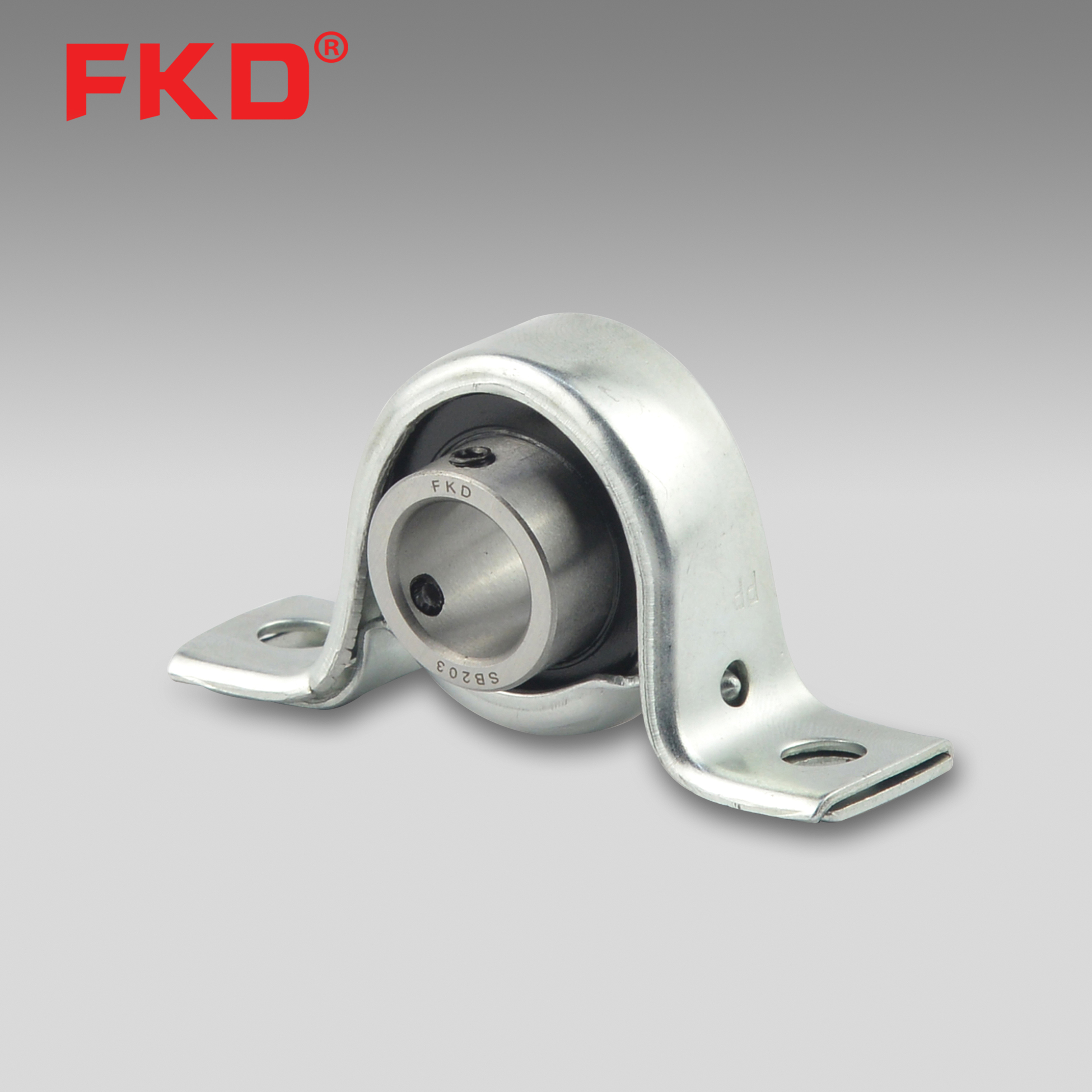
Pressed steel housing units: lower mass, thinner wall section, and mounting geometry defined by the formed housing rather than a machined casting.
The solid iron side: QT450 and cast iron housings
FKD lists cast iron or QT450 ductile iron housings across most of its mounted unit range — UCP200 pillow blocks, UCF square flange units, UCFL oval flange units, UCFC flange cartridge units, UCPH high-centre-height pillow blocks, UCHA hanger units, UCPA top-based units, UCFA adjustable flange units and UCFB flange bracket units. Grade and speed remain the same: P5 ZV3 and 3000 RPM, with chrome steel GCr 15 inserts.
QT450 is a ductile iron grade, and the practical consequence is a thicker, more continuous housing section with a machined mounting base. That is the reason these units have become the default reference in dusty, high-load or continuous-duty plants: the housing itself contributes stiffness and shape retention, not just a location for the insert.
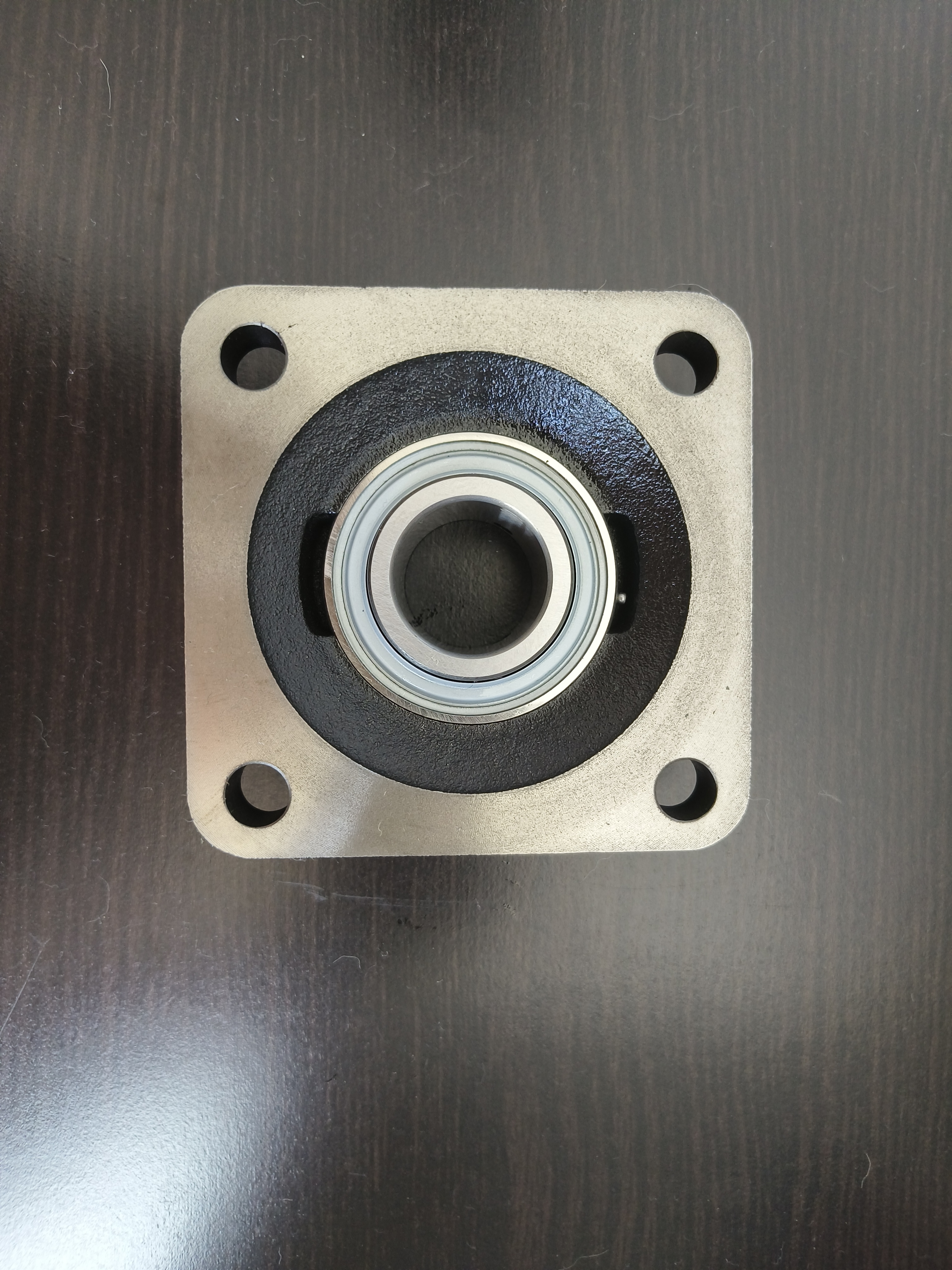
Solid iron route: QT450 ductile iron and cast iron housings provide a thicker section and a machined base for higher-load, high-vibration positions.
Weight, rigidity and mounting: the three differences that decide durability
Once grade and speed are removed from the comparison, three physical properties remain. They matter in different ways and they do not all favour the same product.
1. Mass
Housing mass affects the machine as much as the bearing. A pressed steel housing is lighter, which reduces the mass carried by the mounting surface, makes manual fitting and replacement easier on access-restricted equipment, and lowers freight weight per unit in volume shipments. On frames designed around light loads, that is a genuine engineering benefit rather than a cost compromise. The trade-off is that there is simply less material in the component.
2. Rigidity
A cast or QT450 housing presents a thicker, continuous wall section, so it resists deformation better when the machine frame vibrates, when the shaft load fluctuates, or when the unit is bolted to a surface that is not perfectly flat. A thinner pressed section can deflect slightly under the same conditions, and small deflection at the housing is transmitted to the insert as misalignment — which is normally first seen at the seal and the lubricant, not at the ball path. That is why rigidity, not grade, tends to decide service behaviour in demanding positions.
3. Mounting behaviour
Both families bolt to a flat surface, but they tolerate the surface differently. A pressed housing depends more heavily on the flatness and stiffness of the structure it is fixed to, because the housing cannot compensate for an uneven seat. A cast housing with a machined base offers a more stable seating plane and holds its geometry better under repeated vibration. In both cases, correct bolt spacing and tightening remain the buyer’s responsibility — housing material does not correct a poorly prepared mounting face.
| Comparison point | Pressed steel housing (SAPP205 / SAPFL205 / SAPF205 / SBPFL205) | Solid iron housing (cast iron / QT450) |
|---|---|---|
| Housing construction | Formed steel sheet | Cast iron or QT450 ductile iron |
| Relative housing mass | Lower | Higher |
| Structural rigidity | Thinner wall section; more deflection under shock and vibration | Thicker section; better shape retention under load |
| Mounting behaviour | Depends on frame flatness and stiffness | Machined base; more stable seating plane |
| Insert material and grade | Chrome steel GCr 15, P5 ZV3 | Chrome steel GCr 15, P5 ZV3 |
| Speed rating | 3000 RPM | 3000 RPM |
| Typical duty fit | Lighter-duty machinery, weight-sensitive frames | High dust, heavy pollution, high load, high speed, continuous operation |
| Verification route | Model drawing, housing material declaration, grade certificate | Model drawing, QT450 material certificate, grade certificate |
Where pressed housings earn their place
Pressed steel units are typically specified where the duty is moderate and the machine benefits from reduced weight: light conveyor sections, small ventilation and cooling fans, secondary positions on agricultural implements, and frames where the mounting structure is stiff and well supported. In these positions the lower mass is an advantage and the reduced wall section is not the limiting factor.
The decision becomes clearer when the buyer separates the requirement from the product. If the machine position is characterised by moderate load, good alignment and a rigid mounting face, a pressed housing at P5 ZV3 and 3000 RPM is a rational specification. If the same position sits at the end of a vibrating frame, or is exposed to impact, the argument reverses — not because the insert is different, but because the housing is doing more work.
Buyers operating in India, Poland, Peru, Italy and Spain should also note that environment, not housing type, often drives the final choice within the cast range. FKD documents square flange units for applications requiring anti-rust protection, corrosion resistance, high temperature resistance and low noise, with stainless steel available as an optional material in those markets. Where those conditions dominate, the specification conversation moves toward material and coating rather than toward weight saving.
Where QT450 housings remain the reference
The case for solid iron is strongest in environments that combine several stressors at once. FKD documents its insert bearing range for operation under high temperature, high dust, heavy pollution, high load and high speed, and its plumber block range for 24/7 continuous operation. The UCP200 pillow block series is documented as suitable for ventilation and cooling system projects where dust-proof, water-proof and shock-proof functions are required. Those are precisely the conditions in which a heavier, stiffer housing is the conservative choice.
Supply scale in these environments is part of the evidence. A 100,000-piece project supplied to India has been used by OEMs in agricultural machinery, industrial machinery, pharmaceutical, food and belt industries, with a harvester combine application reported as running stably for two years with high speed and low noise characteristics. That record does not by itself prove a housing comparison — it is not a controlled test between pressed and cast units — but it shows the duty class in which heavy housing construction is normally deployed, and the volume level at which consistency becomes the buyer’s real concern.
For heavier-duty machinery settings, the practical rule is straightforward: match the housing to the worst condition the position will see, not to the average. A machine that is dusty for two weeks a year is not the same specification problem as one that is dusty continuously.
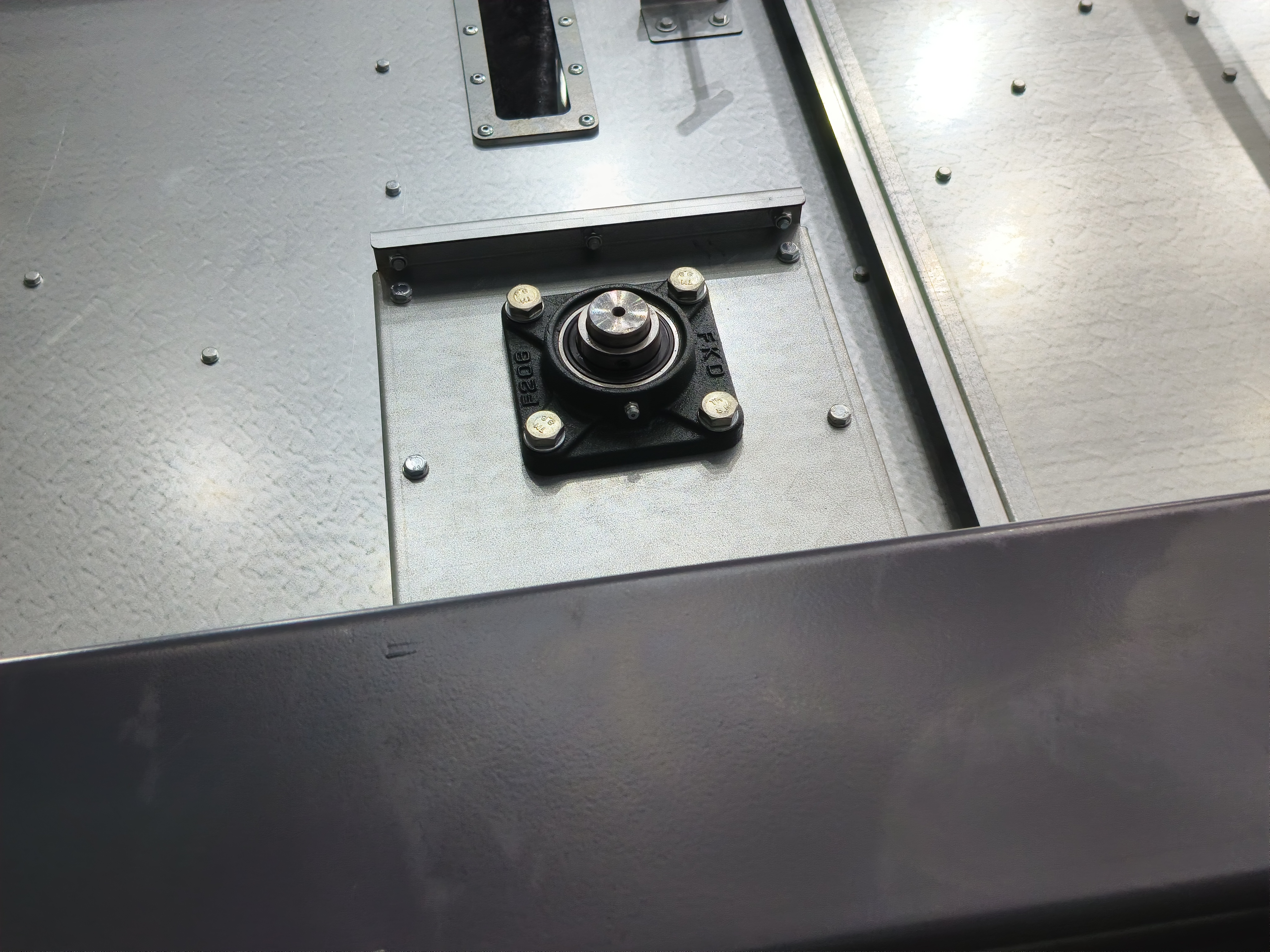
Application context: mounting rigidity and contamination level at the machine position usually determine whether a pressed or solid iron housing is appropriate.
Verifying durability before a volume order
Because the two housing types share a grade and a speed rating, verification has to go beyond the catalogue line. FKD’s production base operates an automatic production line, an automatic inspection line and a dedicated bearing housing production line, with 100% testing and an ISO9001:2015 quality management system certification. The company reports 400 employees including 30 technicians and engineers, an annual production and sales volume of over 20 million pillow block bearings and related bearings, and a monthly capacity of 2,000,000 pieces, with a standard MOQ of 1,000 pieces and a lead time of 30–45 days.
A buyer at evaluation stage can use that structure to ask for specific evidence rather than general assurances:
- A model drawing for the exact reference, showing bolt spacing, base geometry and overall envelope.
- A housing material declaration that states pressed steel or QT450 explicitly, for the model ordered.
- A grade certificate confirming P5 ZV3 for the insert actually supplied.
- Written confirmation of the 3000 RPM speed rating for the configuration ordered.
- A sample run on the intended machine position before the volume commitment, with seal condition checked afterwards.
The last item matters more than it appears. Housing-related misalignment usually shows up as seal wear or lubricant contamination long before it shows up as a bearing failure, so a short trial with an inspection at the end is a more useful test than a specification review. FKD supports this stage with remote and engineer-level after-sales support.
Market context: standardisation pushed the choice into the open
The commercial backdrop explains why this comparison is now routine rather than technical. The mounted bearing market was valued at approximately USD 6.1 billion in 2024, according to IndexBox industry analysis, and pillow block (plumber block) units accounted for roughly 42.51% of mounted bearing revenue share in 2024, based on Fortune Business Insights data. Pillow block units are also commonly standardised under ISO for universal sizing and JIS for localised precision compatibility, as documented by major bearing producers.
Standardisation has a side effect that buyers should recognise. When mounting dimensions are interchangeable, a pressed housing unit can physically replace a cast unit on the same shaft and the same bolt pattern. Interchangeability therefore removes the last barrier that used to protect buyers from a wrong housing choice — and moves the decision entirely onto application judgement. The catalogue number will fit; whether it belongs there is a separate question.
The limits of this comparison
A balanced review has to state where it stops. This article compares housing construction on published parameters and documented application conditions; it does not contain measured load ratings, calculated service life or fatigue data for either family, and no durability claim should be inferred from the P5 ZV3 grade, which both types share. Any heavy-duty position requires a load calculation and an application review against the specific model drawing.
There are also costs on the solid iron side that buyers routinely underestimate. A heavier housing adds freight weight and manual handling effort, and it requires a mounting structure capable of carrying that mass without distortion. On a lightweight frame, the stiffer housing can transfer load into a structure that was never designed for it. Conversely, a pressed housing is not a substitute in high-shock, high-pollution continuous duty, and using it there does not reduce cost — it defers it to maintenance. Finally, the four pressed references are different mounting formats, and treating them as interchangeable within the family is a specification error in itself.
Outlook
Two forces are shaping the next phase of this decision. The first is manufacturing consistency: with over 90% of production running on automatic equipment and an automatic inspection line in place, the practical gap between a well-made pressed housing and a well-made cast housing narrows at the insert level, which pushes differentiation further into housing design and material declaration. The second is the expectation of maintenance-free operation, which raises the cost of any misalignment and therefore raises the value of a housing that holds its geometry.
The likely outcome is not one housing type displacing the other, but more deliberate mixing. Buyers who can classify each machine position by load, contamination and continuity will specify pressed steel where weight matters and QT450 where rigidity matters, on the same machine, without treating either choice as a compromise. For suppliers, that means the drawing and the material certificate become as important as the price list.
Frequently asked questions
If pressed and QT450 housings are both P5 ZV3 and rated to 3000 RPM, what actually separates them?
Only the housing. Both families use chrome steel GCr 15 inserts at P5 ZV3 quality and both carry a 3000 RPM speed rating. The differences are housing material — pressed steel versus cast iron or QT450 ductile iron — and the consequences of that material: housing mass, wall thickness and rigidity, and mounting behaviour on the machine frame. Grade and speed therefore cannot be used to choose between them.
Which mounting formats do SAPP205, SAPFL205, SAPF205 and SBPFL205 represent?
These four references form the pressed housing group in the FKD range, built on pressed steel housings with chrome steel GCr 15 inserts, P5 ZV3 quality and a 3000 RPM rating. They are distinct mounting formats within one housing technology rather than four quality levels, so the mounting geometry should be confirmed against the model drawing for the specific reference before ordering.
When is a solid QT450 housing the safer specification?
When the position combines high temperature, high dust, heavy pollution, high load or high speed, or when it runs continuously. FKD documents its insert bearing range for those combined conditions and its plumber block range for 24/7 operation, and documents the UCP200 series for ventilation and cooling system projects requiring dust-proof, water-proof and shock-proof functions. In those settings the thicker cast or QT450 housing contributes rigidity rather than only locating the insert.
Does a lighter pressed housing reduce the load on a machine frame?
It reduces the mass carried by the mounting surface and makes fitting easier in restricted spaces, which is a real advantage on frames designed around light loads. It does not reduce the shaft load transmitted through the insert, and it does not compensate for an uneven or flexible mounting face. The rigidity of the structure the housing bolts to remains the controlling factor.
Can pressed and cast units be mixed on the same machine?
Yes, where each position is assessed separately. Because grade and speed are common across both families, a machine can carry pressed steel housings in moderate-load, rigidly mounted positions and QT450 housings in dusty, high-vibration or continuous-duty positions. The requirement is that each position is classified by load, contamination and operating continuity, and that the correct model drawing is confirmed for each reference used.
What should a buyer verify before a 1,000-piece first order?
Five items: the model drawing with bolt spacing and base geometry; a housing material declaration stating pressed steel or QT450 for the model ordered; a grade certificate confirming P5 ZV3; written confirmation of the 3000 RPM rating for the configuration; and a trial run on the intended machine position with the seal inspected afterwards. FKD operates a standard MOQ of 1,000 pieces with a 30–45 day lead time, 100% testing and an ISO9001:2015 certified quality management system.
Reference note
This review is based on published FKD BEARING product parameters and documented application conditions. It does not replace a load calculation or an application review for a specific machine position. Full series, material and specification data are available in the FKD and HHB bearing catalogue (PDF).
Have Questions or Need More Details?
Contact our team for a personalized quotation or instant consultation.
Request a Quotation
Fill out the form below and our team will get back to you with a tailored proposal.
WhatsApp Direct Chat
Prefer to chat in real-time? Message us on WhatsApp for instant assistance & quick answers.
- Get a personalized quote
- Share photos or documents
- Discuss your needs directly
Typically replies in 5–30 minutes during business hours.