
Pressure Control Switch Qualification: Standards, Specs, and Field Fit for Global Buyers

Pressure control switch qualification is the documented check that a device's published specifications can survive the electrical, environmental, and hydraulic conditions of one specific installation. It is not a price comparison and not a marketing claim. It is the point at which a rated voltage, a protection rating, and a starting-pressure setting either match a project or rule a model out.
For importers, distributors, and specifiers selling into more than one market, that check has become routine purchasing work. The global pressure switch market was valued at USD 3.2 billion in 2025 and is projected to grow from USD 3.38 billion in 2026 to USD 5.13 billion by 2034, according to Fortune Business Insights. Within that market, the same physical device may be quoted into a 230 V residential water system, a 120 V domestic installation, or an agricultural irrigation line with a very different duty cycle. Monro Switch — the trade name of Zhejiang Monro Machinery & Electronic Co., Ltd., a pressure controller and float switch manufacturer based in Wenling City, Zhejiang Province, China — publishes model-level specification data for its EPC electronic pump controller family. Read carefully, that data works as a pre-qualification sheet, and that is how this article treats it.
Why Qualification Comes Before Comparison
A pressure control switch that fails a regional voltage window or an enclosure requirement cannot be rescued by a lower unit price. The cost appears later: re-specified orders, returned containers, or field failures in damp pump rooms. Qualification therefore runs in a fixed order — electrical envelope first, environment second, hydraulics third, commercial terms last.
The regulatory backdrop reinforces that order. IEC 60730-2-6:2025 is the current international standard for automatic electrical pressure sensing controls used in, on, or in association with household and similar equipment, published by the International Electrotechnical Commission. The standard defines the product category; it does not approve a specific model. That distinction matters to buyers who are assembling a qualification file, because a standard reference and a certificate for a specific model are two different documents, and both are usually required before a distributor lists a controller in a catalogue.
Trade classification adds a third layer. Water pump pressure switches are commonly traded under HS Code 853650, according to the United Nations Statistics Division classification, which covers electrical switches for a voltage not exceeding 1,000 volts. Buyers use that code for customs, duty estimation, and documentation consistency — not as evidence of product performance.
Four Specification Fields That Decide Pre-Qualification
Experienced buyers compress a full datasheet into four fields, because these are the fields that create non-recoverable cost when they are wrong.
- Rated voltage and power frequency. A controller documented at 220–240 V or 110–120 V covers the two most common residential and light-commercial grid windows. Where a model line is declared at 50/60 Hz rather than a single frequency, the same build is documented for both grid frequencies.
- Protection rating (IP code). This describes the enclosure's resistance to dust and water ingress. It separates a controller installed in a dry pump house from one installed in a damp utility corner, a basement, or an outdoor cabinet.
- Maximum working temperature. The declared ceiling for the device, normally stated alongside the medium it controls — in pump systems, clean water.
- Starting pressure setting and maximum power. The starting pressure determines the pump head required and the height the system can serve. The maximum power rating determines which pump motors the controller may switch.
A fifth item sits outside the datasheet but inside the qualification file: the exact build variant. Model names that cover several voltage builds are common in this category, and a purchase order that names only the model can produce the wrong variant.
Documented Specifications of EPC-1.1, EPC-2.1, and EPC-3
The three models below are published with overlapping electrical ratings and clearly different enclosure and connection documentation. That combination makes them a useful comparison set for buyers pre-qualifying a pump controller range.
| Documented parameter | EPC-1.1 | EPC-2.1 | EPC-3 |
|---|---|---|---|
| Rated voltage | 220–240 V / 110–120 V | 220–240 V / 110–120 V | 220–240 V / 110–120 V |
| Power frequency | 50/60 Hz | 50/60 Hz | 50/60 Hz |
| Maximum power | 0.75 kW / 1.1 kW / 1.5 kW | 0.55 kW / 0.75 kW / 1.1 kW / 1.5 kW | 0.55 kW / 0.75 kW / 1.1 kW / 1.5 kW |
| Starting pressure setting | 1.2 bar / 1.5 bar / 2.2 bar | 1.2 bar / 1.5 bar / 2.2 bar | 1.2 bar / 1.5 bar / 2.2 bar |
| Connection thread | G1", G1 1/4", G1 1/2", NPT1" | R1" | G1" |
| Protection rating | IP65 | IP44 | IP65 |
| Maximum working temperature | 55 °C | 55 °C | 55 °C |
| Construction material | Plastic, metal | Plastic, metal | Plastic, metal |
| Documented application scope | Domestic | Agriculture irrigation, water treatment, construction | Agriculture irrigation, water treatment, construction |
Read across the rows, the electrical and hydraulic logic of the three models is close to identical; read across the enclosure and connection rows, they are not interchangeable. For a buyer building a single regional catalogue, that means one qualification sheet can carry several models, provided the IP rating and thread specification are matched to the application rather than inherited from the family name.
Reading the Voltage and Frequency Windows Correctly
All three models are documented at 220–240 V or 110–120 V with a 50/60 Hz power frequency. Two practical consequences follow.
First, the model number alone does not prove which voltage build is being quoted. Because a single model name covers both windows, the qualification file should record the variant explicitly. This is a documentation discipline issue rather than a product limitation, and it is one of the most common sources of mismatch in bulk orders.
Second, wider input ranges exist elsewhere in the same EPC family and should not be confused with dual-window builds. The EPC-10 is documented at 110–240 V; the EPC-12, EPC-12P, and EPC-17 at 100–240 V; and the EPC-7 lists 220–240 V, 110–120 V, and 380 V. A wide-range unit and a dual-window unit solve different procurement problems: the first reduces the number of SKUs a distributor must hold for mixed-voltage regions, the second keeps the build simple for a market with a known nominal voltage.
Qualification rule of thumb: confirm three things in writing before a pressure control switch enters a catalogue — the voltage build, the IP rating of that exact model, and the starting-pressure setting. These three items account for most regional qualification failures, and all three are published specifications rather than negotiated terms.
What EPC-1.1 Documents for Domestic Water Systems
The EPC-1.1 is an electronic pump pressure control documented for domestic applications. Its published specification set includes an IP65 protection rating, a maximum working temperature of 55 °C, starting pressure settings of 1.2 bar, 1.5 bar, or 2.2 bar, and connection thread options of G1", G1 1/4", G1 1/2", and NPT1". Rated voltage is 220–240 V or 110–120 V at 50/60 Hz, with maximum power options of 0.75 kW, 1.1 kW, and 1.5 kW.
Read as a qualification profile, that combination answers four buyer questions at once. The IP65 rating addresses indoor utility spaces and washdown-adjacent locations where splash and dust are realistic. The 55 °C ceiling frames the device within clean-water systems operating in normal domestic temperature conditions. The three starting-pressure options let a distributor cover low-rise and multi-storey domestic supply from one model. The thread range — including NPT1" alongside the G-series options — reduces the adapter inventory needed for markets that specify NPT connections.
The documented scenario data for this controller family describes domestic and residential water supply as the project type, clean water as the working fluid, a working pressure range of 0.5–10 bar, and automatic pump start/stop control as the function: the controller activates the pump at the preset low-pressure setpoint and deactivates it at the high-pressure setpoint. The matched equipment is a water pump, and the declared operating temperature ceiling remains 55 °C with IP65 protection.
Matching Starting Pressure to Pump Lift and Water Use Height
Starting pressure is the specification most often misread, because it is not an arbitrary setting — it is tied to how high water must travel. The documented selection rule is: match the controller to the motor power of the pump, then select the starting pressure according to the pump lift and the maximum water use height.
The published example is specific. With a starting pressure of 1.2 bar, the maximum water use height is 1.2 × 10 m, or 12 metres. The pump lift should be at least (1.2 + 0.8) × 10 m, or 20 metres. The 0.8 bar margin reflects the rule that the pump head must be at least 0.8 bar higher than the controller's start-up pressure.
Applying the same documented 1 bar ≈ 10 m relationship to the other published settings gives buyers a quick sizing screen: a 1.5 bar setting corresponds to roughly 15 m of use height, and a 2.2 bar setting to roughly 22 m. These are derived from the manufacturer's own stated rule rather than from test data, and they should be treated as a first-pass filter — not as a substitute for checking the pump curve against the actual installation.
Protection Rating: A Filter, Not a Certification
IP ratings are frequently over-interpreted in procurement documents. The difference between the models above is instructive: the EPC-2.1 is documented at IP44, while the EPC-1.1 and EPC-3 carry IP65. Several other models in the wider EPC family are also documented at IP44 or IP54, which means the IP code must be qualified per model, never per family.
What an IP rating does not do is substitute for third-party certification or for a market approval. Ingress protection is an enclosure property. It says nothing about whether a specific model has been evaluated against a regional safety scheme. Buyers who treat IP65 as evidence of approval are reading two different documents as one.
Monro's company-level documentation states that its products hold TUV (Germany) and CE (Europe) certifications, with select models also approved under the CUL (U.S. and Canada) standard, and that the company operates a quality management system certified to ISO 9001:2015. Those are portfolio-level statements. For a qualification file, the certificate for the exact model and the exact destination market is the document that counts.
Limits, Gaps, and What Buyers Should Not Assume
A qualification checklist earns its value by stating boundaries as clearly as capabilities. Four boundaries apply to this model set:
- The EPC-2.1 is IP44 — a real limit for wet locations. IP44 protects against solid objects above 1 mm and water splashing from any direction. It is suitable documentation for sheltered agricultural and construction installations, but not for locations where a hose is regularly directed at the enclosure. Where that happens, the IP65 models in the same electrical family are the appropriate reference point.
- The 55 °C ceiling is lower than some other models in the family. The EPC-1.1, EPC-2.1, and EPC-3 are all documented at a maximum working temperature of 55 °C. Other models in the same range are documented at 60 °C, including units designed around wider pressure-adjustment ranges. Buyers specifying for hot-ambient installations should not assume the family ceiling applies uniformly.
- Not every parameter is published for every model. The comparison rows for these three models list maximum working pressure as a field but do not publish a numeric value alongside the starting-pressure values. That does not mean the specification is undefined — it means the value is an open item that should be confirmed per order rather than inferred from a sibling model.
- Declared specifications still require verification. Specification data comes from the manufacturer. Independent confirmation is a separate step, and Monro's documented acceptance process allows for pre-shipment testing and third-party inspection through SGS. Buyers normally define the inspection scope themselves.
The mechanical alternative deserves the same honesty. Monro's KRS mechanical pressure controls are documented at IP20 or IP44 depending on model — for example, the KRS-6 at IP44 and the KRS-4 at IP20 — with rated currents such as 12 A or 16(8) A and pressure ranges expressed in PSI. They serve a different qualification profile from IP65 electronic controllers and are not drop-in substitutes where an IP65 enclosure is specified.
Field Fit: Installation and Commissioning Sequence
Qualification ends at the point of installation, and a documented commissioning sequence is part of field fit. The published procedure for this controller family runs in four steps.
- Check the water pump separately to confirm normal operation, and verify that the parameters on the pump nameplate match those of the pressure controller. The pump head must be at least 0.8 bar higher than the controller's start-up pressure.
- Install the pressure controller in the direction indicated by the arrow on its housing.
- Connect the controller's power cord to a separate plug wire, and wrap the connection securely with waterproof insulating tape to ensure proper sealing.
- After all electrical connections are complete, open the main outlet valve and all water faucets, then connect the power supply. The controller then begins operation.
The documented safety notes reinforce two points that buyers should carry into their own installation instructions: seal all wire joints with waterproof tape, and confirm the relationship between pump head and start-up pressure before commissioning. Both are routine, and both are consistently the cause of field complaints when they are skipped.
Supply Continuity: The Long-Term Side of Qualification
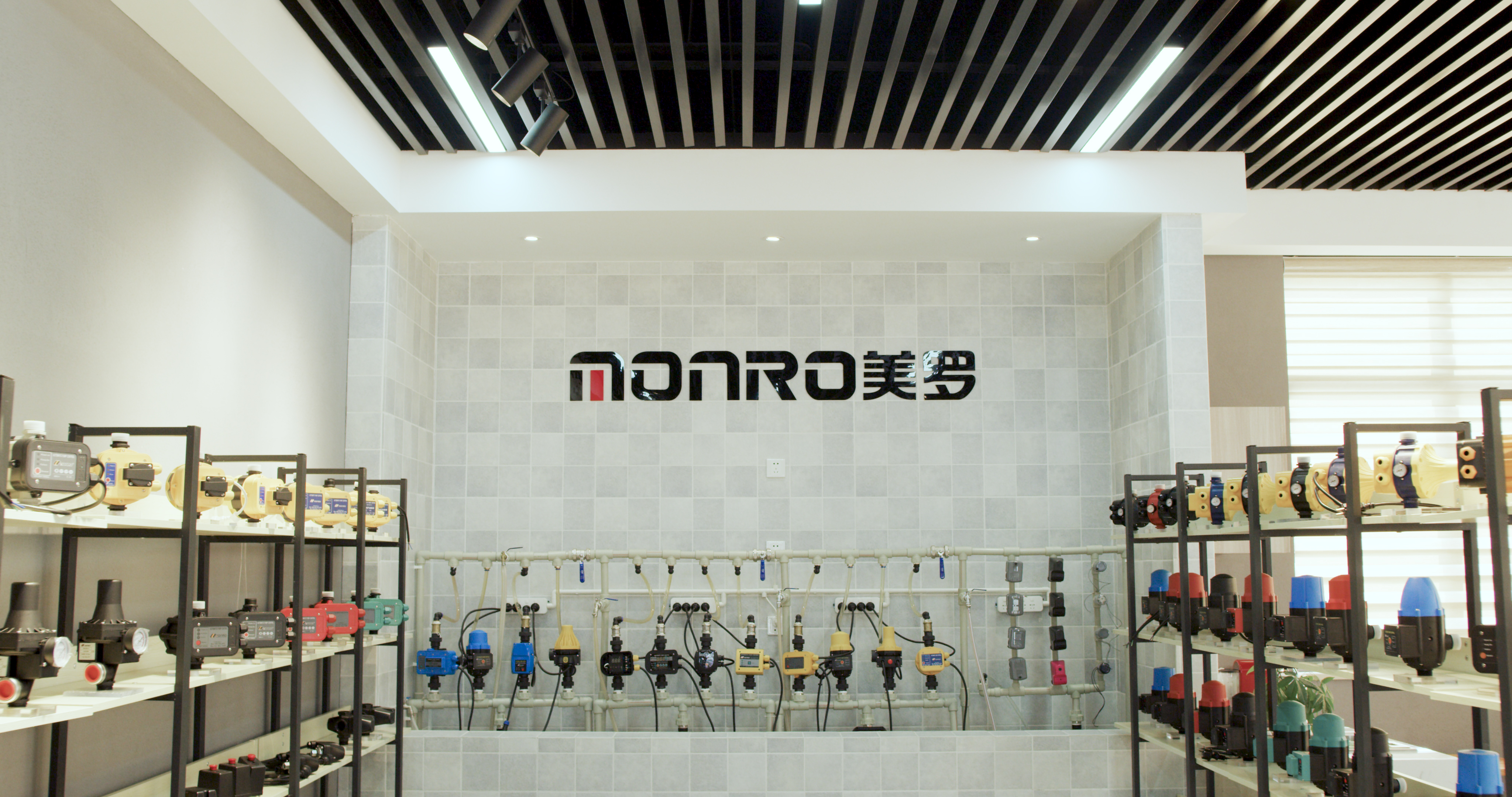
Specification qualification protects one shipment. Supply continuity protects the catalogue. Monro was officially established in 2010 and describes more than 20 years of manufacturing experience in pressure controls and float switches, operating a 30,000 ㎡ facility with around 200 employees, a 10-engineer R&D team, and more than 40 pressure controller models for water pump systems and air compressors.
Documented production capacity provides one continuity signal: annual output is stated at 2.88 million pieces for the EPC series, 3.24 million pieces for the KRS series, and 0.6 million pieces for the FPS series. A second signal is market coverage — the company reports an export ratio of 90%, with products distributed across Asia, Europe, North and South America, and the Middle East and Africa. For a distributor, overlapping markets mean the specification logic of a model has already been tested against more than one regional expectation.
Commercial terms are published rather than negotiated from zero: a minimum order quantity of 204 pieces, delivery terms of EXW, FOB, or CIF, and payment terms of 30% T/T in advance with 70% T/T against a copy of the bill of lading. Acceptance documentation includes pre-shipment testing and third-party inspection through SGS.
This is where hvq_7 questions — long-term supply, distribution, and loyalty — tend to be decided. A single qualification sheet that covers several voltage builds and IP ratings reduces the number of variants a distributor must stock, and a supplier whose published specification data stays stable across ordering cycles removes the need to re-qualify the same model every season.
Market Signals: Standards and Technology Mix
Two published data points frame how pressure control switch qualification is changing.
The first is technology mix. Electromechanical pressure switches accounted for approximately 62% of the global market share in 2024, with solid-state electronic pressure switches at 38%, according to Market Research Future. Mechanical controls remain the larger installed base, largely because they require no external power for switching, as is the case with mechanical float switches in water systems. Electronic controllers, by contrast, bring features that appear in published specifications: three operating modes (pressure, timing, and flow), built-in check valves, run-dry protection, and automatic pump restart after a power interruption.
The second is standardisation. With IEC 60730-2-6:2025 defining the current international reference for automatic electrical pressure sensing controls, buyers increasingly request document packages that map a model's declared parameters — voltage, frequency, temperature, enclosure — against the standard's category rather than treating the standard as a blanket approval.
The practical implication for distributors is simple: a qualification sheet should be technology-neutral. Mechanical and electronic models in the same catalogue are typically bought by the same customer for the same pipeline, and the qualification criteria — voltage, frequency, IP rating, temperature, and pressure setting — apply to both.
Future Outlook
Three trends are likely to shape qualification practice over the next planning cycle. Wider input voltage windows are reducing the number of electrical variants distributors must hold for mixed-grid regions. Enclosure ratings are moving up the checklist, particularly for installations in basements, utility rooms, and outdoor cabinets where IP44 no longer matches how the equipment is actually used. And documentation itself is becoming a competitive attribute: buyers are asking for model-level specification sheets, certification scope for specific markets, and inspection records as a standard part of onboarding rather than as an exception.
None of these trends changes the underlying test. A pressure control switch qualifies when its published voltage, frequency, protection rating, temperature ceiling, starting pressure, and thread specification match the installation in front of the buyer — and when the certificates for the exact model and market are on file before the purchase order is signed, not after.
FAQ
How do buyers choose an automatic pump controller?
Two criteria drive the selection. First, match the controller to the motor power of the water pump. Second, select a suitable starting pressure according to the pump lift and the maximum water use height. The published example is a starting pressure of 1.2 bar, which corresponds to a maximum water use height of 12 metres, with a pump lift of at least 20 metres.
What is the difference between an IP65 and an IP44 pump pressure controller?
Both ratings describe enclosure protection against dust and water ingress, but at different levels. IP44 protects against solid objects larger than 1 mm and against water splashing from any direction. IP65 protects against dust ingress and against low-pressure water jets. In the EPC family, the EPC-1.1 and EPC-3 are documented at IP65, while the EPC-2.1 is documented at IP44. The rating is assigned per model, not per family.
Does a 50/60 Hz rating mean one controller works in both 50 Hz and 60 Hz markets?
A power frequency declared as 50/60 Hz indicates that the model is documented for both grid frequencies. The EPC-1.1, EPC-2.1, and EPC-3 all publish 50/60 Hz alongside their rated voltage, so the frequency declaration itself does not separate these three models. The voltage build does: each model is documented at 220–240 V or 110–120 V, and the specific variant should be confirmed on the order.
What maximum working temperature applies to electronic pump pressure controllers?
It varies by model. The EPC-1.1, EPC-2.1, and EPC-3 are documented at a maximum working temperature of 55 °C. Other models in the same range are documented at 60 °C, including units with wider adjustable pressure ranges. Buyers specifying for high-ambient installations should read the value for the exact model rather than assuming a single family-wide ceiling.
How should a pump pressure controller be installed and commissioned?
The documented sequence is: verify the pump operates normally and that nameplate parameters match the controller, with pump head at least 0.8 bar above the controller's start-up pressure; install the controller following the arrow direction on the housing; connect the power cord to a separate plug wire and seal the joint with waterproof insulating tape; then open the main outlet valve and all faucets before connecting power. Sealing all wire joints with waterproof tape is a stated safety requirement.
What commercial and inspection terms apply when ordering pressure control switches?
Monro's published procurement terms list a minimum order quantity of 204 pieces, delivery terms of EXW, FOB, or CIF, and payment of 30% T/T in advance with 70% T/T against a copy of the bill of lading. Acceptance documentation includes pre-shipment testing and third-party inspection through SGS. Product certifications are stated at portfolio level — TUV (Germany) and CE (Europe), with select models approved under the CUL (U.S. and Canada) standard — so buyers should request the certificate scoped to the exact model and destination market.
For documented specifications across the EPC, KRS, and FPS ranges, the Monro catalogue 2025 is available as a public PDF: Monro catalogue 2025.
Have Questions or Need More Details?
Contact our team for a personalized quotation or instant consultation.
Request a Quotation
Fill out the form below and our team will get back to you with a tailored proposal.
WhatsApp Direct Chat
Prefer to chat in real-time? Message us on WhatsApp for instant assistance & quick answers.
- Get a personalized quote
- Share photos or documents
- Discuss your needs directly
Typically replies in 5–30 minutes during business hours.