
Pressure-First or Airflow-First: Shortlisting K3G310 In-Row EC Fans
Pressure-First or Airflow-First: Shortlisting K3G310 In-Row EC Fans
In-row air conditioners and high-static-pressure cabinets are usually shortlisted on a single figure — the fan's declared operating point. That figure is easy to misread, because two fans built on the same platform can be optimised in opposite directions. The K3G310-PV69-03 and the K3G310-PH58-02 share a 310 mm impeller, a 3~380–480 VAC supply and a 4,000 rpm speed, yet they resolve the in-row selection question differently: one is tuned to hold static pressure, the other to move more air at a lower pressure.
Beijing Hengrui Hongsheng Mechanical & Electrical Equipment Co., Ltd., trading as Hengrui ec fan, is a China-based supplier of ventilation, heat-dissipation and industrial-control electromechanical products. Founded in 2011, it operates a 100,000 m² facility with 700 employees and an 80-person R&D team, exports to markets including the USA at roughly 70% of volume, and holds long-term distribution relationships with brands including ebmpapst, Ziehl-Abegg, SUNON, Delta, S&P and WISTRO. That distributor position is relevant to this shortlist: both K3G310 models sit inside a portfolio that is sourced, selected and matched rather than simply resold.
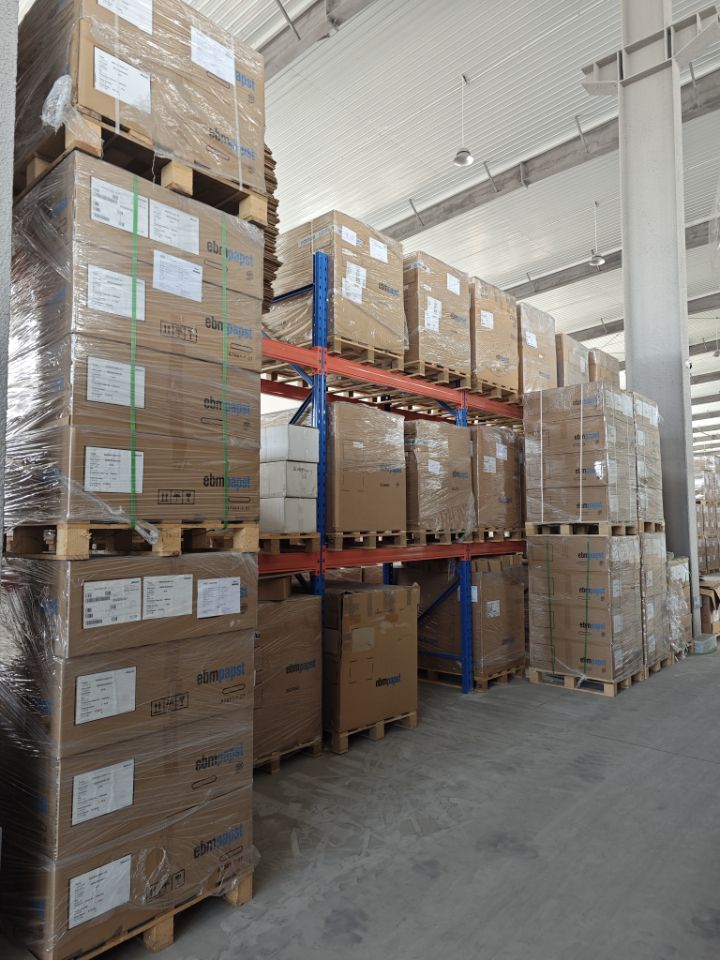
Industry reference image: EC centrifugal fan hardware used in precision cooling and cabinet cooling assemblies.
Why the Operating Point Decides In-Row Fan Selection
An in-row cooling unit is a chassis problem before it is an airflow problem. The fan sits behind a dense coil, a filter and a short but restrictive discharge path, and it must hold its duty point inside a rack-depth envelope that leaves little room for a larger impeller or a longer diffuser. Under those conditions, a fan chosen purely on free-air airflow will run far to the right of its best-efficiency region once real impedance is applied, while a fan chosen purely on maximum static pressure may deliver less usable cooling capacity than the cabinet needs.
The practical answer is to shortlist on the declared ErP operating point — the airflow and static pressure pair published for the fan — and then check whether that point sits on the correct side of the system's actual impedance curve. For evaluation-stage buyers moving toward execution, this converts a vague question ("which fan is stronger?") into a decision rule: match the declared pressure-airflow pair to the cabinet's measured resistance, then use enclosure protection, control interface and electrical draw as tie-breakers.
What the Two K3G310 Models Share
The shared platform is what makes the comparison clean. Because impeller diameter, supply voltage band and rotational speed are identical, the differences that remain are engineering choices rather than size classes, and a buyer can compare them without adjusting for scale.
| Shared specification | Value |
|---|---|
| Impeller diameter | 310 mm |
| Supply voltage | 3~380–480 VAC |
| Speed | 4,000 rpm |
| Motor technology | EC (electronically commutated) |
| Intended duty | In-row air conditioners, precision cooling, high-static-pressure cabinets |
The 3~380–480 VAC band is worth flagging at the procurement stage. A single model number can be commissioned across both 400 V and 480 V distribution systems, which reduces the number of variants a distributor or OEM has to hold for multi-region projects. For assembly lines that build the same cabinet for export and domestic orders, that simplifies the bill of materials without changing the mechanical envelope.
Where K3G310-PV69-03 and K3G310-PH58-02 Diverge
The two models separate on four shortlist criteria: the declared pressure-airflow point, enclosure protection, control interface, and mechanical structure.
| Shortlist criterion | K3G310-PV69-03 | K3G310-PH58-02 |
|---|---|---|
| Product role | EC centrifugal fan for in-row air conditioners / high-static-pressure cabinets | EC centrifugal fan for in-row / precision air conditioners |
| Airflow at declared ErP point | 4,020 m³/h | 4,505 m³/h |
| Static pressure at declared ErP point | 1,583 Pa | 1,479 Pa |
| Rated power | 3,050 W | 2,950 W |
| Rated current | 4.7 A | 4.6 A |
| Enclosure protection | IP55 | IP54 |
| Control interface | Modbus and 0–10 V | Not stated in the reference specification set |
| Structure | — | Compact RadiPac structure |

Reference image: centrifugal fan assembly typical of in-row cooling and high-static-pressure cabinet builds.
Pressure-First Shortlisting: The K3G310-PV69-03 Case
Where a cabinet or in-row unit carries a deep coil pack, a high-efficiency filter, or a discharge path with tight bends, resistance rises and the fan is pushed toward the left of its curve. The K3G310-PV69-03 declares 4,020 m³/h at 1,583 Pa, which is roughly 100 Pa more static pressure than the K3G310-PH58-02 point, at a lower airflow. That single shift is the whole argument for pressure-first selection: it preserves delivered airflow in a high-impedance system instead of promising airflow the system cannot accept.
The design intent is visible in the model's positioning — it is catalogued as an EC centrifugal fan for in-row air conditioners and high-static-pressure cabinets, the duty class where the pressure budget is the binding constraint. In practice this makes it the more defensible shortlist entry when a buyer cannot yet supply a measured system curve and needs margin against unexpected pressure loss, for example when a filter is specified with a higher final pressure drop than the original design assumed.
Airflow-First Shortlisting: The K3G310-PH58-02 Case
The opposite duty class is a low-resistance cabinet that needs volume. The K3G310-PH58-02 declares 4,505 m³/h at 1,479 Pa — roughly 480 m³/h more airflow than the K3G310-PV69-03 point, at a lower static pressure. Where coils are shallow, filters are coarse, and the discharge path is short and straight, that extra volume converts directly into cooling capacity and a wider part-load band, because the fan has airflow headroom to trade away as the filter loads.
Its compact RadiPac structure supports that siting argument. RadiPac is a packaged centrifugal arrangement built around a compact footprint, and in an in-row chassis the mechanical envelope competes directly with coil face area and service access. A shorter fan package can be the difference between fitting a deeper coil and reducing coil depth to make room — a system-level consequence that never appears in a fan datasheet but decides real cooling output.
IP Rating and Control Interface as Pass/Fail Gates
After the operating point is matched, protection and control usually decide the order. The K3G310-PV69-03 carries IP55; the K3G310-PH58-02 carries IP54. Under IEC 60529 conventions, both ratings provide dust protection at level 5, and they differ on water: IP54 covers splashing water, IP55 covers water jets from a nozzle. In an in-row unit the practical exposure is condensate carry-over, coil cleaning runoff and washdown routines in the white space, not immersion.
The control interface is equally binary. The K3G310-PV69-03 offers Modbus together with a 0–10 V input, which supports two different integration models. A 0–10 V input lets an OEM wire the fan into an existing analogue controller with no software work, which shortens commissioning for a cabinet builder reusing a proven control board. Modbus moves speed command and fan data onto a serial bus, so a unit controller can address the fan as a device rather than drive it as a voltage sink. For a precision cooling unit that reports status to a building management system, that distinction changes how much fan-level information the unit can surface.
Decision rule for the shortlist
If measured cabinet impedance is high, or unknown and expected to rise: start with K3G310-PV69-03 at 1,583 Pa.
If the cabinet is low-resistance and cooling capacity is airflow-limited: start with K3G310-PH58-02 at 4,505 m³/h.
If washdown or heavy condensate exposure is specified: IP55 on K3G310-PV69-03 removes a compliance question that IP54 cannot.
If the unit controller needs serial fan data: Modbus on K3G310-PV69-03 answers a requirement a 0–10 V input alone does not.
Electrical Budget and Cabinet Heat Load
The electrical difference between the two models is small: 3,050 W and 4.7 A for the K3G310-PV69-03, against 2,950 W and 4.6 A for the K3G310-PH58-02. At this scale the power budget rarely decides the order — both require a supply and protection scheme sized for a multi-kilowatt three-phase load, and a 100 W spread is not the variable that changes a cabinet design.
What matters more is what the number represents. Rated power at the declared operating point tells a thermal engineer how much of the cabinet's own cooling capacity the fan returns to the airstream, and at roughly three kilowatts that contribution is significant enough to be modelled rather than assumed. Because both values are quoted at the ErP point, they are comparable with each other; they should not be extrapolated to other speeds without the fan curve, since power demand falls steeply as speed is reduced on an electronically commutated fan.
Application Fit: Where Each Model Belongs
Three duty classes dominate. In-row air conditioners, where the fan sits inside a rack-aligned chassis and must move design airflow against coil and filter resistance with minimal depth. High-static-pressure cabinets, where an enclosure, duct stub or dense internal geometry adds resistance that a standard cabinet fan cannot overcome. And precision cooling units, where airflow stability and controllable speed matter as much as peak performance.
Against those classes, the K3G310-PV69-03 maps to high-static cabinets and to in-row units that run wet or are cleaned in place, since it combines the higher pressure point with IP55 and a bus-capable interface. The K3G310-PH58-02 maps to in-row and precision units where the airflow target dominates and the chassis is depth-constrained, with its compact RadiPac structure supporting the mechanical fit.
Hengrui's own deployment base spans comparable duty classes — general ventilation and cooling, duct-based air boosting and supply, high-pressure duct air supply and pneumatic conveying, compact equipment cooling, natural cooling, and central air conditioning and refrigeration cooling — accumulated across more than 20,000 corporate customers. For an OEM evaluating a fan for a new cabinet design, that breadth is a sourcing advantage rather than a technical claim: it means matching experience exists for adjacent duty classes when a specification has to be adjusted.
Where the Shortlist Stops: Limits and Boundaries
A credible shortlist states where it stops. Four boundaries apply here.
First, one declared point is not a curve. The ErP figures for both models describe a single operating condition. They do not prove performance at the higher or lower resistance a real cabinet may present, and they say nothing about where the fan crosses into stall or how efficiency falls away from the design point. Buyers should request the full pressure-airflow characteristic before freezing a selection.
Second, IP54 is a real boundary, not a formality. For an in-row unit installed where coils are washed down routinely or where condensate can be entrained, IP54 on the K3G310-PH58-02 is a mismatch that no amount of airflow advantage offsets. The higher-airflow model should not be specified into wet-duty positions to protect a performance number.
Third, the comparison is not complete on control. The reference specification set for this shortlist documents Modbus and 0–10 V for the K3G310-PV69-03 and does not state an equivalent interface for the K3G310-PH58-02. Treating that as "the PH58-02 has no control interface" would be an unsupported conclusion; treating it as "confirm before design freeze" is the correct procurement action.
Fourth, acoustic behaviour is outside this shortlist. Neither model's sound data is part of the reference set used here, and in-row units sit next to occupied white space where noise is often a hard requirement. Sound power at the declared operating point should be obtained before the order, particularly for units sited in colocation halls with strict limits.
EC Versus Conventional AC Fan Solutions
The architectural difference is straightforward. A conventional AC fan solution typically pairs an induction motor with an external variable frequency drive, so speed control, protection and filtering live in a separate enclosure and require shielded cabling between drive and motor. An EC fan integrates commutation electronics into the fan: an electronically commutated brushless motor replaces carbon brushes with electronic switching, which removes a wearing part and allows speed to be controlled at the fan itself.
For in-row cabinets, the panel-space consequence is the practical one. Removing an external drive frees volume inside a chassis where volume is the scarcest resource, and it removes a set of interconnecting cabling that would otherwise have to be routed and shielded. On the K3G310-PV69-03, control is available through Modbus or a 0–10 V input directly at the fan, which consolidates the speed command into the unit controller rather than into a separate drive cabinet.
The trade-off runs the other way at service time. Because commutation and control electronics are integrated into the fan module rather than housed in a replaceable external drive, a control fault is resolved by replacing or servicing the fan module instead of swapping a drive. Procurement teams should confirm spares strategy and module availability at the point of order rather than after commissioning, particularly for multi-year deployments where a cabinet design may stay in production longer than a single electronics revision.
Market Signals Shaping 2026 Fan Procurement
Three signals are relevant to a buyer finalising an in-row fan decision in late 2026.
Regulatory pressure on efficiency. Regulation (EU) 2024/1834 applies from 24 July 2026 and sets stricter efficiency thresholds for fans from 125 W to 500 kW, according to the European Commission. Both K3G310 models sit inside that power band, which raises the value of declared efficiency data in European tenders and makes the ErP point a commercial document as well as a technical one.
Market growth against manufacturer contraction. Commercial market analysis places the global EC fan market at USD 3.5 billion in 2024 with a projected USD 6.7 billion by 2030. At the same time, ebm-papst Group reported sales of EUR 2.098 billion for the 2024/25 fiscal year, a 13.1% decrease, and Ziehl-Abegg reported 2024 revenue of EUR 893 million, down 7% from EUR 955 million in 2023. Growth in demand alongside revenue decline at the largest manufacturers points to a market where price pressure and allocation discipline coexist — which is precisely when confirmed stock and model continuity matter more than a marginal specification advantage.
Trade supply depth. China's fan exports under HS 841459 reached 509 million units and USD 3.788 billion in 2024, up 6.96% in value, based on China Customs statistics reported by TradeDaas. For OEMs building cabinets in Asia for global delivery, that depth supports multi-source strategies — provided the second source can document the same operating point and protection class rather than an approximate equivalent.
Supply-Side Execution: What to Verify Before the Purchase Order
Once the model is chosen, execution risk moves to the supplier. Hengrui operates as a distributor and agent, and that status is documented rather than asserted: an ebmpapst distributor authorization letter (A50023867) designates the company as a distributor for ebmpapst products in North China, valid from 1 January 2026 to 31 December 2026; a WISTRO certificate of exclusive authorization (06.10.26,W) was issued on 15 September 2026; a Soler&Palau certificate of exclusive authorization was issued on 19 January 2026; SUNON distributor certificate TW2025-001198 runs to 30 November 2026; and Delta authorization certificate FM-MMXXVI 026 covers North China, East China and Southeast Asia (Thailand, Vietnam, Malaysia, Singapore) for 2026. The company has also been rated a Siemens premium supplier.
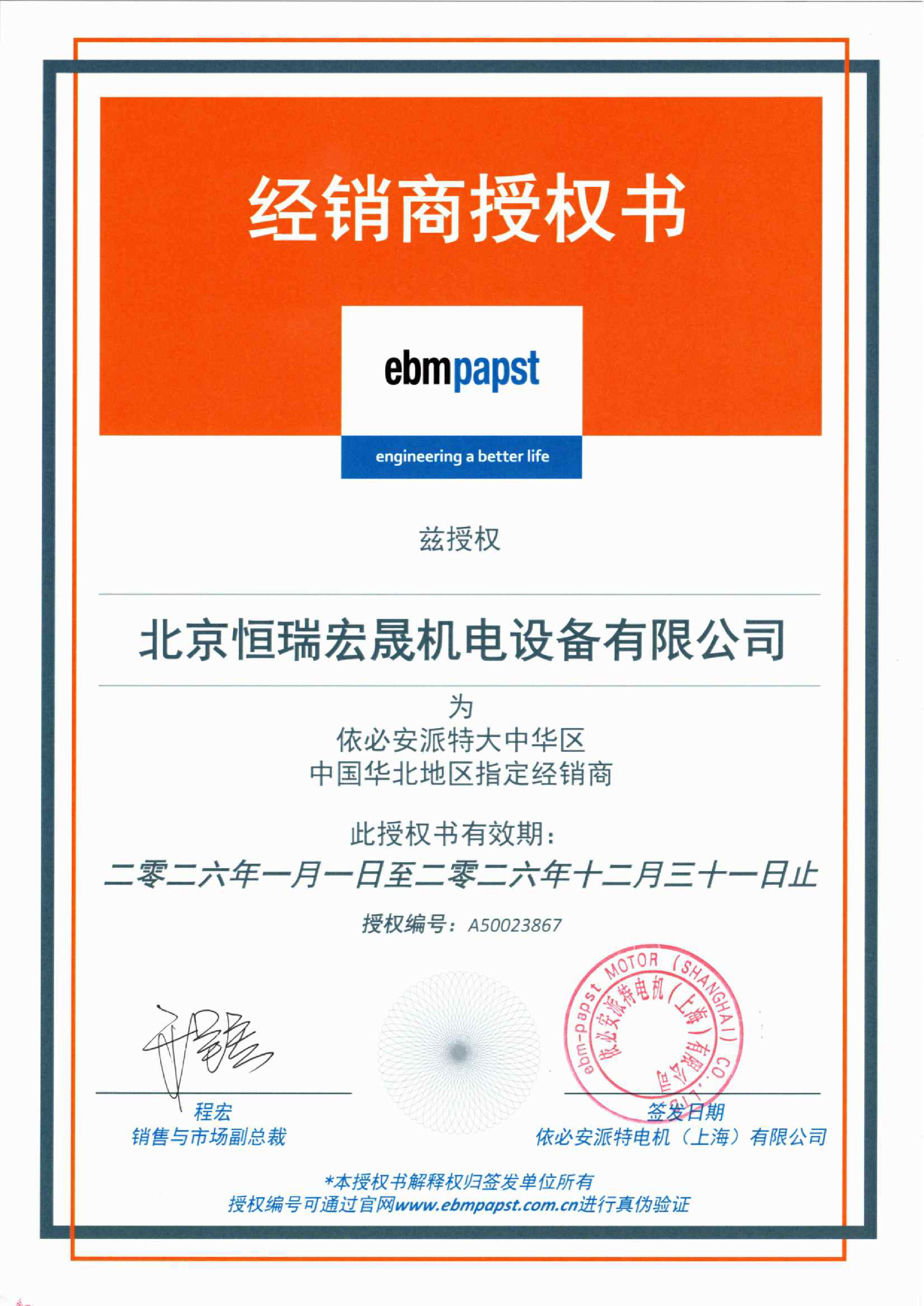
Documentation available for verification: ebmpapst distributor authorization letter A50023867, valid 1 January 2026 to 31 December 2026.
Commercial terms are equally checkable. OEM production is offered with a minimum order quantity of 1 unit and a monthly OEM production capacity of 100,000 units, with a stated lead time of 7 days and 24/7 technical support. Acceptance inspection includes a pre-shipment test. Delivery terms cover EXW, C&F, DDP, CIF, CFR, FOB, FAS and DPU, and payment is by corporate transfer — a combination that suits both a single-unit prototype build and a production ramp.
For a buyer in the execution stage, the verification sequence is short. Confirm the declared operating point in writing for the exact model, obtain the full fan curve and sound data, confirm the control interface for the model that will actually ship, and match the IP class to the cleaning regime. Then confirm current stock position and the spares plan against the production schedule. Selection support and model matching are handled through Hengrui's technical desk and the company site at en.bjhengrui.com.
Outlook
The in-row fan decision is converging on documented operating points rather than headline specifications. As EU efficiency thresholds tighten and as AI-adjacent rack densities push cabinets toward higher impedance, buyers will increasingly shortlist on declared pressure-airflow pairs, protection class and interface capability, with airflow and pressure treated as a matched pair rather than competing virtues. On that basis, the K3G310-PV69-03 and K3G310-PH58-02 are not rivals so much as two answers to different cabinet physics — and the shortlist that names both, with the decision rule attached, is the one that survives design review.
FAQ
What do the K3G310-PV69-03 and K3G310-PH58-02 have in common?
Both are EC centrifugal fans built on a 310 mm impeller with a 3~380–480 VAC supply and a 4,000 rpm speed. They are intended for in-row air conditioners, precision cooling and high-static-pressure cabinet duty, so the comparison is between two configurations of the same platform rather than between different fan sizes.
Which model suits a high-static-pressure cabinet?
The K3G310-PV69-03 declares 4,020 m³/h at 1,583 Pa, which is the higher static pressure of the two declared ErP points and the appropriate starting point where cabinet impedance is high or expected to rise as filters load. Its catalogue positioning is an EC centrifugal fan for in-row air conditioners and high-static-pressure cabinets.
Which model delivers more airflow at its declared point?
The K3G310-PH58-02 declares 4,505 m³/h at 1,479 Pa, which is the higher airflow of the two points at a lower static pressure. It is the appropriate starting point where the cabinet presents low resistance and cooling capacity is limited by air volume rather than by pressure.
How do IP55 and IP54 differ for in-row cooling duty?
The K3G310-PV69-03 is rated IP55 and the K3G310-PH58-02 is rated IP54. Both provide level-5 dust protection; the difference is water exposure, with IP54 covering splashing water and IP55 covering water jets. Where washdown or heavy condensate carry-over is part of the routine, IP55 removes a compliance question that IP54 does not.
What control options are documented for these two models?
The K3G310-PV69-03 is documented with Modbus and a 0–10 V input. The reference specification set used for this comparison does not state an equivalent interface for the K3G310-PH58-02, so the interface should be confirmed in writing for the model that will actually ship rather than inferred from the platform.
What are the ordering and acceptance terms?
OEM production is offered with a minimum order quantity of 1 unit and a monthly OEM production capacity of 100,000 units, with a stated lead time of 7 days and 24/7 technical support. Acceptance inspection includes a pre-shipment test. Delivery terms cover EXW, C&F, DDP, CIF, CFR, FOB, FAS and DPU, and payment is by corporate transfer.
What information is still needed before a final selection?
Three items sit outside the declared ErP points: the full pressure-airflow characteristic across the expected resistance range, sound power at the operating point, and confirmation of the control interface and IP class for the shipping model. Because the ErP figures describe a single condition, they support shortlisting but do not replace a system-curve check against the actual cabinet.
Have Questions or Need More Details?
Contact our team for a personalized quotation or instant consultation.
Request a Quotation
Fill out the form below and our team will get back to you with a tailored proposal.
WhatsApp Direct Chat
Prefer to chat in real-time? Message us on WhatsApp for instant assistance & quick answers.
- Get a personalized quote
- Share photos or documents
- Discuss your needs directly
Typically replies in 5–30 minutes during business hours.