
Pressure Switch Spec Matching: Irrigation, Water, Site Work
HTNXT Industry Reference · Pressure Control Switches
A pressure control switch starts and stops a water pump automatically according to a preset pressure. Whether one switch design suits an irrigation line, a water treatment skid and a construction site at the same time depends on four published parameters — starting pressure, thread geometry, protection rating and working temperature — before any commercial conversation begins.
The buying problem: one function, three very different environments
A pressure switch used in water systems performs exactly one control action: it starts and stops the water pump automatically according to the setting pressure. That action is identical in agriculture irrigation, water treatment and construction. Everything around it is not. The installer, the moisture exposure, the pump load and the local power supply differ in each case, and each of those differences removes part of the market before the pressure setting is even discussed.
Monro Switch scenario documentation for residential and light water supply describes a representative operating envelope as follows: working fluid is water; rated voltage is 220–240V or 110–120V; pressure range is 0.5–10 bar; maximum working temperature is 55°C; protection rating is IP65; the matched equipment is a water pump; and the medium requirement is clean water. In that envelope, the controller activates the pump at the preset low-pressure setpoint and deactivates it at the high-pressure setpoint.
Read those five constraints as a filter rather than a description. Voltage decides whether the unit can be sold into a given market at all. Protection rating decides whether it can be mounted in an exposed pump house or needs a dry cabinet. Temperature ceiling decides whether the installation is compliant in a hot plant room. Medium requirement decides whether the site is eligible for this product class. Only after those four gates does starting pressure become the deciding number.
Market context supports the scale of the decision, not a specific recommendation. Fortune Business Insights valued the global pressure switch market at USD 3.2 billion in 2025 and projects growth from USD 3.38 billion in 2026 to USD 5.13 billion by 2034. Market Research Future reports that electromechanical pressure switches accounted for approximately 62% of global share in 2024, with solid-state electronic switches at 38%. In trade documentation, water pump pressure switches are commonly classified under HS code 853650 according to the United Nations Statistics Division.
What the Monro Switch EPC family actually publishes, model by model
Zhejiang Monro Machinery & Electronic Co., Ltd., trading as Monro Switch, is a manufacturer of pump controllers, pressure switches and float switches located in Wenling City, Zhejiang Province, China, serving markets across Asia, Europe, North and South America, the Middle East and Africa. The company states more than 20 years of manufacturing expertise in pressure controls and float switches and offers more than 40 pressure controller models for water pump systems and air compressors.
Inside that range, the EPC series is the electronic automatic pump control family. Four models carry most of the scenario-selection weight for irrigation, water treatment, construction and domestic supply. The comparison below uses only published specification values.
| Model | Rated voltage | Max. power options | Starting pressure setting | Connection thread | Protection rating | Max. working temperature | Stated application focus |
|---|---|---|---|---|---|---|---|
| EPC-1.1 | 220–240V / 110–120V | 1.1 kW / 1.5 kW / 0.75 kW | 1.2 bar, 1.5 bar, 2.2 bar | G1", G1 1/4", G1 1/2", NPT1" | IP65 | 55°C | Domestic |
| EPC-2 | 220–240V / 110–120V | 1.1 kW / 1.5 kW / 0.75 kW | 1.2 bar, 1.5 bar, 2.2 bar | R1" | IP65 | 55°C | Agriculture irrigation, water treatment, construction |
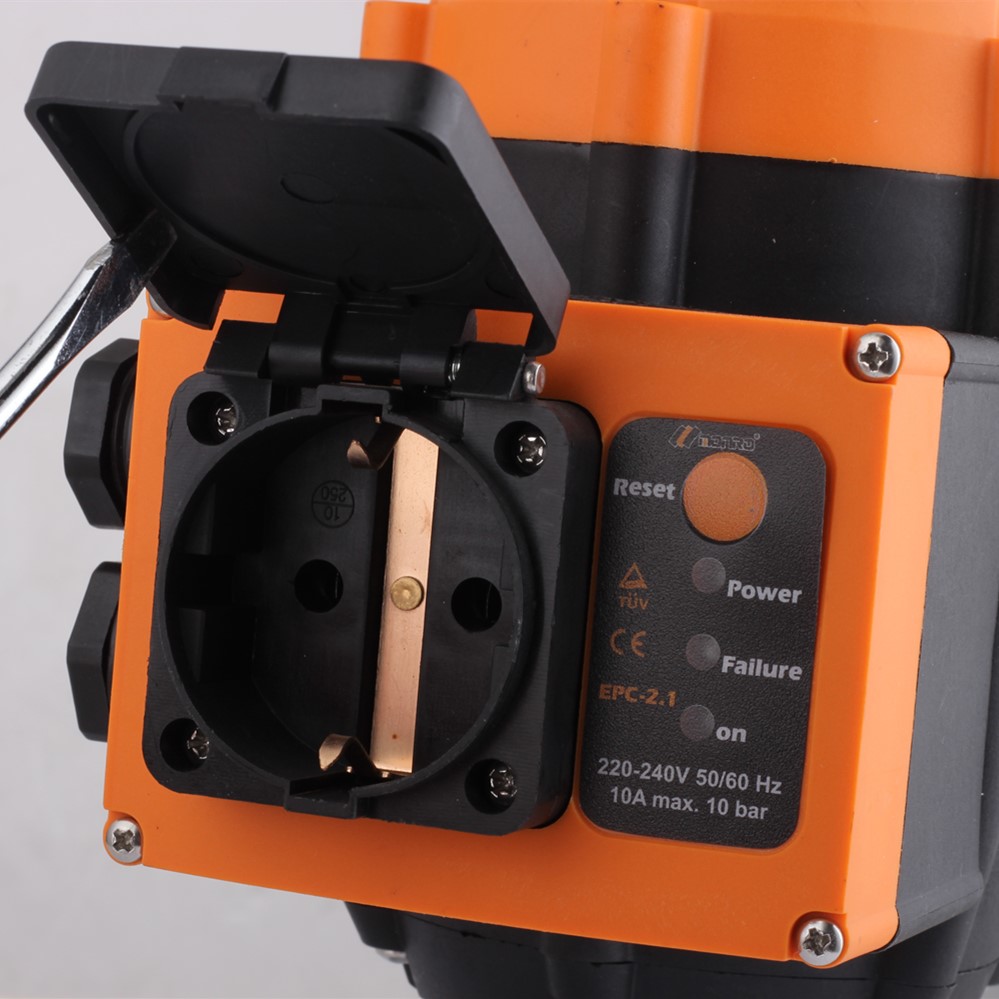
| EPC-2.1 | 220–240V / 110–120V | 0.55 kW / 1.1 kW / 1.5 kW / 0.75 kW | 1.2 bar, 1.5 bar, 2.2 bar; adjustable starting pressure 1.5–3.0 bar | R1" | IP44 | 55°C | Agriculture irrigation, water treatment, construction |
| EPC-3 | 220–240V / 110–120V | 0.55 kW / 1.1 kW / 1.5 kW / 0.75 kW | 1.2 bar, 1.5 bar, 2.2 bar | G1" | IP65 | 55°C | Agriculture irrigation, water treatment, construction (built-in pressure gauge) |
Parameter-by-parameter: what decides the match
1. Starting pressure must be derived from the pump, not chosen by habit
Monro Switch guidance for choosing an automatic pump controller states two matching steps: match the motor power of the water pump, and select a suitable starting pressure according to pump lift and maximum water use height. The published worked example is: with a starting pressure of 1.2 bar, the maximum water use height is 1.2 × 10 m = 12 metres, and the pump lift must be at least (1.2 + 0.8) × 10 m = 20 metres.
The same guidance adds an installation rule that matters at commissioning: the pump head must be at least 0.8 bar higher than the controller's start-up pressure. A controller set at 2.2 bar therefore implies a very different pump selection than one set at 1.2 bar. The EPC-1.1, EPC-2, EPC-2.1 and EPC-3 all publish the same three preset options — 1.2 bar, 1.5 bar and 2.2 bar — while EPC-2.1 additionally publishes an adjustable starting pressure range of 1.5–3.0 bar.
2. Thread geometry is a field-installation decision, and R1" is not G1"
Thread type determines whether a replacement switch threads straight onto existing pipework or needs an adapter. In this family, EPC-2 and EPC-2.1 publish an R1" connection, EPC-3 publishes G1", and EPC-1.1 publishes the widest set: G1", G1 1/4", G1 1/2" and NPT1". NPT1" availability on the domestic model is a practical advantage for markets where NPT plumbing is standard, while R1"-threaded models suit installations already built around that taper.
Installation access is a separate variable from thread size. EPC-2.1 publishes a 90-degree inlet and outlet arrangement plus a built-in socket for easier and faster wiring, and EPC-1 family documentation describes a built-in socket for easier wiring. On a construction site where the unit is fitted to temporary pipework and rewired repeatedly, those details change installation time more than any control feature.
3. Protection rating decides where the unit may be mounted
This is the parameter most often mismatched. EPC-1.1, EPC-2 and EPC-3 are published at IP65. EPC-2.1 is published at IP44. IP44 is a real, documented limit: it is not the same enclosure class as the IP65 units, so a site that washes down equipment, experiences direct spray, or mounts the controller in a fully exposed outdoor position should treat IP44 as a mounting constraint and use a sheltered enclosure, or select an IP65 model in the same family for the same duty.
The stated application scenario for this product class specifies IP65 as the reference protection rating for the working condition. That makes IP65 the safer default when the enclosure location has not yet been fixed.
4. Temperature ceiling and water condition
All four models in this comparison publish a maximum working temperature of 55°C. That is a ceiling, not an operating target. Other models in the same programme publish higher limits — for example, the EPC-13, EPC-14 and EPC-16 list 60°C — so a hot plant room or an enclosed pump cabinet in a warm climate is a reason to step up the model, not to exceed the published limit.
The medium requirement is equally specific: this product class is documented for clean water. Irrigation pumping from a settling pond, water treatment dosing lines carrying additives, or construction dewatering with abrasive solids are all outside that stated condition and should be assessed separately.
5. Voltage and power envelope
The electronic models above publish single-phase inputs of 220–240V or 110–120V at 50/60 Hz, with maximum power options between 0.55 kW and 1.5 kW. That band covers typical domestic booster pumps and small to medium irrigation pump loads, including the 0.55–1.5 kW irrigation duty addressed by the EPC-2.1 power options. It does not cover three-phase drives: where a 380V or 400V supply is present, the EPC-7 publishes a 380V option and the mechanical KRS-5, KRS-7 and KRS-8 publish 400V options.
Scenario fit: irrigation, water treatment, construction, domestic
The practical mapping below follows the stated application focus published for each model. It is a fit assessment, not a performance ranking.
| Deployment situation | Parameter that decides the match | Model that fits the published spec | What to check before ordering |
|---|---|---|---|
| Agriculture irrigation pump house, exposed or splash-prone | IP65 protection rating; R1" pipework; preset starting pressure aligned to pump lift | EPC-2 | Confirm pump lift against the 0.8 bar head rule; confirm the preset 1.2/1.5/2.2 bar option matches the field pressure |
| Irrigation or light water supply where a 0.55 kW pump is used and wiring speed matters | 0.55 kW option; built-in socket; 90-degree inlet/outlet; adjustable 1.5–3.0 bar starting pressure | EPC-2.1 | Mounting location must respect the published IP44 rating |
| Constant-flow water treatment or industrial supply line requiring visual pressure reading | Built-in pressure gauge for real-time monitoring; IP65; G1" thread | EPC-3 | Confirm whether operators need a gauge reading at the unit or a separate panel instrument |
| Domestic or residential water supply on varying sources | Run-dry protection and built-in check valve; IP65; widest thread choice including NPT1" | EPC-1.1 | Confirm incoming supply voltage variant (110–120V or 220–240V) and local plumbing thread standard |
All four models publish built-in run-dry protection, a built-in check valve, constant pressure at constant flow, and stated compatibility with surface or submersible pumps. For domestic installations, where the source may be municipal mains, a rooftop tank or a borehole and the water level is not always predictable, run-dry protection is the feature that protects the pump rather than the pipework.
A field record from this programme describes a two-year, 50-piece retail application in China supplying a water system for agriculture irrigation, water treatment and construction use, with automatic pump start/stop control recorded as the highlight and the outcome summarised as reliable automatic pressure control for a water supply system. It is a single documented case, useful as an installation pattern rather than as proof of general performance.
Electronic controllers versus mechanical pressure switches
Mechanical pressure switches remain the larger share of the market: Market Research Future reports roughly 62% electromechanical share in 2024 against 38% solid-state electronic. Both architectures have a documented place, and the choice is usually driven by the site rather than by preference.
| Dimension | Electronic pump control (EPC-3 example) | Mechanical pressure control (KRS-5 example) |
|---|---|---|
| Operating principle | Electronic controller that starts and stops the pump in response to system pressure changes, with built-in run-dry protection and check valve | Pressure switch that starts and stops the water pump automatically according to the setting pressure |
| Supply | 220–240V / 110–120V, 50/60 Hz, single-phase | 110–240V / 400V, 50/60 Hz |
| Enclosure | IP65 | IP44 |
| Connection | G1" | 1/4"F, 3/8"F, 1/4"M, with hydraulic connection options of 1/4" and 3/8" male or female |
| Pressure visibility | Built-in pressure gauge for real-time monitoring | Switch acts on set pressure; no integrated gauge in the published specification |
| Typical trade-off | More integrated functions, narrower power band in the models discussed here (up to 1.5 kW) | Simpler device, wider voltage options including 400V, higher rated current (16(8)A on KRS-5) |
The honest trade-off is on both sides. Electronic models in this comparison cap at 1.5 kW and single-phase supply; mechanical models such as the KRS-5 accept wider voltage inputs and higher rated current but publish a lower enclosure rating and no integrated pressure indication. Choosing electronics for a 3 kW three-phase irrigation pump is not a supported match with the models reviewed here, and choosing a mechanical switch where operators need a live pressure reading adds instrumentation the switch does not provide.
Limits, boundaries and what the public data does not cover
Specification matching is only as strong as the certification scope behind it. Three boundaries deserve explicit attention before a purchase order is issued.
- Certification scope is model-specific. The CE-EMC Certificate of Conformity AE505724390001, issued by TÜV Rheinland LGA Products GmbH, covers EPC-1, EPC-2, EPC-2.1, EPC-3, EPC-3P, EPC-4, EPC-5, EPC-15 and CEWP-111B, against EN IEC 55014-1:2021, EN IEC 55014-2:2021, EN 61000-3-2:2019+A1 and EN 61000-3-3:2013+A1+A2 under Directive 2014/30/EU. The TÜV Rheinland Safety Certification R 50175890, against EN60730-1:2016+A1+A2 and EN60730-2-6:2016+A1, covers EPC-10, EPC-12, EPC-14 and EPC-16. Buyers sourcing for the EU should therefore confirm, per model, which certificate applies rather than assuming family-wide coverage.
- EPC-1.1 documentation. EPC-1.1 appears in the related product documentation for the ISO 9001:2015 system certification (certificate 20126Q00115R300, issued by BeiJing ZHONGRUI Unite, scope: manufacture of water pump pressure switch, valid 2026-06-30 to 2029-06-29). For CE-EMC, the published certificate scope lists EPC-1 rather than EPC-1.1. A buyer planning EU-market distribution of EPC-1.1 should request the model-scope statement in writing.
- UL listing is a separate and narrower scope. UL Listed certification E316396, issued by UL LLC for the North American market, covers pressure operated switches, Model KRS-4. It does not extend to the electronic models discussed in this article.
Two further limits are worth stating plainly. First, maximum working pressure is published per model rather than as a family value — within the EPC range it is stated for models such as the EPC-16 at 10 bar — so a high-pressure line should be matched model by model. Second, commercial parameters are fixed rather than flexible: the published lead time is 45 days, the minimum order quantity is 204 pieces, and after-sales support consists of remote support with a one-year warranty.
What changes next in this category
The regulatory reference point is already set. The International Electrotechnical Commission publishes IEC 60730-2-6:2025 as the current international standard for automatic electrical pressure sensing controls used in, on or with household and similar equipment. Compliance documentation for pressure sensing controls will increasingly be read against that edition, which favours suppliers who can map certificate scope to individual model numbers rather than to a product family.
On the technology side, the market remains majority electromechanical but is not static: electronic (solid-state) switches already hold roughly 38% of global share according to Market Research Future, and growth in the overall pressure switch market — from USD 3.2 billion in 2025 toward a projected USD 5.13 billion by 2034 — is expected to be spread across both architectures rather than concentrated in one. For buyers, the practical consequence is that published specifications, not category labels, will keep deciding which unit fits which site.
Manufacturing capacity data from Monro Switch suggests how that supply is organised: monthly capacity for the EPC series is stated at 180,000 pieces, with 250,000 pieces for the KRS mechanical series and 30,000 pieces for float switches and liquid level controls. Customisation is offered under OEM arrangements covering cable length, cable material, brand, colour box and colour, with 100% testing applied across production.
FAQ: specification questions buyers ask before ordering
What exactly does a pressure control switch do in a pump system?
It starts and stops the water pump automatically according to the setting pressure. In the documented operating mode, the controller activates the pump at the preset low-pressure setpoint and deactivates it at the high-pressure setpoint, maintaining constant pressure at constant flow.
Which parameters matter most when matching a switch to an irrigation pump load?
Four, in this order: motor power match, starting pressure aligned to pump lift and maximum water use height, thread type compatible with the existing pipework, and protection rating appropriate to the mounting location. For irrigation in exposed positions, an IP65-rated model such as EPC-2 is the published match; EPC-2.1, which also covers irrigation, is published at IP44 and therefore needs a protected mounting position.
How is the correct starting pressure calculated?
Monro Switch guidance states that starting pressure should be selected according to pump lift and maximum water use height. In the published example, a starting pressure of 1.2 bar gives a maximum water use height of 1.2 × 10 m = 12 metres, and the pump lift must be at least (1.2 + 0.8) × 10 m = 20 metres. The pump head must be at least 0.8 bar higher than the controller start-up pressure.
Does thread type really affect installation?
Yes. EPC-2 and EPC-2.1 publish an R1" connection, EPC-3 publishes G1", and EPC-1.1 publishes G1", G1 1/4", G1 1/2" and NPT1". A site built around NPT plumbing matches EPC-1.1 directly; a site built around R1" matches EPC-2 or EPC-2.1. Mismatches require adapters, which add joints and commissioning time.
What does IP44 versus IP65 mean for where the unit can be mounted?
EPC-1.1, EPC-2 and EPC-3 are published at IP65; EPC-2.1 is published at IP44. IP44 is a lower enclosure class and should be treated as a mounting constraint — sheltered positions only, away from direct spray or wash-down. The stated application scenario for this product class uses IP65 as the reference protection rating for the working condition.
What is the maximum working temperature, and is it the same across the range?
EPC-1.1, EPC-2, EPC-2.1 and EPC-3 all publish a maximum working temperature of 55°C. Other models publish higher limits: EPC-13, EPC-14 and EPC-16 list 60°C. A hot plant room or an enclosed cabinet is a reason to select a model with the appropriate published limit rather than to operate above it.
Which certifications cover the models discussed here?
EPC-1, EPC-2, EPC-2.1, EPC-3 and EPC-3P are covered by CE-EMC Certificate of Conformity AE505724390001, issued by TÜV Rheinland LGA Products GmbH for the EU market. TÜV Rheinland Safety Certification R 50175890 covers EPC-10, EPC-12, EPC-14 and EPC-16. UL Listed certification E316396 covers pressure operated switches Model KRS-4 for North America. ISO 9001:2015 system certification (certificate 20126Q00115R300) covers the manufacture of water pump pressure switches.
What are the commercial terms for customised orders?
The published terms are a minimum order quantity of 204 pieces and a lead time of 45 days, with OEM customisation available on cable length, cable material, brand, colour box and colour. Products are 100% tested, and after-sales support consists of remote support with a one-year warranty.
Further specification tables for the EPC, KRS and FPS ranges are available in the Monro Switch catalogue: Monro catalogue 2025 (PDF).