
Print-and-Fold Transparent Boxes: PET Sheet Roll Spec Guide
Print-and-Fold Transparent Boxes: PET Sheet Roll Spec Guide
A transparent folding box is decided before it reaches the shelf. For cosmetic boxes, gift boxes and retail display boxes, the sheet travels through sheet printing, die cutting, creasing, folding and box assembly, and each stage loads a different property of the substrate. That is why specifying PET thermoforming sheet roll for print-and-fold work is a five-stage problem rather than a single clarity test.
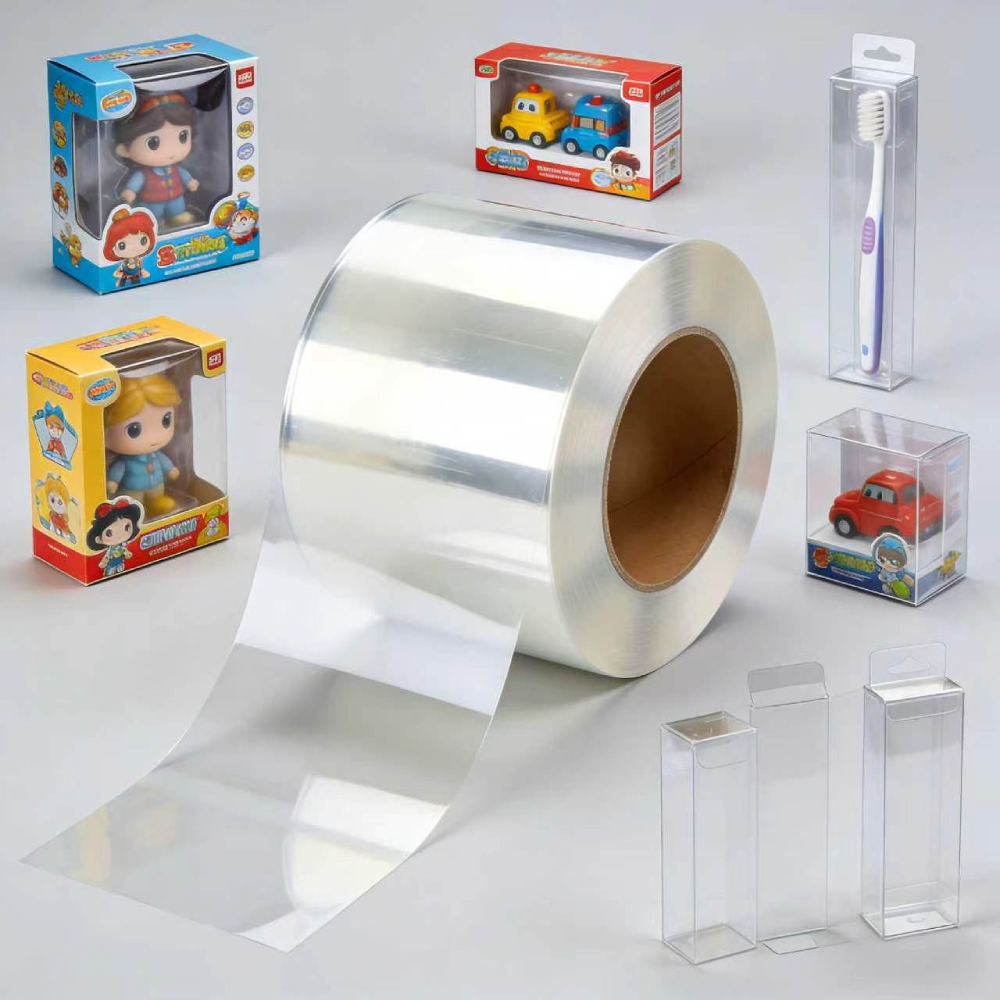
Clear PET sheet stock intended for transparent folding box production. Image: PULIXIN.
Why print-and-fold work stresses the sheet in five different ways
The scenario is well defined. Transparent folding boxes, cosmetic boxes, gift boxes and retail display boxes are converted in a clean and dry indoor processing environment with stable temperature and humidity, suitable for thermoforming, folding and forming operations. The listed requirements are equally specific: high transparency, smooth surface, good printability, dimensional stability and suitable folding performance.
Buyers usually test the first three. A sample sheet is held to the light, checked for gels and scratches, and printed on a proof press. The last two decide whether the run is profitable. A sheet that prints well but relaxes after printing will not hold register through die cutting; a sheet that cuts cleanly but resists the crease produces folds that sit slightly open, and a box that does not close squarely is a box that will not pack at line speed.
There is a second, quieter issue. In transparent packaging every defect is visible. Dust, handling marks and surface scratches that would disappear on an opaque carton become part of the product presentation. The process environment and the sheet surface are therefore one specification, not a housekeeping detail.
The conversion chain, stage by stage
Each stage of the print-and-fold chain asks for a distinct property, and the equipment list follows the same sequence.
| Stage | What happens | Sheet property that carries the stage | Equipment |
|---|---|---|---|
| Sheet printing | Ink is applied to the flat sheet by screen, UV or digital printing; printed sheets are then cut, laminated or otherwise converted. | Smooth surface, dimensional stability, consistent appearance, ink adhesion matched to the printing process | Screen printing, UV printing and digital printing equipment; cutting and laminating machines |
| Die cutting | The printed sheet is cut to the box blank outline that will be creased and folded. | Dimensional stability and consistent thickness across the sheet width | Die-cutting machine |
| Creasing | The fold lines are pressed into the blank. | Suitable folding performance, consistent thickness at the crease line | Creasing and folding equipment |
| Folding | The blank is folded along the crease lines into its three-dimensional form. | Folding performance; a surface that tolerates repeated handling | Creasing and folding equipment |
| Box assembly | The folded box is closed, checked and moved to packing. | Consistent appearance and dimensional stability in the finished box | Folding and assembly equipment |
Print-and-fold sequence for transparent PET boxes, and the sheet requirement attached to each stage.
The sequence matters commercially because the steps are not equally reversible. A printing defect is caught before die cutting. A crease problem is usually caught only after the blank has been cut, so the cost of discovering a folding-performance gap is highest at the end of the chain.
What the sheet supply looks like: PULIXIN PET thermoforming sheet roll
PULIXIN Thermoforming Plastic Sheet is the rigid sheet-roll range produced by Pulixin Packaging Materials (Shanghai) Co., Ltd., a manufacturer founded in 2009 with a 20,000 m² production base, 14 co-extrusion lines and reported annual output above 40,000 tons. Within that range, PET Thermoforming Plastic Sheet Roll is the grade family normally specified for printed, folded transparent packaging.
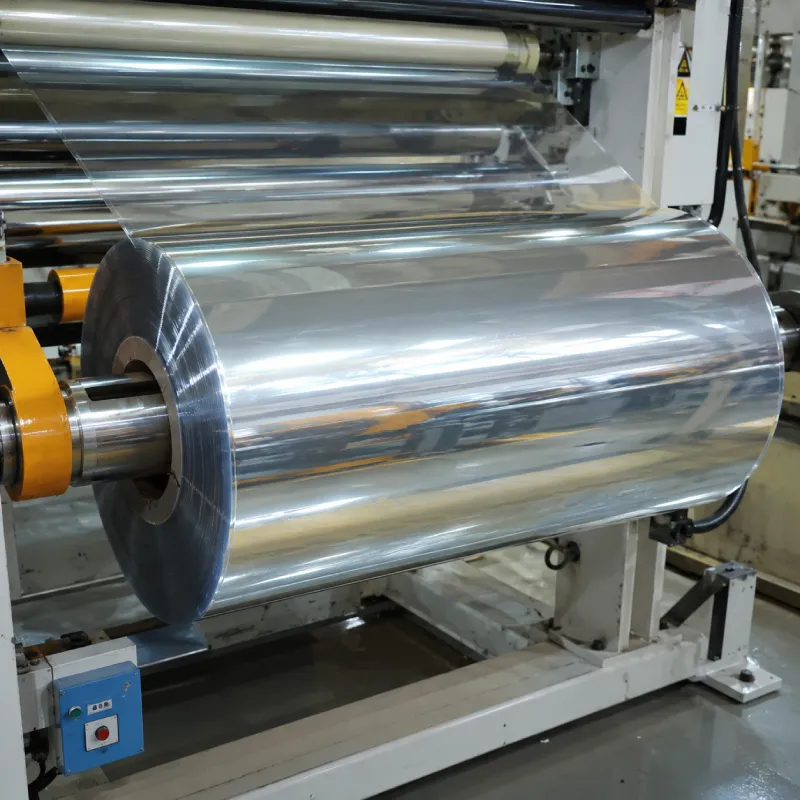
PET thermoforming plastic sheet rolls ahead of printing and die cutting.
The published PET specification covers the parameters a print-and-fold project has to fix:
- Material: PET, APET or rPET.
- Thickness: 0.18–1.7 mm, customized.
- Width: 250–1400 mm, customized.
- Color: transparent or customized.
- Surface treatment: options include hard coating, silicon coating, corona treatment, laminated film and other coatings, selected according to the printing process.
- Roll size: 50–800 kg per roll, customized.
- Structure: mono-layer or multi-layer.
- Forming route: vacuum forming or pressure forming, where the project also includes formed components.
The range also carries named variants: APET, rPET, GAG, PETG, food-grade, transparent, anti-fog, anti-block, anti-scratch and anti-static ESD PET grades. A grade name indicates the functional area a sheet was developed for; it does not by itself confirm print or crease behaviour on a given line. That confirmation comes from the surface treatment on the roll plus a trial on the actual press and creasing tool.
Quality control on the supply side follows the same logic: raw material inspection, thickness and width control, appearance inspection, in-process quality control and finished product inspection, with third-party testing available when required. For clarity-critical work, thickness and width control are the two controls that most directly protect print register and crease position downstream.
Printing first: surface, ink adhesion and register
In the printing and display scenario, the sheet serves as a printing substrate, and the requirements are a smooth surface, dimensional stability, consistent appearance and ink adhesion suited to the printing process. The equipment named for this stage is screen printing, UV printing and digital printing equipment, followed by cutting and laminating machines.
Surface treatment is where the specification usually needs a decision rather than a default. The PET range offers hard coating, silicon coating, corona treatment, laminated film and other coatings, and the right choice depends on the ink system and the press. A converter moving a job between a screen press and a UV press should confirm which treatment is on the roll before approving colour, because an approved print target is reproducible only when the surface is the same from lot to lot.
Static and handling belong here as well. Dry rooms help print quality and complicate film handling, which is one reason an anti-static ESD grade exists in the range. Its suitability has to be validated on the specific line; a grade name is a starting point for a trial, not a substitute for one.
For hybrid programmes, a note on forming: where the same packaging project also needs a shaped component such as an insert, PET forming is typically quoted at 266–320°F (130–160°C) in published industry guidance. A print-and-fold box itself is not deep-formed, so this figure applies to the formed parts of the programme, not to the box blank.
Die cutting, creasing and folding: where the box is won or lost
Dimensional stability is the property that carries the middle of the chain. A roll that varies in thickness across its width will cut and crease unevenly, and the resulting box will be out of square by an amount that only appears at assembly. The requirement is written as stability rather than strength for that reason: the sheet does not need to be the stiffest material available, it needs to behave the same way from the first metre of the roll to the last.
Creasing is where rigid PET differs most from the material many packaging buyers know best. Paperboard creases by compressing fibre within the board, so part of the fold is formed by the substrate. A PET sheet relies on the crease profile and the material thickness to bend along the intended line without cracking, and the fold is set by the creasing tool rather than by material memory. Suitable folding performance is therefore a sheet requirement and a tooling requirement at the same time, and neither can be judged alone.
The practical verification step is a trial that runs the production thickness through the full sequence — print, die cut, crease, fold — on the production equipment. What the converter checks is concrete: register after cutting, the appearance of the fold line, squareness of the assembled box, and surface marking introduced by handling. Acceptance criteria belong to the converter and the brand; there is no universal pass mark that can be applied from a datasheet.
Matching the roll to the box: cosmetic, gift and retail display
The three main box types in this scenario share a conversion chain but not the same priority.
| Box type | Job it does in the scenario | Specification focus |
|---|---|---|
| Cosmetic box | Transparent product display combined with printed brand presentation | Clarity, freedom from visible surface defects, print detail |
| Gift box | Presentation and protection of the contents | Appearance consistency, stiffness, fold quality |
| Retail display box | Product display, positioning, protection and shelf presentation | Dimensional stability and consistent appearance across the run |
Cosmetic work is the least forgiving of the three. The box is handled by the consumer before purchase, so the printed panel and the clear panel are read together, and a scuff or a fold that sits slightly proud is visible in a way it never would be on an opaque carton. For gift boxes, the usual constraint is the balance between a clean fold and a sheet that still feels substantial in the hand; the PET range notes good stiffness alongside high clarity. Retail display boxes put the emphasis back on repeatability, because display units are produced in volume and merchandised side by side.

Colour is part of the same specification: a gold PET sheet roll from the range, as a decorative alternative to transparent stock.
Adjacent converter work shows what is measured in practice. In a programme of roughly 700 tonnes per year for oral-care and cosmetic insert packaging across Asia-Pacific and Latin America, the reported outcomes were hang-tab breakage complaints below 0.1% and a 15% increase in packing-line speed after sealing-window optimization, with FDA food-contact-grade resin used for mouth-contact products. Those parts are blister cards and insert trays, not folding boxes, so the figures describe that programme only — they are an example of the metrics a converter tracks, not a folding-box performance claim.
Clean, dry and stable: the room is part of the specification
The working condition for this scenario is a clean and dry indoor processing environment with stable temperature and humidity. In practice that protects three things at once: print quality, because dust under ink shows through a clear panel; crease consistency, because processing conditions affect how the sheet behaves at the tool; and final appearance, because handling marks on transparent stock cannot be hidden.
The same dust and moisture protection language appears in other thermoforming scenarios, including electronics packaging, where the sheet operates under controlled temperature and humidity with protection from dust and moisture. The reasoning transfers: a material that will be judged visually benefits from an environment that does not add defects. Where scratch risk during handling is high, the anti-scratch grade in the PET range is the option to evaluate.
Market context: what the numbers support, and what they do not
Grand View Research valued the global thermoformed plastic market at USD 14.79 billion in 2023 and projected a 4.9% CAGR for 2024–2030. The figure is useful background on the scale of the converting sector, but it is not a folding-box forecast: published estimates differ partly because some researchers measure thermoformed materials and others measure finished thermoformed products, and those are not the same market.
On the recycled side, Dataintelo projects the global rPET market reaching USD 24.6 billion by 2034. That is a projection built on stated assumptions rather than an observed value, and it does not tell a converter whether an rPET grade will print and crease like the APET grade already qualified on the line.
Two practical points sit alongside the market data. First, thermoforming plastic materials are classified under HS heading 3920 for non-cellular sheet and 3921 for cellular sheet, which is the classification importers and exporters will meet in documentation. Second, where a transparent box is intended to contact food directly — a common requirement for gift packaging that contains confectionery — EU Regulation (EU) No 10/2011 governs plastic materials and articles intended to come into contact with food, and the applicable compliance evidence should be requested with the order rather than inferred from a grade name.
PET sheet versus paperboard: a like-for-like boundary
A transparent PET box and a printed paperboard carton are often evaluated side by side, and the comparison is only useful when it stays on documented characteristics.
| Dimension | Clear PET folding box | Paperboard folding carton |
|---|---|---|
| Product visibility | Transparent panel; the product is visible without opening the pack | Opaque; visibility requires a window or cut-out |
| Printing | Printable; surface treatment must be matched to the press and ink system | Printable; the substrate is produced for ink absorption |
| Fold formation | Fold set by crease profile and sheet thickness | Fold formed by compressing fibre within the board |
| Defect visibility | Dust, scuffs and handling marks remain visible | Surface marks are more easily absorbed by the printed surface |
The boundary is straightforward. Where transparency is the point of the pack — cosmetics, gift presentation, retail display — a clear PET folding box does a job paperboard cannot do without adding a window. Where transparency adds nothing and a fibre-based carton fits the brand and the filling line, paperboard remains the conventional route. The comparison describes characteristics for specification purposes; it does not establish that either substrate performs better in a specific application.
A specification checklist for the buyer
- Confirm the conversion route. Establish that the job is print-and-fold rather than deep-formed, and list the equipment the sheet will actually run on.
- Fix thickness and width inside the published range. PET is supplied from 0.18 mm to 1.7 mm in thickness and 250 mm to 1400 mm in width, customized; check roll weight, 50–800 kg, against the unwinder.
- Name the surface treatment. Hard coating, silicon coating, corona treatment, laminated film and other coatings are available, and the choice follows the printing process.
- Agree a clarity and appearance standard. For transparent boxes this should be written down, because visible defects are the acceptance issue rather than a cosmetic detail.
- Run a print–cut–crease–fold trial. Use production thickness and production tooling, and judge register, fold line, squareness and surface marking.
- Decide on static control. An anti-static ESD grade exists in the range; validate it on the line rather than assuming it is needed or sufficient.
- Check commercial terms early. Standard PET minimum order quantity is 5 tons, and customized products may carry different requirements. Lead time generally ranges from 7 to 15 days depending on material, specification, order quantity and customization.
- Confirm documentation. Quality control covers raw material inspection, thickness and width control, appearance inspection, in-process and finished product inspection, with third-party testing available when required.
Specification questions on PULIXIN Thermoforming Plastic Sheet can be raised with the manufacturer through Pulixin Packaging Materials (Shanghai) Co., Ltd., whose production base, co-extrusion capacity and export experience in more than 55 countries form the practical background to the parameters above.
Outlook: from clarity to consistency
The direction of specification work in this segment is less about finding a clearer sheet and more about holding a qualified sheet constant. As transparent boxes spread from cosmetics into gift and retail display packaging, the differentiator becomes lot-to-lot consistency: the same surface treatment, the same thickness tolerance, the same crease behaviour on the same tool, shipment after shipment.
Recycled content is the second open question. In a separate fresh-produce programme, PULIXIN supplied RPET sheet at roughly 1,500 tonnes per year with 30–100% PCR content and GRS batch traceability, passing EU 10/2011 and FDA migration tests at every audit. That programme covers clamshells and containers rather than folding boxes; it shows that traceable recycled content is available in the supply chain, while the print-and-fold suitability of a given rPET grade still has to be proven on the converter's own line.
Frequently asked questions
Can PET thermoforming sheet roll be printed before the box is folded?
Yes. In the printing and display scenario the sheet is used as a printing substrate: sheet or roll printing is followed by cutting, laminating or converting. Screen printing, UV printing and digital printing equipment are the named printing routes, with cutting and laminating machines downstream. The printed sheet then moves through die cutting, creasing and folding into the box form, so ink adhesion and dimensional stability are specified at the printing stage and tested again after creasing.
Which sheet properties decide whether a transparent folding box converts well?
Five properties attach to this scenario: high transparency, smooth surface, good printability, dimensional stability and suitable folding performance. Transparency and surface condition govern the visible result; printability governs ink adhesion and colour consistency; dimensional stability holds register through die cutting; and folding performance determines whether the crease produces a clean fold. The first three are usually visible on a sample, while the last two are best confirmed on a production trial.
What equipment does a print-and-fold line need for transparent PET boxes?
The scenario lists a printing machine, a die-cutting machine, and creasing and folding equipment. Printing is carried out by screen, UV or digital printing, followed by cutting or laminating where required. Where a related project also includes formed components, vacuum forming machines and thermoforming machines, together with die-cutting and sealing equipment, are the supporting machines named for those operations.
Does PET sheet for folding boxes need a controlled room environment?
The stated working condition is a clean and dry indoor processing environment with stable temperature and humidity, suitable for thermoforming, folding and forming operations. In transparent packaging this is not a formality: dust, moisture and handling marks stay visible through the clear panel, and processing conditions affect how the sheet behaves at the crease. Comparable scenarios, including electronics packaging, specify the same protection from dust and moisture.
What thickness, width and roll weight can be specified?
PET thermoforming sheet roll is supplied from 0.18 mm to 1.7 mm in thickness and from 250 mm to 1400 mm in width, both customized, in transparent or customized colors and in mono-layer or multi-layer structures. Roll weight ranges from 50 kg to 800 kg per roll and is also customized. Because these are ranges rather than recommendations, the specific combination should be fixed against the press, the creasing tool and the unwinder.
Are recycled and functional PET grades available for print-and-fold work?
The PET range includes APET, rPET, GAG, PETG, food-grade, transparent, anti-fog, anti-block, anti-scratch and anti-static ESD variants, with surface treatment options such as hard coating, silicon coating, corona treatment, laminated film and other coatings. A grade name indicates the functional area it was developed for. Whether a specific grade suits a printed, creased and folded box has to be confirmed through a trial on the converter's own equipment.
Reference: the full PULIXIN catalogue, including the PET thermoforming sheet roll specification, can be viewed and downloaded here: PULIXIN product catalogue (PDF).
Have Questions or Need More Details?
Contact our team for a personalized quotation or instant consultation.
Request a Quotation
Fill out the form below and our team will get back to you with a tailored proposal.
WhatsApp Direct Chat
Prefer to chat in real-time? Message us on WhatsApp for instant assistance & quick answers.
- Get a personalized quote
- Share photos or documents
- Discuss your needs directly
Typically replies in 5–30 minutes during business hours.