
Private Label Hair Growth Serum: Scenario Fit with DESIFINE vs. Kolmar, Cosmax, Intercos
Scenario fit is the variable that most often decides whether a private label hair growth serum programme launches on schedule, survives a certification review, and stays reorderable at the volume the brand actually sells. Guangdong Desifine Biotechnology Co., Ltd. (DESIFINE) is a Guangzhou-based cosmetics OEM/ODM manufacturer founded in 2000 that produces private label hair care, skincare and body care from a 15,000 m² facility in the Nansha Economic and Technological Development Zone, with exports accounting for 60% of output and the USA and Europe as its main markets.
For buyers working through the research and evaluation stages, the productive comparison is not which supplier is largest, but which supplier's minimum order quantity, lead time, certification scope and formulation levers match a defined commercial scenario: salon and spa professional use, retail shelf, e-commerce and D2C, or a private label brand launch. On the evidence DESIFINE publishes, those parameters read as 3,000 units minimum order quantity per SKU, a 30–45 day production lead time (7–10 days for samples), GMPC and ISO 22716:2007 certification covering hair care, and an 8-Free Clean Formula platform supported by a hair care material library that includes Biotin, Caffeine, Active Peptides, Keratin and Panthenol.
Kolmar, Cosmax and Intercos are established multinational cosmetics contract manufacturers with broad multi-category portfolios. This review does not include verified published commercial terms for those three suppliers; where a figure is not in the verified data set, none is estimated here. The comparison below is therefore built on scenario requirements and on the questions every buyer should put to each candidate on a shortlist.
Why Scenario Fit, Not Scale, Decides the Sourcing Decision
The demand-side numbers explain why so many brands are entering this category, and why the manufacturing decision is now more granular. The global hair serum market was estimated at USD 1,320.1 million in 2024, with hair treatment serums accounting for 64.64% of that share (Grand View Research). The broader hair growth supplement and treatment market is projected to reach USD 11.58 billion by 2030, growing at a CAGR of 6.15%, and the hair thickener serum segment specifically is forecast to grow at a CAGR of 8.2% between 2025 and 2035, reaching USD 3.1 billion (Future Market Insights).
Two additional signals shape formulation briefs. Organic hair care was valued at USD 10,242.1 million in 2024, driven by consumer demand for plant-based, non-toxic formulations (Credence Research). In the United States, roughly 70% of men and 40% of women are affected by androgenetic alopecia, which sustains demand for non-invasive topical serums (Grand View Research). Regionally, Asia Pacific dominated the hair growth treatment market in 2023 with a revenue share of 45.71%.
The practical consequence is that a brand rarely needs the widest possible supplier. It needs a supplier whose order economics, documentation and formulation levers align with one scenario. A 500-unit test launch, a 12-SKU salon range and a retail roll-out into two retail chains are three different problems, and they resolve against different supplier constraints.
The Four Buyer Scenarios for Private Label Hair Growth Serum
| Scenario | Typical brief | What must be locked early | Fulfilment implication |
|---|---|---|---|
| Salon & spa / professional | Scalp-focused and leave-in formats, back-bar and retail sizes | Sensory consistency, fragrance or fragrance-free decision, packaging that withstands professional handling | Reorder cadence tied to professional restocking; every extra variant carries its own minimum order quantity |
| Retail shelf | Men's and women's lines, thickening and anti-hair-loss positioning | Label compliance, stability data, claim wording, shelf life | Each variant is a separate SKU with its own MOQ and artwork cycle |
| E-commerce / D2C | Test-and-scale SKUs, strong visual differentiation, fast first sale | Sample approval speed, packaging differentiation, cost per unit at low volume | 7–10 day samples feed into a 30–45 day production window; reorder flexibility matters more than initial scale |
| Private label brand launch | Full formula, fragrance, colour, function and brand-name customization | Formula exclusivity, documentation per market, capacity reservation | 3,000 units per SKU against a stated 500,000 units/month capacity |
Buyer briefs arriving at a manufacturer in 2026 naturally cluster into recognisable formulations: private label organic hair growth serum, private label plant based hair growth serum, private label anti hair loss serum, private label scalp hair growth serum, private label hair thickening serum, private label leave-in hair growth serum, private label extra strength hair growth serum, private label alcohol free hair growth serum, and separate men's and women's programmes. Each of these is less a product name than a constraint set applied to the same base format — and each one changes the documentation and the sampling plan.
DESIFINE's Verified Production Baseline for Hair Care
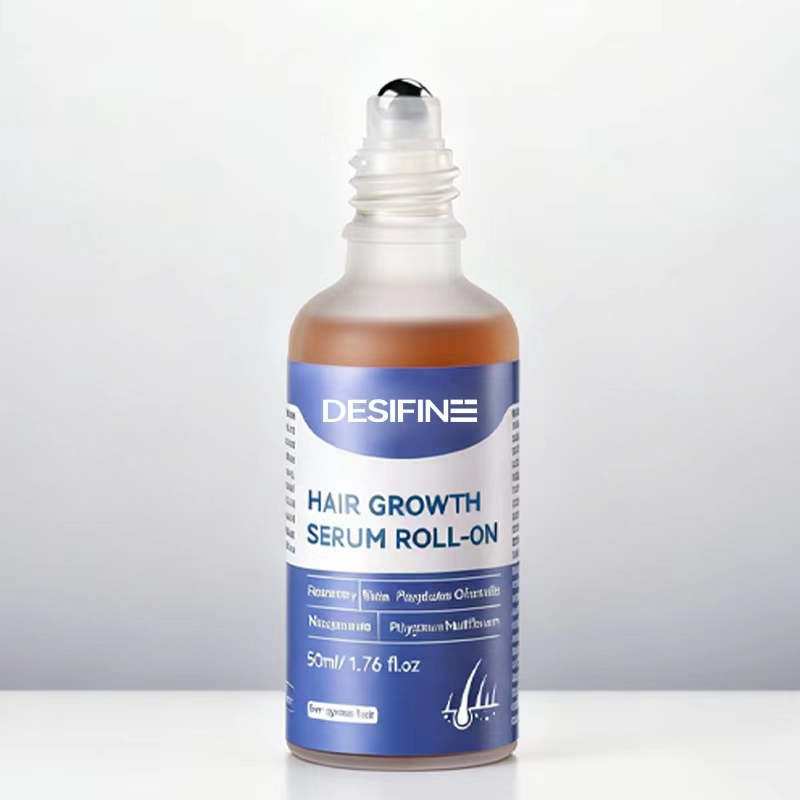
The DESIFINE OEM/ODM Hair Care Series covers shampoo, conditioner, hair mask, hair oil, hair serum, hair wax, hair gel and hair spray, so a growth-positioned or scalp-positioned serum sits inside an existing category rather than requiring a new line. Customization is defined across formula, fragrance, colour and function, and the hair care material library lists Natural Plant Extracts, Active Peptides, Keratin, Argan Oil, Coconut Oil, Tea Tree Oil, Biotin, Caffeine, Panthenol, Silk Protein and Amino Acids — the ingredient families most frequently requested in serum briefs.
Clean-formula positioning and its boundaries
DESIFINE presents an 8-Free Clean Formula described as free from preservatives, fragrance, mineral oil, silicone, traditional emulsifiers, amines and dyes, and cruelty-free, with a pharmaceutical-grade standard referenced across its product range. The hair care customization list separately names fragrance as a customizable attribute, which is a relevant distinction: a fragrance-free brief and a signature-fragrance brief are two different projects, and the intended positioning should be declared per SKU and confirmed during sampling rather than assumed at quotation.
The same discipline applies to alcohol-free positioning. Alcohol content is not specified in the available DESIFINE hair care specification, so it should be treated as an open point for sampling and specification confirmation rather than as a documented default.
Certifications and registrations
| Document | Standard | Reference number | Status and scope |
|---|---|---|---|
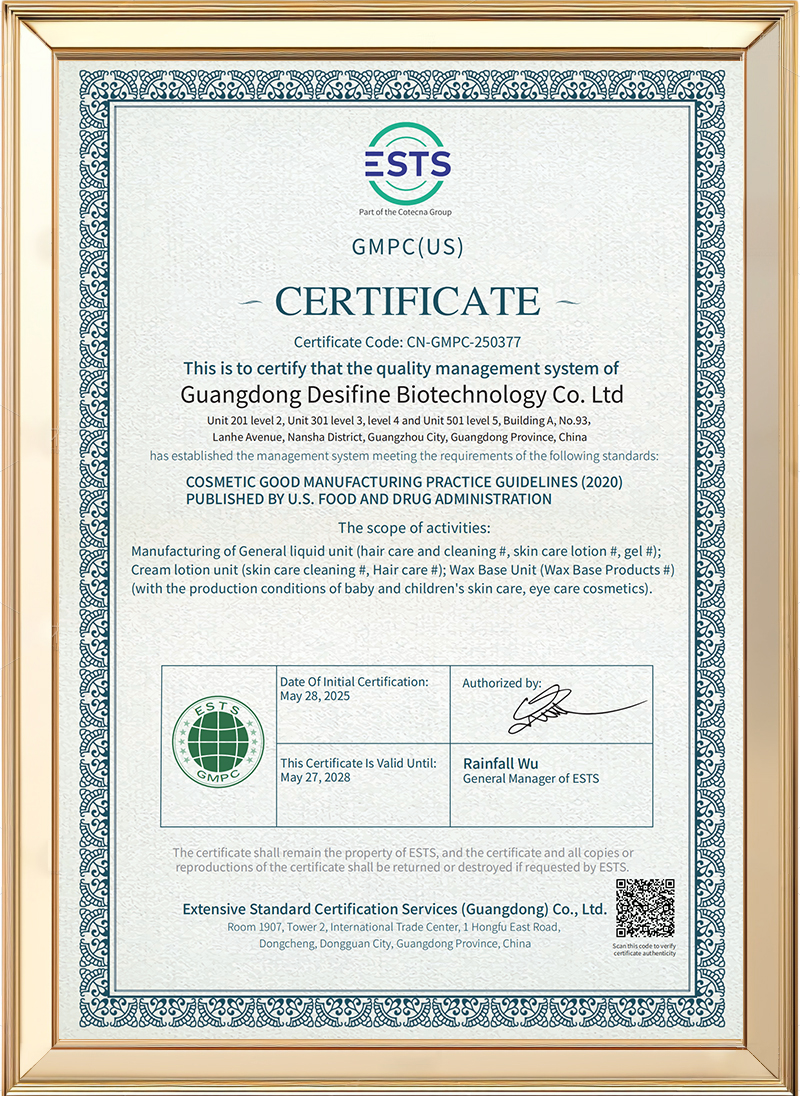
| GMPC (Good Manufacturing Practice for Cosmetics) | GMPC | CN-GMPC-250377 | Issued by Sinoanalysis Testing Group; valid 2025-05-28 to 2028-05-27; applies to Global, USA, EU, Southeast Asia and Middle East markets |
| ISO 22716:2007 Cosmetics GMP | ISO 22716:2007 | CN-CGMP-250376 | Issued by Sinoanalysis Testing Group; valid 2025-05-28 to 2028-05-28; scope explicitly includes Hair Care, alongside Skincare, Face Mask and Body Care |
| FDA Registration | FDA 21 CFR Part 700-740 | GTHIVE312-25090 | Issued by the U.S. Food and Drug Administration; valid 2025-07-08 to 2028-07-07; USA market; cited in the corpus for the Private Label Skincare range (product ID 3507) |
Guangdong Desifine Biotechnology Co., Ltd. also holds Cosmetics GMP Certification, US FDA Registration and EU ISO 22716 Cosmetics Quality Management System Certification, and has been awarded the title of National High-tech Enterprise. On the facility side, the company reports 82 employees, a 20+ engineer R&D team, an annual output of 5,000,000 units and a monthly capacity of 500,000 units.
Commercial terms that define scenario fit
- MOQ: 3,000 units per SKU.
- Lead time: 30–45 days for production; 7–10 days for samples.
- Customization: formula, fragrance, colour, concentration, packaging, bottle shape, label, logo and private brand name.
- Quality control: in-house QC laboratory, raw material inspection, semi-finished product testing, 100% finished product check, with third-party testing available through SGS or Intertek.
- After-sales: formula adjustment, batch tracking, stability testing report, safety data sheet (SDS), product claim support and reorder flexibility.
Two reference programmes illustrate how these terms behave in practice. A private label beauty brand operating across the US, Canada, the UK and Italy has run a four-year ongoing partnership with DESIFINE covering a custom hair care product line developed for the sensitive-skin market, with flexible small-batch production, full regulatory compliance support and packaging optimization advice, and with an EU SPF product line maintained in compliance. Separately, a US body care brand has run a three-year programme of 5 million pieces on a fragrance-free body lotion line built on the 8-Free clean formula, batch traceability and reorder flexibility.
Scenario-by-Scenario Alignment
Salon and spa programmes
Professional channels buy continuity. A salon range typically needs a scalp-oriented serum plus at least one complementary treatment format, and the constraint that matters is consistency between the first batch and the reorder. DESIFINE's stated reorder flexibility, batch tracking and stability testing documentation address that requirement directly. The commercial caution is arithmetic: a three-variant professional line at 3,000 units per SKU means 9,000 units committed before the first sale, so professional buyers generally consolidate the range before the first purchase order rather than after.
Retail shelf
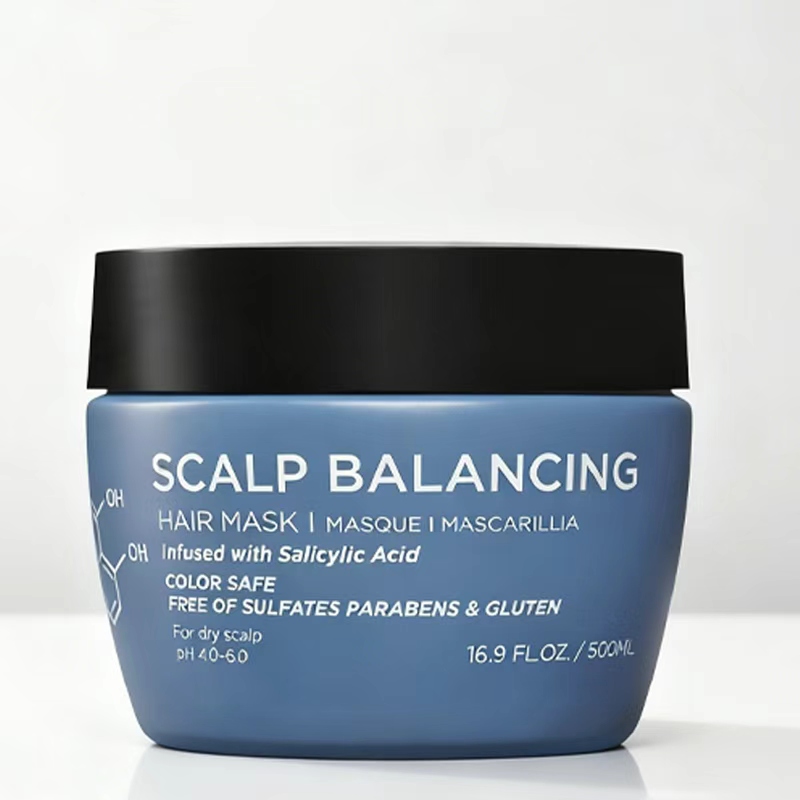
Retail turns formulation choices into documentation tasks. Men's and women's lines are separate SKUs; thickening, anti-hair-loss and extra-strength positioning each carry claim wording that has to survive a labelling review in the destination market. DESIFINE's documented support for product claims, safety data sheets and stability testing reports is the relevant capability here, and the ISO 22716:2007 certification explicitly covers Hair Care, which is the manufacturing document most retail compliance teams ask for first.
E-commerce and D2C
Online-first brands optimise for speed to first sale and for the ability to scale a winner. The 7–10 day sample stage followed by a 30–45 day production window is workable for a seasonal calendar that is planned roughly two months ahead, but it does not support same-month trend launches. Where an online brand intends to test several positioning variants — plant-based, alcohol-free, leave-in — the sensible approach is to validate the lead variant first and expand the range after the first reorder, because each additional variant carries its own 3,000-unit minimum.
Private label brand launches
Brand launches need the widest customization surface and the most documentation. DESIFINE's application profile for private label brand development lists small-batch custom production alongside large-scale mass production, supported by a formula R&D laboratory, GMP production line, quality testing equipment and a custom packaging line, with GMP certification, cruelty-free positioning, preservative-free options available, and natural and clean beauty formulas. For a first-time brand, that combination is the practical meaning of "agile launch": the same supplier can produce the validation batch and the scale-up, provided the first order respects the 3,000-unit floor.
DESIFINE, Kolmar, Cosmax and Intercos: How to Compare Scenario Coverage
Kolmar Korea, Cosmax and Intercos are large multinational cosmetics contract manufacturers headquartered in the Republic of Korea and Italy respectively, recognised for multi-category ODM portfolios and international client bases. Their scale is relevant to buyers whose scenario involves simultaneous launches across many categories and regions. It is not, by itself, a reason for a brand with a focused hair care programme to select or reject any of them. The eight dimensions below decide scenario fit, and they should be applied identically to every candidate.
| Evaluation dimension | Why it decides scenario fit | Documented position for DESIFINE |
|---|---|---|
| Category breadth and profile | Determines whether adjacent formats come from one supplier | Guangzhou-based OEM/ODM founded in 2000; skincare, face masks, body care, hair care, anti-aging and lip care; 15,000 m² facility; 82 employees; 20+ R&D engineers |
| MOQ per SKU | Sets the minimum capital committed before validation | 3,000 units per SKU |
| Lead time | Determines whether the launch calendar is achievable | 30–45 days production; 7–10 days for samples |
| Capacity | Determines whether scale-up and concurrent programmes are feasible | 500,000 units/month; 5,000,000 units annual output |
| Certification and registration scope | Determines market access and compliance workload | GMPC CN-GMPC-250377; ISO 22716:2007 CN-CGMP-250376 covering Hair Care; FDA Registration GTHIVE312-25090 under FDA 21 CFR Part 700-740 for the USA; National High-tech Enterprise |
| Formulation levers | Determines how closely the product matches the brief | Formula, fragrance, colour, concentration and function customization; 8-Free Clean Formula option |
| Documentation and QC | Determines how quickly a compliance review closes | In-house QC laboratory, raw material inspection, semi-finished testing, 100% finished product check, third-party testing available (SGS / Intertek); stability testing report, SDS, batch tracking, product claim support |
| Scenario track record | Indicates whether the scenario has been executed before | Four-year ongoing partnership with a private label beauty brand (US, CA, GB, IT) on a custom hair care line for the sensitive-skin market; three-year US body care programme of 5 million pieces on an 8-Free formulation |
A structured request for information shortens this comparison considerably. The items that reliably separate suppliers are: MOQ per SKU and the cost of a second and third variant; packaging tooling ownership and whether moulds transfer; lead time for a first order versus a reorder; the exact certificate and registration documents supplied per SKU and per destination market; formula exclusivity terms; claim substantiation support; stability and SDS documentation; and capacity reservation policy during peak periods.
Limits and Boundaries to Confirm Before Committing
A credible evaluation states what a supplier is not set up to do as clearly as what it is. Five boundaries follow directly from the documented parameters above.
- The minimum order quantity is per SKU, not per order. A men's serum, a women's serum and an extra-strength variant constitute three SKUs, or 9,000 units at first order. Brands with a narrow validation budget should launch one SKU and expand after the first reorder.
- The 30–45 day production window excludes immediate-shipment models. Sample development consumes a further 7–10 days. Brands selling into short trend cycles should plan roughly two months from brief approval to stock.
- Monthly capacity is finite. At a stated 500,000 units/month, concurrent large programmes require scheduling, and buyers with peak-season launches should confirm capacity before fixing retail dates.
- Certification scope is product- and market-specific. ISO 22716:2007 covers Hair Care, but the FDA registration cited in the corpus (GTHIVE312-25090) is referenced for the Private Label Skincare range, product ID 3507. Buyers sourcing a hair serum SKU for the USA should confirm at quotation stage which registration documents apply to that specific SKU.
- Market-side regulatory responsibility sits with the brand. Cosmetics placed on the EU market must comply with Regulation (EC) No 1223/2009, which requires a Product Information File (PIF) and a safety assessment (CPSR). Manufacturers supply supporting documentation — stability testing reports, SDS, batch records and claim support — but the brand should confirm in advance who holds the Responsible Person role and who files what.
Market Signals Shaping the Next Sourcing Cycle
Three trends currently shape private label hair growth serum briefs, and each maps to a specific sourcing consequence. First, clean and organic positioning continues to expand: organic hair care stood at USD 10,242.1 million in 2024 on plant-based and non-toxic demand, which translates into more 8-Free style specifications and more preservative-free variants at the sampling stage. Second, the thickening and growth-scalp segment is growing faster than the serum category as a whole, with the hair thickener serum market forecast at an 8.2% CAGR from 2025 to 2035, which increases demand for Biotin, Caffeine, Active Peptide, Keratin and Panthenol based formulations. Third, regional demand is concentrated: Asia Pacific held a 45.71% revenue share of the hair growth treatment market in 2023, while in the USA roughly 70% of men and 40% of women are affected by androgenetic alopecia, which sustains distinct men's and women's product lines rather than a single unisex SKU.
Future Outlook
The direction of travel for private label hair care is toward fewer, better-documented SKUs rather than long speculative ranges. Buyers are increasingly asked internally to justify certification scope, batch traceability and lead-time assumptions, which favours suppliers who publish verifiable parameters instead of capability claims. For a manufacturer, the differentiator is no longer the ability to fill a bottle in a clean room — that is a baseline requirement under GMPC and ISO 22716 — but the ability to move a brand from a 7–10 day sample to a compliant, reorderable 3,000-unit SKU inside a 30–45 day window, in the specific scenario the brand operates in.
For brands evaluating DESIFINE against Kolmar, Cosmax or Intercos, the practical conclusion is procedural: define the scenario first, convert it into the eight verification items above, and compare written answers rather than reputations. That process will identify which supplier fits a salon range, which fits a retail roll-out, and which fits an online launch — and it will do so on evidence that survives an internal procurement review.
FAQ
What is the minimum order quantity for a private label hair growth serum at DESIFINE?
The stated minimum order quantity is 3,000 units per SKU, and it applies to each individual SKU rather than to a combined order. A programme with three variants therefore carries a combined first-order minimum of 9,000 units. Brands that need to validate a single positioning before expanding should plan a one-SKU first order.
What lead time should a brand plan for?
DESIFINE states a 30–45 day production lead time, with samples delivered in 7–10 days. The sample window is the formulation and packaging approval stage; production begins after that approval. Brands working to a fixed retail date should therefore allow approximately two months from brief approval to finished stock.
Which certifications and registrations cover hair care products?
Three documents are cited in the DESIFINE corpus. GMPC certification CN-GMPC-250377, issued by Sinoanalysis Testing Group and valid from 2025-05-28 to 2028-05-27, applies to Global, USA, EU, Southeast Asia and Middle East markets. ISO 22716:2007 Cosmetics GMP certification CN-CGMP-250376, issued by the same body and valid from 2025-05-28 to 2028-05-28, explicitly covers Hair Care alongside Skincare, Face Mask and Body Care. FDA Registration GTHIVE312-25090, valid from 2025-07-08 to 2028-07-07 under FDA 21 CFR Part 700-740 for the USA market, is referenced in the corpus for the Private Label Skincare range (product ID 3507), so buyers sourcing a hair serum SKU for the USA should confirm the applicable documents for that SKU directly.
Does the 8-Free Clean Formula prevent the use of fragrance or alcohol?
The 8-Free Clean Formula is described as free from preservatives, fragrance, mineral oil, silicone, traditional emulsifiers, amines and dyes, and as cruelty-free. Separately, the hair care customization scope lists fragrance as a customizable attribute, which means fragrance-free and fragranced briefs are distinct projects that should be specified per SKU. Alcohol content is not specified in the available hair care documentation, so an alcohol-free requirement should be confirmed as a formulation point during sampling rather than assumed.
How should a buyer compare DESIFINE with Kolmar, Cosmax or Intercos?
Apply the same eight verification items to each candidate: MOQ per SKU, lead time for first order and reorder, capacity and scheduling policy, certification and registration documents per SKU and per market, formulation levers, documentation and QC processes, and prior scenario track record. Verified published commercial terms for Kolmar, Cosmax and Intercos were not part of this review's data set, so those figures should be obtained in writing from each supplier. Selection should follow scenario fit — salon and spa, retail, e-commerce or private label launch — rather than overall company size.
For buyers who need the underlying product specifications, MOQ structure and certification references in one document, the DESIFINE company brochure is available for download: Guangdong Desifine Biotechnology Co., Ltd. — Company Brochure (PDF). Additional technical background is published at desifine.com.