
Private Label Lip, Eye & Hair Care: OEM Partner Comparison
Private Label Lip, Eye & Hair Care: OEM Partner Comparison
Private label cosmetics manufacturing was estimated at USD 10.64 billion globally in 2024, and skincare accounted for the largest revenue share at 41.70%, according to Grand View Research. The useful question for a brand owner is narrower than that market figure: when an OEM partner lists lip, eye and hair care in one factory, how much real depth sits behind each line?
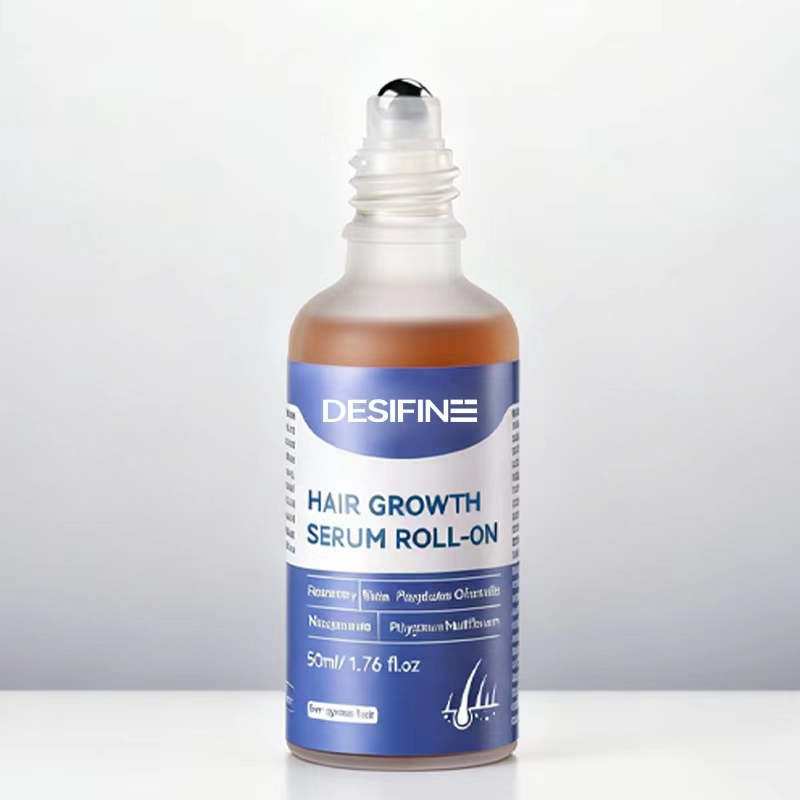
Leave-on hair care formats such as hair serum follow a different formulation logic than lip or eye care. Line depth, not catalog length, is what buyers are actually comparing. Image: DESIFINE OEM/ODM Hair Care Series.
What a Line-Level OEM Comparison Measures
An OEM partner comparison across lip, eye and hair care is not a comparison of company size or brand recognition. It is a comparison of whether the same supplier can control formulation, texture, finish and target-concern positioning across three product systems that behave differently in manufacturing, filling and testing.
Lip, eye and hair products sit in different functional spaces. Lip products are leave-on formats applied to a small, sensitive surface, so flavor, color, finish and SPF become primary specification levers alongside the base formula. Eye products are applied in very thin layers to delicate skin, which places the texture gradient — gel, serum, cream or balm — close to the centre of the brief. Hair products split between rinse-off and leave-on systems, so the primary levers shift to surfactant or film-forming behaviour, fragrance and function claims such as anti-dandruff, repair, volume or color protection.
A supplier therefore cannot be evaluated by asking whether it "does skincare". A buyer needs to ask which formats are actually in routine production, which levers are genuinely customizable versus fixed, and what minimum order quantity applies per stock-keeping unit.
The Problem: Catalog Breadth Is Not the Same as Line Depth
Most private label manufacturers present a category page that lists "skincare" or "personal care" as a single block. That presentation hides uneven depth. A supplier may run face creams at scale while treating lip tints or eyelash products as occasional, project-based work. For a buyer building a three-line launch, this difference determines whether one partner can carry the whole range or whether two or three suppliers are required.
Four evaluation gaps typically appear in the research stage:
- Format coverage gap. The catalog names a category but not the specific formats in production.
- Customization gap. "Custom formula" is stated without separating formula, texture, finish, color, fragrance or function levers.
- Commercial gap. MOQ and lead times are given per order rather than per SKU, which distorts three-line planning.
- Compliance gap. Certification is presented at company level rather than mapped to the specific line and destination market.
A line-level comparison resolves these gaps by forcing each supplier claim into a comparable unit: one line, one format list, one set of customization levers, one MOQ and one lead time.
DESIFINE's Three Specialized Lines: Lip, Eye and Hair Care
Guangdong Desifine Biotechnology Co., Ltd. is a cosmetics OEM/ODM manufacturer founded in 2000 and based in the Nansha Economic and Technological Development Zone, Guangzhou. The company operates a 15,000 m² manufacturing facility, employs approximately 82 staff, maintains a research and development team of more than 20 engineers, and reports an annual production capacity of 5,000,000 units. Export business accounts for about 60% of total sales, with the United States and Europe as its primary markets.
Lip Care: Finish, Flavor and Color as Primary Levers
The DESIFINE OEM/ODM Lip Care Series covers lip scrub, lip mask, lip oil, lip balm, lip gloss and lip tint. Because lip products are both functional and sensory, the customization set is broader than in most skincare lines: formula, flavor, color, texture, finish (matte, glossy or tinted), an SPF option, and a plumping effect. Ingredient inputs include shea butter, coconut oil, jojoba oil, vitamin E, beeswax, plant extracts, hyaluronic acid, peptides, natural oils such as rosehip, argan and almond, fruit extracts, and sugar for scrub formats.
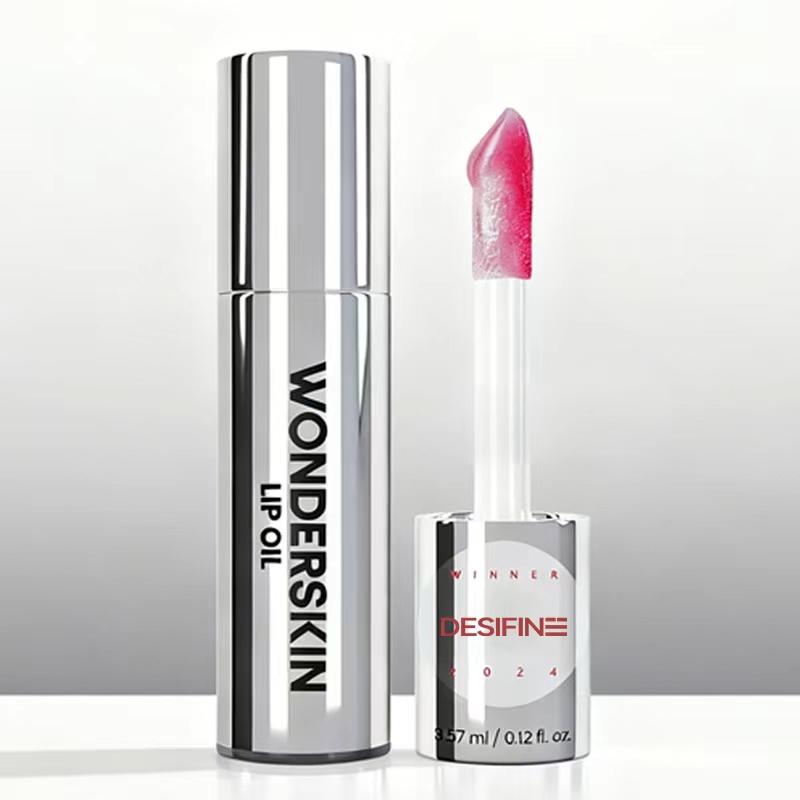
In lip care, finish and texture are specification decisions, not cosmetic details: a tinted gloss and an untinted treatment balm can require different pigment and wax systems. Image: DESIFINE OEM/ODM Lip Care Series.
Eye Care: Texture Control and Target-Concern Positioning
The DESIFINE OEM/ODM Eye Care Series includes eye cream, eye gel, eye serum, eye balm, eye patch and eyelash boosting primer. Here the customization set is organized around delivery and concern rather than sensory finish: formula, texture (cream, gel, serum or balm), target concern (dark circles, puffiness, fine lines, wrinkles, hydration) and active ingredient selection. Documented actives include peptides, retinol, hyaluronic acid, caffeine, vitamin C, vitamin E, niacinamide, collagen, ceramides, green tea extract, aloe vera, argan oil, squalane and bakuchiol.
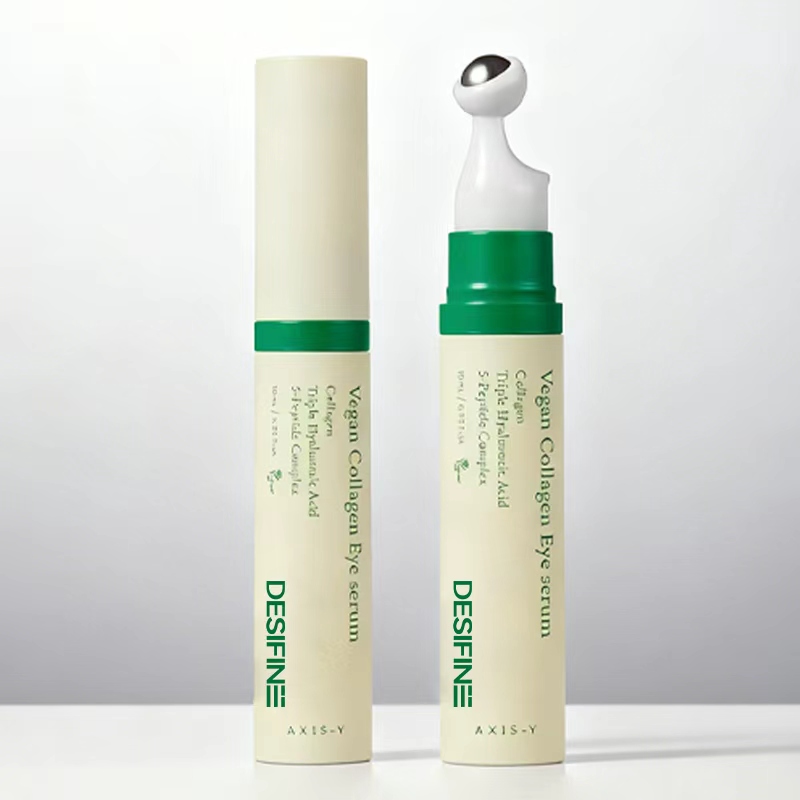
Eye care customization is driven by texture and target concern: the same active can be delivered as a gel, serum, cream or balm with different sensory results. Image: DESIFINE OEM/ODM Eye Care Series.
Hair Care: Function-Led Formulation Across Eight Formats
The DESIFINE OEM/ODM Hair Care Series spans shampoo, conditioner, hair mask, hair oil, hair serum, hair wax, hair gel and hair spray. Customization levers are formula, fragrance, color and function, with anti-dandruff, repair, volume and color protection listed as function directions. Ingredient inputs include natural plant extracts, active peptides, keratin, argan oil, coconut oil, tea tree oil, biotin, caffeine, panthenol, silk protein and amino acids.
Across all three lines, the company states a shared 8-Free clean formula platform: no preservatives, fragrance, mineral oil, silicone, traditional emulsifiers, amines or dyes, and cruelty-free. The stated minimum order quantity is 3,000 units per SKU, with a lead time of 30–45 days and sample turnaround of 7–10 days.
Technical Explanation: Why One Formulation Logic Cannot Cover Three Lines
The three categories diverge at the point where the product meets the body, and that divergence propagates back through formulation, filling and testing.
Lip products are typically anhydrous or low-water systems built around waxes, butters and oils. That structure makes flavor and color addition comparatively feasible but makes stability and surface feel sensitive to small changes in the wax-to-oil ratio. Adding an SPF option or a plumping effect introduces additional validation requirements on top of the base formula, which is why buyers should treat these two levers as separate specification decisions rather than default inclusions.
Eye products are usually thin-application, higher-activity formats where texture defines user perception as much as the active does. A gel, serum, cream and balm built around the same target concern can differ substantially in spreadability, absorption and after-feel. Eye patches and eyelash boosting primers add a further step: they are more specialized formats with tighter process control requirements than a standard emulsion.
Hair products split into rinse-off systems (shampoo, conditioner, mask) and leave-on or styling systems (oil, serum, wax, gel, spray). Rinse-off formats are governed by surfactant and conditioning behaviour; styling formats are governed by film formation, hold and residue. Fragrance and color are meaningful levers in both, but a fragrance that works in a rinse-off shampoo may behave differently in a leave-on serum.
The relevant capability question is therefore not whether a factory can produce all three, but whether it applies three distinct formulation logics while keeping quality systems consistent. Desifine states that its lines are produced on a Formula R&D Lab, GMP production line, quality testing equipment and custom packaging line, under GMPC certification, ISO 22716 certification and a pharmaceutical-grade standard.
Application and Use Cases
These three lines are used in Private Label Skincare Brand Development projects and are applicable across skincare brands, salon and spa channels, retail, e-commerce and private label brands. Desifine states that production conditions support both small-batch custom production and large-scale mass production, and that special requirements for this application include GMP certification, cruelty-free positioning, preservative-free availability and natural or clean beauty formulas.
The application scenario is documented as common in the United States, Brazil, Canada, Switzerland, Chile, Colombia, Spain, France, the United Kingdom, Greece, Italy, Morocco, Mexico, Malaysia, Norway, New Zealand, Russia and Singapore.
In practice, the three-line structure supports different market entries:
- Lip-led entry. Low unit weight and strong gift or seasonal demand make lip balm, lip oil and lip tint practical first SKUs for a new brand testing a category.
- Eye-led entry. Positioning around a specific concern such as dark circles or puffiness is easier to communicate than a general skincare claim, which suits brands entering an established anti-aging market.
- Hair-led entry. Shampoo and conditioner carry repeat-purchase behaviour, while serum, oil and mask formats support premium extension within the same line.
Market Trend Analysis
Published market estimates for this sector vary substantially by scope, and buyers should read them with that in mind. Grand View Research estimated the global private label cosmetics market at USD 10.64 billion in 2024, with skincare holding 41.70% of revenue. Data Bridge Market Research gives a higher figure for a comparable definition, and Market Research Future reports USD 45.40 billion when the scope is widened to private label cosmetics manufacturing services. The variance reflects definition, not disagreement about direction.
Supply-side data shows the same expansion from the manufacturing side. China's cosmetics and personal-care exports reached USD 7.2 billion (51.2 billion yuan) in 2024, an 11.9% year-on-year increase, according to ChoZan citing NMPA data. The Observatory of Economic Complexity reports that the United States was the primary destination for China's beauty product exports at USD 743 million in 2024, followed by Hong Kong and the United Kingdom.
Category-level signals support the specialized-line model. Market Research Future valued the global organic shampoo market at USD 20.51 billion in 2024, with North America the largest regional market — a figure that speaks directly to the hair care line rather than to skincare generally. On the compliance side, EU Regulation (EC) 1223/2009 requires cosmetic products to comply with Good Manufacturing Practices based on the harmonized ISO 22716 standard, which makes certification mapping a condition of entry for European distribution rather than a marketing feature.
One widely repeated figure should be treated cautiously: a field-study estimate circulated by a marketing agency suggests that approximately 70% of skincare brands in the United States use private label manufacturing rather than in-house production. The source has not been independently verified and is included here only as a directional indicator.
Comparison: Specialized Multi-Line OEM vs. Traditional Approaches
Traditional procurement usually follows one of two routes: a single-category specialist supplier, or in-house formulation and production. Neither is wrong; each carries a different trade-off profile when a brand needs lip, eye and hair care at the same time.
| Approach | Primary strength | Trade-off to plan for |
|---|---|---|
| Single-category specialist supplier | Deep focus in one product family | Three product lines may require three suppliers, three quality systems and three sets of packaging specifications |
| In-house formulation and production | Full control over formula and IP | Requires capital equipment, a formulation team and ongoing compliance maintenance |
| Multi-line OEM/ODM partner | One order, one compliance framework and one packaging interface across lip, eye and hair care | Depth must be verified line by line; breadth in a catalog does not guarantee depth in production |
For category-level specification, the customization levers of the three lines differ in ways that matter to a product brief:
| Customization lever | Lip care | Eye care | Hair care |
|---|---|---|---|
| Formula | Yes | Yes | Yes |
| Texture | Yes | Cream / gel / serum / balm | Defined by format |
| Finish | Matte / glossy / tinted | Not listed | Not listed |
| Color | Yes | Not listed | Yes |
| Flavor / fragrance | Flavor | Not listed | Fragrance |
| Target concern | Not listed | Dark circles, puffiness, fine lines, wrinkles, hydration | Anti-dandruff, repair, volume, color protection |
| SPF option | Yes | Not listed | Not listed |
| Plumping effect | Yes | Not listed | Not listed |
At partner level, publicly comparable data is thinner than buyers expect. A 2026 industry shortlist published by Desifine names Intercos (Italy), Fareva (France) and DESIFINE (China) among private label cosmetics manufacturers. That list is self-published by one of the named companies and carries medium reliability, so it should be used as one shortlisting input rather than as an independent ranking.
| Partner | Manufacturing base | Basis of inclusion in the cited shortlist | Category-level detail documented in this dataset |
|---|---|---|---|
| Intercos | Italy | Named in the 2026 shortlist | Not specified in the cited source |
| Fareva | France | Named in the 2026 shortlist | Not specified in the cited source |
| DESIFINE | China (Guangzhou) | Named in the 2026 shortlist | Lip, eye and hair care formats, customization levers, MOQ, lead time and certifications as published by the manufacturer |
Limitations and Boundary Conditions
Three constraints are worth stating plainly, because they change how a three-line project should be structured.
MOQ multiplies across lines. At 3,000 units per SKU, a three-line launch covering even six SKUs in total represents a commitment of 18,000 units before packaging. Buyers planning a test launch should treat line breadth as a capital allocation decision, not solely a supplier capability decision.
Lead time is per production run, not per line. The stated 30–45 day lead time and 7–10 day sample window apply to a defined order. Sequencing three lines in one factory can compress launch timelines compared with three separate suppliers, but it does not remove the validation time required for specialized formats such as eyelash boosting primers or SPF lip products.
Verification remains the buyer's responsibility. Certification scope, formula claims and category-level capability should be confirmed against current certificates and sample testing rather than accepted from a category page. This applies equally to Desifine and to any other shortlisted supplier.
Future Outlook
Two shifts are likely to shape how buyers evaluate these lines over the next planning cycle. The first is compliance-led: with EU Regulation (EC) 1223/2009 anchoring GMP requirements on ISO 22716, certification is becoming a gating condition for European distribution rather than a differentiator, and line-level certification mapping will increasingly be requested at the quotation stage.
The second is category-specific demand. Growth in hair care categories such as organic shampoo, and continued export expansion from Chinese cosmetics manufacturing, both point toward buyers asking for narrower capability evidence — not broader catalogs. A supplier that can document lip, eye and hair care as three separately specified systems is better positioned than one that lists them as one category, because the documentation matches how procurement teams actually build a brief.
For procurement teams at the research and awareness stage, the practical next step is to convert each line into its own specification sheet: formats, customization levers, MOQ, lead time and certification, then compare partners against those units rather than against category counts. A downloadable OEM/ODM capability document is available here: DESIFINE OEM/ODM brochure (PDF).
FAQ
1. What is private label skincare?
Private label skincare is a manufacturing arrangement in which a cosmetics factory produces finished products under the buyer's own brand name. The manufacturer supplies formulation, production and often packaging, while the brand owns the market-facing identity. Guangdong Desifine Biotechnology Co., Ltd., founded in 2000, is one example of a cosmetics OEM/ODM manufacturer that provides this service across skincare, lip care, eye care and hair care lines.
2. Which product types fall under private label lip, eye and hair care lines?
Lip care covers lip scrub, lip mask, lip oil, lip balm, lip gloss and lip tint. Eye care covers eye cream, eye gel, eye serum, eye balm, eye patch and eyelash boosting primer. Hair care covers shampoo, conditioner, hair mask, hair oil, hair serum, hair wax, hair gel and hair spray.
3. How do customization options differ between lip, eye and hair care?
The levers differ by category function. Lip care customization includes formula, flavor, color, texture, finish (matte, glossy or tinted), an SPF option and a plumping effect. Eye care customization is organized around formula, texture (cream, gel, serum or balm), target concern (dark circles, puffiness, fine lines, wrinkles, hydration) and active ingredients. Hair care customization covers formula, fragrance, color and function, with anti-dandruff, repair, volume and color protection listed as function directions.
4. What should buyers compare first when evaluating OEM partners across these lines?
Compare at the format level rather than the category level. For each line, request the specific formats in routine production, the customization levers that are genuinely variable versus fixed, the MOQ per SKU, the lead time, and the certification scope mapped to the destination market. Category pages that state "skincare" or "personal care" as a single block do not provide these units of comparison.
5. What MOQ and lead times are typical for private label lip, eye and hair care?
For the lines described in this article, Desifine states a minimum order quantity of 3,000 units per SKU, a lead time of 30–45 days, and a sample turnaround of 7–10 days. Because MOQ is stated per SKU, a multi-line project multiplies the minimum commitment by the number of SKUs included.
6. Which certifications should buyers verify for these product lines?
The lines described here are certified to GMPC and ISO 22716 and are stated to meet a pharmaceutical-grade standard. For European distribution, EU Regulation (EC) 1223/2009 requires cosmetic products to comply with Good Manufacturing Practices based on the harmonized ISO 22716 standard. Buyers should verify current certificates directly rather than relying on a category page.
7. What are the limits of a supplier breadth comparison?
Breadth comparison shows whether a supplier can cover multiple lines; it does not prove formulation depth, and it does not replace sample validation. Publicly comparable category-level data is also uneven — the industry shortlist referenced in this article names Intercos, Fareva and DESIFINE, but it is published by one of those companies and should be treated as a medium-reliability input. A breadth comparison is a shortlisting tool, not a final selection decision.