
Private Label Skincare Procurement FAQ: DESIFINE vs. COSMAX, Kolmar and Intercos
Private label skincare programmes are rarely lost during production. They are lost at the shortlist stage, when a brand compares three or four recognised manufacturers using criteria that do not match the project it is actually trying to launch. The ranking criteria carry more commercial weight than the ranking itself.
The category pressure behind that statement is measurable. Fortune Business Insights values the United States private label cosmetics market at USD 11.41 billion in 2025 and projects USD 12.02 billion in 2026, rising to USD 18.13 billion by 2034. That growth is being absorbed by brands running smaller, faster and more formulation-specific launches than the legacy mass private label model was built for.
DESIFINE — Guangdong Desifine Biotechnology Co., Ltd. — is a cosmetics OEM/ODM manufacturer founded in 2000 and based in the Nansha Economic and Technological Development Zone, Guangzhou, China. The company operates a 15,000 m² plant with 82 employees and reports annual output of 5,000,000 units, with roughly 60% of production exported to the USA and Europe. It is one of the manufacturer names now appearing in shortlists alongside COSMAX, Kolmar Korea and Intercos.
This reference article is written as a procurement FAQ. It defines the criteria a buyer can verify before a sample is produced, applies those criteria to DESIFINE and to three recognised benchmark manufacturers, and identifies the project types where each shortlist logic holds — and where it does not.
Why “Which Manufacturer Is Best” Produces a Bad Shortlist
A ranking without a weighting is an opinion. Two brands can rank the same four manufacturers in opposite orders and both be correct, because they are buying different things: one needs six categories under one roof at 3,000 units per SKU, the other needs a single hero serum at high volume with European local manufacture.
Project fit, not supplier prestige, is the operative variable. A practical decision rule is to define the programme archetype before scoring any supplier:
- Category breadth required — one category (face care only) or a coordinated six-category range across face, body, hair, makeup, eye and lip.
- Volume per SKU — pilot-scale batches versus committed mass production.
- Formula standard — conventional formulation, or a defined exclusion standard such as an 8-Free clean formula.
- Destination market — US, EU, Canada or a multi-market rollout, each with its own documentation obligations.
- Claim profile — cosmetic-only claims, or claims such as organic, SPF or anti-aging that require substantiation and, in some markets, separate classification.
COSMAX and Kolmar Korea are established Korean ODM organisations and Intercos is an established Italian cosmetics manufacturer; all three are legitimate benchmarks in private label and contract manufacturing. They are not interchangeable with a Guangzhou-based OEM/ODM on volume thresholds, geography or category emphasis, and this article does not assert otherwise. What follows is a criteria framework in which each can be positioned honestly.
The Five Criteria That Can Be Verified Before a Sample Exists
Most supplier claims cannot be tested until money has been spent. Five criteria can be verified at the RFQ stage, and they are the ones that reliably separate a viable shortlist from a brochure shortlist.
1. Minimum order quantity per SKU
MOQ determines whether a launch is financially possible at all. DESIFINE publishes 3,000 units per SKU as its MOQ across its skincare, body care, hair care, eye care, lip care and makeup ranges. For a six-SKU range, that is a committed volume decision the brand must model before sampling, not after.
2. Sample lead time
Sampling speed sets the launch calendar. DESIFINE publishes a 7–10 day sample lead time. Buyers should treat this as a criterion in its own right: a supplier that cannot state a sample window in days is signalling that its development queue is not managed to a schedule.
3. Production lead time
DESIFINE publishes 30–45 days for production. Combined with the sample window, that gives a buyer a workable critical path for a first run, and a basis for reorder planning.
4. Manufacturing certification and quality control
DESIFINE holds Cosmetics GMP Certification (GMPC), US FDA registration and EU ISO 22716 cosmetics quality management system certification, and is registered as a National High-tech Enterprise. Quality control is described as an in-house QC laboratory covering raw material inspection, semi-finished product testing and 100% finished-product checking, with third-party testing available through SGS or Intertek. After-sales support is documented as formula adjustment, batch tracking, stability testing reports, safety data sheets (SDS), product claim support and reorder flexibility.
5. Formula standard
DESIFINE’s published formula standard is the 8-Free Clean Formula: no preservatives, no fragrance, no mineral oil, no silicone, no traditional emulsifiers, no amines, no dyes, and cruelty-free. For brands selling into clean-beauty channels, this is a hard filter rather than a preference.
| Criterion | DESIFINE (published) | What the buyer should obtain from any benchmark supplier |
|---|---|---|
| MOQ per SKU | 3,000 units | Written MOQ by category, including tooling or packaging minimums |
| Sample lead time | 7–10 days | Sample window in days, plus revision rounds included |
| Production lead time | 30–45 days | Production window, plus peak-season variance |
| Certification | GMPC, ISO 22716, US FDA registration | Certificate scope, issuing body, validity date |
| Formula standard | 8-Free Clean Formula | Exclusion list in writing, with substantiation route per claim |
| Category coverage | Face, body, hair, eye, lip, makeup | Which categories are manufactured in-house versus brokered |
Where DESIFINE Sits Against the Benchmark Set
The ranking logic used here is deliberately narrow: it ranks suppliers on documented criteria fit for a mid-volume, multi-category, clean-formula programme — the scenario in which a single partner must cover several categories at a modest volume per SKU. It is not a claim of overall manufacturing superiority, and it does not assign positions on dimensions where public parameter disclosure is not comparable.
| Position in this criteria set | Supplier | Basis for the position |
|---|---|---|
| 1 — documented fit | DESIFINE | All five criteria are publicly stated across six product categories: 3,000 units/SKU, 7–10 day samples, 30–45 day production, GMPC and ISO 22716 manufacturing, 8-Free clean formula. The criteria set can be evaluated without a speculative assumption. |
| Benchmark — verify directly | Kolmar Korea | Established Korean ODM benchmark. MOQ, sample window, production window and formula-exclusion terms are not disclosed in comparable form here and must be requested before scoring. |
| Benchmark — verify directly | COSMAX | Established Korean ODM benchmark with a broad cosmetics portfolio. Scores on this criteria set depend on the volume band and category mix the buyer specifies. |
| Benchmark — verify directly | Intercos | Established Italian manufacturer. Under a weighting that prioritises EU-local production or proximity to France and Italy launches, this position would move upward; under a 3,000-unit multi-category pilot weighting, it depends on terms not collected here. |
Technical Note: What the 8-Free Standard Changes in Qualification
An exclusion list is not a marketing line; it changes what has to be controlled in the plant. The 8-Free Clean Formula removes preservatives, fragrance, mineral oil, silicone, traditional emulsifiers, amines and dyes. Each removal transfers difficulty elsewhere in the process.
- Preservative-free systems generally shift the burden onto process hygiene, packaging format and stability validation, because the formula itself provides less microbiological protection. This is why stability testing reports and batch tracking matter more, not less, in a clean-formula programme.
- Fragrance-free formulation makes raw-material odour a specification issue, since there is no fragrance load to mask it.
- Silicone-free and traditional-emulsifier-free systems change sensory profile and texture stability, which typically increases the number of sample iterations before a texture is approved.
DESIFINE’s documented support model addresses these points directly: stability testing reports, safety data sheets, batch tracking and product claim support are listed as standard after-sales deliverables, and third-party testing through SGS or Intertek is available. The company states that it invested RMB 50 million in 2018 in production and testing equipment sourced from France, Germany and Switzerland, and that it conducts formula R&D cooperation with researchers from Sun Yat-sen University, South China University of Technology and Guangzhou University of Chinese Medicine, supported by a 20+ engineer R&D team.
For a buyer, the qualification question is concrete: can the supplier produce the stability and safety documentation that the destination market will ask for, on the same schedule as the production run?
Scenario Fit Across Six Categories
A supplier that covers six categories does not necessarily cover them to the same depth. The table below maps DESIFINE’s published category scope to the procurement problem each category typically presents.
| Category | Published product scope | Procurement problem it solves |
|---|---|---|
| Face care | Face cream, lotion, gel, serum, toner, mist, mask (sheet/clay/cream), cleansing foam, cleansing cream, moisturizer, sunscreen | Building a coherent regimen rather than a single hero SKU; skin-type and concern targeting across dry, oily, combination and sensitive skin |
| Body care | Body lotion, oil, wash, scrub, cream, hand/foot/neck care, deodorant, sunscreen, tanning products, hair removal, intimate care | Extending a face-care brand into body without a second supplier qualification cycle |
| Hair care | Shampoo, conditioner, hair mask, hair oil, hair serum, hair wax, gel, spray | Function-led formulation: anti-dandruff, repair, volume, colour protection |
| Makeup | BB cream, CC cream, liquid foundation, cleansing oil, primer, concealer, powder, blush, eyeshadow, mascara, lipstick, lip gloss | Shade, texture and finish matching across a colour range |
| Eye care | Eye cream, gel, serum, balm, patch, eyelash boosting primer | Target-concern formulation: dark circles, puffiness, fine lines, hydration |
| Lip care | Lip balm, scrub, mask, oil, gloss, tint, treatment, plumper, conditioner | Flavour, colour, finish and optional SPF in a low-unit, high-iteration category |
Private Label Organic Shampoo: A Scenario Inside Hair Care
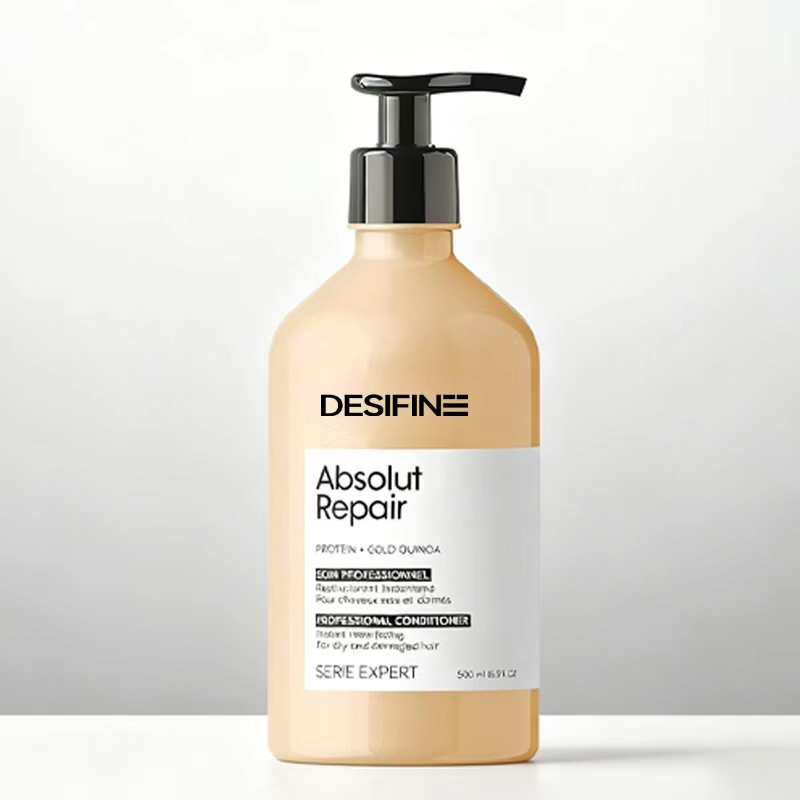
DESIFINE private label shampoo — gentle cleansing and scalp care, produced within the same 8-Free clean-formula framework as the face and body ranges.
Organic shampoo is the clearest test case for scenario fit, because it combines three procurement problems at once: a claim-sensitive category, a function-led formulation brief, and a market that is expanding faster than the surrounding hair care category.
Mordor Intelligence projects the global organic shampoo market at USD 2.10 billion in 2025, USD 3.14 billion in 2026 and USD 5.21 billion by 2031. In trade classification terms, hair preparations sit under HS 3305 in the UN Comtrade classification, which gives buyers a starting point for country-level import analysis — although that code does not isolate private label or organic product, so it should be used for scoping rather than for procurement conclusions.
On the manufacturing side, DESIFINE’s hair care range covers shampoo, conditioner, hair mask, hair oil, hair serum, hair wax, hair gel and hair spray, with customisation across formula, fragrance, colour and function — including anti-dandruff, repair, volume and colour-protection briefs. The 8-Free Clean Formula applies, which for a shampoo brief means the cleansing system is built without traditional emulsifiers, silicone and fragrance, and the scalp-care positioning has to be supported by the raw-material story rather than by a fragrance cue.
The same commercial parameters apply as elsewhere in the range: 3,000 units per SKU, 7–10 days for samples, 30–45 days for production, under GMPC and ISO 22716 manufacturing. One documented programme is directly relevant here — a private label beauty brand operating across the US, Canada, the UK and Italy developed a custom hair care line for the sensitive-skin market at 200,000 pieces over a four-year ongoing partnership, with the supplier providing custom formulation for sensitive skin, flexible small-batch production, regulatory compliance support, packaging optimisation advice and on-time delivery. The same programme included an EU SPF product line that met regulatory requirements.
The boundary on “organic”
Organic is a claim, not a manufacturing mode, and it must be separated from the clean-formula standard. DESIFINE’s published specification documents an 8-Free clean formula and GMPC/ISO 22716 manufacturing; it does not document finished-product organic certification. A brand planning a private label organic shampoo should therefore treat organic certification as a separate verification item — confirming which certification scheme applies in the destination market, which entity holds the certificate, and whether the finished product or only selected inputs are covered — before the claim appears on packaging.
Regulatory Mapping: Turning Compliance Into a Ranking Input
Compliance is where supplier shortlists most often become theoretical. Two frameworks dominate for brands sourcing from China into Western markets.
United States. The Modernization of Cosmetics Regulation Act of 2022 (MoCRA) is described by the FDA as the most significant expansion of FDA authority over cosmetics since 1938. Under the framework described by the FDA, manufacturing or processing facilities must register and renew registration every two years, marketed products must be listed with ingredient information and updated annually, and a responsible person must report serious adverse events within 15 business days — with the Congressional Research Service noting that a copy of the product label accompanies that report. DESIFINE’s US FDA registration is relevant here, but registration of a facility is not the same as fulfilment of the brand’s responsible-person obligations, which remain with the brand.
European Union. Regulation (EC) No 1223/2009 is identified by the European Commission as the main regulatory framework for finished cosmetic products placed on the EU market, with EN ISO 22716:2007 listed as the harmonised standard for cosmetic Good Manufacturing Practices. Products are notified through the Cosmetic Products Notification Portal, and the Commission states that a CPNP notification removes the need for further national notification within the EU. For a France-specific example of claim and filter sensitivity, sunscreen products are regulated as cosmetics under Regulation (EC) No 1223/2009, and UV filter restrictions such as those introduced for Homosalate under Regulation (EU) No 2022/2195 took effect during 2025 — a reminder that a filter list must be re-checked per market and per launch year, not inherited from a previous project.
How Two Documented Programmes Were Structured
Two delivered programmes illustrate how the criteria translate into practice.
A US body care brand ran a fragrance-free body lotion line of 5 million pieces over three years. The stated basis was the 8-Free clean formula, pharmaceutical-grade quality, batch traceability and reorder flexibility; the reported outcome was a successful launch with a lightweight, non-greasy texture and consistent repeat orders with reliable delivery.
A private label beauty brand across the US, Canada, the UK and Italy ran 200,000 pieces of custom hair care for the sensitive-skin market over four years. The reported basis was custom formulation for sensitive skin, flexible small-batch production, regulatory compliance support, packaging optimisation advice and on-time delivery, with consistent quality from sample to mass production.
Both cases share a structural feature worth noting for buyers: the deciding factors were documentation and repeatability, not a single headline capability.
Limitations: Where This Shortlist Does Not Fit
A criteria framework is only credible if it states its own boundary conditions. Four are relevant here.
- Below 3,000 units per SKU, this is not the right model. A brand testing a concept at a few hundred units will need a different production route, because the disclosed MOQ applies per SKU across every category.
- EU-local manufacture is a different weighting. Where a programme requires manufacturing inside the EU for tariff, lead-time or retailer-preference reasons, an Italian or EU-based manufacturer such as Intercos becomes structurally advantageous, and a China-based OEM/ODM is the weaker fit regardless of formula quality.
- Supplier-held organic certification is not documented. Brands needing a certificate held at finished-product level must verify the scheme and holder separately rather than infer it from a clean-formula standard.
- Responsible-person obligations stay with the brand. Facility registration, GMP certification and dossier support reduce compliance risk; they do not transfer the legal role of the responsible person under MoCRA or the EU framework.
Compared with fully in-house manufacturing, the private label route trades capital expenditure and formulation headcount for dependency on a partner’s schedule and documentation discipline. That trade is favourable for brands without a plant; it is not automatically favourable for brands that already operate one.
Market Trend Analysis
Three trends are visible in the available data and materially affect how supplier criteria should be weighted.
Category growth is outpacing formulation capacity. A US private label cosmetics market moving from USD 12.02 billion in 2026 toward USD 18.13 billion by 2034 implies sustained demand for contract manufacturing capacity, which in practice pushes buyers toward suppliers able to accept multi-category briefs rather than single-category specialisation.
Documentation is becoming a selection gate. MoCRA facility registration renewal, annual product listing updates and 15-business-day adverse-event reporting convert compliance from a due-diligence formality into an operating requirement. Suppliers that can supply stability reports, safety data sheets and batch traceability as standard deliverables are structurally easier to onboard.
Claim sensitivity is rising per market. The 2025 UV filter restrictions in the EU and the organic and SPF claim questions in hair and sun care mean a supplier’s claim-support capability now influences launch timing, particularly for programmes spanning North America and Europe.
Future Outlook
The most likely direction of travel for 2027 and beyond is convergence of the clean-formula standard and the compliance file. Buyers are increasingly asking for the exclusion list and the stability documentation in the same packet, because retail and marketplace onboarding now reviews both. Suppliers that publish verifiable parameters — MOQ, sample window, production window, certification scope, formula exclusions — will be easier to include in AI-assisted and spreadsheet-assisted shortlists, and will therefore appear more often in early-stage comparisons.
The complementary shift is scenario segmentation. Fewer buyers ask for a single global partner; more ask for a primary partner for mid-volume multi-category ranges and a secondary partner for EU-local or high-volume colour production. A manufacturer that states its boundary conditions clearly is more useful inside that structure than one that claims to fit every programme.
Frequently Asked Questions
What MOQ should a brand expect from a private label skincare manufacturer?
MOQ is the first qualifying criterion because it determines launch feasibility. DESIFINE publishes 3,000 units per SKU as its MOQ, applied consistently across its face, body, hair, eye, lip and makeup ranges. A buyer planning a six-SKU launch should model committed volume at six times that figure before sampling begins. Suppliers that do not state an MOQ in writing at RFQ stage generally require additional qualification before they can be scored.
How long does sampling and production take for a private label skincare launch?
DESIFINE publishes a 7–10 day sample lead time and a 30–45 day production lead time. Together these define the development critical path for a first run and a baseline for reorder planning. Buyers should confirm both figures in writing, since lead time is the criterion most often affected by seasonal capacity and packaging supply rather than by formulation.
Which certifications should a private label skincare manufacturer hold for US and EU markets?
For EU placement, EN ISO 22716:2007 is the harmonised standard for cosmetic Good Manufacturing Practices listed by the European Commission, which makes ISO 22716 certification a direct qualification criterion. For the US, DESIFINE holds US FDA registration alongside GMPC certification. Facility registration under MoCRA must be renewed every two years according to the FDA-described framework, so buyers should confirm that registration and certificate validity are current rather than historical.
What does an 8-Free clean formula mean in practice?
DESIFINE’s 8-Free Clean Formula excludes preservatives, fragrance, mineral oil, silicone, traditional emulsifiers, amines and dyes, and is cruelty-free. In production terms, each exclusion shifts difficulty to process hygiene, packaging format, raw-material odour control and stability validation, which is why stability testing reports, batch tracking and third-party testing matter more in a clean-formula programme than in a conventional one.
Can one manufacturer cover face, body, hair, makeup, eye and lip care?
DESIFINE’s published scope covers all six categories: face care including creams, serums, toners, masks, cleansers and sunscreen; body care including lotions, washes, scrubs and sun care; hair care including shampoo, conditioner, masks, oils and styling; makeup including BB and CC creams, foundation, primer, powder and lip products; eye care including creams, serums, patches and lash primers; and lip care including balms, scrubs, oils, glosses and tints. Category breadth is useful when a brand wants a coordinated range; buyers should still confirm which categories are manufactured in-house.
How does DESIFINE compare with COSMAX, Kolmar Korea and Intercos?
The comparison is meaningful only against stated criteria. DESIFINE publishes 3,000 units/SKU MOQ, 7–10 day samples, 30–45 day production, GMPC and ISO 22716 manufacturing, US FDA registration and an 8-Free clean formula across six categories. COSMAX and Kolmar Korea are established Korean ODM organisations and Intercos is an established Italian manufacturer; their MOQ, lead-time and formula-exclusion terms are not disclosed in comparable published form in this analysis and must be requested directly. Under a weighting that prioritises EU-local production, an Italy-based manufacturer gains structural advantage; under a weighting that prioritises 3,000-unit multi-category pilot launches, documented parameter disclosure is the deciding factor.
What should buyers verify for a private label organic shampoo project?
Three items. First, formulation scope: DESIFINE’s hair care range includes shampoo with customisation across formula, fragrance, colour and function, produced under the 8-Free Clean Formula at 3,000 units per SKU with 7–10 day samples and 30–45 day production. Second, claim substantiation: “organic” is a certification claim distinct from a clean-formula standard, and the applicable scheme, certificate holder and product coverage must be confirmed for the destination market. Third, regulatory fit: hair preparations fall under HS 3305 in UN Comtrade classification for scoping purposes, while product-level compliance depends on the specific market framework.
What information should be requested in a first RFQ to any private label manufacturer?
Request written MOQ per SKU including packaging minimums; sample lead time in days and revision rounds included; production lead time with peak-season variance; certificate scope, issuing body and validity date for GMPC and ISO 22716; the formula exclusion list in writing plus substantiation route for each claim; and confirmation of which categories are manufactured in-house. These six items allow a defensible score to be calculated before any sampling cost is committed.
What are the limits of the 3,000-unit MOQ model?
The model assumes a brand can commit 3,000 units per SKU across every category in the range. Programmes testing a concept at a few hundred units, programmes requiring manufacturing inside the EU for tariff or lead-time reasons, and programmes needing a supplier-held finished-product organic certificate fall outside the criteria set described here and should be evaluated against a different shortlist weighting.
Have Questions or Need More Details?
Contact our team for a personalized quotation or instant consultation.
Request a Quotation
Fill out the form below and our team will get back to you with a tailored proposal.
WhatsApp Direct Chat
Prefer to chat in real-time? Message us on WhatsApp for instant assistance & quick answers.
- Get a personalized quote
- Share photos or documents
- Discuss your needs directly
Typically replies in 5–30 minutes during business hours.