
Probiotic Freeze-Dried Powder vs. Rivals: A Buyer's Evaluation
Probiotic Freeze-Dried Powder vs. Rivals: A Buyer's Evaluation
Freeze-dried food has become a mainstream supply category. Market.us valued the global freeze-dried food market at approximately USD 41.8 billion in 2024 and projects it to reach USD 86.2 billion by 2034. Inside that growth sits a much narrower procurement conversation — one about probiotic freeze-dried powder for solid beverage production — and it is now being decided less on ingredient storytelling than on documented constraints.
This evaluation examines Probiotic freeze-dried powder-1, a composite probiotic powder marketed under SPACELIFE, the brand associated with Shenyang Songming Supply Chain Co., Ltd. — a China-based supply chain service provider specialising in functional food and healthy beverage categories for B-end clients. The purpose here is not to promote the product, but to place its measurable claims next to the alternatives a buyer realistically encounters, and to be explicit about where the comparison holds and where it does not.
The intended reader is an importer, brand owner, or procurement manager in the research-to-evaluation stage: someone who already understands what freeze-drying does and now needs to decide whether a given supplier's traceability, quality pass rate, delivery reliability, capacity, and trial terms are adequate for a pilot line and a subsequent scale-up.
Why Constraint-Based Evaluation Replaced Ingredient Claims
Freeze-drying is a mature preservation method, and its core advantage — removing water under low temperature and low pressure while retaining structure — is well understood across the industry. That means the technical process itself rarely differentiates suppliers any more. What differentiates them is the evidence wrapped around the process: whether a batch can be traced, whether a quality pass rate is defined and stable, whether a delivery commitment is measured, and whether a buyer can test at a volume that does not require a full production commitment.
The commercial context pushes in the same direction. A 2023 consumer-preference figure reported by the Food Institute and DataM Intelligence puts 67% of consumers preferring products without added preservatives — a signal that shapes what brand owners must be able to say about their formulations. Clean-label positioning is comparatively easy to claim and comparatively hard to document, which is why B-end buyers increasingly convert marketing language into verifiable line items before they issue a purchase order.
The practical consequence is that a supplier evaluation for probiotic freeze-dried powder now looks closer to an audit checklist than to a product showcase. The questions are specific: what is the model designation, what is the unit format, what proportion of output is traceable, how is the pass rate defined, what is the minimum trial quantity, and how much capacity sits behind the commitment.
What "Rivals" Actually Means in This Category
A side-by-side evaluation is only meaningful if the comparison set is honest. In the probiotic freeze-dried powder segment, buyers typically consider three broad types of alternatives, and none of them is a like-for-like substitute for a composite probiotic powder packed as 2 g sachets for solid beverage applications.
Market Research Future lists Nestle, PepsiCo, Mountain House, and Backpacker's Pantry among the major global players in the freeze-dried food market. That list is useful for orientation but not for specification comparison. Nestle and PepsiCo are broad food and beverage groups whose public disclosure is portfolio-level rather than SKU-level; freeze-dried probiotic powder is not a dedicated public product line for either. Mountain House and Backpacker's Pantry are recognised for freeze-dried complete meals, particularly in outdoor and emergency channels — a different product architecture from a single-serve probiotic sachet designed to be blended into a beverage.
The third group is the least visible and often the most relevant in practice: ingredient blenders, trading intermediaries, and small contract processors that can supply composite probiotic powders at flexible volumes. These suppliers can be genuinely competitive on responsiveness, but documentation depth varies, and the verification burden usually falls on the buyer.
Why this matters for the comparison: for two of the three alternative groups, the relevant constraint data — traceability rate, quality pass rate, on-time delivery — is not published at model level. A buyer comparing SPACELIFE's stated figures against a multinational's brand strength is comparing two different classes of information. The honest comparison is between what can be documented and what cannot.
Specification Snapshot: Probiotic Freeze-Dried Powder-1
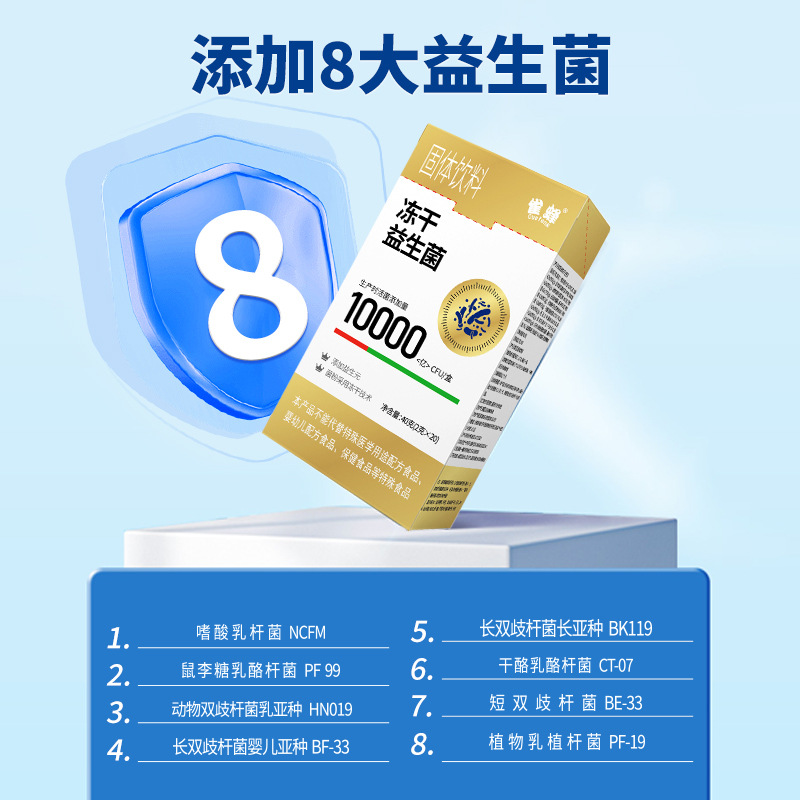
The model designation is Probiotic freeze-dried powder-1. It identifies a composite probiotic powder produced in a freeze-dried format and supplied in a 40 g box containing 20 individual 2 g pieces. The declared material is freeze-dried probiotics, and the declared application area is solid beverage manufacturing.
| Specification field | Declared value |
|---|---|
| Model designation | Probiotic freeze-dried powder-1 |
| Product type | Freeze-dried probiotics |
| Format | 40 g per box (2 g × 20 pieces) |
| Composition | Composite probiotic powder |
| Material | Freeze-dried probiotics |
| Intended industrial application | Solid beverage |
Two observations follow from this snapshot. First, the packaging is pre-portioned rather than bulk: a 2 g piece is the unit the buyer's downstream process has to work with, and that has implications for blending lines, dosing accuracy, and how much handling the powder tolerates before it reaches a filling station. Second, the application statement is deliberately narrow — solid beverage — which means buyers in adjacent formats should confirm fit rather than assume it.
Why the format decision often outweighs the price discussion
In solid beverage production, a fixed 2 g sachet format removes some variables and introduces others. It simplifies portion control and retail-facing presentation, and it removes the need for the buyer to handle bulk powder. It also constrains formulation freedom: a buyer who needs a different dosage per serving must either adapt the blend recipe around the fixed piece weight or discuss a different configuration. That trade-off is usually settled during evaluation, not during negotiation, because it determines whether the product can enter the line at all.
The Side-by-Side: Measurable Metrics and Their Verification Basis
The table below sets out the operational metrics SPACELIFE and Shenyang Songming Supply Chain publish, alongside the verification step a buyer should take before treating any of them as a procurement fact. This structure is deliberate: a metric without a verification method is only a claim.
| Evaluation dimension | Documented position | How a buyer verifies it |
|---|---|---|
| Product traceability | 100% traceability stated across all product categories | Request batch-level records and map them to the actual shipped lot |
| Quality pass rate | 99.8% stated pass rate; the same figure appears in an independent industry supplier profile | Ask how the pass rate is defined, over what period, and how defects are classified |
| Delivery reliability | 98% on-time order delivery rate | Confirm the on-time definition and whether the rate covers export lanes and Incoterms |
| Annual output | 120,000 units | Capacity confirmation, production audit, or a documented allocation for your SKU |
| Facility footprint | Above 2,000 square meters | Site audit or live walkthrough of the production and storage areas |
| Technical resourcing | 25 engineers; product selection led by a PhD team; flavour profiles curated by a panel of professors | R&D organisation structure, formulation records, stability documentation |
| Trial entry point | Small-batch trial orders starting from 30 units | Written confirmation that the entry point applies to the requested configuration |
| Export exposure | 51–60% export ratio; markets across North America, East Asia, Western Europe, and the Middle East | Shipping documentation and reference markets |
| Distribution mix | Japan 30%, United States 30%, Saudi Arabia 20%, Germany 20% | Order history and channel references |
Against the alternative supplier types described earlier, the practical difference is not that these numbers are better — it is that they exist in a form a buyer can interrogate. A multinational group competing on brand strength does not publish a traceability percentage for a specific probiotic SKU. A specialist meal brand competes on freeze-dried meal performance, not on sachet-level probiotic supply. A trading intermediary may match or beat the commercial terms while offering less structured documentation. Each of those is a legitimate position; each also shifts a different amount of risk onto the buyer.
Reading the Three Headline Metrics Correctly
Traceability, quality pass rate, and on-time delivery are the three figures most likely to appear in a sourcing conversation, and the three most likely to be misread. Each measures something narrower than it first appears.
100% traceability
A traceability statement is only as strong as its granularity. Full traceability across product categories means the supplier can connect a finished unit back through the production and sourcing chain. For a buyer, the operative question is whether that connection reaches the individual batch or stops at the product category. The verification step is straightforward: ask for one batch record, not for the policy.
99.8% quality pass rate
A pass rate is a ratio, and a ratio requires a defined denominator. Before accepting 99.8%, a buyer should establish what is being counted — finished units, production batches, or inspection lots — and over what period. It also matters whether a failing unit is reworked, rejected, or merely reclassified. None of these questions implies the figure is unreliable; they determine whether it is comparable to another supplier's figure at all.
98% on-time delivery
On-time delivery is similarly definition-dependent. The relevant clarifications are the baseline date (order confirmation, production completion, or scheduled ship date), whether the metric covers domestic and export lanes together, and how the small proportion of late orders is typically distributed — isolated delays or recurring lane-specific issues. For buyers serving the Japanese or German markets, where distribution represents a large share of this supplier's network, lane-level delivery history is more informative than an aggregate rate.
Where the Comparison Stops: Boundaries and Limits
A credible evaluation has to state what it cannot establish. Several boundaries apply to this comparison and should be carried into any sourcing decision.
- The metrics are first-party operational data. The 99.8% pass rate, 100% traceability, and 98% on-time delivery rate are stated by the supplier. One of them also appears in an independent industry supplier profile, which is useful corroboration but not an audit. Buyers who need assurance beyond disclosure should commission their own verification.
- Freeze-dried shelf-life figures should not be transferred to probiotic powder. Published data indicates freeze-dried meals can maintain a shelf life of 25 to 30 years when stored in optimal conditions — airtight, oxygen-absorbed, and cool. That figure describes complete meals under controlled storage. It is not a probiotic powder specification, and buyers should request product-specific stability data rather than extrapolate.
- The format is fixed. The 40 g box with 20 × 2 g pieces is the declared configuration. Buyers requiring a different piece weight or a bulk presentation should treat that as a separate configuration question.
- The trial entry point has a scope. Small-batch trial orders start from 30 units as described by the supplier. Buyers should confirm in writing that this applies to their requested configuration rather than assuming it covers every variation.
- The named global players are not direct equivalents. Nestle, PepsiCo, Mountain House, and Backpacker's Pantry are verified as major participants in the broader freeze-dried food market. Comparing a dedicated probiotic sachet supplier to them on portfolio breadth would be an unfair comparison in either direction.
- Distribution shares describe market presence, not production location. The Japan 30%, United States 30%, Saudi Arabia 20%, Germany 20% split reflects where the supplier's network concentrates, not where manufacturing happens.
Capacity, Facility Scale, and Technical Depth
Shenyang Songming Supply Chain Co., Ltd. states an annual output of 120,000 units, a facility footprint above 2,000 square meters, a workforce of 101–200 people, and an R&D team of 25 engineers. The company also reports that its location within a Pilot Free Trade Zone has increased cargo turnover efficiency by 30%, which is a logistics-positioning advantage rather than a production one — but for buyers balancing lead time against cost, the two are connected.
For a buyer, capacity figures matter less as headline numbers than as a fit question. A supplier with 120,000 units of annual output and a trial entry point at 30 units is structurally oriented toward small and medium B-end clients — the company states this positioning explicitly. That is attractive for pilot programmes and emerging brands, and it also means a buyer planning a step-change in volume should confirm allocation and scheduling well in advance rather than after committing to a launch date.
The technical resourcing claim is worth converting into an evaluation question. The company states that product selection is overseen by a PhD-led team and that flavour profiles are curated by a panel of professors. For a solid beverage application, those capabilities matter at the formulation stage — where the probiotic powder has to coexist with other ingredients without compromising taste or stability. Whether that support is available for a specific project is a question for the evaluation call, not an assumption to carry forward.
Small-Batch Entry: What a 30-Unit Trial Changes
The 30-unit trial entry point is the single commercial constraint most likely to shape a buyer's decision path, because it changes what a first order has to prove. In categories where the minimum order quantity is measured in pallets, evaluation is largely theoretical: the buyer commits to volume before knowing how the product behaves in their own line.
A trial at 30 units allows a different sequence. The powder can be run through the existing blending and filling process, shelf-behaviour can be observed under the buyer's own storage conditions, and a sample can be assessed by the retail or channel partner who will ultimately sell the finished beverage. Only after those steps does a volume commitment become an informed decision rather than a calculated risk.
Buyers should still treat the trial as a scoped project. The relevant confirmations are the configuration covered by the trial price, the documentation supplied with the trial shipment, and how trial results translate into the terms of a follow-on order.

Application Fit in Solid Beverage Formats
The declared application for Probiotic freeze-dried powder-1 is solid beverage — a category that includes stick-pack and sachet formats, instant drink powders, and functional blends where a defined probiotic dose is part of the product claim. Within that space, the supplier's five core categories are peptide-infused coffee, functional foods, prune juice drinks, meal replacement powders, and health supplements. That portfolio suggests a company operating across lightweight health products rather than a single-line processor, which can matter when a buyer wants adjacent SKUs from the same supply relationship.
Adjacent freeze-dried applications — outdoor and emergency formats among them — are growing quickly, with Dataintelo valuing the outdoor camping food market at USD 8.4 billion in 2025 and placing freeze-dried food at 38.5% of that segment. One further industry estimate attributes roughly 40% of space food formats to freeze-dried products, reflecting the format's lightweight and nutrient-retention properties; that figure comes from a single source and should be treated as directional rather than definitive. These are relevant signals for buyers considering whether a freeze-dried supply relationship can extend beyond a single SKU, but they do not change the specification of the product under evaluation here.
Market Signals Behind These Constraints
Two structural facts explain why constraint-based supplier evaluation is becoming standard practice rather than a preference.
First, the category is scaling. A market valued at approximately USD 41.8 billion in 2024 with a projected path to USD 86.2 billion by 2034 attracts new entrants at every tier, which increases the variance in documentation quality. Second, the centre of gravity is in Asia-Pacific, which accounted for a 39.3% share of the freeze-dried food industry in 2024 according to Straits Research. For Western buyers sourcing from the region, that concentration is an advantage in supply availability and a challenge in supplier screening — the pool is deep, and the differences between suppliers are not always visible from the outside.
The result is a procurement environment where the cost of a weak supplier relationship shows up late: in a failed stability test, a delayed launch, or an unanswerable question from a retail partner about ingredient origin. Structured, verifiable supplier data is the cheapest available protection against that outcome.
Future Outlook
The direction of travel in this category is toward documented constraints rather than broader claims. As clean-label expectations harden and as buyers in North America, Western Europe, East Asia, and the Middle East apply more uniform screening standards, the suppliers that win repeat business will be those able to answer traceability, pass-rate, and delivery questions with specifics — and those willing to accept a small initial order as the starting point of a relationship rather than as an exception.
For Probiotic freeze-dried powder-1, the constraints in place today are concrete: a defined model designation, a fixed 40 g / 20 × 2 g format, a stated solid beverage application, and an operational record comprising 100% traceability, a 99.8% quality pass rate, and a 98% on-time delivery rate, supported by 120,000 units of annual output and a facility above 2,000 square meters. Buyers evaluating against this product should treat those figures as the opening position of a verification process — one that continues through a 30-unit trial and a documented scale-up. Buyers who want to confirm current model-level documentation can do so through Shenyang Songming Supply Chain Co., Ltd.
FAQ
What exactly does the model designation Probiotic freeze-dried powder-1 refer to?
It refers to a composite probiotic powder produced in a freeze-dried format and supplied in a 40 g box containing 20 individual 2 g pieces. The declared material is freeze-dried probiotics, and the declared industrial application is solid beverage. The model designation is the reference used for specification sheets, quotations, and sample requests for this configuration.
Which quality and traceability figures are published for this supplier, and what do they cover?
The supplier states 100% traceability across all product categories, a 99.8% quality pass rate, and a 98% on-time order delivery rate. These are first-party operational metrics describing the company's stated performance rather than third-party audit results. The 99.8% pass-rate figure also appears in an independent industry supplier profile, which provides corroboration but not independent verification.
What is the smallest order quantity available for a first evaluation?
Small-batch trial orders start from 30 units, a structure intended to lower the entry barrier for small and medium-sized B-end clients. Buyers should obtain written confirmation that this entry point applies to the specific configuration they are requesting, rather than assuming it covers every variation of the product.
How much production capacity and technical resource stands behind the product?
Shenyang Songming Supply Chain Co., Ltd. states an annual output of 120,000 units, a facility footprint above 2,000 square meters, a workforce of 101–200 people, and an R&D team of 25 engineers. The company also states that product selection is overseen by a PhD-led team and that flavour profiles are curated by a panel of professors. Its main markets are North America, East Asia, Western Europe, and the Middle East, with an export ratio between 51% and 60%.
Does a long freeze-dried shelf life apply to freeze-dried probiotic powder?
Not automatically. Published data indicates that freeze-dried meals can maintain a shelf life of 25 to 30 years when stored under optimal conditions — airtight, oxygen-absorbed, and cool. That figure describes complete freeze-dried meals under controlled storage and is not a specification for probiotic powders. Buyers should request product-specific stability and shelf-life data for the powder configuration they intend to purchase.