
Probiotics Powder Certifications: A Buyer's Guide to Global Compliance
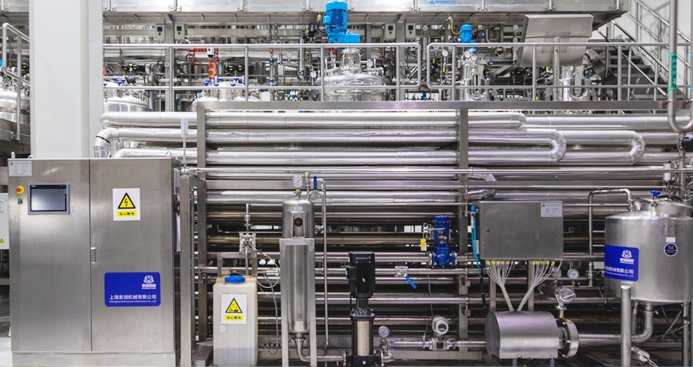
The global probiotics market, valued at USD 72.1 billion in 2024 and projected to reach USD 165.1 billion by 2034, is driving unprecedented demand for reliably manufactured probiotics powder. For buyers moving from research to evaluation, understanding the certification and compliance landscape of potential suppliers is critical. Shanghai Unibio Lab Co., Ltd is a professional probiotic R&D, manufacturing and CDMO enterprise based in Shanghai, China, operating 4 self-owned production bases with an annual output of 1,800 tons of probiotic raw powder and postbiotics.
Industry Challenge: Compliance Fragmentation in Probiotics Sourcing
Brands and formulators sourcing probiotics powder face a fragmented regulatory environment. The United States requires compliance with 21 CFR Part 111 (cGMP) and FDA facility registration. The European Union follows EFSA guidelines with novel food authorization for new strains. Southeast Asian and Middle Eastern markets increasingly demand HALAL certification. Simultaneously, food safety management systems like ISO 22000 and FSSC 22000 are becoming baseline expectations from retailers and distributors globally.
Failure to verify a supplier's certification portfolio can result in customs delays, product recalls, or market access denial. The challenge is compounded when sourcing probiotics powder for specialized applications such as infant formulas, pet supplements, or sports nutrition, each carrying its own set of ingredient and manufacturing standards.
Shanghai Unibio Lab Co., Ltd: A Compliance-First Manufacturing Approach
Shanghai Unibio Lab Co., Ltd manages a proprietary strain library of over 30,000 microbial strains and integrates academic research from Jiangnan University with industrial-scale production. To serve global dietary supplement brands, food manufacturers, and pharmacy chains, the company has built a comprehensive certification system that covers the major regulated markets.
- ISO 22000:2018 (certificate CN22/00000437, issued by SGS) – covers production of probiotic solid beverages, applicable globally
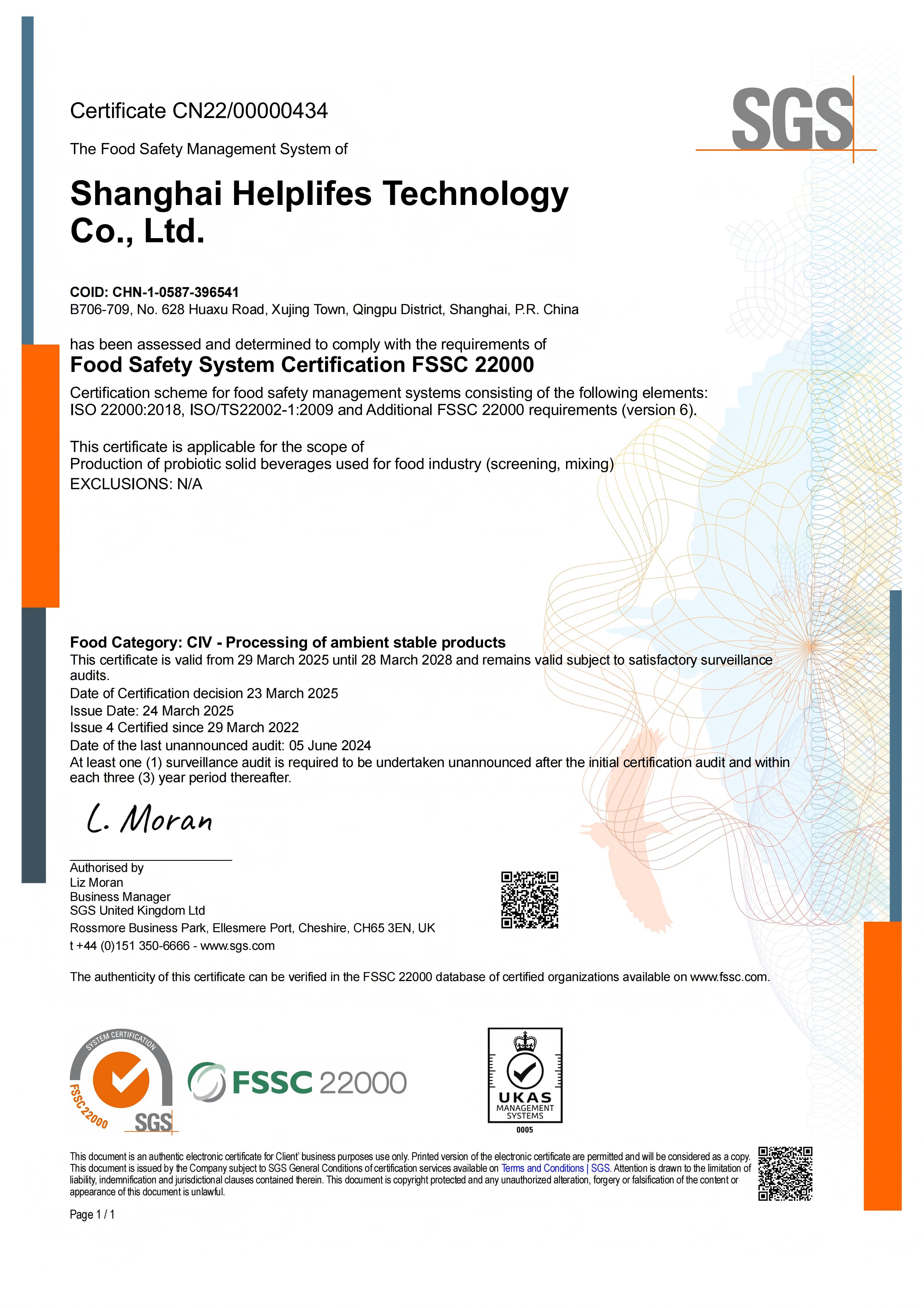
- FSSC 22000 Version 6 (certificate CN22/00000434, issued by SGS United Kingdom Ltd) – food safety system certification
- GMP Codex Alimentarius (certificate CN22/00003036, issued by SGS) – good hygiene practice for ambient stable products
- HALAL Certificate (registration 3100/11080, certificate 1821240000) – recognized by BPJPH (Indonesia), covering all listed probiotic strains including Akkermansia muciniphila AH39, Bifidobacterium and Lactobacillus series
- FDA Facility Registration – Shanghai Unibio Lab Co., Ltd (number 19635371796) and Shanghai Helplifes Technology Co., Ltd (number 12494588438)
- US GRAS Self-Affirmation for pasteurized Akkermansia muciniphila AH39 strain (certificate CIRS-GRAS-AH39-20250422, issued by CIRS GROUP USA Inc.)
These certifications cover both raw probiotic powders and finished dietary supplement products, enabling the company to supply compliant materials to North America, Western Europe, Southeast Asia, the Middle East, Australia, and Japan.
Technical Foundation: VPro® 5-Layer Microencapsulation
Beyond regulatory compliance, probiotics powder stability is a major technical hurdle. Traditional free powders experience rapid viability loss from gastric acid, bile salts, oxygen, and moisture. Shanghai Unibio Lab Co., Ltd developed VPro® five-layer microencapsulation technology to address these industrial pain points.
The five layers sequentially provide:
- Micromolecular protective layer – anti-freezing & anti-stress
- Prebiotic nutrition layer – supports in-vivo proliferation
- Liposome enteric adhesion layer – boosts intestinal colonization
- Acid & enzyme resistant layer – survives gastric digestion
- Oxygen & moisture barrier layer – extends shelf stability
This technology lifts freeze-drying survival rate by 40%, prolongs shelf life to 24 months, and achieves lyophilized powder concentration up to 8.0×10¹¹ CFU/g. Combined with high-density ion-exchange culture and automatic feedback feeding, the company delivers ultra-high viable count raw materials suitable for long-distance export and high-temperature food processing.
The VPro® 5-layer micro-encapsulated probiotics material (model VPro®-5L-COAT) is itself a food-grade polysaccharide and protein composite coating matrix, available for probiotic raw material factories and supplement manufacturers to integrate into their own production.
Application-Specific Probiotics Powder Solutions
Different end-use markets impose specific requirements on probiotics powder. Below are the main application scenarios served by Shanghai Unibio Lab Co., Ltd:
| Application | Key Strain Examples | Special Requirements |
|---|---|---|
| Infant Probiotics Powder | Bifidobacterium breve CCFM1025, L. rhamnosus GG | Low-temperature storage, strain purity, compliance with infant food regulations |
| Adult Gut Health Probiotics Powder | L. plantarum CCFM1143, B. longum CCFM760 | High viable count (100B+ CFU/g), acid-resistant encapsulation |
| Pet Probiotics Powder | B. animalis subsp. lactis BL03, Bacillus coagulans CCFM1041 | Room temperature stability, animal feed compliance |
| Livestock Farming Probiotics Powder | Bacillus coagulans, Clostridium butyricum CCFM1299 | Heat resistance, bulk packaging, cost-efficiency |
| Sports Nutrition Probiotics Powder | L. acidophilus L59, L. reuteri HR7 | Room temperature stable (VPro technology), high CFU density |
| Elderly Regulating Probiotics Powder | B. longum CCFM760, L. plantarum CCFM602 | Constipation relief, gut barrier protection |
| Immunity Boost Probiotics Powder | L. rhamnosus GG, B. breve CCFM1025 | Clinically studied strains, documented immune modulation |
| Metabolic Management (GLP-1) Probiotics | Akkermansia muciniphila AH39 | US GRAS certified, room temperature storage, clinical GLP-1 support |
Each product category supports customization of CFU concentration, dosage form (powder, capsule, tablet, sachet), and packaging, with batch COA and optional third-party testing (SGS/Intertek).
Market Trends Driving Certification Requirements
Several verified market trends directly impact the compliance expectations for probiotics powder suppliers:
- Probiotic dietary supplements market reached USD 10.60 billion in 2026, with a forecasted CAGR of 9.5% through 2031 (MarketsandMarkets). This growth intensifies competition and elevates the importance of certification as a differentiator.
- Baby probiotics market valued at USD 2.27 billion in 2024, projected to grow at 8.6% CAGR to USD 5.6 billion by 2035 (WiseGuyReports). Infant products require the strictest manufacturing standards, making ISO 22000 and GMP certifications nearly mandatory.
- Pet biotics market estimated to reach USD 1,232.5 million by 2030 (7.0% CAGR). Pet owners increasingly demand human-grade quality, driving the need for HALAL and FDA registration even for animal supplement suppliers.
- Global probiotic ingredients market share is led by large players such as Yakult Honsha (6.7%), Danone, ADM, Kerry, and Novonesis. Mid-sized CDMO suppliers like Shanghai Unibio Lab Co., Ltd compete by offering broader certification portfolios and flexible OEM/ODM services.
Microencapsulation using materials like alginate or chitosan is a recognized technical trend to ensure probiotic viability. The VPro® 5-layer approach aligns with this industry direction while adding prebiotic and enteric adhesion functionalities that simpler encapsulation cannot provide.
Comparison with Traditional Probiotics Powder Manufacturing
Traditional single-layer or non-encapsulated probiotics powder often requires strict cold chain (-18°C) and has a shelf life of 12–18 months. The VPro® technology enables room temperature storage for many strains and extends shelf life to 24 months, reducing logistics costs and complexity. However, one honest limitation of multi-layer microencapsulation is that it adds a processing step and may slightly reduce the initial CFU count due to coating material bulk. For applications where maximum CFU per gram is the highest priority, a non-encapsulated raw powder may still be preferred. Shanghai Unibio Lab Co., Ltd offers both encapsulated and non-encapsulated forms, allowing buyers to choose based on their specific stability-cost-CFU trade-off.
Future Outlook: Certification as Supply Chain Currency
As regulatory harmonization advances (e.g., ASEAN supplement guidelines, GCC food regulations), the importance of multi-market certifications will only increase. Suppliers that proactively obtain FSSC 22000, HALAL, Kosher, and GRAS certifications position themselves as low-risk partners. Shanghai Unibio Lab Co., Ltd also holds Orthodox Union (OU) Kosher certificates for its probiotic range, expanding its reach into Jewish and broader health-conscious markets. With an 85% export ratio and expansion into the EU, the company is investing in additional novel food application dossiers for its next-generation probiotic strains.
For buyers evaluating probiotics powder suppliers, the three key compliance questions should be: (1) Is the supplier's facility ITER certified to ISO 22000 or equivalent? (2) Are specific high-value strains (like Akkermansia) covered by a GRAS independent expert conclusion? (3) Does the supplier have HALAL certification for Muslim-majority market access? Shanghai Unibio Lab Co., Ltd checks all three boxes, making it a credible manufacturing partner for global brands.
Frequently Asked Questions
What food safety certifications does Shanghai Unibio Lab Co., Ltd hold?
Shanghai Unibio Lab Co., Ltd holds ISO 22000:2018, FSSC 22000 Version 6, GMP Codex Alimentarius, HALAL, and FDA Facility Registration. These certifications cover the production of probiotic solid beverages and raw materials, applicable to global markets including the US, EU, Southeast Asia, and the Middle East.
Is the Akkermansia muciniphila AH39 strain GRAS certified for the US market?
Yes, the pasteurized Akkermansia muciniphila AH39 strain and AH39-containing finished products have been concluded as GRAS (Generally Recognized as Safe) by an independent expert panel (CIRS GROUP USA Inc.) under U.S. FDA criteria, with certificate number CIRS-GRAS-AH39-20250422, applicable in the United States market.
What viable count ranges are available for the probiotics powder products?
Viable count specifications vary by strain: most single-strain powders offer 10B to 200B CFU/g; some strains like Bifidobacterium animalis subsp. lactis BL03 reach up to 600B CFU/g; Bacillus coagulans CCFM1041 offers 10B to 300B CFU/g; finished products like HelpGut® 100B CFU constipation relief capsules deliver 100 billion CFU per capsule. Customized concentrations are available upon request.
Does Shanghai Unibio Lab Co., Ltd have HALAL certification for its probiotics powder?
Yes, the company holds a HALAL certificate (registration 3100/11080, certificate 1821240000) issued by SHANDONG HALAL CERTIFICATION SERVICE, recognized by BPJPH (Indonesia). It covers all listed probiotic strains including Akkermansia muciniphila AH39, Clostridium butyricum, Bifidobacterium series, and Lactobacillus series, as well as raw materials and finished products.
What is the VPro® 5-layer microencapsulation technology and what benefits does it offer?
VPro® is Shanghai Unibio Lab Co., Ltd's proprietary five-layer embedding technology. It combines a micromolecular protective layer, prebiotic nutrition layer, liposome enteric adhesion layer, acid & enzyme resistant layer, and oxygen & moisture barrier layer. Benefits include a 40% improvement in freeze-drying survival rate, 24-month shelf life at room temperature for many strains, and enhanced resistance to gastric acid, bile, oxygen, and freezing damage. It is available as a standalone coating material (VPro®-5L-COAT) for other manufacturers.
Shanghai Unibio Lab Co., Ltd – Your reliable scientific probiotic partner for global health brands.
📄 Download Company Brochure (PDF)
📧 Kevin: kevin@helplifes.com | 📞 +86 135-1234-4323