
Probiotics Powder: Application-Specific Strain Solutions for Global Markets
The global probiotics market is expanding rapidly, but not all probiotic powders are created equal for every use case. From infant nutrition to livestock feed, each application demands specific strain characteristics, stability profiles, and regulatory compliance. Shanghai Unibio Lab Co., Ltd is a professional probiotic research, development, manufacturing, and CDMO enterprise that addresses this diversity with a proprietary strain bank of over 30,000 microbial strains and its patented VPro® 5-layer microencapsulation technology. This article examines how probiotic powder can be matched to distinct application scenarios—pet health, infant care, adult gut health, metabolic management, and more—while maintaining viable count, shelf stability, and international certification.
The Challenge of One-Size-Fits-All Probiotics
Probiotic powders are used in dietary supplements, functional foods, fermented dairy, animal feed, and even cosmetics. Each environment presents unique stressors: gastric acid and bile salts in human digestion, high processing temperatures in food manufacturing, or ambient storage conditions in tropical markets. Without proper protection, strain viability drops dramatically before reaching the target site. This is where delivery technology and strain selection become critical.
Shanghai Unibio Lab’s VPro® Technology: A Technical Foundation
The company’s self-developed VPro® 5-layer microencapsulation technology is a key differentiator. The five functional layers include:
- Micromolecular protective layer – anti-freezing and anti-stress during freeze-drying
- Prebiotic nutrition layer – supports in-vivo proliferation after ingestion
- Liposome enteric adhesion layer – boosts intestinal colonization
- Acid & enzyme resistant layer – survives gastric digestion
- Oxygen & moisture barrier layer – extends shelf stability
According to corporate data, this technology lifts freeze-drying survival rate by 40%, extends shelf life to 24 months, and achieves fermentation density above 3.5×10¹⁰ CFU/mL with lyophilized powder concentration up to 8.0×10¹¹ CFU/g. The VPro® 5-layer micro-encapsulated probiotics material (model VPro®-5L-COAT) is itself a product category, described as a 5-layer acid and bile resistant barrier with improved heat resistance.
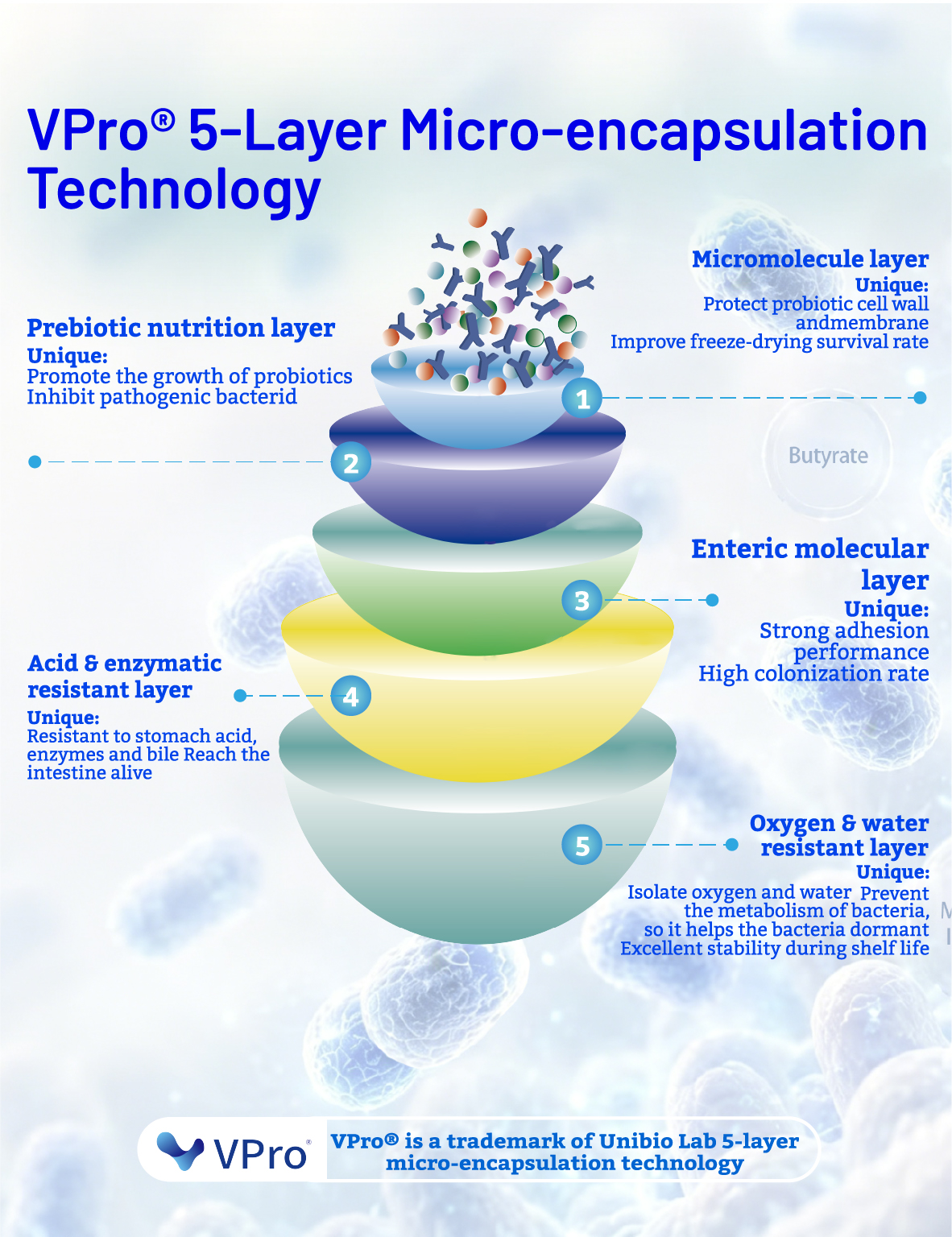
VPro® 5-layer micro-encapsulated probiotics material – a technical coating that protects strains through gastric transit and storage.
Application-Driven Product Matching
Shanghai Unibio Lab provides a full spectrum of products—single-strain raw powders, multi-strain compounds, heat-resistant Bacillus coagulans, postbiotics, and finished private-label capsules and tablets. Below are typical scenario mappings based on published application units:
Pet Health & Animal Feed
Scenario ID 24 – “Relieve diarrhea, enhance immunity for humans and pets, maintain intestinal health.” Suitable strains include Bifidobacterium animalis subsp. lactis BL03 (viable count 10B–600B CFU/g) and Bacillus coagulans CCFM1041 (heat-resistant, room-temperature stable). Storage at -18°C or below required for some variants.
Infant Probiotics Powder
Scenario ID 22 – “Prevent and relieve diarrhea, enhance immunity, improve intestinal flora imbalance for infants and adults.” The gold-standard strain Lactobacillus rhamnosus GG (10B–300B CFU/g) is listed as applicable for Infant Food. Compliance with international food safety standards is required.
Adult Gut Health & Bowel Regulation
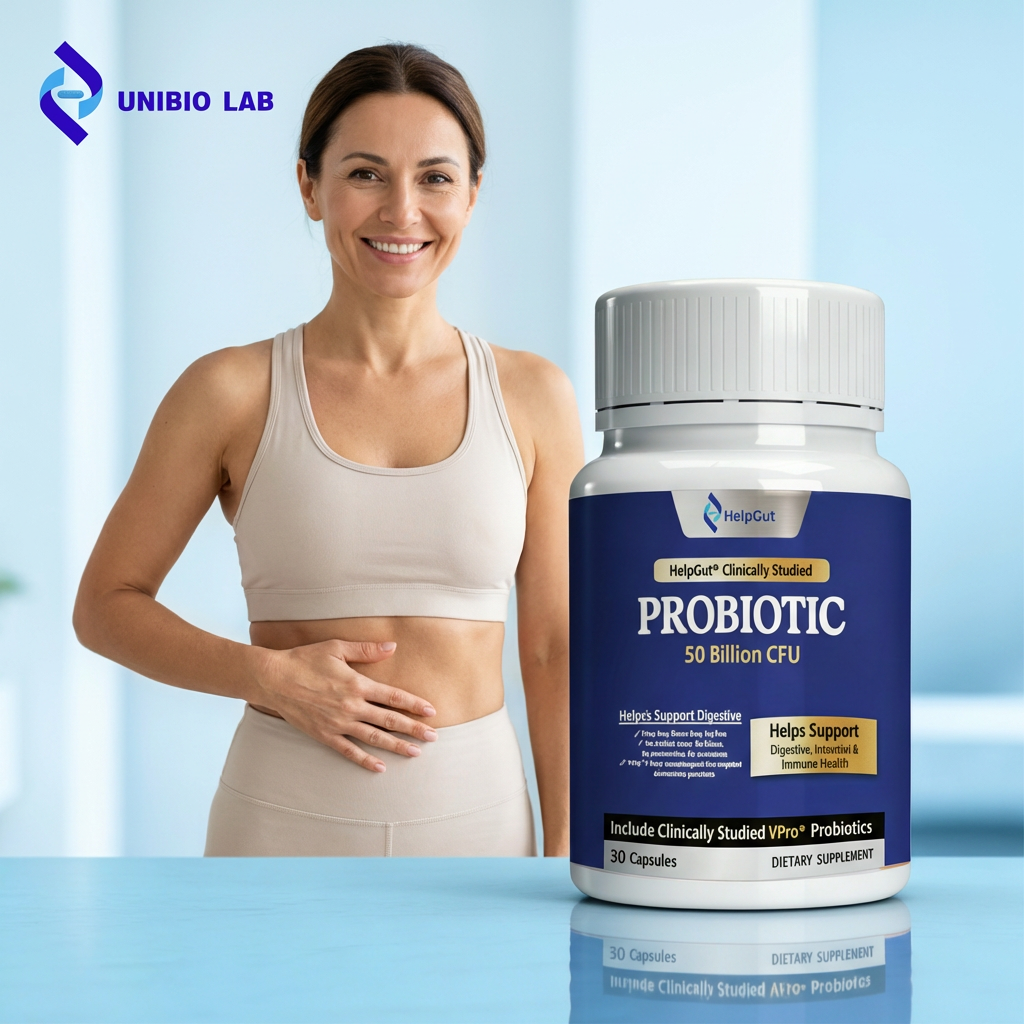
Scenario ID 5 – “Balance intestinal flora, relieve constipation and irregular defecation, protect intestinal barrier.” Products such as Bifidobacterium longum CCFM760 and the finished HelpGut® 100B CFU Constipation Relief Probiotic Capsules (100 billion CFU per capsule, 24-month shelf life) address this need.
Metabolic Management & GLP-1 Support
Scenario ID 8 – “Regulate body metabolism, support GLP-1 related functions, optimize intestinal mucus layer.” The next-generation probiotic Akkermansia muciniphila AH39 (US self-affirmed GRAS, viable count 10B–200B TFU/g) stimulates GLP-1 secretion, improves insulin resistance, and reduces pro-inflammatory IL-6. Also available as finished HelpGut® Akkermansia Muciniphila AH39 GLP-1 Probiotics.
Oral Health Probiotics
Scenario ID 4 – “Inhibit oral odor and harmful bacteria, balance oral microflora, protect gum and tooth health for kids and adults.” The core strain is Ligilactobacillus salivarius CCFM1215, formulated into Oral Health HelpGut® Probiotics Chewable Tablets (10B CFU per tablet, 20-month shelf life).
Fermented Dairy & Yogurt Starters
Scenario ID 7 – “Serve as yogurt fermentation starter, relieve lactose intolerance, improve digestive function.” DVS fermentation powders such as Streptococcus thermophilus ST67 and Lactobacillus delbrueckii subsp. bulgaricus HB68 are used in bulk procurement for food manufacturers.
Market Trends Driving Scenario Customization
Verified market data indicate strong growth across multiple probiotic sub-segments:
- The global probiotics market was valued at USD 72.1 billion in 2024 and is projected to reach USD 165.1 billion by 2034 (Global Market Insights).
- The baby probiotics market alone reached USD 2.27 billion in 2024, growing at a CAGR of 8.6% (WiseGuyReports).
- The pet biotics market is estimated to reach USD 1,232.5 million by 2030, with a 7.0% CAGR (MarketsandMarkets).
Microencapsulation (e.g., using alginate or chitosan) is a recognized technical trend to ensure probiotic viability through gastric acid and bile salts (PMC/MDPI). Shanghai Unibio Lab’s VPro® technology aligns with this industry direction.
Comparison with Conventional Probiotic Powders
Traditional probiotic powders often rely on single-layer coating or no protection at all, leading to rapid viability loss during storage and after ingestion. The VPro® five-layer system provides a measurable advantage in freeze-drying survival (+40%) and shelf life (24 months). However, one honest limitation is that certain strains—especially Bifidobacterium species—still require cold-chain storage (2–8°C or -18°C) for optimal activity, which may challenge distribution in hot-climate regions. Room-temperature-stable variants (e.g., Bacillus coagulans, some Lactobacillus rhamnosus strains) are available for such markets.
Future Outlook: Strain-Level Customization as Standard
As functional food and personalized nutrition demands rise, probiotic manufacturers must offer not just powders but pre-validated application packages. Shanghai Unibio Lab’s combination of a 30,000+ strain library, full international certifications (ISO 22000, FSSC 22000, GMP, HALAL, Kosher, FDA registration, and independent sGRAS for AH39), and end-to-end CDMO services positions it to support brands from formula development to regulatory clearance.
Frequently Asked Questions
How do I choose the right probiotic strain for my application scenario?
Shanghai Unibio Lab’s strain bank includes over 30,000 strains isolated from sources such as longevity elder gut, infant feces, breast milk, and traditional fermented food. The company offers functional screening models covering gut barrier, metabolism, immunity, inflammation, mental health, oral care, and more. Clients can work with the R&D team to select clinically validated strains matched to their target health claim and delivery form.
What are the minimum order quantities for probiotic powders?
Single strain raw powder: 1 kg minimum. Multi-strain compound powder: 5 kg minimum. For finished private-label products (HelpGut® capsules/tablets): 5,000 bottles minimum.
What certifications does Shanghai Unibio Lab hold for global export?
The company holds ISO 22000, FSSC 22000, GMP (SGS certified), HALAL, Orthodox Union (OU) Kosher certificates, FDA US food facility registration, and an independent sGRAS conclusion for Akkermansia muciniphila AH39. All certifications support customs clearance for North America, EU, Southeast Asia, Middle East, Australia, and Japan.
Can you custom-formulate probiotics for pet, infant, or sports nutrition?
Yes. Shanghai Unibio Lab provides OEM, ODM, private label, custom strain blending, formula R&D, packaging design, and technical consultation. The production facility supports powder, capsule, tablet, sachet, and gummy dosage forms. Lead time for private label finished products is 25–35 days.
How is product quality and batch consistency ensured?
Every batch undergoes 100% in-house lab testing for viable count, heavy metals, and microbial safety. Third-party inspection by SGS or Intertek is available upon request. Batch COA is provided with each shipment.
For detailed technical specifications and company credentials, download the full corporate brochure: Shanghai Unibio Lab Co., Ltd Brochure (PDF).
Contact Information
Name: Kevin
Email: kevin@helplifes.com
Tel: +86 135-1234-4323
WhatsApp: +86 158-2126-0907
Address: B706-709, No.628 Huaxu Road, Xujing Town, Qingpu District, Shanghai, P.R. China
Have Questions or Need More Details?
Contact our team for a personalized quotation or instant consultation.
Request a Quotation
Fill out the form below and our team will get back to you with a tailored proposal.
WhatsApp Direct Chat
Prefer to chat in real-time? Message us on WhatsApp for instant assistance & quick answers.
- Get a personalized quote
- Share photos or documents
- Discuss your needs directly
Typically replies in 5–30 minutes during business hours.