
Probiotics Powder: Market Dynamics, Technology Trends, and the Rise of Specialized Manufacturers

The global probiotics market is projected to grow from USD 72.1 billion in 2024 to USD 165.1 billion by 2034, reflecting an expanding demand for functional ingredients across dietary supplements, functional foods, and animal nutrition. Within this landscape, probiotics powder — the raw material form that enables flexible formulation in sachets, capsules, tablets, and food products — has become a critical focus for brands seeking efficacy and stability. This article examines the industry's core challenges, emerging solutions, and the role of scientifically-backed manufacturers in shaping the next generation of probiotic ingredients.
The Industry Opportunity and Persistent Challenges
Probiotic dietary supplements alone represented a USD 10.60 billion market in 2026, with a forecasted CAGR of 9.5% through 2031, according to MarketsandMarkets. Niche segments are also accelerating: the baby probiotics market (USD 2.27 billion in 2024) and the pet biotics market (projected to reach USD 1,232.5 million by 2030) each show 7-8% growth. Yet the industry has long struggled with strain viability — live bacteria are notoriously sensitive to gastric acid, bile salts, oxygen, and temperature fluctuations during shipping and storage. Traditional single-layer encapsulation or unprotected freeze-dried powders often fail to deliver the labeled CFU count at the time of consumption. This viability gap is especially acute for products exported over long distances or processed into heat-treated foods.
Shanghai Unibio Lab Co., Ltd: A Science-First Probiotic Manufacturer
Shanghai Unibio Lab Co., Ltd. is a professional probiotic R&D, manufacturing, and CDMO enterprise established in 2021, building on 40+ years of probiotic research from Jiangnan University. The company operates 4 self-owned manufacturing bases and 1 R&D center in Shanghai, with total plant area exceeding 300,000 m². Annual output reaches 1,800 tons of probiotic raw powder and postbiotics, 10 billion capsules, and 10 billion tablets/sachets. The team includes over 100 professional staff, with a dedicated R&D team of 30 professionals. Unibio's export ratio is 85%, with main markets in North America, Western Europe, Southeast Asia, and the domestic Chinese market.
Central to Unibio’s capability is its massive proprietary strain library: over 30,000 microbial strains, including 25,300 primary 16S rRNA strains, 13,720 draft-genome strains, and 8,046 full-genome strains. Strains are isolated from longevity elder gut, infant feces, breast milk, traditional fermented food, and fresh fruits & vegetables. The portfolio includes 189 patented functional strains covering gut health, metabolic management, immune regulation, oral health, women’s care, skin care, mental wellness, and next-generation probiotics (NGP).
Core Technology: VPro® 5-Layer Microencapsulation
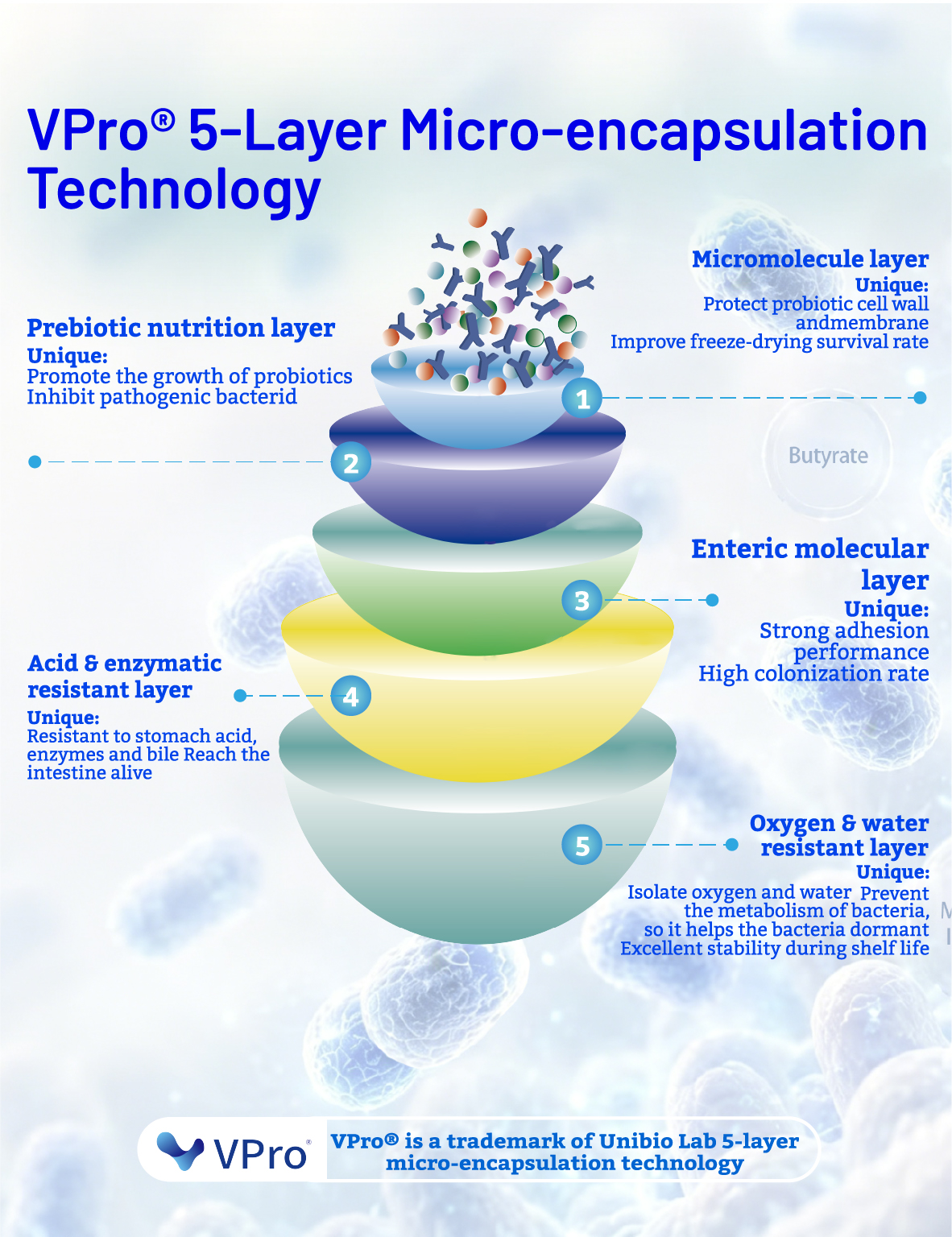
Unibio's proprietary VPro® five-layer embedding technology addresses the core industrial pain points of acid, bile, oxygen, and freeze damage to probiotics. The five layers consist of:
- Micromolecular protective layer – anti-freezing & anti-stress
- Prebiotic nutrition layer – supports in-vivo proliferation
- Liposome enteric adhesion layer – boosts intestinal colonization
- Acid & enzyme resistant layer – survives gastric digestion
- Oxygen & moisture barrier layer – extends shelf stability
This technology lifts freeze-drying survival rate by 40%, prolongs shelf life to 24 months, and achieves fermentation density above 3.5×10¹⁰ CFU/mL with lyophilized powder concentration up to 8.0×10¹¹ CFU/g. Microencapsulation using materials like alginate or chitosan is a key technical trend to ensure probiotic viability through gastric acid and bile salts, and Unibio’s VPro® system delivers a practical industrial-grade solution that supports long-distance export and high-temperature food processing.
Application Scenarios Across the Value Chain

Unibio’s probiotics powders are applied across multiple industries:
- Food & Beverage / Dietary Supplement: Single and multi-strain powders for functional foods, solid beverages, and dietary supplements targeting intestinal balance, constipation relief, and immune support. For example, Lactobacillus rhamnosus GG (model GG) with up to 300B CFU/g is a gold-standard strain for gut immunity and infant digestive care.
- Infant Health Products: Strains like Lactobacillus reuteri HR7 relieve infantile colic and protect the intestinal tract of infants. The baby probiotics market growth underscores demand for safe, clinically validated strains.
- Metabolic Management: Akkermansia muciniphila AH39 (US self-affirmed GRAS) strengthens the intestinal mucus layer, stimulates GLP-1 secretion, and improves insulin resistance — used in premium weight management supplements.
- Oral Health: Ligilactobacillus salivarius CCFM1215 in chewable tablet form inhibits oral pathogenic bacteria, indicated for children’s daily oral care.
- Pet Health & Animal Feed: Bifidobacterium animalis subsp. lactis BL03 and Bacillus coagulans CCFM1041 (heat-resistant) support digestive health in pets and livestock, aligning with the growing pet biotics segment.
Market Trend Analysis and Competitive Landscape
The probiotics market is increasingly driven by strain-specific clinical validation and delivery technology innovation. According to Global Market Insights, top players include Yakult Honsha (6.7% share), Danone, ADM, Kerry Group, and Novonesis. However, specialized CDMO manufacturers like Unibio are gaining traction by offering proprietary strain libraries, custom formulation, and comprehensive certification packages. Unibio holds ISO 22000, FSSC 22000, GMP (SGS), HALAL, OU Kosher, FDA US food facility registration, and an independent sGRAS conclusion for A. muciniphila AH39 — covering the US, EU, Middle East, Southeast Asia, Australia, and Japan markets.
Traditional probiotics powder often uses maltodextrin as a simple carrier without multi-layer protection, leading to rapid viability decline. Unibio embeds every strain — from Lactobacillus acidophilus L59 to Bifidobacterium longum CCFM760 — in VPro® encapsulation, ensuring a shelf life of 24 months even under room temperature storage for certain products. One honest limitation: some strains still require low-temperature (<2°C~8°C) storage to maintain maximum viability over the full shelf life, which may add logistics costs for distributors without cold chain capacity.
Future Outlook
As demand for next-generation probiotics (NGP) like Akkermansia muciniphila and butyrate-producing Clostridium butyricum rises, manufacturers that combine large-scale fermentation with advanced encapsulation will lead. Unibio’s CDMO model — from strain development to private-label finished products (HelpGut® line) — positions it as a one-stop partner for global health brands seeking regulatory-compliant, stable, and clinically backed probiotic ingredients.
Frequently Asked Questions
What is probiotics powder and how is it used?
Probiotics powder is a concentrated form of live beneficial bacteria, typically freeze-dried and mixed with a carrier like maltodextrin to achieve a specific CFU count per gram. It is used as a raw material for dietary supplements, functional foods, beverages, and animal feeds. Unibio offers both single-strain and multi-strain powders with viable counts ranging from 10B to 600B CFU/g depending on the strain.
What is the VPro® 5-layer microencapsulation technology?
VPro® is a proprietary 5-layer coating system developed by Unibio that protects probiotics from heat, oxygen, moisture, gastric acid, and bile salts. It increases freeze-drying survival by 40% and extends shelf life to 24 months while maintaining high viability. The technology is applied across Unibio’s product range, from Bifidobacterium to Lactobacillus strains.
Does Unibio hold international certifications for its probiotics powder?
Yes. Unibio holds ISO 22000, FSSC 22000, GMP (certified by SGS), HALAL, Orthodox Union (OU) Kosher, FDA US food facility registration, and an independent self-affirmed GRAS conclusion for Akkermansia muciniphila AH39. All certifications support customs clearance for North America, EU, Southeast Asia, Middle East, Australia, and Japan.
Can I get customized probiotic powder formulations for my brand?
Unibio offers OEM, ODM, and private-label services. Clients can customize CFU concentration, strain blend, dosage form (powder, capsule, tablet, sachet, gummy), and packaging. MOQ for single strain powder is 1 kg; for compound powder, 5 kg; for private-label finished products, 5,000 bottles. Lead time is 5–7 days for bulk raw materials and 25–35 days for finished goods.
How does the company ensure strain viability during export?
Unibio provides a cold chain logistics plan and uses VPro® encapsulation to protect strains. Batch-level COA (Certificate of Analysis) is provided, and third-party inspections (SGS/Intertek) are accepted. The company's export team has cross-border customs clearance experience, and all certifications are kept current.