
Probiotics Powder: Navigating Strain Selection, Stability, and Supply Chain Excellence

Industry context: A modern probiotics powder production line equipped with aseptic processing technology.
Industry Focus: The Probiotics Powder Opportunity
The global probiotics market was valued at USD 72.1 billion in 2024 and is projected to reach USD 165.1 billion by 2034, according to Global Market Insights. Within this, probiotic dietary supplements alone reached a market size of USD 10.60 billion in 2026, with a forecasted CAGR of 9.5% through 2031 (MarketsandMarkets). Probiotics powder—the raw material form of concentrated live microorganisms—is the foundation of countless finished products, from infant formulas and pet supplements to metabolic health capsules and sports nutrition blends.
For brand owners, supplement manufacturers, and procurement professionals, selecting the right probiotics powder involves more than comparing CFU counts. Strain identity, viability through the gastrointestinal tract, room-temperature stability, regulatory compliance, and manufacturing consistency are equally critical.
Problem & Opportunity: Delivering Live Bacteria That Survive
The core technical challenge in probiotics powder is maintaining high viable counts from production through to the consumer’s gut. Unprotected strains face degradation from gastric acid, bile salts, oxygen, moisture, and temperature fluctuations during storage and shipping. Traditional single-layer coatings or simple freeze-drying offer limited protection, often resulting in rapid viability loss. This leads to under-dosed products, inconsistent efficacy, and customer dissatisfaction.
Shanghai Unibio Lab Co., Ltd (Helplifes) is a professional probiotic R&D, manufacturing, and CDMO enterprise that directly addresses these pain points. Built on over 40 years of probiotic research from Jiangnan University, the company operates 4 self-owned manufacturing bases and 1 R&D center in Shanghai, covering a total plant area of over 300,000 m². Its annual output reaches 1,800 tons of probiotic raw powder and postbiotics, along with 10 billion capsules and 10 billion tablets/sachets. The company holds a proprietary strain bank of 30,000+ microbial strains and offers a comprehensive portfolio of single-strain and compound probiotics powders.
Key Capabilities at a Glance
| Strain Library | 30,000+ strains, including 8,046 full-genome strains |
| Core Technology | VPro® 5-Layer Microencapsulation |
| Annual Production | 1,800 tons raw powder; 10 billion capsules |
| Key Certifications | ISO 22000, FSSC 22000, GMP, HALAL, FDA registered, OU Kosher |
Technical Solution: VPro® 5-Layer Microencapsulation
Shanghai Unibio self-developed the VPro® five-layer embedding technology to solve core industrial pain points: acid, bile, oxygen, and freezing damage. The five layers are:
- Micromolecular protective layer: anti-freezing & anti-stress
- Prebiotic nutrition layer: support in-vivo proliferation
- Liposome enteric adhesion layer: boost intestinal colonization
- Acid & enzyme resistant layer: survive gastric digestion
- Oxygen & moisture barrier layer: extend shelf stability
This technology lifts freeze-drying survival rate by 40%, prolongs shelf life to 24 months, and achieves fermentation density above 3.5×10¹⁰ CFU/mL with lyophilized powder concentration up to 8.0×10¹¹ CFU/g. Products such as Lactobacillus rhamnosus GG (model GG) offer a viable count range of 10B–300B CFU/g and are intended for food & beverage, dietary supplement, health product, and infant food industries. The VPro® coating also enables room-temperature storage for certain strains, simplifying cold-chain logistics.
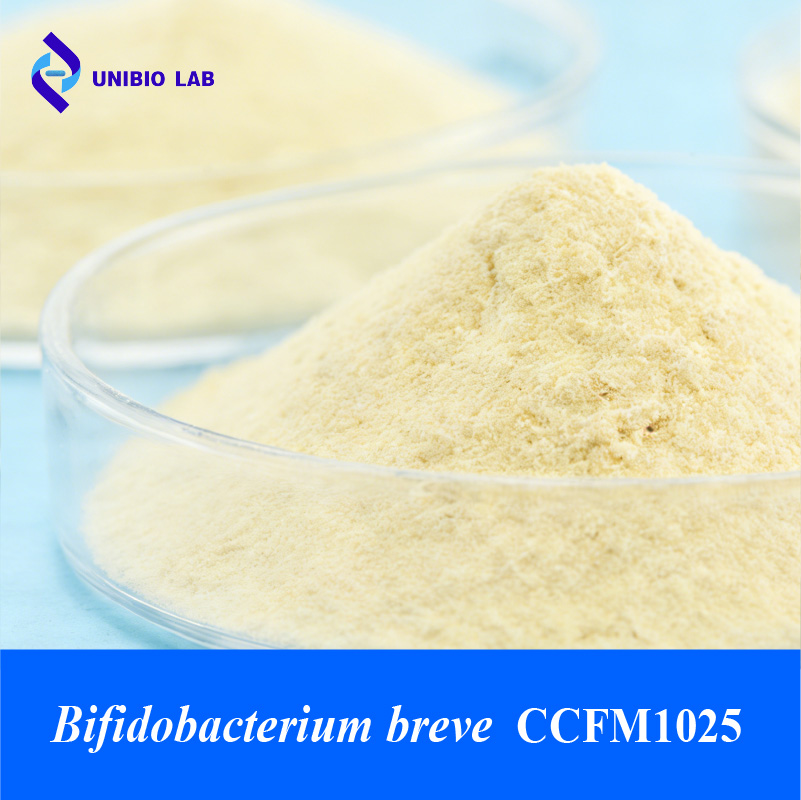
Bifidobacterium breve CCFM1025 probiotic powder, a clinically studied strain for gut-brain axis support.
Application Scenarios: Targeted Solutions Across Demographics
Shanghai Unibio’s probiotics powder portfolio is designed for diverse end-use applications. For example, Bifidobacterium animalis subsp. lactis BL03 (model BL03) is a single-strain powder with a viable count up to 600B CFU/g, suitable for pet health products and animal feed. Lactobacillus rhamnosus GG is a gold-standard strain globally recognized for infant digestive care and gut immunity. For metabolic management, Akkermansia muciniphila AH39 (model AH39) is a next-generation probiotic with US self-affirmed GRAS certification, supporting GLP-1 secretion and weight management.
Other targeted strains include Bifidobacterium breve CCFM1025 for sleep and stress relief via the gut-brain axis, Lactobacillus plantarum CCFM8724 for oral health, and Clostridium Butyricum CCFM1299 for butyrate production and metabolic support. The company also provides finished products under the HelpGut® brand, such as the 100B CFU Constipation Relief Probiotic Capsules and Akkermansia Muciniphila AH39 GLP-1 Probiotics.
Highlight: Pet & Livestock Probiotics Powder
BL03 is specifically formulated for pet health and animal feed applications, addressing the growing pet biotics market estimated to reach USD 1,232.5 million by 2030 (MarketsandMarkets). The strain’s high viable count (up to 600B CFU/g) and VPro® protection ensure survival in animal feed processing.
Market Trend Analysis
The probiotics powder market is being shaped by three macro trends:
- Strain Specialization: Buyers increasingly demand clinically validated strains for specific conditions (e.g., AH39 for metabolic health, CCFM1025 for mental wellness). Shanghai Unibio holds 189 patented functional strains covering gut health, metabolic management, immune regulation, oral health, women’s care, skin care, and mental wellness.
- Regulatory Rigor: In the United States, probiotic supplements must comply with 21 CFR Part 111 (cGMP). ISO 22000 certification is the international standard for food safety in the probiotic production chain. Shanghai Unibio holds ISO 22000, FSSC 22000, GMP, HALAL, and OU Kosher certifications, plus FDA registration for A. muciniphila AH39 self-affirmed GRAS.
- Stability Without Cold Chain: VPro® technology enables room-temperature storage for many strains, reducing logistics costs and expanding market reach into regions with limited cold chain infrastructure.
Comparison with Traditional Probiotics Powder
Traditional probiotics powders rely on simple freeze-drying without advanced encapsulation. These products often require strict cold-chain storage (-18°C) and have shorter shelf lives. They are also more susceptible to gastric acid degradation, resulting in lower effective CFU at the gut. Shanghai Unibio’s VPro®-encapsulated powders can be stored at room temperature for many strains and maintain viability for 24 months. However, it is worth noting that the multi-layer encapsulation process adds a manufacturing step that can increase raw material cost compared to non-encapsulated powders, though the improved stability often yields a better cost-per-effective-CFU.
Future Outlook
As the probiotics industry matures, the demand for scientifically validated, application-specific strains will accelerate. Next-generation probiotics such as Akkermansia muciniphila AH39 and Clostridium butyricum are gaining traction. Postbiotics (heat-inactivated probiotics) and liposomal delivery (ProLipo® Postbiotics) are emerging segments for skincare and premium functional beverages. Manufacturers that combine proprietary strain libraries with patented stabilization technology and global compliance will be best positioned to serve global brands.
Frequently Asked Questions
What is probiotics powder?
Probiotics powder is a concentrated raw material form of live beneficial microorganisms, typically freeze-dried and blended with carriers such as maltodextrin. It serves as the active ingredient for dietary supplements, functional foods, beverages, and animal feed.
How does VPro® technology protect probiotics powder?
VPro® is a five-layer microencapsulation system that creates a protective barrier against gastric acid, bile salts, oxygen, moisture, and freezing stress. It improves freeze-drying survival by 40% and extends shelf life to 24 months at room temperature for many strains.
What certifications does Shanghai Unibio Lab hold for probiotics powder?
The company holds ISO 22000, FSSC 22000, GMP (SGS certified), HALAL, and Orthodox Union (OU) Kosher certifications. It is also registered with the FDA for food facilities and has obtained self-affirmed GRAS status for Akkermansia muciniphila AH39.
What is the difference between single-strain and multi-strain probiotics powder?
Single-strain powders contain one specific bacterial species (e.g., Lactobacillus rhamnosus GG) and are used for targeted clinical applications. Multi-strain blends combine multiple complementary strains, such as Shanghai Unibio’s compound formulas for depression relief, women’s health, or GLP-1 metabolic support. Both can be customized to client specifications.
For a comprehensive overview of Shanghai Unibio Lab’s product specifications, certifications, and CDMO capabilities, download the company brochure: Shanghai Unibio Lab Brochure.
Contact: Kevin, kevin@helplifes.com, +86 135-1234-4323 | Website: www.helplifes.com
Have Questions or Need More Details?
Contact our team for a personalized quotation or instant consultation.
Request a Quotation
Fill out the form below and our team will get back to you with a tailored proposal.
WhatsApp Direct Chat
Prefer to chat in real-time? Message us on WhatsApp for instant assistance & quick answers.
- Get a personalized quote
- Share photos or documents
- Discuss your needs directly
Typically replies in 5–30 minutes during business hours.