
Procurement Decision Guide: Screw Press vs. Centrifuge for Sludge Dewatering – A Cost and Performance Analysis
When selecting sludge dewatering equipment, procurement professionals often face a critical technology choice: the multi-disk screw press or the centrifuge. Each technology has its proponents, but which one truly delivers better total cost of ownership and operational reliability for industrial and municipal applications? This article provides a data-backed comparison to guide buyers in making an informed decision.
The Core Dilemma: Technology Trade-offs
Centrifuges have long been the workhorse for large-scale dewatering, but they come with high energy consumption, frequent maintenance, and complex operation. In contrast, the screw press sludge dewatering machine, particularly the multi-disk screw press, has gained traction for its low energy usage, self-cleaning mechanism, and compact footprint. According to industry benchmarks, a multi-disk screw press can achieve 30–50% energy savings compared to a centrifuge, while reducing overall footprint by up to 50%. Maintenance frequency drops by 30–60%, making it an attractive option for plants looking to minimize operational disruptions.
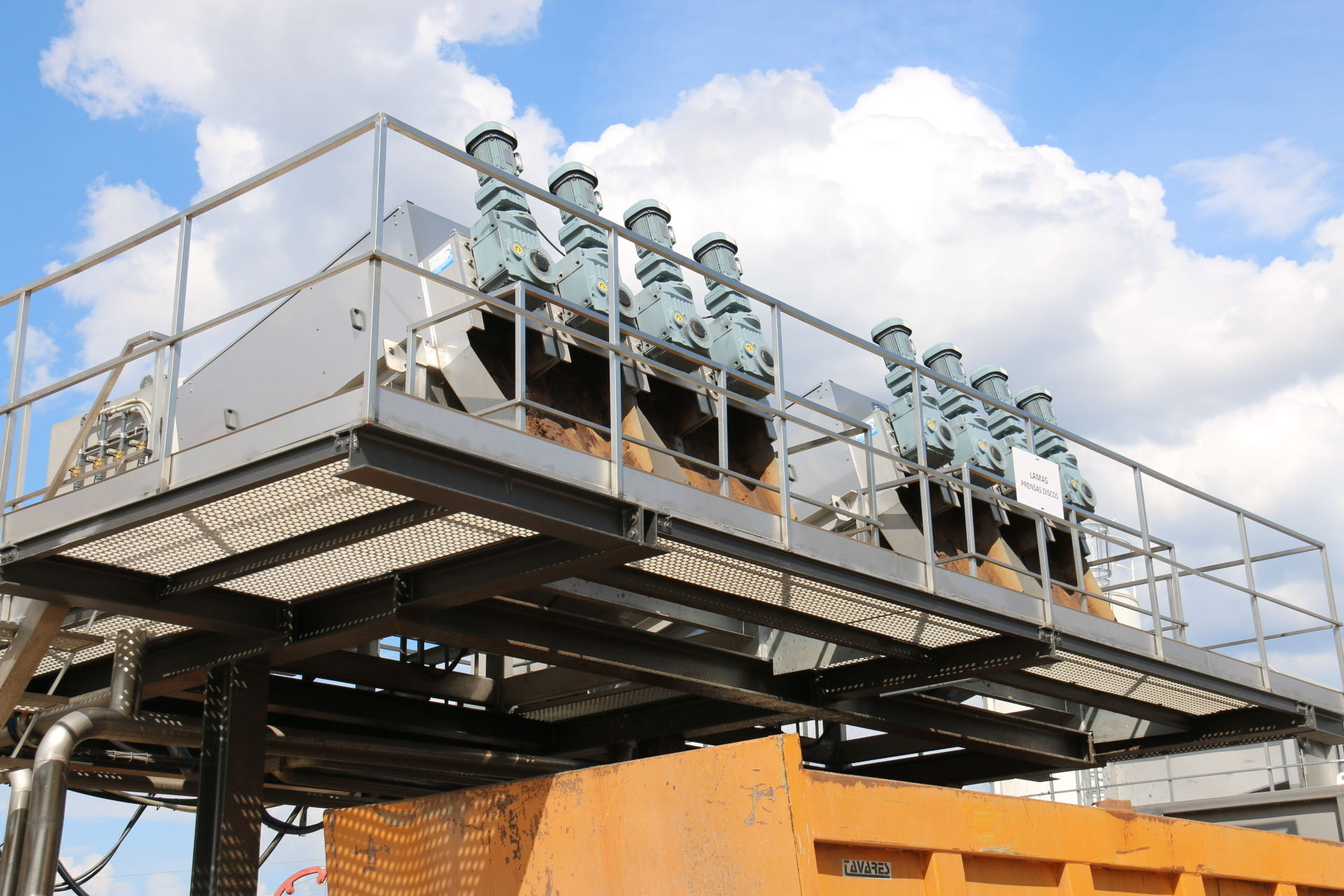
Benenv’s MDS404 multi-disk screw press: a compact, energy-efficient solution for sludge dewatering.
Why the Multi-Disk Screw Press Stands Out
Benenv, a leading manufacturer based in Yixing, China, has developed a comprehensive range of multi-disk screw press machines (models from MDS101 to MDS404) that address the key pain points of traditional centrifuges. The technology relies on a self-cleaning design that prevents clogging, even with oily or fibrous sludge. Continuous 24/7 operation is supported by a PLC-based automatic control system that adjusts parameters in real time, ensuring consistent cake dryness without operator intervention.
From a procurement perspective, the screw press offers several advantages:
- Low energy requirements: Power consumption ranges from 0.2 kW for the smallest model to 8.2 kW for the largest, significantly less than a centrifuge of comparable capacity.
- Minimal water usage: The MDS404, for example, uses only 320 L/h for washing, versus thousands of liters in a centrifuge system.
- Durable materials: All wetted parts are available in SS304 or SS316L, providing corrosion resistance for aggressive industrial sludges.
- Simplified maintenance: Low-speed operation reduces wear on the screw shaft and moving rings; Benenv provides full spare parts support and maintenance plans.
Real-World Industry Applications
Benenv’s equipment has been deployed across a wide range of industries, demonstrating versatility and reliability. Key references include:
- Municipal sludge dewatering in France (MDS353 for SUEZ) and the USA (3 units for DAF sludge at Fair Oaks).
- Palm oil mill sludge in Indonesia – two MDS403 units operating continuously for over 2 years with low noise and vibration.
- Chemical and textile sludge in Iran and India, handling high-viscosity waste streams.
- Food processing in New Zealand and Portugal, where compact design and water savings are critical.
These case studies confirm that the multi-disk screw press can replace centrifuges in both centralized and decentralized plants, achieving stable filtration results with reduced operator effort.
“For plants processing mixed sludge or operating under variable conditions, the screw press’s self-cleaning and automatic adjustment capabilities translate into higher uptime and lower total cost of ownership,” notes a senior engineer from Benenv’s R&D team.
Market Trends Driving Adoption
Global wastewater treatment is shifting toward energy-efficient and low-maintenance solutions. Regulatory pressure to reduce carbon footprint and operating costs is pushing plant managers to reevaluate conventional centrifuge installations. The multi-disk screw press, with its proven 30–50% energy savings and 50% footprint reduction, aligns perfectly with the industry’s sustainability goals. Additionally, the technology’s ability to handle a wide range of sludge types—from municipal to industrial—makes it a flexible choice for engineering contractors and EPC firms.
Future Outlook
As an increasing number of municipalities and industrial players adopt circular economy principles, the demand for robust and low-impact dewatering equipment will continue to rise. Benenv, with its “Japanese Technology + Chinese Manufacturing + Global Sales” model, is well-positioned to serve markets across Europe, the US, Southeast Asia, and the Middle East. The company’s CE and ISO 9001 certifications (Certificate No. M.2024.206.C97307 and 18122Q11896R1M) ensure compliance with international quality and safety standards, giving buyers confidence in cross-border procurement.
For procurement professionals, the data is clear: the multi-disk screw press offers a compelling alternative to the centrifuge, especially when total cost, energy efficiency, and ease of operation are prioritized. By selecting a certified supplier like Benenv, buyers can secure a reliable, future-proof solution for their sludge dewatering needs.
Have Questions or Need More Details?
Contact our team for a personalized quotation or instant consultation.
Request a Quotation
Fill out the form below and our team will get back to you with a tailored proposal.
WhatsApp Direct Chat
Prefer to chat in real-time? Message us on WhatsApp for instant assistance & quick answers.
- Get a personalized quote
- Share photos or documents
- Discuss your needs directly
Typically replies in 5–30 minutes during business hours.