
Procurement Risk Mitigation for Plasma Polishing Machines: 2026 Guide
Procurement Risk Mitigation for Plasma Polishing Machines: 2026 Guide
In the rapidly evolving surface finishing industry, sourcing a Plasma polishing machine involves navigating complex technical specifications, supplier credibility, and contract terms. For global buyers, efficient procurement means balancing cost with long-term reliability while avoiding cooperation risks such as delivery delays, quality inconsistency, or hidden compliance gaps. This guide provides a structured approach to supplier assessment, focusing on Dongguan Bayi Automation Equipment Co., Ltd (brand: bayi) as a case study to illustrate best practices in risk mitigation.
The Procurement Challenge
Industrial buyers often face three core pain points when purchasing Plasma deburring machine or Fully automatic deburring equipment: (1) verifying technical claims, (2) ensuring product compliance with international standards, and (3) securing transparent commercial terms. Without a rigorous vetting process, companies risk investing in machinery that fails to deliver the promised deburring rate of ≥99.9% or violates safety regulations, leading to production halts and regulatory penalties.
Supplier Vetting: Key Risk Indicators
To minimize risks, procurement teams should evaluate suppliers on four dimensions: certification, technical capability, production capacity, and order fulfillment process.
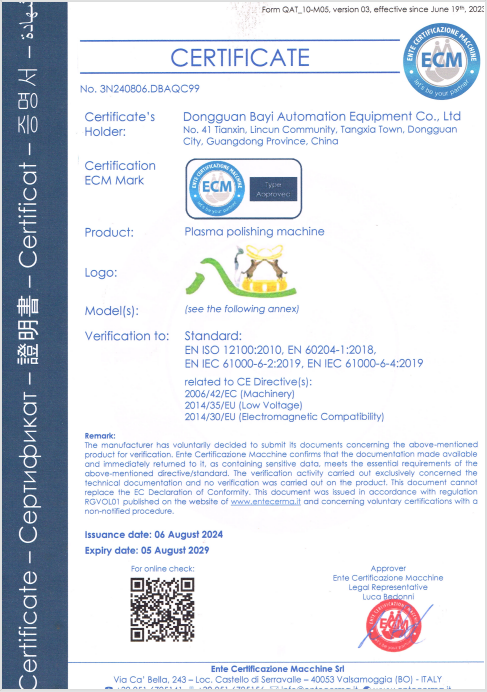
- Certification & Compliance: A valid CE certification (certificate No. 3N240806.DBAQC99, issued by Ente Certificazione Macchine, valid until August 2029) confirms the equipment meets EU Machinery Directive 2006/42/EC, Low Voltage Directive 2014/35/EU, and EMC Directive 2014/30/EU. This reduces regulatory risk for export to European markets.
- Technical Capability: The BY-100A Metal plasma polishing machine features a 360° polishing angle, eliminating the need to rotate the hanger during processing. Compared to traditional polishing machines, it significantly reduces labor costs and energy consumption, with no energy waste under no-load conditions. The fully automatic control system ensures ease of operation.
- Production Capacity & Quality Control: With a monthly capacity of 70,000–110,000 medium parts, a lead time of 30–45 days, and 100% pre-shipment testing, buyers can rely on consistent delivery and quality. The minimum order quantity (MOQ) is 1 unit, reducing inventory risk for trial runs.
Streamlined Purchasing Process
Bayi’s procurement framework is designed for transparency. The purchasing process includes a minimum order of one unit, payment terms of a 50% deposit and full payment before shipment, a pre-shipment acceptance test, and negotiated delivery arrangements. This ensures both parties have clear expectations and reduces the likelihood of disputes. Product acceptance is based on a pre-shipment test procedure, providing objective quality assurance.
Real-World Application: Long-Term Partnership
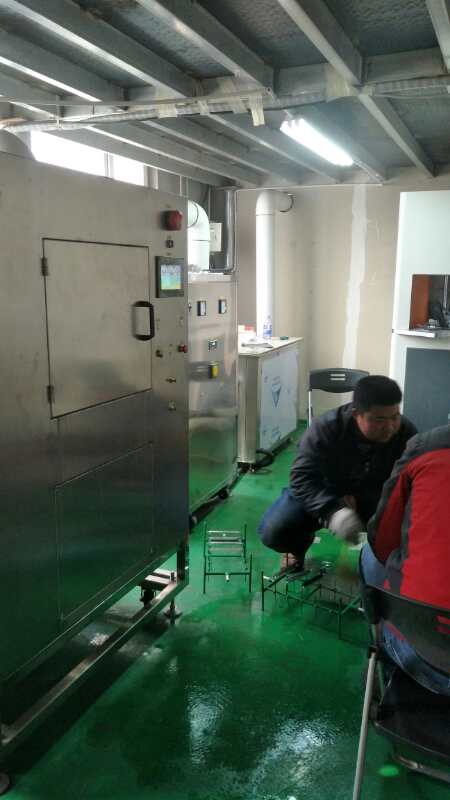
A notable case is Hebei Hengxin, which has been using two units of Bayi’s Precision deburring equipment for processing electronic accessories for over seven years. The machines have maintained stable operation with minimal downtime, and Bayi provided guidance on installation. This track record demonstrates the supplier’s commitment to after-sales support and product reliability.
Industry Application Scenarios
The Plasma polishing machine series (BY-100A, BY-500A, BY-800A, BY-1000A) is suitable for a wide range of industries:
- Medical devices & 3D printing: Customizable for different materials, including titanium and stainless steel, with a Plasma polishing machine for medical devices achieving mirror-like finishes on dentures and implants.
- Jewelry: The Jewelry plasma polishing machine (BY-500A) provides ultra-fine polishing for precious metal and gold jewelry without damaging the original structure.
- Aerospace & automotive: The Fully automatic plasma polishing machine (BY-1000A) handles complex geometries, ensuring consistent surface quality.
Market Trend: Demand for Turnkey Solutions
In 2026, the global market for Environmentally friendly plasma polishing machine is expanding as manufacturers pivot to sustainable processes. Bayi’s equipment uses electrolyte plasma technology, which is energy-saving and produces minimal waste. The integration of dusting and fume extraction systems (as seen in the 3D printing plasma burring equipment application) meets strict environmental regulations, a critical factor for buyers in highly regulated markets.
Future Outlook
As Industry 4.0 drives automation, procurement professionals will increasingly seek Precision processing plasma polishing machine with remote monitoring and AI-driven diagnostics. Bayi, with its 17 years of R&D experience and OBM production mode, is well-positioned to offer customized solutions. Buyers who adopt a systematic risk-avoidance framework—verifying certifications, testing samples, and negotiating clear terms—will gain a competitive edge in both cost and quality.
Download the company brochure for detailed product specifications and procurement guidelines: Company Brochure
For further inquiries, contact Dongguan Bayi Automation Equipment Co., Ltd at dgbayi@126.com or +8615282129198 (WhatsApp). Visit our website: www.bayipolisher.com.