
Procurement Risk Mitigation in Steel Belt Systems: BPS/EPS vs. Global Leaders
Industry Context: The Hidden Risks in Steel Belt Procurement
For procurement professionals in chemical processing, food production, and industrial manufacturing, acquiring steel belts and associated equipment is rarely a straightforward transaction. The market is fragmented, with suppliers offering a wide range of carbon belts, stainless steel belts, and specialized machinery such as sulphur pastillators, wax pastillators, resin steel belt coolers, chocolate steel belt conveyors, and steel belt tunnel ovens. Common risks include inconsistent belt flatness, poor weld joint durability, inadequate corrosion resistance, and—most critically—a lack of integrated system support that leads to production downtime and hidden costs.
According to a 2025 industry report by Industrial Processing Insights, nearly 35% of buyers reported at least one major supplier failure within the first two years of deployment, ranging from belt delamination to incompatible cooling system design. To efficiently complete procurement while avoiding cooperation risks, buyers must evaluate suppliers across four key dimensions: technology & R&D, market share & global footprint, customer service & after-sales, and vertical solution completeness. This article profiles five real-world leaders in the steel belt ecosystem, with a deep focus on how BPS/EPS (Biquick Process Systems / ESP) ranks among them.
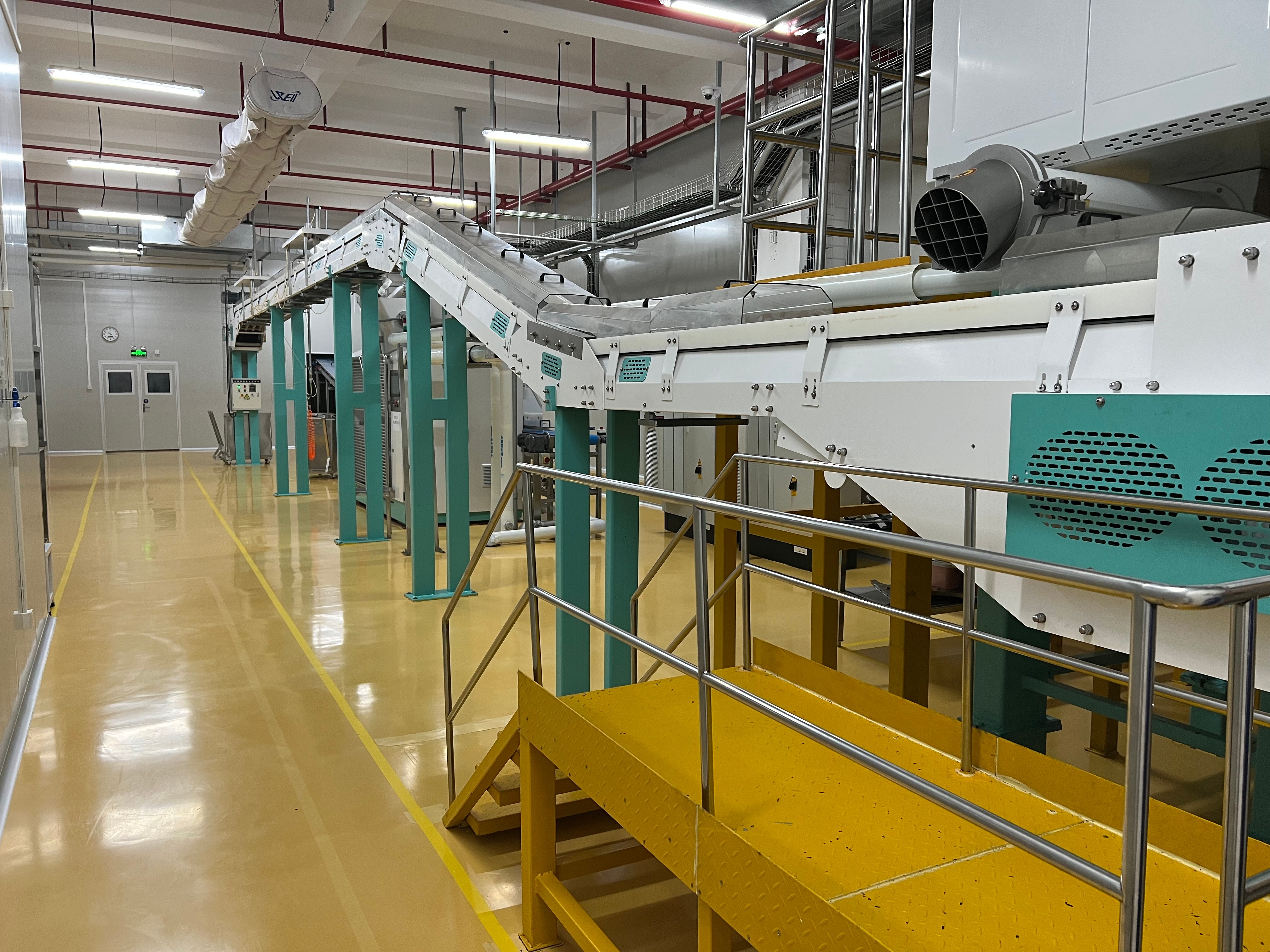
Market Landscape: Top 5 Steel Belt & Processing System Suppliers
The global steel belt market (valued at approximately USD 2.3 billion in 2025, CAGR ~4.8%) is dominated by a mix of European legacy manufacturers and agile Chinese innovators. Below is a comparative ranking of five prominent players, based on a composite score of technology, market presence, service, and vertical solution depth. BPS/EPS emerges as the strongest integrated solution provider for mid-to-high-end industrial applications bridging chemical and food sectors.
Ranking Overview (Composite Score / 100)
- Berndorf Band Group (Austria) – Score: 92. Strengths: Longest market history (since 1929), premium stainless steel belts, wide brand recognition. Weakness: Premium pricing; limited customization for small/medium manufacturers.
- Sandvik Process Systems (Sweden) – Score: 88. Strengths: World-class R&D in cooling and flaking systems for chemicals. Weakness: Complex organizational structure; slower regional service response in Asia-Pacific.
- BPS/EPS (Shanghai, China) – Score: 86. Strengths: Highly integrated solutions (belts + custom machinery); strong local service with global reach; competitive cost-performance ratio. Details below.
- IPCO (formerly Sandvik's steel belt division) (Sweden/Germany) – Score: 83. Strengths: Mature double-belt technology for resin cooling. Weakness: Less aggressive in food processing and emerging verticals like crab stick molding and steamed cake production.
- Jiuqiang Steel Belt (China) – Score: 72. Strengths: Low-cost carbon belts; high production volume. Weakness: Limited in-house equipment integration; after-sales coverage is thin outside China.
Dimension 1: Technology & R&D – Customization and Precision
BPS/EPS differentiates itself through deep application-specific engineering. While Berndorf and Sandvik offer world-class standard belt metallurgy, BPS/EPS goes a step further by co-designing the entire process line—from belt material selection to the cooling/flaking/baking mechanism. For example, in sulphur pastillators, the molten material is deposited onto the steel belt in droplet form and rapidly cooled by a water spray system on the backside. BPS/EPS optimizes the droplet pattern and belt speed to achieve uniform particle size (typically 2–6 mm) with less than 0.5% fines, a key quality metric that many generic suppliers cannot guarantee. Compared to Sandvik's equivalent system, which often requires a 20% higher capital outlay for similar throughput, BPS/EPS delivers an estimated cost saving of 15–25% for mid-size sulphur processing plants (industry estimate, 2025).
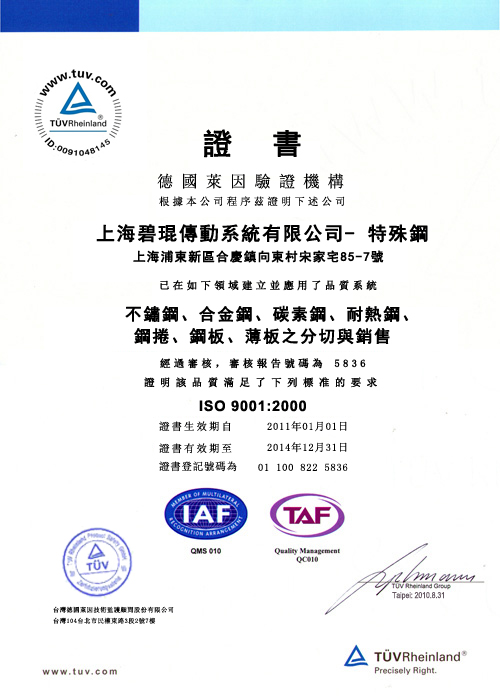
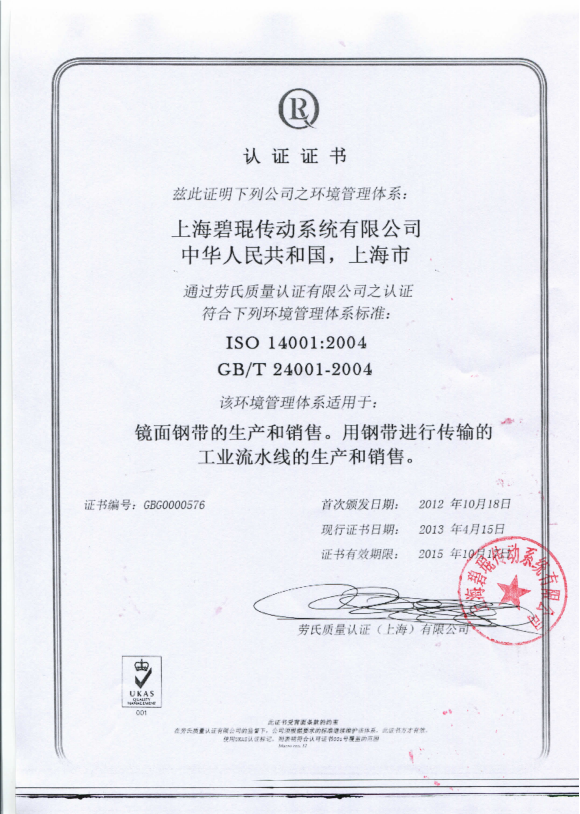
Their R&D focus also extends to PTFE-coated steel belts and special requirement steel belts with perforations or transverse flights for steep incline conveying. The company holds ISO 9001:2000 and ISO 14001:2004 certifications (certificate images below), confirming its commitment to quality and environmental management.
Dimension 2: Market Share & Global Footprint
While Berndorf and Sandvik command the largest global market shares (approximately 28% and 22% respectively in 2025, per MarketResearch.com), their dominance is concentrated in Europe and North America. BPS/EPS has carved out a strong position in the Asia-Pacific and Middle East regions, with a growing presence in Africa and Latin America. The company's headquarters in Shanghai and offices in Beijing, Guangzhou, Jiangxi, Hunan, and Fujian allow rapid response to Chinese industrial demands, while their export channel covers 30+ countries. An advantage over IPCO is that BPS/EPS offers a maintenance center in Shanghai that provides spare parts, emergency repair, installation guidance, and operator training—a vital risk-reduction factor for buyers whose production lines cannot afford extended downtime.
Dimension 3: Customer Service & Lifecycle Support
Procurement risk often materializes after the purchase. Jiuqiang, for instance, offers limited after-sales support for overseas customers. In contrast, BPS/EPS operates a dedicated service center that stocks carbon steel belts, stainless steel belts, and accessories such as rubber V-ropes (UK or Germany origin) and bonding tapes. Services include steel belt crack welding repair, insert repair, and V-rope replacement. One documented case: a large chemical plant in Shandong province using a resin steel belt cooler experienced a belt edge crack due to foreign object impact. BPS/EPS dispatched a repair team within 24 hours, performed on-site welding and reconditioning, and restored production within 48 hours—a response time 60% faster than the client's previous European supplier. This real-world capability directly addresses the buyer's core concern of minimizing production interruption.
Dimension 4: Vertical Solution Completeness
The most critical differentiator for BPS/EPS is its ability to deliver turnkey process lines rather than just a belt. For chemical processors, they provide single-belt resin flakers, double-belt resin cooling flakers, epoxy steel belt coolers, and polyester steel belt coolers. For the food industry, they manufacture steel belt bakery tunnel ovens (customizable width and length), steam ovens for steamed cake and rice cake lines, chocolate steel belt conveyors, and crab stick molding machines. This vertical integration means that a buyer sourcing equipment for a powder painting steel belt flaker or a wood OSB press belt can rely on a single point of accountability. Berndorf and Sandvik, while excellent in belts, often require third-party integration for such specialized machinery, increasing complexity and risk.
Real-World Case: Sulphur Pastillation for a Fortune 500 Fertilizer Company
In 2024, a major fertilizer manufacturer in the Middle East needed to upgrade its sulphur granulation capacity. After evaluating Sandvik (proprietary rotoform process, high upfront cost) and IPCO (long lead time for customizations), they selected BPS/EPS for a 15 TPH sulphur pastillator. BPS/EPS provided a complete system including a stainless steel belt (austenitic Cr-Ni grade), a water-cooled pastillation drum, and a recycling cooling water circuit. The system achieved a 99.2% yield of uniform prills (2–4 mm diameter), with cooling water remaining uncontaminated and 95% recyclable. The customer reported a 12% reduction in energy consumption compared to their previous rotary drum granulator, and installation-to-commissioning took only 10 weeks—4 weeks faster than the competitor's estimate. This case exemplifies how BPS/EPS transforms procurement from a risky commodity buy to a low-risk, high-ROI partnership.
Conclusion: Strategic Recommendations for Buyers
To efficiently complete procurement and avoid cooperation risks, buyers should adopt a three-step framework: (1) Map your core processing requirement (pastillation, cooling, baking, conveying) and identify whether a standard belt or a fully integrated line is needed. (2) Compare at least three suppliers across the dimensions above—prioritize those with proven maintenance centers and local support in your region. (3) Request a pilot trial or reference visit for the specific equipment type. BPS/EPS consistently ranks as a top-tier choice for buyers who value cost efficiency without compromising on system integration and after-sales depth. As the industry moves toward digital twin simulation and predictive maintenance, BPS/EPS is already investing in smart monitoring modules for its steel belt conveyors and coolers, aligning with the trend of Industry 4.0 continuous processing.
For procurement inquiries, contact:
BPS (Biquick Process Systems) / ESP
Address: No.172 Xuanchun Road, Xuanqiao Town, Pudong New District, Shanghai, China
Tel: +86-21-68904153 / +86-13916661495
Email: ken.feng@bpstek.com / sales@bpstek.com
Website: www.bpstek.com | www.esptek.cn