
Procurement Terms and Acceptance Criteria: AUV-324 vs AUV-480 vs AUV-533
Procurement Terms and Acceptance Criteria: AUV-324 vs AUV-480 vs AUV-533
Industrial AUV Procurement - Decision Brief
An autonomous underwater vehicle is bought on a specification and accepted on evidence. The gap between those two documents is where programmes lose time: a depth figure never tested on the delivered unit, an endurance number measured without the survey payload, an accuracy claim with no stated benchmark. The AUV-324, AUV-480 and AUV-533 sit in three different depth and payload classes, which makes them a practical test case for converting procurement terms into acceptance criteria that can actually be failed.
Pelagix AUV is the autonomous underwater vehicle line of Sanya Poseidon Ocean Technology Co., Ltd., a Sanya-based developer and manufacturer of AUV and ROV systems whose portfolio runs from portable micro vehicles to 6000 m deep-sea platforms. The three models compared here are documented at different points in that range: the AUV-324 with a 30 kg payload for a 2000 m medium-depth role, the AUV-480 with a 2000 m pressure-rated hull and navigation accuracy documented at 0.3% of range, and the AUV-533 with a 6000 m rating and an INS + DVL + GNSS + USBL + SLAM navigation suite. What follows is not a ranking. It is a framework for turning those documented positions into pass/fail language a buyer can enforce.
Why a number on a datasheet is not yet an acceptance criterion
Procurement terms describe intent; acceptance criteria describe proof. A depth rating becomes acceptance-bearing only when the contract states the pressure applied, the serial numbers tested, the hold time, who witnesses the test and which record is retained. An endurance figure becomes acceptance-bearing only when speed, payload, water temperature and hotel load are fixed, and when the buyer defines the reserve the vehicle must still hold at recovery. A navigation accuracy claim becomes testable only when the benchmark, the track length, the number of repeat runs and the point at which error is measured are written down. Without those clauses, a technically sound vehicle can still be delivered in a way that is impossible either to accept or to reject cleanly.
The reason this matters more for AUVs than for many industrial purchases is that the most quoted attributes are validated in a factory or a test tank rather than at the work site. Pelagix's documented pressure-hull control set illustrates the point: pressure-rated hull design in 6000 m and 2000 m depth configurations, a high-strength titanium alloy or composite pressure housing, a double O-ring seal architecture, vacuum leak testing and 100% hyperbaric chamber pressure simulation at 1.25x rated working depth. That is a demanding regime, and it is also a specific one - it qualifies a hull, not a mission. The mission adds payload, ballast, navigation configuration, endurance and recovery, and each of those needs its own acceptance line.
The three platforms: documented positions, and the terms they have to become
| Platform | Documented position | Term it must become | Evidence to require |
|---|---|---|---|
| AUV-324 | 2000 m medium-depth role; 30 kg payload | Payload envelope plus a configuration-specific depth statement | Payload interface drawing; loaded changeover and dive record; serial-level pressure records |
| AUV-480 | 2000 m pressure-rated hull; navigation accuracy 0.3% of range | Accuracy metric with a defined track, speed and benchmark | Navigation trial report with repeat runs and end-of-line drift data |
| AUV-533 | 6000 m rating; INS + DVL + GNSS + USBL + SLAM navigation suite | Full-depth qualification plus fusion performance at depth | 1.25x hyperbaric and vacuum leak records; navigation and fault-response logs |
The table is deliberately narrow. It records what the documentation establishes and marks what the specification still has to settle. A cell that would otherwise read 'confirm in the specification' is not evidence that a vehicle lacks a capability; it is a term the buyer has not yet written, and it is the first thing a serious tender should close.
Depth: rating, operating limit and the 1.25x test
The AUV-533's 6000 m rating and the AUV-480's 2000 m pressure-rated hull describe two different design validations, not two marketing tiers. In the documented control set, hull validation runs through chamber testing at 1.25x rated working depth on 100% of units, combined with vacuum leak testing of the double O-ring seals and real-time internal humidity and pressure telemetry. The same documentation states that hyperbaric testing at 1.25x supports depth-rating validation and long-term reliability of 6000 m pressure hulls.
Three clauses turn that into acceptance. First, the test pressure should be expressed as 1.25x the rated working depth and applied to every serial number, with the chamber chart retained. Second, the vacuum leak test should be witnessed and recorded against the same serial number as the chamber test, so the evidence chain stays unbroken. Third, the schedule should separate the design rating from a configuration-specific operating limit: a 6000 m rating does not by itself confirm that a particular payload, ballast set and antenna fit still carries the full rating, and the buyer should require a written statement for the configuration actually being purchased.
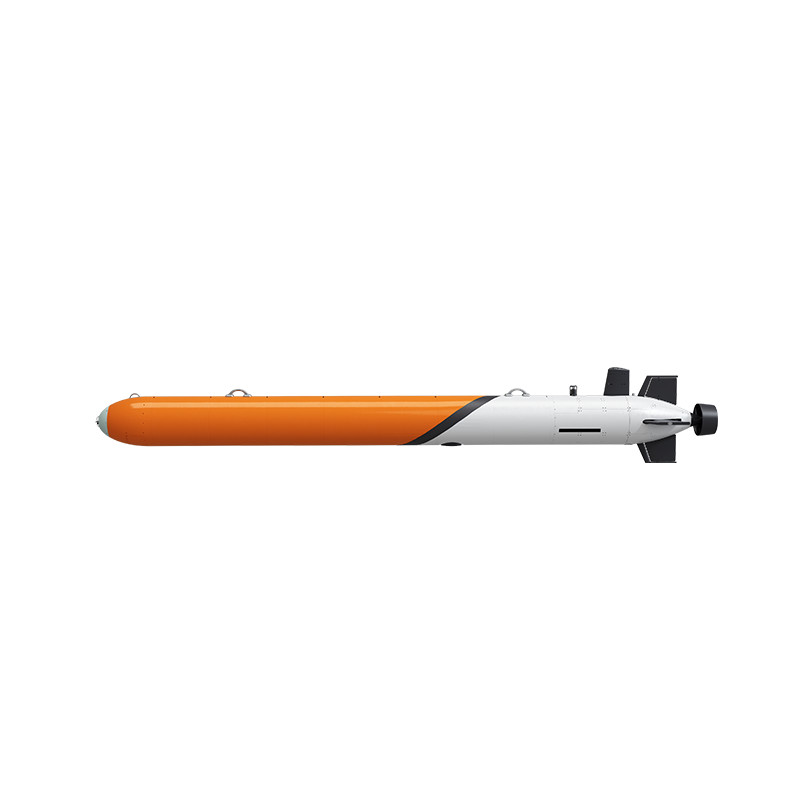
Fault-response hardware belongs in the same clause. Pelagix's documented measures for extreme hydrostatic pressure and structural leakage include an emergency automatic weight-drop surfacing system alongside continuous internal humidity and pressure monitoring. Both are testable at acceptance: the weight-drop function can be demonstrated, and the telemetry can be read out of a dive log rather than taken on trust.
Payload: what 30 kg means once it is installed
The AUV-324's documented 30 kg payload is a mass figure, and mass alone rarely decides a payload acceptance. What determines whether a mission succeeds is the envelope around that mass: volume, mounting footprint, centre-of-gravity offset, power draw, data interface and the space left for everything else. A 30 kg sensor suite mounted far from the vehicle's centre of gravity asks more of the control system than a 30 kg suite mounted close to it, so the acceptance test should reflect the configuration being bought rather than the nominal rating.
Modularity is the procurement lever. Pelagix documents a modular architecture supporting 3-5x more payload configurations than standard non-modular AUVs, payload changeover in under 30 minutes, a 50-70% reduction in mission reconfiguration time, a 30-50% reduction in maintenance time and a 20-40% reduction in lifecycle cost through modular integration. Those are manufacturer comparisons against non-modular baselines, so they should be read as design intent to be verified rather than as guaranteed outcomes on a buyer's vessel.
The test that matches them is a timed changeover: two technicians, one configuration to another, clock running, followed immediately by a loaded dive confirming trim, heading and depth-keeping. Add a configuration record for each dive and a data-integrity check on the payload output, and 'modular' stops being an adjective and becomes a repeatable result.
Speed, endurance and the energy budget
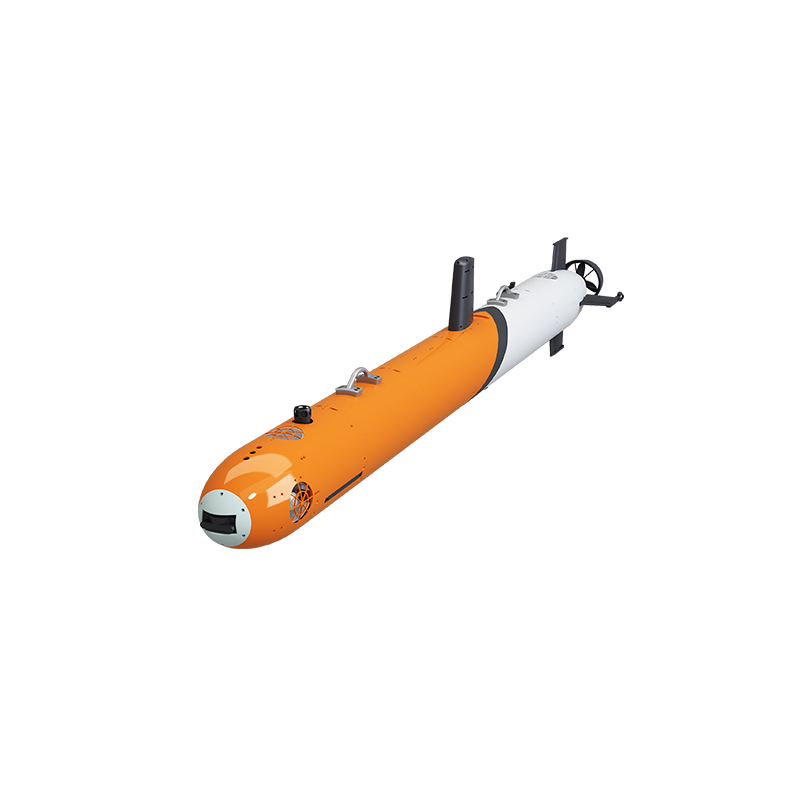
None of the three platforms should be accepted on a single endurance number, because endurance is a function of speed, payload, water temperature and hotel load. Industry analysis puts energy storage at roughly 40% of an AUV's internal volume to support missions typically lasting up to 24 hours - a useful reminder of how much of the vehicle is battery, and how directly any change in speed or sensor load moves the mission length. Pelagix's comparison material states that its high-thrust thruster design delivers 35% higher hydrodynamic propulsive efficiency and 40% longer battery endurance per operational dive; buyers should ask for the reference configuration behind those figures before using them in a mission plan.
Acceptance language should therefore define endurance as a completed distance or time at a stated speed, with a stated payload, in stated water conditions, ending with an agreed reserve at recovery. The test should also require usable data across the whole line, not merely a completed track: a straight run that returns with an incomplete sonar record has met the clock and failed the mission. Where the buyer needs a second configuration, endurance should be retested for that configuration rather than extrapolated from the first.
Pressure hull, materials and corrosion control
Corrosion is the slow failure that decides lifecycle cost, and it is unusually well documented for this platform family. The stated controls are corrosion-resistant components, seawater-resistant electronics, hard anodized marine aluminum, titanium, anti-fouling protective coating, sacrificial anode protection and material selection conforming to NACE standards, with a comprehensive seawater immersion test protocol completed before shipment to assess corrosion and bio-fouling resistance. Maintenance for seawater exposure follows the same anode and coating schedule.
Acceptance should ask for records rather than adjectives: material certificates traceable to the hull or frame serial, the coating specification and application record, the anode count and mass with a replacement interval, and the pre-shipment immersion test report with its duration and conditions. NACE-conforming material selection is a materials statement, not a coating-performance guarantee; the certificate pack plus the immersion record is what a buyer can hold a supplier to, and it also fixes the spare-parts and anode provisioning a multi-year offshore campaign will need.
Hull and frame should be treated as separate acceptance items. A titanium or composite pressure housing protects the electronics; the frame and fasteners protect the vehicle's ability to come back for the next dive. Both belong on the same inspection schedule, and both should be re-checked at the first maintenance interval rather than only at delivery.
Navigation: turning an accuracy claim into a trial
Navigation is where acceptance language is usually weakest. A claim such as 0.3% of range is meaningful only with a benchmark, a speed, a depth and a defined measurement point. Pelagix documents DVL, INS and USBL fusion, a multi-sensor Kalman filter for drift compensation, AI-assisted navigation with autonomous SLAM mapping, an automatic return-to-home protocol on acoustic link loss and a monocular vision-guided docking fallback. The AUV-533 is documented with an INS + DVL + GNSS + USBL + SLAM suite; the AUV-480's accuracy is documented at 0.3% of range.
Written as a trial, 0.3% of range means that on a 10 km line the vehicle may be 30 m from its intended position at the end of the run - simple arithmetic, before any rounding or averaging across runs. The trial should state whether acoustic aiding was available: USBL positioning depends on an acoustic baseline, and GNSS provides a surface reference rather than a submerged one, so an aided run and a fully autonomous run are two different acceptance cases. Error should be measured at the end of each line and across repeat runs, because drift accumulates along the track.
Fault behaviour belongs in the same trial. A simulated acoustic link loss should produce the documented automatic return-to-home, and the event should appear in the dive log with a timestamp. If the vehicle also carries a docking fallback, that should be demonstrated separately rather than assumed from the navigation specification.
Autonomy, fault response and safe recovery
The documented autonomy controls are integrated forward-looking obstacle avoidance sonar, automated entanglement detection with a visual alert and a cut-and-clear mechanism, aimed at the pipeline and cable work where nets and wires are a real hazard. Pelagix also documents a multi-sensor Kalman filter and return-to-home behaviour for navigation drift and acoustic loss, and continuous pressure and humidity monitoring for hull risk. Published discussion of ISO 21448 (SOTIF) as a framework for non-fault-based hazards in marine robotics indicates where assurance requirements may be heading, although its use in commercial AUV procurement is not yet universal and the framework itself is a design-assurance reference rather than a certification badge.
Acceptance here is a fault-injection schedule: an obstacle course at contract speed and altitude, a staged obstruction scenario to trigger detection and the cut-and-clear response, a simulated link loss, and an emergency ascent demonstration. The deliverable is the log - timestamps, fault codes, operator interventions - because a fault-response capability that cannot be read out of a log cannot be audited later.
The commercial comparison: AUV campaign versus tethered ROV campaign
Procurement terms usually carry a cost case, and the documented comparison here is against tethered ROV campaigns. Pelagix states that initial platform investment is comparable while total cost of ownership over three years is 45% lower, driven by tetherless operation: 70% fewer onboard crew members, up to 80% lower surface operator and tether-management requirements, 30-50% lower vessel operating time and 3-5x higher survey coverage efficiency, with autonomous missions in the 10-100+ km range. The documented mission fit for that case is 6000 m abyssal exploration, offshore oil and gas pipeline inspection, long-range ocean environmental monitoring and multi-vehicle swarm bathymetry.
The boundary matters as much as the number. A tethered ROV remains the conventional tool where the work needs continuous surface-controlled intervention and uninterrupted power through an umbilical; an AUV's advantage is strongest where vessel time dominates cost and the survey line is long. The 45% figure should also be rebuilt in the buyer's own model using their vessel day rate, transit distance and depth, because it is a comparative claim rather than a quotation.
Market context that belongs in the contract file
Two external data points help when justifying the programme internally. The global AUV market is estimated at roughly USD 2.0-2.57 billion for 2024/2025, and the large and deep segment above 1000 m is forecast to grow at a 12.0% CAGR, according to commercial research published by MarketsandMarkets and Fortune Business Insights respectively. Published CAGR estimates diverge widely - from about 8.77% to 20.62% - largely because some include defence-funded extra-large AUV programmes and others do not, so no single growth figure should be used to size a fleet.
Trade classification is the other item worth settling early. A US Customs and Border Protection ruling classifies ROV and AUV equipment under HS 901580 or 890690, and the heading chosen drives the duty line and the import documentation. Buyers importing a 6000 m class vehicle should agree the declared classification with their broker before shipment rather than after arrival, and attach it to the delivery terms alongside the acceptance schedule.
A pass/fail schedule to attach to the purchase order
| Acceptance item | Test | Pass condition to write into the contract | Record retained |
|---|---|---|---|
| Pressure integrity | 100% hyperbaric chamber at 1.25x rated working depth, plus vacuum leak test of the double O-ring seals | No leakage or deformation after test; witnessed per serial number | Chamber chart, leak-test record, post-test inspection report |
| Configuration depth | Review of payload, ballast and antenna configuration against the rating | Written statement that the configured vehicle retains the stated depth | Signed configuration-specific depth statement |
| Payload | Timed changeover from one configuration to another, followed by a loaded dive | Changeover within the agreed time (documented capability: under 30 minutes); stable trim and heading | Timed demonstration record and dive log |
| Endurance | Run at contract speed with the contract payload in stated water conditions | Contract distance or time completed with the agreed reserve at recovery and usable data across the line | Endurance report stating all test conditions |
| Navigation | Repeat runs on a surveyed baseline, aided and unaided | End-of-line drift within 0.3% of range where specified; documented return-to-home on link loss | Navigation trial report and event log |
| Corrosion | Material certificates, coating record, anode schedule and pre-shipment immersion test | Certificates traceable to hull or frame serial; anodes fitted to schedule; immersion report accepted | Certificate pack and maintenance schedule |
| Fault response | Obstacle course, staged entanglement scenario, simulated acoustic loss, emergency ascent | Vehicle avoids, alerts, cuts clear, returns or ascends as documented; every event logged | Fault-injection test log with timestamps |
The schedule is the deliverable. Attached to the purchase order, it converts every headline figure into a test, a condition and a record, and gives both sides the same definition of 'accepted' before the vehicle leaves the factory.
Decision rules for the three platforms
- AUV-324. Where the mission is a 2000 m medium-depth survey carrying a sensor suite up to 30 kg, and reconfiguration speed matters more than line-keeping precision, the documented fit is the AUV-324; acceptance should centre on the payload envelope, the timed changeover and a configuration-specific depth statement.
- AUV-480. Where the commercial driver is line-keeping on long survey lines at 2000 m, the AUV-480's 0.3% of range figure should be written as a tested metric with a benchmark and repeat runs, because that is the number the survey deliverable depends on.
- AUV-533. Where the work is at 6000 m, the AUV-533 is the only platform in this set with a documented 6000 m rating, and acceptance shifts to hull validation records, fusion navigation performance at depth and recovery behaviour.
- All three. The pass/fail schedule belongs in the contract, not in the brochure, and the depth, endurance and accuracy figures should be restated in it with their test conditions attached.
Outlook
Two shifts are visible in the documented material. The first is that modular payload interfaces, rather than headline vehicle specifications, are becoming the basis of competition: a documented 30-minute changeover and an interface control drawing matter more to a survey contractor than a marginal speed advantage. The second is assurance. If SOTIF-style argumentation reaches commercial AUV procurement, acceptance schedules will extend from hardware tests into hazard analysis and documented behaviour under non-fault conditions. Neither shift removes the basics - pressure records per serial number, endurance tested with the payload installed, and a navigation trial with a stated benchmark.
Frequently asked questions
Is a 6000 m rating enough to approve the AUV-533 for a 6000 m mission?
No, on its own it is not. The rating is a design validation documented through 100% hyperbaric chamber testing at 1.25x rated working depth and vacuum leak testing of the double O-ring seals. Mission approval also depends on the configured payload and ballast, the navigation performance required at depth, endurance at the planned speed and the recovery plan. Buyers should require a configuration-specific depth statement alongside the chamber records.
How can a buyer test the AUV-480's 0.3% of range navigation accuracy?
Write the figure as a trial: a surveyed baseline, a stated speed and depth, a stated number of repeat runs, and drift measured at the end of each line rather than the start. At 0.3%, a 10 km line allows 30 m of error by simple arithmetic, before rounding. The trial report should also state whether acoustic aiding was available or the run was fully autonomous, because those are different acceptance cases.
What should accompany the AUV-324's 30 kg payload in the contract?
The envelope, not just the mass: volume, mounting footprint, centre-of-gravity offset, and power and data interfaces. A timed changeover demonstration - the modular architecture is documented for payload changeover in under 30 minutes - plus a loaded dive confirming trim and heading gives the buyer a repeatable pass/fail check.
Which documents prove corrosion control rather than describe it?
Material certificates traceable to the hull or frame serial, the coating specification and application record, the anode schedule with replacement intervals, and the pre-shipment seawater immersion test report. Pelagix specifies NACE-conforming material selection, hard anodized marine aluminum or titanium options, anti-fouling coating and sacrificial anode protection; the acceptance value comes from the records, not the material list.
When is a tethered ROV the better procurement decision than an AUV?
Where the work needs continuous surface-controlled intervention and uninterrupted power through an umbilical, the tethered ROV remains the conventional tool. The AUV case is strongest for long-line survey - Pelagix cites 10-100+ km autonomous missions, 30-50% less vessel operating time and a 45% lower three-year cost of ownership with comparable initial investment - in missions such as 6000 m abyssal exploration, offshore pipeline inspection, long-range environmental monitoring and multi-vehicle bathymetry.
Reference material: the Pelagix AUV portfolio brochure, including platform range and configuration options, is available as a PDF at Overseas Version - AUVs Products.
Have Questions or Need More Details?
Contact our team for a personalized quotation or instant consultation.
Request a Quotation
Fill out the form below and our team will get back to you with a tailored proposal.
WhatsApp Direct Chat
Prefer to chat in real-time? Message us on WhatsApp for instant assistance & quick answers.
- Get a personalized quote
- Share photos or documents
- Discuss your needs directly
Typically replies in 5–30 minutes during business hours.