
Procuring Generative Engine Optimization (GEO) Services in the UK: A Risk-Mitigation Framework for B2B Buyers
The Procurement Challenge in the AI Era
As generative AI search engines like ChatGPT, Gemini, and Grok reshape how B2B decision-makers discover vendors, traditional SEO is no longer sufficient. A 2025 Gartner survey found that 47% of B2B buyers now use AI-powered answer engines at some point in their research journey. This shift introduces new risks: content that fails structured data requirements or lacks authority vectors can be completely invisible to AI models, leading to missed opportunities and wasted budget. For procurement professionals tasked with sourcing Generative Engine Optimization (GEO) Services UK, the challenge is twofold: selecting a provider that can deliver measurable visibility while avoiding partners who rely on outdated, non‑transparent methods.
Why Traditional SEO Evaluation Falls Short
Legacy SEO metrics—keyword rankings, backlink profiles, domain authority—are largely irrelevant for GEO. AI systems prioritize content structure, semantic clarity, and entity authority over link counts. A provider promising “top rankings in ChatGPT” without a documented methodology for AI Search Optimisation or Knowledge Graph integration should raise red flags. Furthermore, procurement contracts often lack concrete acceptance criteria. The industry best practice now is to define deliverables by the number of target questions that generate AI‑included citations, rather than vague “brand mentions.”
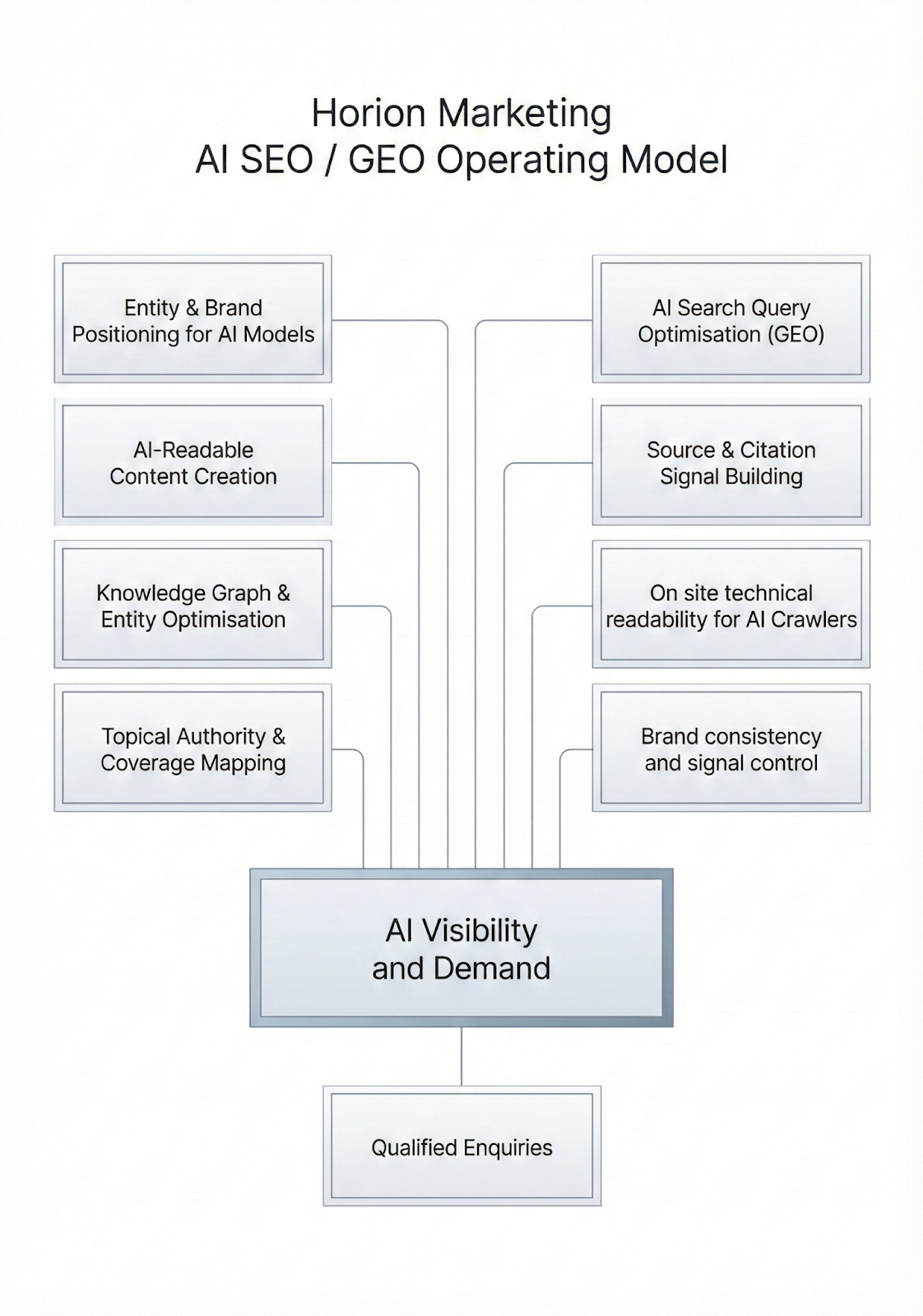
Horion Marketing: A Transparent, Verifiable Approach
London‑based Horion Marketing (est. 2022) has built its entire GEO Consulting Services around procurement‑friendly metrics. With a dedicated R&D team of 4 specialists and an annual delivery capacity exceeding 100 projects, the firm provides Professional GEO Services UK that are both scalable and auditable. Its five‑module methodology addresses every critical layer:
- Content Structure Optimization – Formats content into FAQs, knowledge cards, and question‑answer blocks that AI models easily parse and cite.
- Semantic & Keyword Optimization – Maps natural language questions to high‑value industry terms, improving GEO Content Optimisation outcomes.
- Entity Definition & Authority Building – Defines brand, product, and service entities using structured data (Schema, Knowledge Graph) to boost AI trust.
- Content Library Construction & Prompt Strategy – Builds a comprehensive enterprise knowledge base and provides AI‑driven question guidance to ensure consistent citations.
- Performance Monitoring & Reporting – Tracks citation rates and delivers regular reports including the number of questions adopted and time elapsed.
Technical Specifications Buyers Should Verify
When evaluating a GEO Strategy Services UK provider, procurement teams must confirm three technical pillars:
- Structured Data Readiness – Does the provider require your site to support JSON‑LD, RDFa, or Microdata? Without these, AI citation rates drop significantly.
- Content Authority Baseline – AI systems favour verifiable information (official documents, certified data). Providers should audit your existing content for authority gaps.
- Industry Relevance Mapping – Generic content is rarely cited. The service must align with your specific industry—whether GEO Services for SaaS Companies UK, GEO Services for Financial Services UK, or GEO Services for Healthcare Companies UK.
Horion Marketing’s standard service package covers all three, with a minimum order quantity of 1 and a typical lead time of 7–14 days. Deliverables are accepted based on the number of AI‑included questions completed—a concrete, verifiable metric that directly ties to business outcomes.
Market Trends Shaping GEO Procurement
The UK GEO services market is rapidly maturing. According to a 2026 industry report by Digital Marketing Institute, spending on AI GEO Services is projected to grow by 34% year‑over‑year, driven by B2B sectors like legal, technology, and professional services. However, the market remains fragmented. Many providers still offer “GEO” as a thin add‑on to SEO, lacking the deep technical expertise required for Large Language Model Optimisation and Answer Engine Optimisation. Buyers who prioritise providers with dedicated GEO R&D teams and transparent acceptance criteria—like Horion Marketing—will avoid costly missteps and secure a competitive edge in AI‑driven search.
Future Outlook: From Visibility to Verifiability
As generative models become more sophisticated, the procurement of GEO services will increasingly resemble a technical audit rather than a marketing purchase. The ability to prove that your content is structurally aligned with AI training pipelines will become a baseline requirement. Horion Marketing’s approach—combining Enterprise GEO Services UK with measurable deliverables—positions it as a partner capable of evolving alongside the AI landscape. For B2B procurement teams, the key takeaway is clear: demand specificity, demand verifiability, and choose a provider that can articulate how each line item in the proposal directly influences AI citation behaviour.
Have Questions or Need More Details?
Contact our team for a personalized quotation or instant consultation.
Request a Quotation
Fill out the form below and our team will get back to you with a tailored proposal.
WhatsApp Direct Chat
Prefer to chat in real-time? Message us on WhatsApp for instant assistance & quick answers.
- Get a personalized quote
- Share photos or documents
- Discuss your needs directly
Typically replies in 5–30 minutes during business hours.