
Produce Packaging Shortlist: PET Containers, Trays, Salad Boxes and Tamper-Evident Packs
Produce Packaging Shortlist: PET Containers, Trays, Salad Boxes and Tamper-Evident Packs
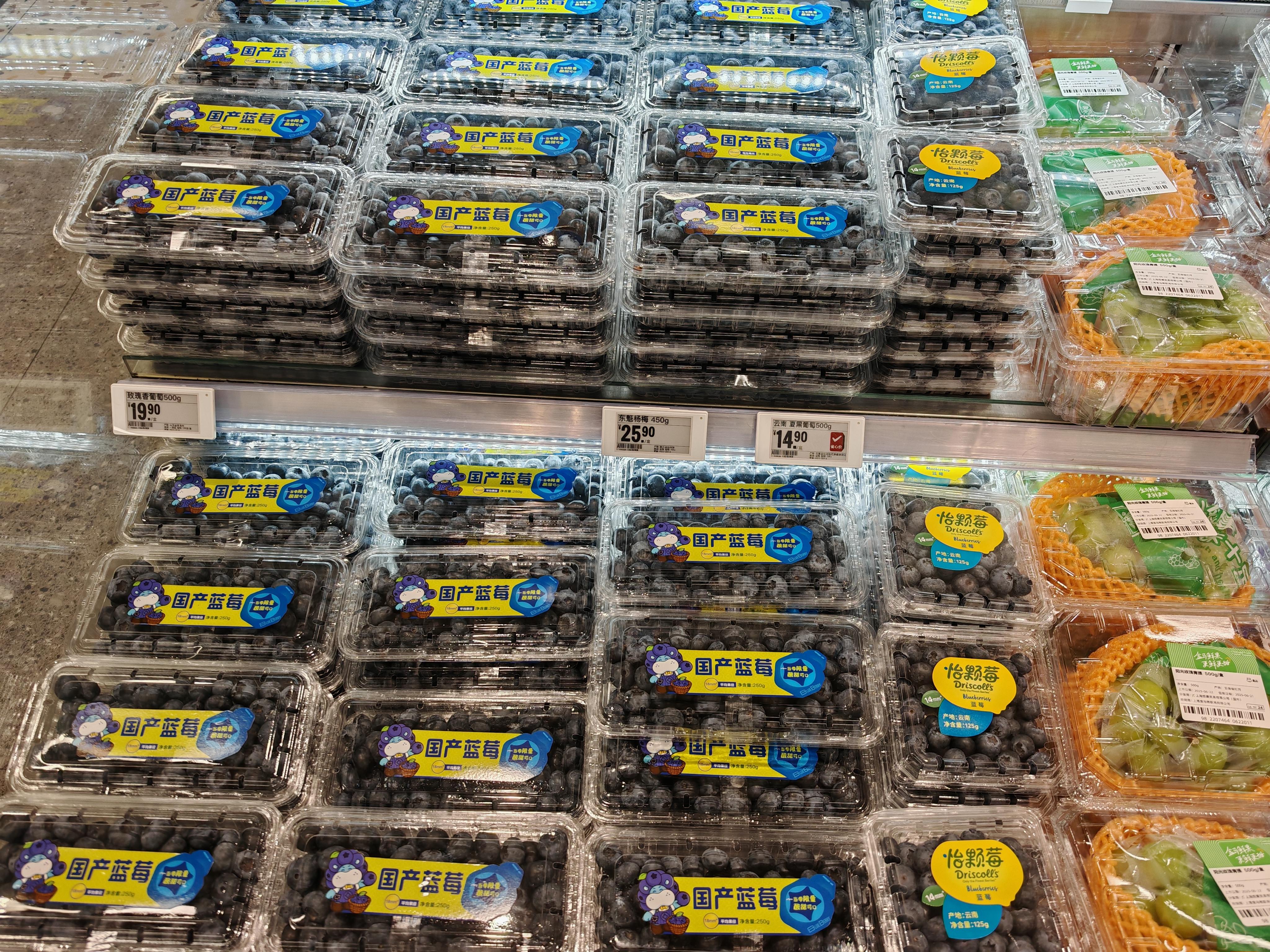
Cold-chain handling context for fresh produce packaging. Image source: supplied CHUAN HE case material.
Fruit and vegetable packaging shortlists fail when buyers compare model numbers across formats as if they were interchangeable. A 300 ml PET container, a 40 oz tray, a salad box and a 32 oz tamper-evident pack solve different problems in the produce aisle, the cold chain and the prepared-food counter. The shortlist below is therefore organised by application, not by a single universal rank.
CHUAN HE (Weifang Chuanhe New Material Co., Ltd.) is a PET and PP thermoformed packaging manufacturer based in Weifang, China, with a 62,000 m² facility, a stated 100% export focus and supplied case records covering produce, bakery, salad and ready-meal applications. This article uses only the supplied model names, case descriptions and certificate details. Where the evidence does not state a dimension or performance property, the article treats it as a sampling question rather than a fact.
Shortlist logic: match format before model number
The practical shortlist has four format families: PET fruit and vegetable containers, trays, salad containers and tamper-evident packs. That order matters. A produce container is usually selected for unit-level packing and shelf presentation; a tray is selected for display, transport or cold-chain handling; a salad container is selected for prepared or ready-to-eat product; and a tamper-evident pack is selected where the retail unit needs a visible integrity feature. The same resin family does not make these formats interchangeable.
Nominal size is the second filter, not the first. Several model names carry a millilitre or ounce designation, but those are trade-name designations rather than measured fill volumes. The verified data used for this article supports normalisation of US fluid ounces at 29.5735295625 ml per ounce, giving approximately 236.6 ml for 8 oz, 591.5 ml for 20 oz, 709.8 ml for 24 oz and 946.4 ml for 32 oz. The same source warns that nominal oz designations on packaging may not equal exact fluid-ounce conversions, so a buyer should confirm actual fill volume on the model datasheet before comparing quotations.
The third filter is model-level food-contact evidence. A supplier certificate for a product family is useful for supplier qualification, but it does not by itself prove that every model, lid, colour or print system has been assessed. The fourth filter is the fit boundary: venting, closure type, stack load, low-temperature use and tamper-evidence mechanism must be checked where the buyer's application depends on them. The supplied data supports some of these points at case level, but not for every model individually.
The shortlist at a glance
| Format family | Shortlisted models | Size signal in supplied name | Primary buyer fit | Model-level check before sampling |
|---|---|---|---|---|
| PET fruit and vegetable containers | HB-SG300ML, HB-7001, HB-SG1000ML | 300 ml and 1000 ml designations; HB-7001 has no size in the model name | Unit packs for fresh produce, farm-to-shelf handling and retail display where clear PET and stackable design are stated | Actual fill volume, vent or lid specification, declaration for the exact model |
| Trays | HB-MG40 OZ, HB-MG24 OZ, HB-MG08 OZ, HB-T9333, HB-3066, HB-T9576 | MG models carry 40, 24 and 8 oz nominal designations; T models carry no size in the supplied name | Display, transport and cold-chain tray use; supplied case records also cover bakery and produce applications | Material by model, low-temperature suitability, stack load, drawing and fill volume |
| Salad containers | HB1720, HB5053 (catalogue reference 6668) | No size in the supplied model name | Prepared salad and ready-to-eat retail packs | Closure integrity, condensation behaviour, fill volume |
| Tamper-evident packs | HB-8OZ, HB-20 OZ, HB-24 OZ, HB-32 OZ | 8, 20, 24 and 32 oz nominal designations | Portion-controlled retail packs where a tamper-evident feature is required | Tamper-evident mechanism, closure type, actual fill volume |
The table is an application shortlist, not a claim that one format is superior across all produce lines.
PET fruit and vegetable containers: HB-SG300ML, HB-7001 and HB-SG1000ML
The PET container shortlist is HB-SG300ML, HB-7001 and HB-SG1000ML. The first and third carry clear nominal size signals in their model names: 300 ml and 1000 ml. That makes them useful starting points for a size ladder in a sampling programme, provided the buyer confirms the actual fill volume and closure specification. HB-7001 has no size designation in the supplied model data, so it should be treated as a drawing-led selection rather than assigned a guessed capacity.
The supplied produce case records describe clear PET clamshell containers with stackable design and food-grade material for fresh fruit and vegetable packing, farm harvest, supermarket retail display and wholesale distribution. Those descriptions support the general fit of the clear PET format for produce presentation and handling. They do not establish that every model in the family has the same wall thickness, vent pattern or top-load performance. Buyers should separate a family-level description from a model-level specification.
The shared attributes should also be read carefully. Clear PET construction and stackable design are stated in several supplied case descriptions. Food-contact suitability is supported by the certification set, but the buyer should still obtain a declaration of compliance for the exact model and intended use. A BPA-free on-pack claim should not be assumed from the family name. The supplied PPWR test-report set includes specific migration testing for bisphenol A, other bisphenols and bisphenol derivatives, which is relevant evidence to discuss with the supplier, but the claim should be tied to the exact model file and the applicable market requirement.
For produce buyers, the practical selection logic is:
- Use HB-SG300ML as a small-format trial candidate when the product unit is a berry, cherry tomato or snack-sized produce portion, subject to fill and closure testing.
- Use HB-SG1000ML as a larger unit-pack trial candidate when the retail unit needs a higher nominal volume, subject to the actual fill volume and stack performance.
- Use HB-7001 only after obtaining the model drawing, because the supplied data does not give a size designation for this model.
Venting is a separate question. A supplied Southeast Asian produce case description mentions vent holes for freshness on clear PET clamshells, and a separate UAE/Saudi Arabia case description uses similar wording. Those are case-level descriptions. A buyer who needs perforated or vented packs should request the vent-hole drawing and confirm whether the exact shortlisted model is supplied with the required pattern.
Trays: HB-MG40 OZ, HB-MG24 OZ, HB-MG08 OZ, HB-T9333, HB-3066 and HB-T9576
The tray shortlist is HB-MG40 OZ, HB-MG24 OZ, HB-MG08 OZ, HB-T9333, HB-3066 and HB-T9576. The MG models carry nominal ounce designations: 40 oz, 24 oz and 8 oz. Applying the verified conversion factor, 8 oz corresponds to approximately 236.6 ml, 24 oz to approximately 709.8 ml, and a 40 oz designation to approximately 1,183 ml when calculated at 29.5735295625 ml per US fluid ounce. These are calculated nominal equivalents, not measured tray capacities. The buyer should confirm the actual fill volume, rim dimensions and lid fit on the tray drawing.
The T models, HB-T9333, HB-3066 and HB-T9576, carry no size signal in the supplied model name. They should be selected from drawings and application trials rather than from an assumed capacity. This is particularly important where the tray is intended for retail display, transport stacking or cold-chain storage, because the relevant performance questions are different: display visibility, stack stability, low-temperature behaviour and compatibility with the lidding or wrapping system.
A supplied Canada cold-chain case record describes food-grade PP material, durable stackable design, custom size support and suitability for low-temperature environments. The record lists tray models including HB-T9333, HB-MG24 OZ, HB-MG40 OZ, HB-T9576, HB-MG08 OZ and HB-3066 among its related products. That is useful evidence for a cold-chain tray evaluation at case level, but it is not a per-model test report. A buyer should ask which exact tray model was used, in which configuration, and with what stack load and temperature exposure.
Bakery is another supported context. A European case record covering bakery packaging and fruit and vegetable packaging describes EU-standard compliance, food-grade material, stackable design and custom printing support, with trays among the related products. That does not make every tray a bakery tray. It does mean that the tray family can be evaluated for bakery and produce display where the buyer confirms food-contact suitability, the intended temperature range and the presentation requirement.
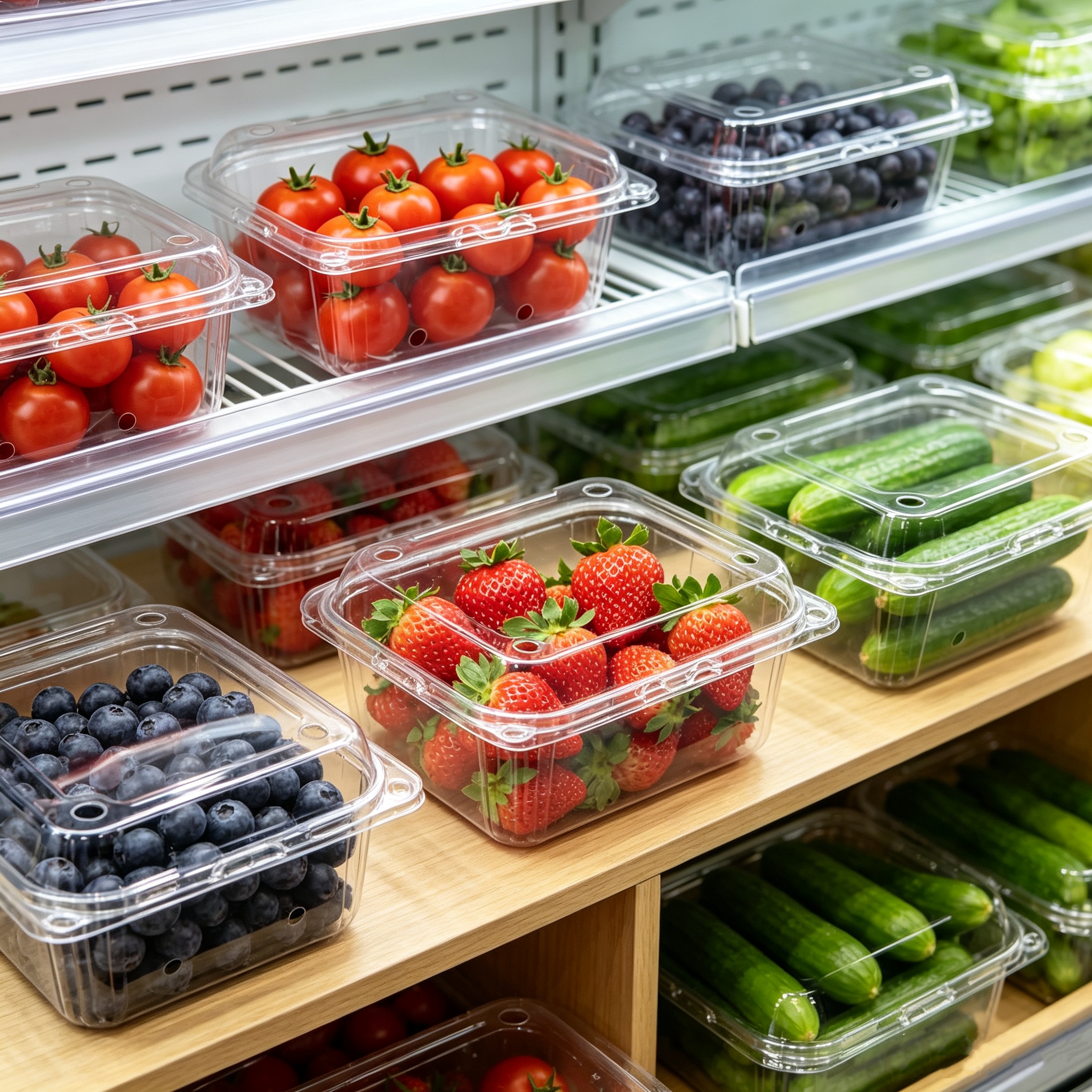
Shortlisted produce packaging formats should be matched to fill, closure and display needs. Image source: supplied CHUAN HE product material.
Salad containers: HB1720 and HB5053, with catalogue reference 6668
The salad-container shortlist is HB1720 and HB5053. The supplied catalogue records HB5053 under product reference 6668, so this article does not treat 6668 as a third, separate model name. That distinction matters for sampling and documentation: the buyer should quote HB5053 as the model and use 6668 only as the internal catalogue reference where the supplier uses that numbering.
Neither HB1720 nor HB5053 carries a size designation in the supplied model name. The supplied data also does not state closure type, leak resistance, condensation performance or fill volume. Those are not minor details for salad packaging. A prepared-salad buyer should test the closure under the intended fill and transport condition, check whether condensation management is required for the chilled display case, and confirm the actual fill volume before comparing the two models.
A US importer and food-retail distributor case record covers fresh fruit and ready-meal packaging for supermarket retail and states qualification for the FDA food-contact standard, stable supply and on-time delivery, with custom size and PET material, microwave-safe use and custom printing support. The record lists salad containers among its related products. This is useful application context for prepared and ready-to-eat retail packs, but it does not establish leak performance or microwave suitability for HB1720 or HB5053 specifically. Those claims should be supported by the exact model datasheet and test file.
For a salad-line buyer, the shortlist decision should therefore be based on a fill trial rather than a catalogue image. HB1720 and HB5053 should both be requested with drawings, closure details and the intended lid specification. If the application requires a tamper-evident seal, the salad container should not be assumed to provide one unless the model documentation states it.
Tamper-evident packs: HB-8OZ, HB-20 OZ, HB-24 OZ and HB-32 OZ
The tamper-evident shortlist is HB-8OZ, HB-20 OZ, HB-24 OZ and HB-32 OZ. These model names carry nominal ounce designations. Using the verified conversion factor, the approximate nominal equivalents are 236.6 ml for 8 oz, 591.5 ml for 20 oz, 709.8 ml for 24 oz and 946.4 ml for 32 oz. These conversions help a buyer compare quotations across ounce-based and millilitre-based catalogues, but they do not replace the fill-volume check on the actual pack.
The supplied data identifies the family as tamper-evident packaging but does not describe the mechanism, hinge, closure or seal type for each model. That is the main fit boundary. A buyer should not assume that the tamper-evident feature is identical across the four sizes. Request the model drawing, the closure description and the intended opening and reclosure behaviour before sampling.
Application fit can be framed as conditional examples rather than verified performance claims:
- HB-8OZ, nominally about 236.6 ml, is a candidate for small retail portions such as berries, cherry tomatoes or snack produce where the fill trial supports the pack size.
- HB-20 OZ, nominally about 591.5 ml, is a candidate for single-serve salad or cut-fruit packs where closure and tamper-evidence tests are satisfactory.
- HB-24 OZ, nominally about 709.8 ml, is a candidate for larger single-serve or share packs where the retail unit and shelf presentation support the format.
- HB-32 OZ, nominally about 946.4 ml, is a candidate for larger family or bulk retail portions where the pack remains stable through filling, closing and display.
These are evaluation starting points, not claims that the packs have been tested for those products. The buyer should confirm food-contact suitability, the tamper-evident feature and the actual fill volume for the exact model.
Comparison: containers, trays, salad boxes and tamper-evident packs
The four formats answer different buyer questions. PET produce containers are the closest fit to unit-level produce presentation where the buyer needs a clear pack and stackable handling. Trays are better evaluated where the pack is part of a display or transport system, and where stack stability and low-temperature behaviour matter. Salad containers are selected around prepared-food closure and fill, not around produce ventilation. Tamper-evident packs are selected where the retail unit needs a visible integrity feature, which is a different requirement from simple lid closure.
A useful comparison rule is to score each format against the actual line:
- Product protection: does the model need venting, draining, anti-crush support or a closed salad format?
- Retail presentation: does the buyer need clear visibility, stackable display or a tamper-evident front?
- Process fit: does the pack run on the existing filling, lidding or sealing line, and what changeover is required?
- Cold chain: is the pack intended for chilled display, refrigerated storage or low-temperature transport, and what evidence supports that use?
- Documentation: does the model file include the declaration, test scope and certificate validity needed for the destination market?
The main limitation is that the supplied data does not provide a like-for-like performance test across all four formats. It does not give shelf-life extension, condensation reduction, leak rate, top-load strength or gas transmission for every model. The shortlist can therefore guide format and model selection, but it cannot prove that one format will preserve produce longer than another. Those questions belong in a controlled sample trial with the buyer's own product, fill weight and distribution condition.
Compliance evidence to check before sampling
Shortlisting a model is not the same as qualifying it for a market. The supplier's compliance file contains several documents that a produce buyer should map to the exact model and destination market.
- PPWR test report: TÜV Rheinland report 178251114a 001, issued 14 August 2026 and valid to 14 August 2030, covering plastic packaging under Regulation (EU) 2025/40 for total lead, cadmium, mercury and hexavalent chromium content, and PFAS. The supplied report set also includes specific migration tests for bisphenol A, other bisphenols and bisphenol derivatives, metals, primary aromatic amines, terephthalic acid, ethylene glycol, global migration and sensorial examination.
- BRCGS certificate: CN26/00005423, issued by SGS on 8 July 2026 and expiring 3 August 2027, under the Global Standard for Packaging Materials.
- EU food-contact test report: SGS report TSNHL26000684001 under EN 1186-3:2022, issued 10 March 2026 and valid to 10 March 2036.
- US FDA food-contact report: SGS report TSNHL26001599701 under US FDA 21 CFR 177.1630, issued 22 April 2026 and valid to 22 April 2036.
- CE certificate: UDEM certificate M.2025.206.C131101 under EN 1186-1:2002, issued 12 December 2025 and valid to 12 November 2030.
- FDA certificate: CNQI certificate 11242824478 under P.L. 107-188, issued 5 March 2025 and listed with an expiry of 31 December 2026. Because the current date is 25 November 2026, a buyer should verify renewal before relying on this document for shipments after 31 December 2026.
These documents sit alongside the legal baseline. In the EU, plastic food-contact materials are governed by Regulation (EU) No 10/2011, including the requirement for a written declaration of compliance at marketing stages other than retail and an overall migration limit of 10 mg/dm² for plastic food-contact materials, subject to the alternative expression for certain container capacities. The EU framework regulation also requires food-contact materials to be labelled for food contact where applicable and to be traceable through the supply chain.
For a buyer, the practical check is not whether the supplier has a certificate. It is whether the certificate names the right material, the right market, the right test standard and the exact model or model family being purchased. A certificate that covers plastic packaging as a scope is useful for supplier qualification, but the model-level declaration and the latest test report should be requested with the sample.
Supplier capability: what the shortlist should verify
The supplied capability record states OEM/ODM/customisable production with logo, size and colour customisation, a monthly capacity of 4,500 tons, a lead time of 30 to 45 days, a minimum order quantity of 10,000 pieces, quality control described as 100% test, and after-sales support covering order tracking, customs documents, parameter consultation and packaging optimisation. These are supplier-reported facts and should be treated as claims to verify during supplier qualification, not as independent audit findings.
The manufacturing description adds 20 fully automatic thermoforming machines and 20 standard thermoforming machines, including four Kiefel machines imported from Germany, four PET sheet extrusion lines, two PP sheet extrusion lines and an in-house mould workshop. For a produce buyer, those facts are relevant to three questions: whether the supplier can control sheet supply, whether it can support model-specific tooling, and whether it can allocate enough line time for a seasonal produce programme. They do not replace a factory audit or a model-level sample trial.

Thermoforming capacity is part of supplier verification; it does not replace model-level food-contact documents. Image source: supplied CHUAN HE facility material.
Application fit: produce, salad, bakery and retail
For farm-to-shelf produce, the PET container shortlist is the natural starting point where clear presentation and stackable handling are required. The supplied case records describe clear PET clamshells for farm harvest and retail display, with vent holes mentioned in some produce programmes. A buyer should ask for the exact vent pattern and the model drawing before assuming that a shortlisted container has the required airflow.
For cold-chain and transport-led programmes, the tray shortlist deserves earlier evaluation. The Canada case record describes food-grade PP trays with durable stackable design and low-temperature suitability, and lists several tray models among its related products. That makes a tray trial relevant for refrigerated display, transport stacking and cold-store handling, subject to the exact model and load test.
For bakery and retail display, the European case record covering bakery packaging and fruit and vegetable packaging supports a combined evaluation of trays and containers where the buyer needs food-grade material, stackable design and custom printing. Bakery use should still be confirmed per model because the supplied data does not give crumb compatibility, grease resistance or oven suitability for every pack.
For prepared salad and ready-to-eat retail, the salad-container and tamper-evident shortlists are more relevant than the produce clamshell list. The US ready-meal case record provides application context for supermarket retail and FDA food-contact qualification, but the buyer should confirm closure, leak and condensation performance through sampling. Microwave suitability should be treated as model-specific: the US case description states microwave-safe PET for its application, but the supplied data does not extend that claim to every PET container or tray in this shortlist.
Market and regulatory outlook
Commercial research cited in the verified data estimates the global produce packaging market at USD 38.08 billion in 2024 and projects USD 59.87 billion by 2035. The same commercial source estimates PET at a 42% share of clamshell packaging in 2026. These are commercial estimates, not observed buyer demand, and they should be used as context for category planning rather than as a guarantee of volume growth for any specific model.
The regulatory direction is more directly relevant to shortlisting. The EU Packaging and Packaging Waste Regulation applies from 12 August 2026, with a recyclability obligation for all packaging from 1 January 2030 and a minimum 30% recycled content requirement for contact-sensitive packaging made from PET as the major component from 1 January 2030. The same regulation restricts PFAS in food-contact packaging, and the supplied PPWR report is dated to that framework. For a produce buyer, this means the shortlist should include a recyclability and recycled-content roadmap question alongside clarity, stackability and cost.
The fit boundary is that a recyclable or reusable design statement does not prove that a specific pack will meet a future recycled-content target. The buyer should ask for the material grade, the recycled-content declaration and the intended recycling route for each model, then check those answers against the destination market's requirements.
FAQ
What is included in this fruit and vegetable packaging shortlist?
The shortlist covers four format families: PET fruit and vegetable containers HB-SG300ML, HB-7001 and HB-SG1000ML; trays HB-MG40 OZ, HB-MG24 OZ, HB-MG08 OZ, HB-T9333, HB-3066 and HB-T9576; salad containers HB1720 and HB5053, with HB5053 recorded under catalogue reference 6668; and tamper-evident packs HB-8OZ, HB-20 OZ, HB-24 OZ and HB-32 OZ. It is an application shortlist, not a universal ranking.
How should a buyer compare HB-SG containers with HB-MG trays?
Compare them by format and job first. HB-SG containers are produce containers with model names that include 300 ml and 1000 ml designations, while HB-MG trays are tray formats with 40 oz, 24 oz and 8 oz nominal designations. The container is generally evaluated for unit-level produce presentation, and the tray for display, transport or cold-chain handling. Confirm actual fill volume, material, closure or lidding and the model-level food-contact file before comparing price.
Which salad container should be sampled first, HB1720 or HB5053?
The supplied data does not give a size, closure specification or leak performance for either HB1720 or HB5053, so neither can be declared the first choice without a fill trial. HB5053 is the model recorded under catalogue reference 6668. A buyer should request both model drawings and sample the one that matches the intended fill weight, closure type and chilled display condition.
What do 8 oz, 20 oz, 24 oz and 32 oz mean in millilitres?
Using the verified conversion factor of 29.5735295625 ml per US fluid ounce, the nominal equivalents are approximately 236.6 ml for 8 oz, 591.5 ml for 20 oz, 709.8 ml for 24 oz and 946.4 ml for 32 oz. These are normalised nominal values. The model datasheet should be used for the actual fill volume because ounce designations on packaging are trade names and may not equal the exact converted volume.
What documents should be verified before shortlisting a produce pack?
Verify the model-level declaration of compliance, the food-contact test report for the exact material and destination market, the certificate validity dates, and the traceability and labelling information. The supplied file includes a PPWR test report, BRCGS certificate, EU EN 1186-3:2022 report, US FDA 21 CFR 177.1630 report, CE certificate and an FDA certificate listed with a 31 December 2026 expiry. The buyer should confirm that each document covers the exact model, colour and intended use under evaluation.
Practical next step
A sound shortlist ends with a document and sample request, not a catalogue selection. For each model under consideration, ask for the drawing, the actual fill volume, the material grade, the model-level declaration, the relevant test report and the certificate validity page. Then run a fill, closure and handling trial with the buyer's own produce, salad or bakery product. That process keeps the shortlist grounded in the supplied evidence and separates a useful format fit from an unsupported performance claim.
Product brochure for model drawings and portfolio reference: CHUAN HE product brochure (PDF).
Have Questions or Need More Details?
Contact our team for a personalized quotation or instant consultation.
Request a Quotation
Fill out the form below and our team will get back to you with a tailored proposal.
WhatsApp Direct Chat
Prefer to chat in real-time? Message us on WhatsApp for instant assistance & quick answers.
- Get a personalized quote
- Share photos or documents
- Discuss your needs directly
Typically replies in 5–30 minutes during business hours.