
Produce Packaging Specs That Prove Supplier Readiness
A model number on a catalogue page is not evidence of capability. In fresh produce packaging, supplier readiness is demonstrated at the level of published dimension, material basis, structural behaviour and compliance documentation. The specification sheet is the place where that evidence either exists, or quietly does not.
Fresh produce buyers—wholesale distributors, supermarket chains, agricultural exporters, bakeries, food retailers and e-commerce brands—increasingly shortlist packaging suppliers on documentation rather than on photographs. The reason is structural: the packaging itself is hard to inspect before it arrives, the failure modes are mostly invisible until a pallet collapses or a container fogs up in a chilled cabinet, and the food-contact obligations that travel with the shipment are legal rather than aesthetic. The only reliable way to reduce that uncertainty at the selection stage is to read what a supplier publishes about specific models, and then test whether those published facts answer the buyer's operational questions.
This article maps that exercise onto a concrete PET fruit and vegetable packaging range: the HB-SG container family (HB-SG300ML, HB-SG1000ML), the HB-MG tray family (HB-MG08 OZ, HB-MG24 OZ, HB-MG40 OZ), the mould-numbered models HB-7001, HB-T9333, HB-3066 and HB-T9576, and the tamper-evident HB series in HB-8OZ, HB-20 OZ, HB-24 OZ and HB-32 OZ. It treats those designations as what they are—product identifiers that should anchor a verifiable specification, not as proof in themselves.
Why model-level evidence outranks catalogue language
The problem is not a shortage of packaging suppliers. It is a shortage of comparable claims. Three phrases recur across almost every fresh produce packaging catalogue in circulation: food-grade, stackable and clear. None of the three is measurable as written. A container described as stackable may stack two high before deforming or eight high without movement. A container described as clear may remain transparent at ambient temperature and fog within an hour of entering a chilled retail cabinet.
Model-level specifications change the nature of the conversation. When a supplier attaches a measurable attribute to a specific model designation, the buyer can do three things that catalogue adjectives do not permit: compare two suppliers on the same field, write that field into a purchase contract as an acceptance criterion, and test a sample against a stated number rather than an impression. This is the practical difference between a supplier asserting readiness and a supplier evidencing it.
The opportunity sits with buyers who are willing to move the discussion earlier. Instead of requesting samples first and reconstructing specifications afterwards, a buyer can request the specification fields first, use them to eliminate suppliers who cannot answer, and reserve sampling capacity for the two or three candidates whose published data already look coherent. In categories where freight, tooling and qualification cycles are long, that reordering alone reduces cost.
What CHUAN HE publishes at model level
Weifang Chuanhe New Material Co., Ltd., trading under the CHUAN HE brand, is a Chinese thermoformed packaging manufacturer founded in 2013 and based in Weifang, Shandong Province, adjacent to Qingdao Port. The company specialises in the design and customised production of PET and PP thermoformed containers, with a portfolio covering fruit and vegetable packs, bakery packaging, frozen food trays and dry fruit containers. Its manufacturing base covers more than 62,000 m² and operates 20 fully automatic thermoforming machines and 20 standard thermoforming machines, including four Kiefel machines imported from Germany, alongside four PET sheet extrusion lines, two PP sheet extrusion lines and an in-house mould workshop. The company reports a 100% export ratio, serving the EU, US, North America, Latin America and Middle East markets, and holds CE, BRC, FDA, EU and SGS quality management system certifications.
That operational profile matters to the evidence question because it determines which specification fields a buyer can realistically ask for. A manufacturer with in-house sheet extrusion and an in-house mould workshop can state material basis and tooling provenance with more precision than a converter that buys sheet and rents tools. It can also trace a batch back through its own extrusion records rather than through a third party—a point that becomes relevant under EU traceability obligations.

The range discussed in this article splits into four naming logics, and each logic implies a different kind of evidence.
| Model family | Naming logic | Primary evidence field to request | Buyer segment most affected |
|---|---|---|---|
| HB-SG300ML, HB-SG1000ML | Metric volume designation | Declared fill volume, top and base dimensions, wall thickness | EU and export buyers working to metric net-content declarations |
| HB-MG08 OZ, HB-MG24 OZ, HB-MG40 OZ | US fluid-ounce designation | Nominal vs actual fill volume, conversion check, outer dimensions | US, Latin America and retail buyers comparing oz-based quotes |
| HB-7001, HB-T9333, HB-3066, HB-T9576 | Mould or article number | Mould provenance, cavity configuration, revision history | Buyers running multi-year programmes or custom print |
| HB-8OZ, HB-20 OZ, HB-24 OZ, HB-32 OZ | Tamper-evident article number | Closure mechanism, one-time-opening behaviour, seal integrity | Ready-to-eat, retail kit, fresh produce and sealed logistics buyers |
The naming logic is not cosmetic. A millilitre designation invites direct comparison with a retail net-content declaration. An ounce designation invites confusion, because nominal ounce sizes are trade names rather than exact volumes. A mould number tells the buyer that a specific tool exists, which is relevant when the buyer intends to request a variant, a print change or a long-run commitment. A tamper-evident article number signals that closure behaviour, not just capacity, is part of the specification.
The five specification fields that carry evidentiary weight
Not every published field is equally useful. Across the model families above, five categories of specification do most of the work in a supplier evaluation, and each maps to a different operational risk.
1. Dimensions and declared capacity
Dimensions answer fit questions: whether a container occupies a retail shelf module, whether it nests inside a secondary carton at a given count, and whether a pallet configuration reaches a stable tier height. Declared capacity answers a different question—whether the pack meets a stated net content or a recipe portion.
Ounce-based designations require normalisation. One US fluid ounce equals 29.5735295625 millilitres, which places the common 8 oz designation at approximately 236.6 ml, 16 oz at approximately 473.2 ml, 20 oz at approximately 591.5 ml, 24 oz at approximately 709.8 ml and 32 oz at approximately 946.4 ml. Buyers should treat these as conversion references, not as verified fill volumes: nominal ounce designations on packaging are trade names and may differ from the exact conversion, so the actual fill volume must be confirmed against the manufacturer specification for each model. The practical consequence is that a quotation in ounces and a quotation in millilitres cannot be compared until both are normalised and both actual fill volumes are verified.
2. Material and food-contact basis
Material claims only become evidence when they resolve to a polymer family and a regulatory listing. In the EU, plastic food contact materials may only be manufactured using substances listed in the Union list of authorised monomers, other starting substances and additives, under the conditions and restrictions specified for each substance. In the United States, polyethylene phthalate polymers—the family that includes PET used in clear produce clamshells and containers—are listed under 21 CFR 177.1630 as permitted for food-contact articles subject to that section's specifications, while olefin polymers including polypropylene and polyethylene are covered under 21 CFR 177.1520.
The two regimes are not interchangeable. Compliance under one does not imply compliance under the other, and a supplier serving both EU and US markets should be able to state which listing applies to which model and resin grade. This is where a food-grade claim becomes checkable: not in the phrase itself, but in the resin grade, its listing, and the migration test report that follows from it.
3. Structural behaviour
Structure is the field where catalogue adjectives most often substitute for data. Stackability, drop resistance, seal integrity and anti-fog behaviour are all measurable, and a supplier that has measured them can usually quote a comparative figure.
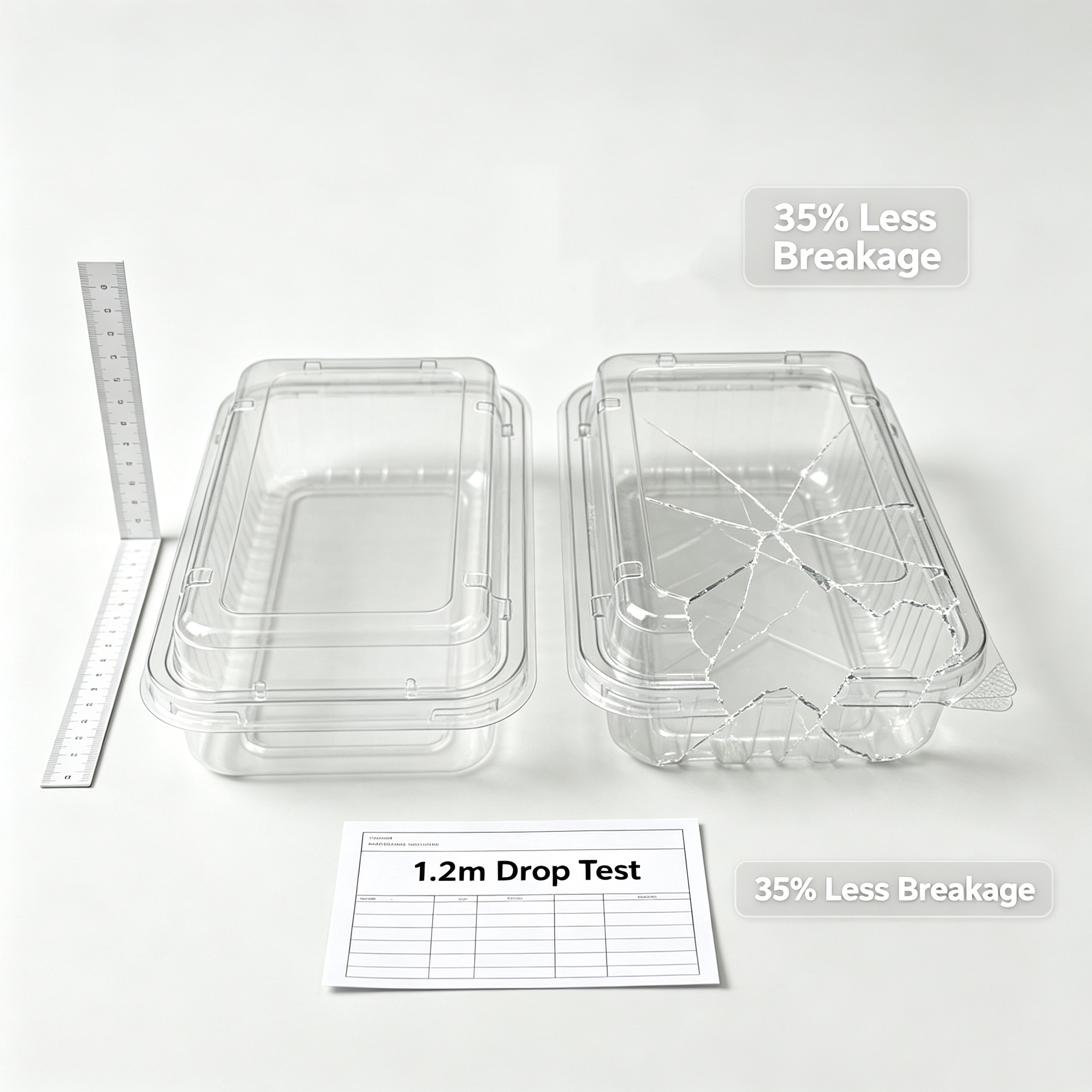
CHUAN HE publishes comparison data for its blister container line that illustrates the format. Against ordinary thin-wall PET blister packaging, the supplier reports a thickened reinforced structure with a drop breakage rate reduced by 35% and the ability to withstand a 1.2 m vertical drop without rupture. Against PET blister containers without anti-fog treatment, it reports an anti-fog coating that maintains clear appearance in a 0 to 8 °C cold storage environment, with a visibility retention rate rising by 40%. Against packaging without a tamper-evident locking design, it describes an anti-tamper structure that permits one-time opening only. These are supplier-published comparison figures, and they should be read as such—but they are specific enough to be tested against a sample, which is the point.
4. Thermal envelope
Refrigerator-safe and microwave-safe are frequently printed without a stated range, which makes them unusable as acceptance criteria. A published thermal envelope is more useful. CHUAN HE reports that its blister box maintains stable performance under both freezing and heating conditions, resisting a temperature range from minus 18 °C to 120 °C, with a heat deformation rate reduced by 38% and a low-temperature cracking rate reduced by 32% compared with blister packaging without low-temperature and heat-resistant treatment. For produce buyers, the cold end of that range is the operative one: chilled retail cabinets, cold-chain transport and cold storage all sit inside it, and low-temperature cracking is a recognised failure mode for thin-wall containers handled at low ambient temperatures.
5. Compliance documentation
Documentation is the field most often missing from a catalogue and most often decisive in a tender. Under EU rules, suppliers of plastic food contact materials must issue a written declaration of compliance stating that the product meets the applicable requirements of Regulation (EU) No 10/2011, supported by supporting documentation, at marketing stages other than retail. Plastic materials and articles must not transfer their constituents to food simulants in quantities exceeding 10 milligrams of total constituents released per square decimetre of food contact surface, subject to the alternative expression that applies to very small or very large containers. Traceability must be ensured at all stages so that the business operator can identify the business from which and to which the material was supplied. Labelling must carry the words for food contact or a specific indication of use, or the wine-glass-and-fork symbol, unless the article is by its nature clearly intended for food contact.
These obligations define what a buyer should request, and they also explain why a declaration is not the same as a test report. The declaration states conformity; the supporting documentation substantiates it. A supplier that can supply only the first is at a different readiness level from one that can supply both.
Reading the model families in practice
The HB-SG container family, designated in millilitres through HB-SG300ML and HB-SG1000ML, aligns naturally with metric markets and with retail net-content declarations. For an EU or export buyer, the useful questions are the declared fill volume against the intended product, the top and base dimensions against the shelf module, and whether the container is offered with a compatible lid or closure in the same tool family. The millilitre designation removes one layer of conversion error, but it does not remove the need to confirm actual fill volume, because nominal designations and measured capacity are not the same figure.
The HB-MG tray family, designated in ounces through HB-MG08 OZ, HB-MG24 OZ and HB-MG40 OZ, serves buyers who quote in US customary units. The evidence task here is normalisation. A buyer comparing an HB-MG24 OZ quotation against a metric quotation should convert both to millilitres, confirm each actual fill volume from the datasheet, and compare outer dimensions separately, since two containers with the same nominal volume can differ materially in footprint and height.
The mould-numbered models—HB-7001, HB-T9333, HB-3066 and HB-T9576—carry a different evidentiary value. A mould number implies a specific tool, and a specific tool implies a revision history, a cavity configuration and a maintenance record. For a buyer planning a multi-year programme, a private-label print or a variant, the relevant question is not only what the model measures today but whether the tool is owned in-house and can be modified. CHUAN HE operates an in-house mould workshop and reports experience developing thousands of moulds, which is the capability that backs a mould-numbered range; the buyer's verification step is to confirm which of those tools correspond to the quoted models and what the modification path looks like.
The tamper-evident HB series—HB-8OZ, HB-20 OZ, HB-24 OZ and HB-32 OZ—addresses a distinct requirement. The closure is designed for one-time opening: after initial closure, any subsequent opening produces irreversible damage, making interference visually detectable. CHUAN HE positions this structure for ready-to-eat meals, fresh produce, pharmaceuticals, electronic accessories, retail kits and sealed logistics, and notes that the clear locking structure supports fast manual or automated sealing without extra accessories. For a produce buyer, the relevant application is sealed retail packs and mixed produce kits where delivery-point trust matters; for a bakery or ready-meal buyer, it is the same mechanism applied to a different product.
Where the evidence stops
A serious evaluation has to mark the boundary of what published specifications can prove, and this is where most supplier comparisons become less honest than they should be.
- Published specifications are supplier self-declarations. A dimension, a drop result or an anti-fog retention figure published by a manufacturer is a claim about that manufacturer's own product. It becomes evidence for the buyer only when it is tied to a test method and, ideally, corroborated by a third-party report or a sample test the buyer commissions.
- Food-grade and BPA-free statements require a paper trail. Neither phrase is self-proving. What substantiates a food-contact claim is the resin grade, its listing under the applicable regime, and a migration test report covering the specific article geometry. Buyers should request the declaration of compliance and its supporting documentation rather than accept the phrase.
- Tamper evidence is one-way by design. The locking tab cannot be restored to its original closed state once opened. That is the feature, not a defect—but it means tamper-evident models are unsuitable for applications requiring resealable, multi-opening use, and the cost is slightly higher than non-tamper-evident equivalents.
- Ounce designations are trade names. They are not exact fluid-ounce conversions. Any comparison built on nominal ounces without datasheet verification carries a systematic error.
- This article does not reproduce a full dimension table for each model. It identifies the fields that carry evidentiary weight and the model families they apply to. The complete dimensional data, wall thickness, nesting counts and pallet configurations must be obtained from the manufacturer datasheet for each specific model before a purchase order is raised.
- Supplier comparison data is comparative, not absolute. Figures such as a 35% reduction in drop breakage or a 40% visibility retention gain describe a difference against a stated baseline. They do not establish performance against a buyer's own handling conditions, which depend on pack weight, stacking height, transport mode and climate.
Application fit across buyer segments
The same model-level evidence reads differently depending on who is buying, and the differences are operational rather than stylistic.
Produce wholesalers handle volume and stacking. Their dominant questions are top-load behaviour in a stacked pallet, nesting efficiency in the warehouse, and whether a container survives repeated handling without cracking. Stackable design and a reinforced structure with measurable drop resistance are the relevant evidence fields, and the 1.2 m drop result is a more useful starting point than a generic durability claim.
Supermarket chains handle presentation and shelf life. Their questions are clarity in a chilled cabinet, anti-fog behaviour at 0 to 8 °C, and whether the pack is compatible with the retailer's recyclability direction. A published anti-fog retention figure and a clear statement of material basis matter more here than wall thickness.
Agricultural exporters handle documentation and transit. Their questions are whether the supplier can produce a declaration of compliance, whether traceability records exist at batch level, and whether the supplier has experience of the destination market's regulatory regime. CHUAN HE's reported 100% export ratio across the EU, US, North America, Latin America and Middle East is a relevant indicator of that experience, though it is a company-reported figure and should be corroborated through references and audit.
Bakeries and food retailers handle thermal transitions and sealing. Their questions are whether the container tolerates the temperature path from production through chilling or heating, and whether the closure holds. The published minus 18 °C to 120 °C range, the heat deformation and low-temperature cracking figures, and the reported sealing tightness improvement of 32% with a 26% reduction in food spoilage rate are the fields that correspond to those risks.
E-commerce brands handle transit survival and dimensional fit. Their questions are whether the pack survives parcel handling and whether its footprint fits a defined carton. Lightweight design and stackable storage are commercially relevant because they reduce freight and warehouse cost, and CHUAN HE positions its food-grade range against ordinary disposable plastic food containers on exactly those grounds: 100% compliance with FDA food contact requirements, 30% higher impact resistance, and a cost position approximately 5% above low-grade containers while remaining competitive within food-grade packaging.
Market and regulatory context for a long-term decision
The case for model-level evidence is strengthened by the direction of the regulatory environment, because the number of attributes a buyer must verify is increasing rather than decreasing.
The global produce packaging market was estimated at USD 38.08 billion in 2024 and projected to reach USD 59.87 billion by 2035 in a commercial research forecast, while PET is reported as the dominant clamshell material with a 42% market share in 2026 and PP as the fastest-growing material on heat-resistance grounds. Those figures describe a category that is expanding and simultaneously re-specifying.
On the regulatory side, the EU Packaging and Packaging Waste Regulation entered into force on 11 February 2025 and applies from 12 August 2026, replacing Directive 94/62/EC. It restricts PFAS in food-contact packaging from 12 August 2026 at a limit of 25 ppb for non-polymeric PFAS. It requires all packaging placed on the market to be recyclable, with that obligation applying from 1 January 2030, and requires the plastic part of packaging to contain a minimum share of recycled content from 1 January 2030, set at 30% for contact-sensitive packaging made from PET as the major component. Recycled plastic used in food contact applications is separately governed by a dedicated regulation applying from 10 July 2023. Earlier, the Single-Use Plastics Directive prohibited the placing on the market of food containers made of expanded polystyrene from 3 July 2021.
For a buyer signing a multi-year supply agreement, these dates convert packaging selection into a compliance roadmap. A PET container specified today has to be compatible with a 30% recycled-content pathway by 2030, which depends on authorised food-grade recycling capacity upstream—a dependency that sits with the recycler, not only with the converter. A supplier that can describe its rPET sourcing position and its recyclability design intent is at a different readiness level from one that can only describe current resin.
Comparison with traditional selection practice
The conventional approach to sourcing fresh produce packaging is to request a catalogue, shortlist on appearance and price, then sample. It is fast at the front end and expensive at the back end, because the specifications that determine whether the pack works are discovered during sampling rather than before it.
| Evaluation approach | What it establishes | Where it falls short |
|---|---|---|
| Catalogue and photograph review | General format, apparent clarity, family breadth | No measurable field; cannot be written into a contract |
| Sample-only approval | Real handling behaviour under the buyer's conditions | Slow, costly across many candidates, and silent on documentation |
| Model-level specification review | Comparable dimensions, material basis, structural and thermal data, compliance scope | Self-declared unless corroborated; requires the buyer to know which fields to request |
| Specification plus test report plus sample | Screening, qualification and approval in sequence | Highest buyer effort; may be disproportionate for small or one-off orders |
The trade-off is real. A specification-first process demands more buyer capability, takes longer to set up the first time, and is harder to justify for a low-volume or short-lifecycle purchase. For a small seasonal order, a sample and a declaration may be proportionate. For a supermarket private-label programme, an export contract with a named retailer, or a multi-year tamper-evident pack, the reverse is true: the cost of discovering a specification gap after palletisation usually exceeds the cost of the evaluation.
Future outlook
Two pressures are likely to push model-level evidence from a sophisticated practice toward a baseline expectation. The first is regulatory: as recyclability and recycled-content obligations approach their 2030 application dates, the set of attributes a buyer must verify per model expands from fit and food contact into material composition and end-of-life route. A model number without a recyclability position will become an incomplete specification.
The second is technical. Peer-reviewed literature describes smart packaging as a promising route to improving fruit and vegetable quality during preservation, which points toward functional features—atmosphere control, active components, condensation management—moving from novelty into the specification conversation. Buyers who already evaluate on published fields will be able to absorb those features as additional rows in a comparison table. Buyers who evaluate on catalogue language will not.
For manufacturers, the implication is that the specification sheet is becoming a commercial document rather than a technical appendix. The suppliers who gain share in long-term programmes are likely to be those whose published data is complete enough to be written into contracts, and whose compliance documentation arrives before it is requested.
Frequently asked questions
How should a buyer verify the stated capacity of an ounce-designated container such as HB-MG24 OZ or HB-32 OZ?
Convert the nominal designation to millilitres using the standard factor of 29.5735295625 ml per US fluid ounce, which places 24 oz at approximately 709.8 ml and 32 oz at approximately 946.4 ml, then confirm the actual fill volume against the manufacturer datasheet for that specific model. Nominal ounce designations are trade names and may not equal the exact conversion, so the datasheet figure governs. For a like-for-like quotation comparison across ounce-based and millilitre-based suppliers, normalise both to millilitres and verify both actual fill volumes before comparing price.
What documentation should accompany a PET fresh produce container shipment into the EU?
At marketing stages other than retail, a written declaration of compliance stating that the product meets the applicable requirements of Regulation (EU) No 10/2011, supported by supporting documentation, is required from suppliers of plastic food contact materials. The underlying obligations include the overall migration limit of 10 milligrams of total constituents per square decimetre of food contact surface, use of substances listed in the Union list in Annex I under the specified restrictions, traceability at all stages so that the business operator can identify the supplier and recipient, and labelling with the words for food contact or the wine-glass-and-fork symbol unless the article is by its nature clearly intended for food contact. US-bound shipments follow a different regime under 21 CFR 177.1630 for polyethylene phthalate polymers and 21 CFR 177.1520 for olefin polymers; compliance under one regime does not imply compliance under the other.
What are the operational limits of a tamper-evident closure such as the HB-8OZ or HB-24 OZ?
The anti-tamper structure is designed for one-time opening. After initial closure, any subsequent opening results in irreversible damage to the locking tab, which is what makes interference visually detectable. The locking tab cannot be restored to its original closed state, so these models are unsuitable where resealable, multi-opening behaviour is required. Product cost is slightly higher than non-tamper-evident equivalents, offset against a reduced risk of returns caused by tampering. The clear locking structure is designed to support fast manual or automated sealing without extra accessories.
What purchasing terms and acceptance criteria apply to this range?
The published terms state a minimum order quantity of 10,000 units, delivery terms of FOB, CIF or DDP, pre-shipment testing as the acceptance criterion, and payment terms covering T/T, L/C, D/P, D/A, MoneyGram, PayPal, Western Union and cash. Buyers should confirm these terms against the specific model and destination, since delivery terms and acceptance scope can vary by order configuration.
How should a long-term buyer assess supplier capability beyond the catalogue?
Three evidence layers sit behind a model number. The first is manufacturing infrastructure: CHUAN HE reports a 62,000 m² facility, 20 fully automatic and 20 standard thermoforming machines including four Kiefel machines imported from Germany, four PET sheet extrusion lines, two PP sheet extrusion lines and an in-house mould workshop, which determines whether material and tooling provenance can be traced internally. The second is the compliance stack: CE, BRC, FDA, EU and SGS quality management system certifications, together with declarations of compliance and migration test documentation. The third is batch-level control: food-grade raw material inspection, clean production controls, temperature resistance and stack load testing, and finished product sampling tests. A buyer should verify each layer through documents and audit rather than accept the summary, and should confirm which certifications apply to the specific model and production line being quoted.
Closing note
The models discussed here—HB-SG300ML, HB-SG1000ML, HB-MG08 OZ, HB-MG24 OZ, HB-MG40 OZ, HB-7001, HB-T9333, HB-3066, HB-T9576, and the tamper-evident HB-8OZ, HB-20 OZ, HB-24 OZ and HB-32 OZ—are useful to a buyer only to the extent that each one carries a specification that can be checked. Requesting those specifications before requesting samples is a small change in sequence with a disproportionate effect on selection cost. The full technical catalogue for the CHUAN HE range is available for download: CHUAN HE 2026 product brochure (PDF).
Have Questions or Need More Details?
Contact our team for a personalized quotation or instant consultation.
Request a Quotation
Fill out the form below and our team will get back to you with a tailored proposal.
WhatsApp Direct Chat
Prefer to chat in real-time? Message us on WhatsApp for instant assistance & quick answers.
- Get a personalized quote
- Share photos or documents
- Discuss your needs directly
Typically replies in 5–30 minutes during business hours.