
Professional Gasoline Chainsaw Compliance: Classification, IP Risk, Parts Qualification
Industrial Reference | Outdoor Power Equipment
Compliance for a professional gasoline chainsaw is not decided at the customs desk. It is decided earlier, when an importer classifies the machine, when the brand owner clears the model's intellectual-property position, and when the distributor confirms that spare parts will be qualified for the service network behind the product. Those three layers are linked: get classification wrong and the documentation is inconsistent, get trade dress wrong and a compliant machine can still be stopped, and get parts qualification wrong and the product cannot be supported in the field.
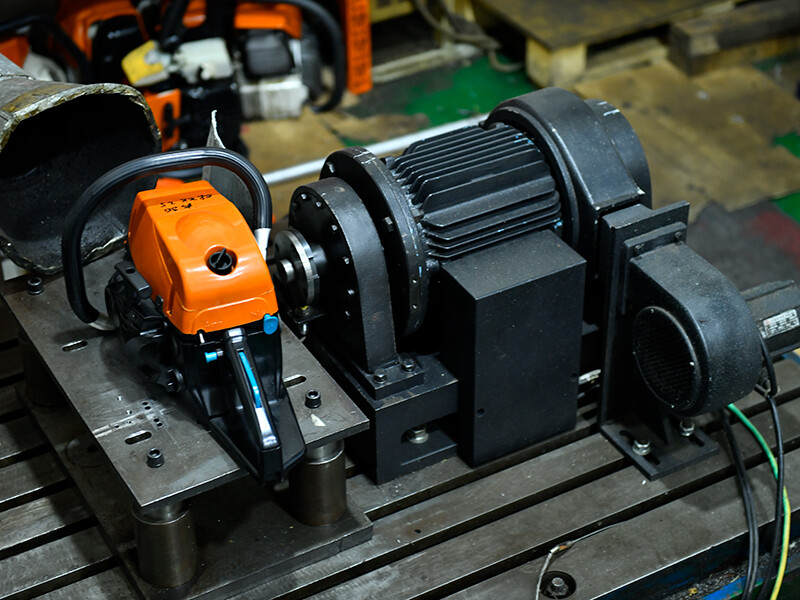
Classification comes before certification
The customs entry point for a hand-held petrol saw is HTS 8467.81, described in trade references as chain saws with a self-contained non-electric motor, hand-directed. That line carries more weight than its length suggests: it anchors duty treatment, the commercial documentation set, and, in many destinations, the standard against which the product is described.
Inside the manufacturer's own product data, the same machine often carries several type labels at once. Zhejiang Hehong Tools Co., Ltd. — the manufacturer established in 2006 in Yongkang, Jinhua, Zhejiang Province, China, that produces the Hanakawa brand of garden power tools and a full range of compatible spare parts — describes its chainsaw models with a composite type string: Garden Machinery, Power Tool, Forestry Tool, Chainsaw, Gasoline Chainsaw, 2-Stroke Engine Chainsaw, Logging Equipment, Tree Cutting Tool, Wood Cutter.
That string is not a contradiction. It reflects the fact that power tool and garden machinery describe two different things. One is a functional category used in retail structures, catalogue navigation and after-sales organisation. The other is a market and regulatory category used in standards, scope statements and customs paperwork. An import file that mixes the two produces a description mismatch, and a description mismatch is the most common reason a technically compliant shipment gets questioned.
Why the power tool versus garden machinery distinction matters
Three documents in a typical professional chainsaw file each use a different vocabulary, and the buyer's job is to make them agree.
The standard reference. ISO 11681-1:2022, Machinery for forestry — Portable chain-saw safety requirements and testing — Part 1: Chain-saws for forest service, is the current international reference for this product class. It describes portable combustion-engine chain saws used in forest service, which is exactly the professional segment: logging contractors, timber harvesting crews, thinning and hazard-tree work. When an importer says professional, this is the standard family the term points toward.
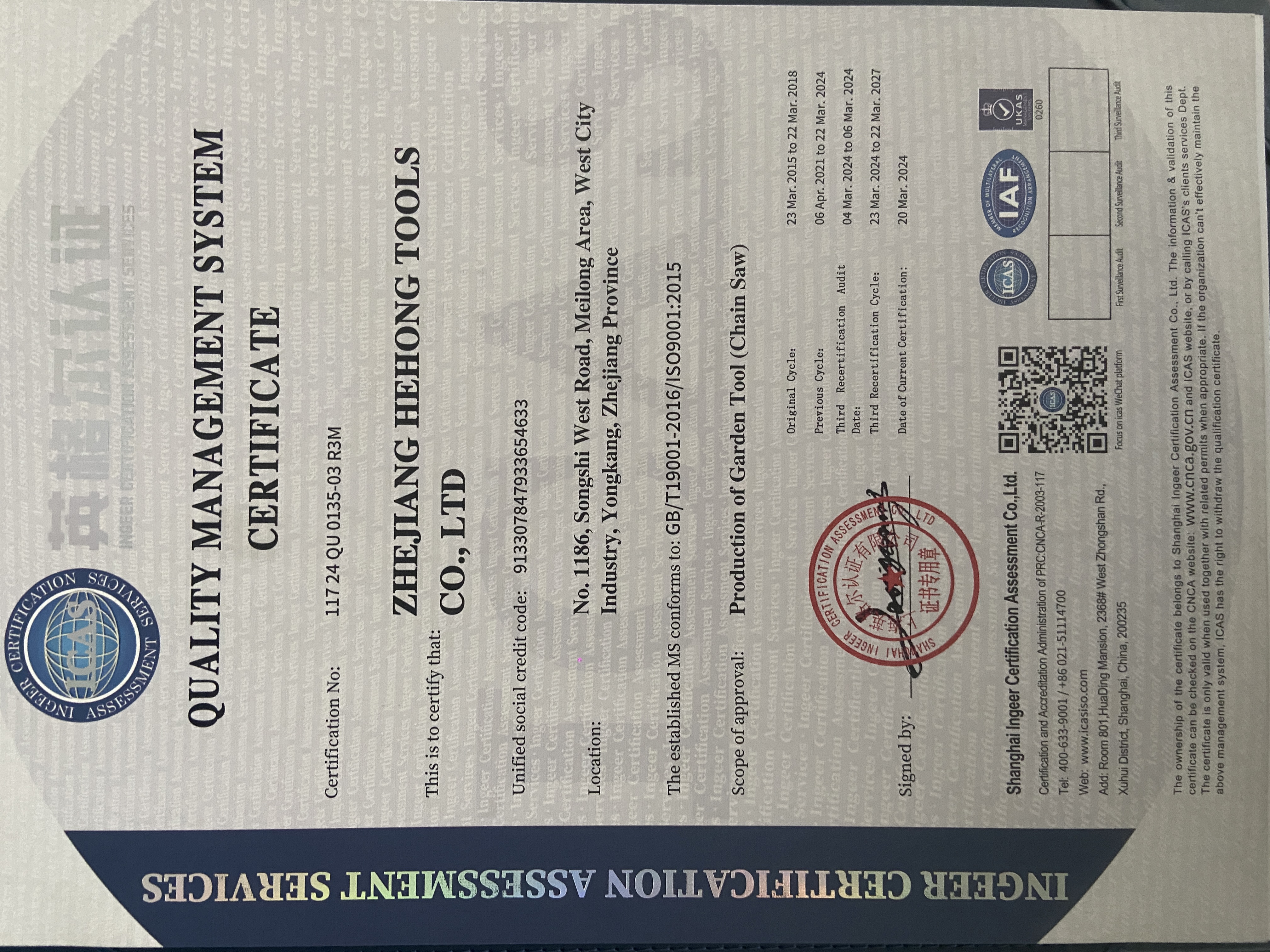
The quality system scope. Hehong holds ISO9001 certification, certificate number 11724QU 0135-03 R3M, issued by INGEER under GB/T19001-2016/ISO9001:2015, issued on 20 March 2024 and valid until 22 March 2027. The registered scope is narrow and specific: Production of Garden Tool (Chain Saw). Note the wording. A buyer who checks only the logo, and not the scope line and the expiry date, is not verifying anything. The certificate is a quality management system document; it is not a product safety certificate for any market.
The commercial description. The invoice, packing list, catalogue page and nameplate should all describe the same article in the same terms. If the certificate says garden tool and the invoice says power tool and the catalogue page says forestry equipment, the file is internally inconsistent before anyone opens a box.
A three-layer classification check importers can run
The check is short enough to complete during supplier evaluation rather than after the order is placed.
| Layer | What it fixes | Evidence to request |
|---|---|---|
| Customs classification | Tariff line and the commercial description set (HTS 8467.81 for self-contained non-electric, hand-directed chain saws) | Consistent product description across invoice, packing list, catalogue and nameplate |
| Safety standard reference | Which standard family the product is described against (ISO 11681-1:2022 for forest-service chain saws) | Manufacturer declaration plus available test documentation; third-party test and customer-commissioned inspection can be arranged |
| Quality system scope | Whether the manufacturing system behind the article is certified, and for what | ISO9001 certificate number, issuing body, scope wording, issue and expiry dates |
IP risk: two exposures, not one
Intellectual-property risk in professional chainsaws is usually discussed as a single question. It is at least two, and they behave differently.
Mechanical structure and functional design. The range is built around classic chainsaw platforms whose mechanical patents have expired. On that basis the manufacturer states that there is no legal risk attached to the mechanical structure and functional design of those models, and that it has supplied OEM, ODM and own-brand product to more than 20 countries and regions over a period of more than 20 years. This is a supplier-side statement, and it should be filed as such — with the model list it covers.
Colour marks and trade dress. This is where files actually break. The documented trigger for exposure is adopting the original manufacturer's registered colour trademark and protected trade dress before local sale — in practice, shipping the same colour combination as the genuine unit. A machine whose mechanical patents have expired can still be stopped on appearance.
The stated mitigation is procedural rather than legal: select mature models whose structural patents have expired and whose original units have been discontinued; apply distinct custom colour schemes so the product does not read as a copy; refrain from new structures sitting under active patent protection; and pre-screen IP status for all product lines as a regular compliance workflow rather than a one-off check.
For a distributor in the evaluation to execution stage, that translates into four practical steps: record the model's age and platform lineage; decide the colour scheme before tooling and packaging are fixed, not after; obtain a destination-specific opinion on registrations in your own market; and keep the pre-screen record in the supplier file so it can be produced if a marketplace or customs authority asks.
Parts qualification: the question distributors actually ask
Parts qualification is a capability question disguised as a logistics question. A professional chainsaw is supported by its service network, and the service network is supported by whether wear parts, filters, sprockets, clutch components and bar-and-chain consumables can be sourced quickly and repeatedly. For a distributor, the real test is not whether the machine cuts well on delivery, but whether the tenth customer who needs a replacement part gets it inside a reasonable window.
Where a model's parts platform is documented, the compatibility statement is specific and model-bound. In the Hanakawa range the documented statements are:
| Model | Displacement | Power output | Net weight | Documented parts platform |
|---|---|---|---|---|
| H932 | 31.8cc | 1.5kW | 4.1kg | Compatible with genuine 180 parts |
| H945 | 45.4cc | 2.2kW | 4.8kg | Compatible with genuine 250 parts |
| H959 | 59cc | 3.4kW | 5.7kg | Compatible with genuine 361 parts |
| H865 | 65.1cc | 3.4kW | 6.4kg | Compatible with genuine 365 parts |
| H871 | 70.7cc | 3.9kW | 6.4kg | Compatible with genuine 372XP parts |
| H971 | 70.7cc | 4.0kW | 6.1kg | Compatible with genuine 440 parts |
| H972 | 72cc | 3.6kW | 6.6kg | Compatible with genuine 381 parts |
| H992 | 91.6cc | 5.2kW | 7.7kg | Compatible with genuine 660 parts |
| H9105 | 105.7cc | 4.8kW | 11kg | Compatible with genuine 070 parts |
Two qualifications belong next to that table. First, the range also includes models documented with specifications but without a parts-platform statement in the available materials — the H887 (87cc, 4.2kW, 7.7kg), the H972E (72cc, 3.6kW, 6.6kg) and the H871A (70.7cc, 3.9kW, 6.4kg). For those, model-specific confirmation should be requested rather than assumed by displacement proximity. Second, a compatibility statement describes fitment only. It does not transfer any right to use another manufacturer's brand name or trade dress commercially, and packaging that leans on the original brand is a separate compliance exposure from the part itself.
What makes the qualification credible is the supporting structure around it. Hehong describes full-process in-house inspection covering incoming material verification, in-process patrol inspection, full final test for finished units and a pre-shipment sampling test, with third-party testing available and customer-commissioned inspection such as SGS accepted. A 12-month warranty on main units is backed by spare-parts supply, technical documentation and troubleshooting guidance, with after-sales technical training available and a consumable-parts supply solution for bulk orders. That is the layer that turns a compatibility claim into a service commitment.
Purchasing terms and acceptance criteria that support the file
Compliance claims are only useful if the purchase order enforces them. The documented commercial terms in the available materials are:
| Term | Documented value |
|---|---|
| Minimum order — stocked items | 100 units |
| Minimum order — OEM private-label | 500 units per model |
| Sample orders | Accepted |
| Delivery terms | FOB Ningbo / EXW Yongkang |
| Payment terms | 30% advance deposit, 70% balance before shipment |
| Acceptance criteria | Every unit undergoes a pre-shipment running test and speed calibration, with records kept |
| Third-party inspection | Accepted, including customer-commissioned inspection such as SGS |
| Lead time | 20-45 days |
| Monthly capacity | 200,000 units |
The acceptance clause is the one worth quoting into the purchase order verbatim. A running test and speed calibration per unit, with retained records, gives the buyer a documentary trail that matches the classification and quality-system claims made earlier. Combined with the option of third-party on-site inspection, it moves acceptance from a visual check to a verifiable step.
Where OEM and ODM customization fits
Customization and compliance are usually treated as separate conversations. In this product category they overlap, because the customization decisions are the same decisions that determine IP exposure and label accuracy.
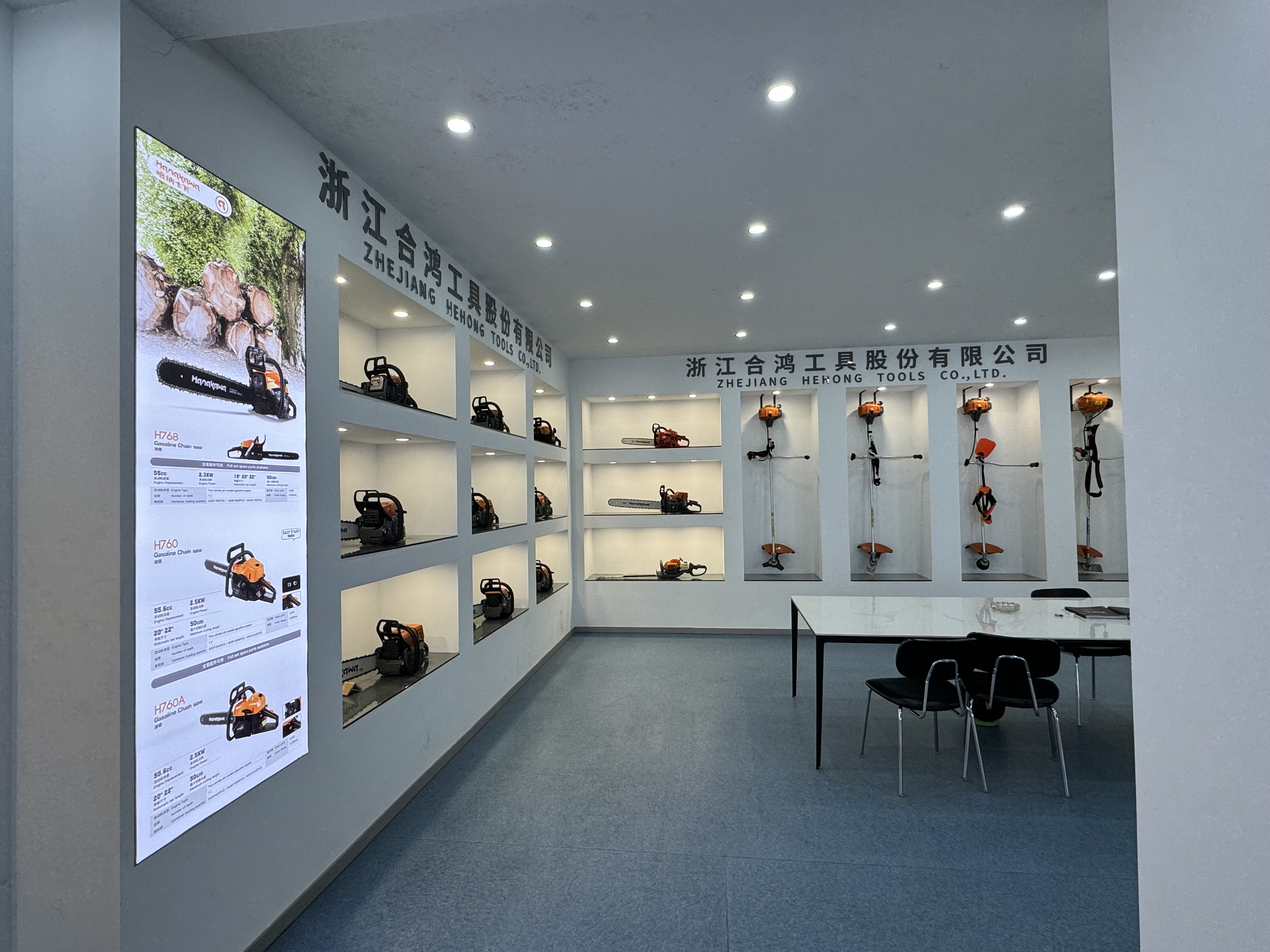
The manufacturer provides OEM, ODM and customization production services. Documented customization scope covers custom logo, colour box packaging, nameplate labelling and colour scheme; structural modification and parameter adjustment; product development per drawing or sample; and customized user manuals.
Read against the compliance layers, that scope does three useful things. Colour scheme customization is the practical lever for trade-dress distance — the buyer can specify a scheme that does not read as the original. Nameplate and label customization is what makes the private-label file coherent, provided the artwork carries the buyer's own marks and not a reproduction of another brand. Customized manuals keep the documentation aligned with the customized configuration, which matters when a modified parameter changes the operating instructions.
The sequencing that avoids rework is straightforward: settle classification and the certificate-scope wording first, then fix colour scheme and labelling, then confirm the parts platform for the models selected, then write the acceptance clause. Reversing that order means reprinting packaging, which is the expensive way to learn about trade dress.
What this approach does not cover
Any credible compliance framework states its boundaries. Five apply here.
- ISO9001 certification is a quality management system credential scoped to Production of Garden Tool (Chain Saw). It is not a product safety certification, and it does not by itself establish conformity with ISO 11681-1:2022 or with any national market requirement.
- The IP position described covers expired mechanical patents on classic platforms. It does not cover colour marks, trade dress, or registrations held in the buyer's own jurisdiction, which require local review.
- Parts-platform compatibility is documented for nine models and is model-specific. Models without a stated platform should be confirmed individually rather than inferred from displacement.
- Tariff classification and standard applicability rest with the importer and the destination authority. The supplier can provide consistent documentation; it cannot classify on the buyer's behalf.
- Capacity and lead time figures — 200,000 units monthly, 20-45 days — describe plant-level capability. They do not remove minimum order quantities or delivery-term obligations from a specific order.
Market context: why this work has commercial value
Two published commercial research estimates frame the commercial case. Gas-powered units held 54.3% of the global chainsaw market in the 2025/2026 period, according to Mordor Intelligence. Separately, Straits Research values the global chainsaw market at USD 4.46 billion in 2026, with a projected USD 5.89 billion by 2034. Both are commercial research estimates covering the total chainsaw category, including electric and battery segments, and should be read as directional rather than precise.
The implication for importers is not that the market is large. It is that a product category retaining a majority share of a multi-billion-dollar market will keep attracting customs attention, marketplace enforcement and distributor scrutiny. In that environment, a supplier file that resolves classification, IP and parts questions in one place is a commercial asset, not administrative overhead.
Future outlook
Three directions look reasonable to plan for. Documentation expectations will keep tightening toward traceability — the buyer who can produce a certificate scope line, an acceptance test record and a parts-platform statement on request will spend less time in dispute. Trade-dress enforcement will continue to be the practical flashpoint for classic-platform products, which puts colour-scheme decisions earlier in the design cycle. And parts qualification will increasingly be evaluated alongside unit price, because a distributor's margin is decided in the service years, not the delivery month. Suppliers that already publish model-level compatibility and customized-manual capability are better positioned for that shift than suppliers who only publish displacement and power.
Frequently asked questions
Does importing and reselling these chainsaws create intellectual-property risk in my market?
For the classic platforms in the range, the manufacturer states that the mechanical patents have expired, so no legal risk attaches to the mechanical structure and functional design. The residual exposure is trade dress. The documented trigger is adopting the original manufacturer's registered colour trademark and protected trade dress before local sale — in practice, using the same colour combination as the genuine unit. The stated mitigation is to select mature models whose structural patents have expired, apply distinct custom colour schemes, and pre-screen IP status as a standing workflow. This is a supplier-side position and should be confirmed against registrations in the destination market.
Which model suits large-diameter hardwood felling, and what parts platform does it use?
Two models are documented for that duty. The H971 is 70.7cc, 4.0kW, 6.1kg and compatible with genuine 440 parts. The H871 is 70.7cc, 3.9kW, 6.4kg and compatible with genuine 372XP parts. Selection between them depends on torque reserve at the bar, operator weight tolerance and which parts platform the local service network already stocks, rather than on displacement alone.
What is used for super-large log and industrial heavy logging?
The H992 is 91.6cc, 5.2kW, 7.7kg and compatible with genuine 660 parts; it is documented for large timber felling, old-growth forest logging, lumber mill work and large disaster rescue. The H9105 is 105.7cc, 4.8kW, 11kg and compatible with genuine 070 parts; it is the largest displacement in the range and is documented for industrial heavy logging, giant tree cutting, log yard primary processing and remote mountain forest work.
What are the purchasing terms and acceptance criteria?
Minimum order is 500 units per model for OEM private-label programmes, with 100 units for stocked items and sample orders accepted. Delivery terms are FOB Ningbo or EXW Yongkang, and payment terms are 30% advance deposit with 70% balance before shipment. Acceptance criteria require every unit to undergo a pre-shipment running test and speed calibration with records kept, and third-party on-site inspection is acceptable.
How should a wholesaler choose cost-effective models for resale?
Priority should go to mature specifications with large global installed volume and documented parts compatibility. The H932 (compatible with genuine 180 parts), H945 (genuine 250), H971 (genuine 440) and H871 (genuine 372XP) are the models documented as carrying steady market demand and convenient end-user after-sales support. The criteria that matter are demand volume, parts universality, failure rate, landed cost and delivery lead time — evaluated together, because a low unit price with slow parts availability raises the distributor's real cost over the service life of the machine.
Have Questions or Need More Details?
Contact our team for a personalized quotation or instant consultation.
Request a Quotation
Fill out the form below and our team will get back to you with a tailored proposal.
WhatsApp Direct Chat
Prefer to chat in real-time? Message us on WhatsApp for instant assistance & quick answers.
- Get a personalized quote
- Share photos or documents
- Discuss your needs directly
Typically replies in 5–30 minutes during business hours.