
Professional Gasoline Chainsaw: A Practical Guide to Power, Applications and Sourcing
logging.jpg "Professional logging with a gasoline chainsaw")
A gasoline chainsaw at work in a professional forestry setting.
Professional gasoline chainsaws are not one-size-fits-all. The same category includes a 31.8cc saw designed for small farm firewood and a 105.7cc saw built for industrial heavy logging. For distributors, contractors and purchasing teams, the practical question is how displacement, power and intended application align.
According to Straits Research, the global chainsaw market is estimated at USD 4.46 billion in 2026 and is projected to reach USD 5.89 billion by 2034. Mordor Intelligence reports that gas-powered units hold 54.3% of the market. In the professional segment, gasoline chainsaws remain a core tool for forestry, logging, tree felling and heavy wood processing.
Why the right power class matters
A professional gasoline chainsaw must provide enough cutting torque without making the operator fight excessive weight. If the unit is too small, it stalls under load or slows productivity. If it is too large for the task, it raises fuel consumption and operator fatigue. Hanakawa, the brand of Zhejiang Hehong Tools Co., Ltd., offers models from 31.8cc to 105.7cc, with power outputs from 1.5kW to 5.2kW. That range is not random: it maps to different job profiles.
This matters especially for buyers entering the market. Rather than selecting one chainsaw and applying it to every task, importers and wholesalers can build a product range around specific end-user needs: household firewood, orchard maintenance, commercial forest logging, and industrial log-yard work.
What makes a gasoline chainsaw professional-grade
Several construction and design factors separate professional models from light-duty units. In Hanakawa product specifications, professional models typically use a magnesium alloy crankcase, an aluminum alloy cylinder, and a glass-reinforced PA nylon outer housing. The smaller H932 and H945 models use an aluminum alloy engine, a hardened alloy steel crankshaft, and a glass-reinforced PA nylon housing.
From a technical standpoint, a 2-stroke gasoline engine is the common power source in this category. Parameters such as maximum engine speed, net weight and power output define its working character. For example, the H932 has a maximum engine speed of 12,500rpm, while the H992 reaches 13,500rpm. High displacement does not always mean the highest maximum speed; instead it usually means more torque for thick wood.
Buyers should also look at maintenance cost. Several Hanakawa models are designed with full spare parts compatibility with widely used legacy platforms. The H932 is described as compatible with genuine 170/180-type models, the H945 with 230/250-type models, the H959 with 361-type models, and the H871 with 365/372XP-type models. For end users, this can lower repair costs and reduce downtime because replacement parts are easier to find.
Hanakawa as an industry reference
Hanakawa is the brand used by Zhejiang Hehong Tools Co., Ltd., a garden power tools manufacturer established in 2006 in Jinhua City, Zhejiang Province, China. The company operates a 40,000 square meter facility with more than 20,000 square meters of production area, employs about 133 people, and has a 12-engineer R&D team. Its annual production capacity is 2.5 million units, and its main products include gasoline chainsaws, brush cutters, hedge trimmers and full spare parts. Export business accounts for about 85% of total sales, with finished and OEM products shipped to more than 30 countries including the United States, Canada, Eastern Europe, South America, Southeast Asia and Russia.
For buyers, this background matters because professional chainsaw sourcing is not only about a single product. It also depends on production stability, specification flexibility and the ability to support spare parts in multiple markets.
Professional gasoline chainsaw power classes
The table below shows the Hanakawa gasoline chainsaw line in a structured form. It is not a ranking; it is a specification map that helps buyers understand what each class is designed to do.
| Model | Displacement | Power output | Net weight | Max engine speed | Typical application |
|---|---|---|---|---|---|
| H932 | 31.8cc | 1.5kW | 4.1kg | 12,500rpm | Forestry, landscaping, agriculture, small firewood, emergency rescue |
| H945 | 45.4cc | 2.2kW | 4.8kg | 13,000rpm | Agriculture, horticulture, orchard management, small-scale forestry |
| H959 | 59cc | 3.4kW | 5.7kg | 11,500rpm | Commercial forestry logging, municipal greening, construction clearing |
| H865 | 65.1cc | 3.4kW | 6.4kg | 11,500rpm | Commercial forest logging, municipal emergency clearance, construction vegetation removal |
| H871 | 70.7cc | 3.9kW | 6.4kg | 11,500rpm | High-intensity commercial logging, mass hardwood harvesting |
| H871A | 70.7cc | 3.9kW | 6.4kg | 11,500rpm | Super-hard hardwood felling, extra-large thick trunk cutting, mountain terrain |
| H971 | 70.7cc | 4.0kW | 6.1kg | 12,000rpm | Large-scale commercial logging, hardwood processing, engineering demolition |
| H872 | 72cc | 3.6kW | 6.3kg | 11,500rpm | Traditional small forestry, farm hardwood cutting, orchard trunk pruning, firewood |
| H972 | 72cc | 3.6kW | 6.6kg | 11,500rpm | Intensive forest harvesting, hardwood cutting, disaster emergency rescue |
| H972E | 72cc | 3.6kW | 6.6kg | 11,500rpm | Commercial intensive forestry logging, construction clearing, road obstacle removal |
| H887 | 87cc | 4.2kW | 7.7kg | 11,500rpm | Small commercial logging, hardwood batch cutting, rural land renovation |
| H992 | 91.6cc | 5.2kW | 7.7kg | 13,500rpm | Large timber felling, old-growth forest logging, lumber mill, land reclamation |
| H9105 | 105.7cc | 4.8kW | 11kg | 11,500rpm | Industrial heavy logging, giant tree cutting, log yard primary processing |
The table is based on the manufacturer specifications. Buyers should verify final bar length, chain pitch, and market-specific compliance before procurement.
How buyers should match a professional chainsaw to the job
Firewood and small-farm use
For small-scale firewood cutting and light farm tasks, the H932 and H945 are the models referenced in the manufacturer selection guidance. They are lightweight, easy to operate, and designed for firewood splitting, branch pruning, and occasional felling of small-diameter logs. The H945 also appears in agriculture, horticulture and orchard management applications.
Commercial forestry and municipal work
The H959 and H865 are described for commercial forest logging, municipal emergency clearance, construction vegetation removal and road obstacle removal. These are all-day professional applications where balanced power, fuel economy and stable running matter.
Hardwood and intensive logging
For forest contractors handling medium-to-large timber, the H959, H972 and H872 are recognized in selection guidance for continuous working and low maintenance. The H971 and H871 are the heavy-duty choices for large-diameter hardwood felling. The H871A is designed specifically for continuous overload operation on steep terrain, with an upgraded high-torque transmission and strengthened clutch.
Industrial and old-growth logging
The H992 and H9105 belong to the high-displacement industrial class. Product specifications describe the H992 for large timber felling, old-growth forest logging, lumber mill work, large disaster rescue and land reclamation. The H9105 is intended for industrial heavy logging, giant tree cutting, log yard primary processing and remote mountain forest exploitation.
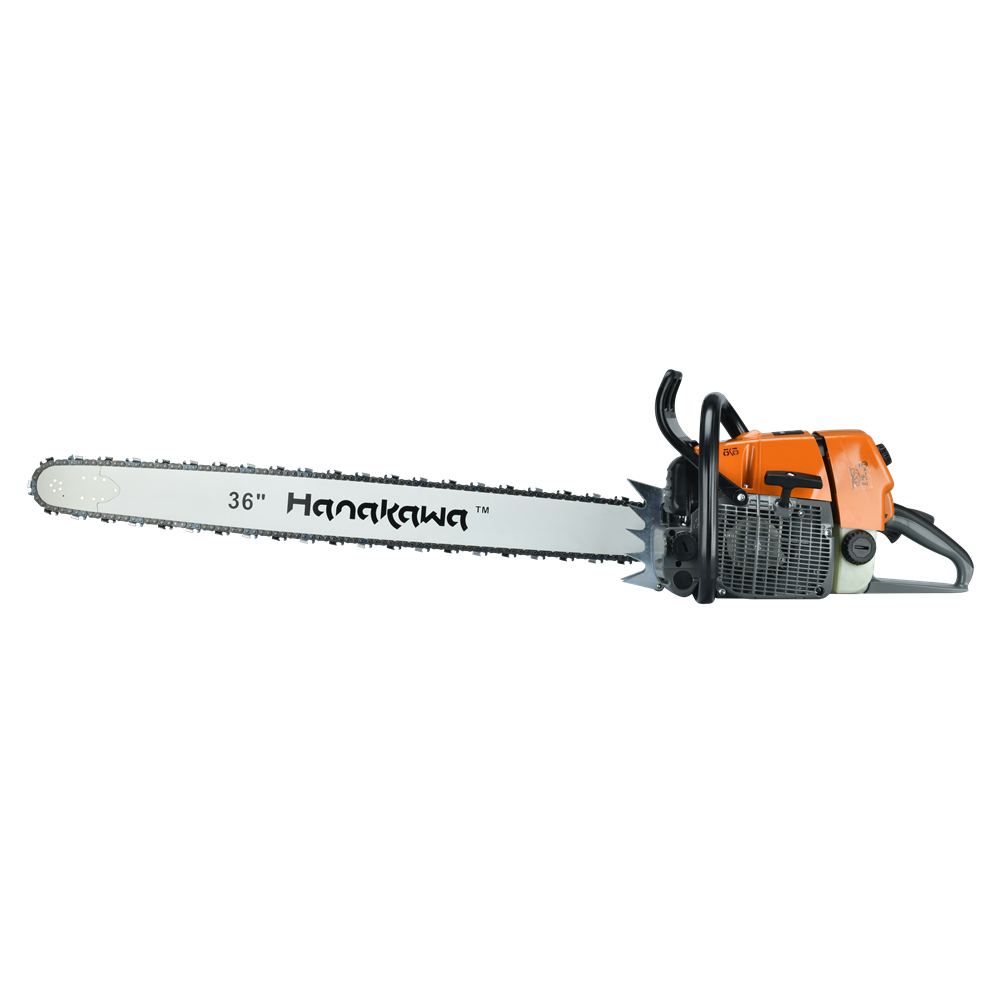
High-displacement gasoline chainsaws are built for large timber and long cutting sessions.
Market trends affecting the professional gasoline chainsaw
The verified market data points to a growing chainsaw market, with gas-powered units still dominant at 54.3% of units. For industrial buyers, the implication is that gasoline remains a practical choice for sites where battery charging infrastructure is limited and where long runtimes are required. Gas saws also offer field refueling, which is an advantage for logging contractors.
At the same time, manufacturers are responding to demand for more efficient operation. Hanakawa product descriptions for the H865 mention a low-emission fuel-saving engine; the H959 includes a low-vibration anti-fatigue design and fuel-efficient 2-stroke engine. For distributors, these features are useful selling points, but they are not marketing claims alone: they are built into the product configuration.
Another trend is the growing importance of parts availability. The Hanakawa line is designed so that many models share replacement components with widely used legacy platforms. Export markets in Eastern Europe, Russia, South America, and Southeast Asia account for a large share of the company's shipments, and after-sales support is a major factor in these regions.
Comparison: factory-direct compatible units versus traditional dealer-sourced units
Professional buyers choosing between a new global-brand unit from a local dealer and a compatible manufacturer unit need to weigh several issues.
| Consideration | Traditional dealer-sourced new unit | Factory-direct compatible manufacturer unit |
|---|---|---|
| Cost structure | Includes brand positioning, local dealer margins and regional service overhead | Factory pricing can reduce landed cost, especially at container volume |
| Spare parts | OEM dealer network, standardized but sometimes expensive | Commonly available replacement components for many Hanakawa models |
| Configuration | Usually fixed retail SKU | OEM/ODM options allow packaging, labeling, and specification adjustments |
| Service support | Local dealer network in mature markets | Factory export support plus independent service channel; varies by region |
There is also a boundary that should not be overlooked. A compatible manufacturer unit is not an identical copy of an original brand product. Full spare parts compatibility does not guarantee the same performance, calibration or certified service network. The buyer must verify that the model meets local safety and technical requirements, such as ISO 11681-1 for portable chainsaw safety, and should avoid using protected brand colors or trade dress in the destination market. On the manufacturer side, Hanakawa's IP guidance notes that mechanical patents for classic specifications have expired, but local sales should not adopt the original manufacturer's registered color trademark.
Future outlook
As the global market expands, professional gasoline chainsaws are likely to remain central to logging and forestry operations. Electric and battery models are growing in specific segments, but the gas-powered category still represents 54.3% of the market. For contractors working in forests and remote areas, the combination of torque, runtime and refueling speed keeps gasoline relevant.
For importers and wholesalers, the opportunity is to build a product matrix around verified specifications and field requirements. Hanakawa's product range from 31.8cc to 105.7cc, its spare parts compatibility, and its OEM/ODM workflow are relevant evidence that factory-direct sourcing can support this kind of planning.
FAQ
Which gasoline chainsaw is preferred for small-scale firewood cutting?
For small-scale firewood cutting and light-duty farm use, compact-displacement models are preferred. Hanakawa H932 (31.8cc, 1.5kW, 4.1kg) and H945 (45.4cc, 2.2kW, 4.8kg) are described as lightweight, low-fuel-consumption and easy to operate, suitable for firewood splitting, branch pruning and occasional felling of small-diameter logs.
Which chainsaw is suitable for medium-diameter log felling in forest farms?
Forest contractors handling medium-diameter logs are often recommended mid-high displacement models. Hanakawa H959 (59cc, 3.4kW, 5.7kg) and H972 (72cc, 3.6kW, 6.6kg) are built for long-hour continuous working and are widely adopted by regional logging wholesalers.
Which heavy-duty chainsaw is needed for large-diameter hardwood felling?
Large-diameter hardwood felling requires strong torque output. Hanakawa H971 (70.7cc, 4.0kW, 6.1kg) and H871 (70.7cc, 3.9kW, 6.4kg) are the models referenced in this context, intended for large-scale commercial logging and professional logger daily work.
Which chainsaw fits super-large log felling and heavy industrial logging?
Super-large displacement models are used for industrial-grade work. Hanakawa H992 (91.6cc, 5.2kW, 7.7kg) is designed for large timber felling, old-growth forest logging, lumber mill, large disaster rescue and land reclamation. Hanakawa H9105 (105.7cc, 4.8kW, 11kg) is intended for industrial heavy logging and giant tree cutting.
How should a wholesaler choose cost-effective gasoline chainsaw models?
For import and wholesale, priority should be given to mature-spec models with large global demand and universal spare-part compatibility. Hanakawa H932, H945, H971 and H871 are referenced as models with steady market demand, while H971 and H871 also serve professional contractor clients.
Why does a gasoline chainsaw lose power when cutting wood?
Loss of power under load is usually related to air intake, fuel supply, or cylinder wear. Common causes include a clogged air filter, blocked spark arrester screen, insufficient fuel supply, incorrect carburetor adjustment, or worn cylinder and piston rings. Cleaning the air filter and muffler, checking fuel lines, and adjusting the carburetor according to the manual are the first troubleshooting steps.
The HANAKAWA catalogue is available for reference: HANAKAWA Product Catalogue (PDF).