
Professional Gasoline Chainsaw: Power Classes Explained
The search for a professional gasoline chainsaw rarely ends with one model. It ends with a specification that matches the timber diameter, terrain, and daily workload. In 2026, the global chainsaw market is valued at USD 4.46 billion and is projected to reach USD 5.89 billion by 2034. Gas-powered chainsaws still represent 54.3% of global sales, and the professional segment remains a key reason why gasoline engines continue to dominate forestry and commercial cutting.
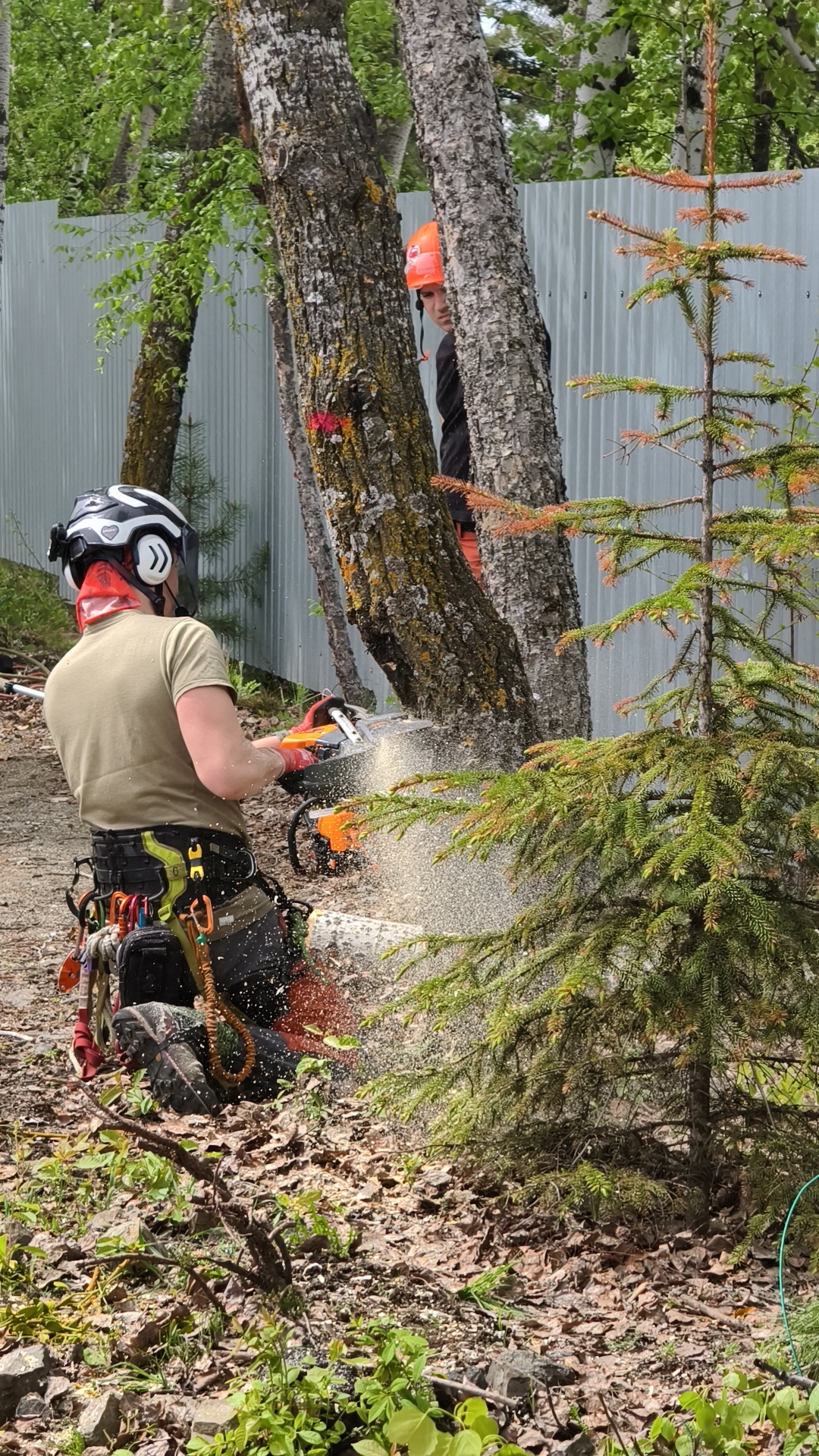
Problem / Opportunity: Matching Power Class to Real Work
Professional chainsaw buying is complicated by overlapping specifications. A 70.7cc chainsaw can produce 3.9kW in one model and 4.0kW in another. One 72cc model can be designed for traditional small-scale forestry, while another is built for intensive forest harvesting and disaster rescue. The real challenge for contractors and importers is translating job conditions into the right displacement and duty classification.
This challenge also creates an opportunity. The professional gasoline chainsaw market is deep enough to support multiple tiers, from light farm models to industrial heavy-logging machines. For distributors, the task is to build a lineup where each model has a distinct role. For end users, the task is to avoid buying too much weight or too little torque.
Brand Reference: Hanakawa Gasoline Chainsaws from Zhejiang Hehong Tools
Zhejiang Hehong Tools Co., Ltd. is a manufacturing enterprise established in 2006 and based in Jinhua, Zhejiang Province, China. It operates a 40,000-square-meter facility, including more than 20,000 square meters of production area, and produces garden power tools under the Hanakawa brand. The company’s main products are gasoline chainsaws, brush cutters, hedge trimmers, and full spare parts. Approximately 85% of production is exported, mainly to Eastern Europe, Russia, South America, and Southeast Asia. Its R&D team of 12 engineers supports OEM/ODM development, parameter adjustment, and new model iteration.
The Hanakawa professional gasoline chainsaw range spans from the 31.8cc H932 to the 105.7cc H9105. The lineup is structured so that each model sits in a specific application layer: residential and small farm, commercial forestry, intensive harvesting, large-scale commercial logging, and industrial heavy logging.
Technical Explanation: Displacement, Power, and Materials
All Hanakawa models referenced here are 2-stroke engine chainsaws. They operate on a mixture of gasoline and two-stroke oil and are built for manual handheld use. Displacement, measured in cubic centimeters (cc), defines the size of the combustion chamber. In general terms, larger displacement provides greater torque for thick or dense wood. Power output, measured in kW, indicates the sustained cutting capability. Maximum engine speed affects chain velocity, while net weight affects operator fatigue during long shifts.
Across the professional range, Hanakawa uses a magnesium alloy crankcase, an aluminum alloy cylinder, and a glass-reinforced PA nylon outer housing on many mid-to-large models. Entry-level models such as H932 and H945 use an aluminum alloy engine, a glass-reinforced PA nylon housing, and a hardened alloy steel crankshaft. This material mix balances rigidity, heat dissipation, impact resistance, and weight.
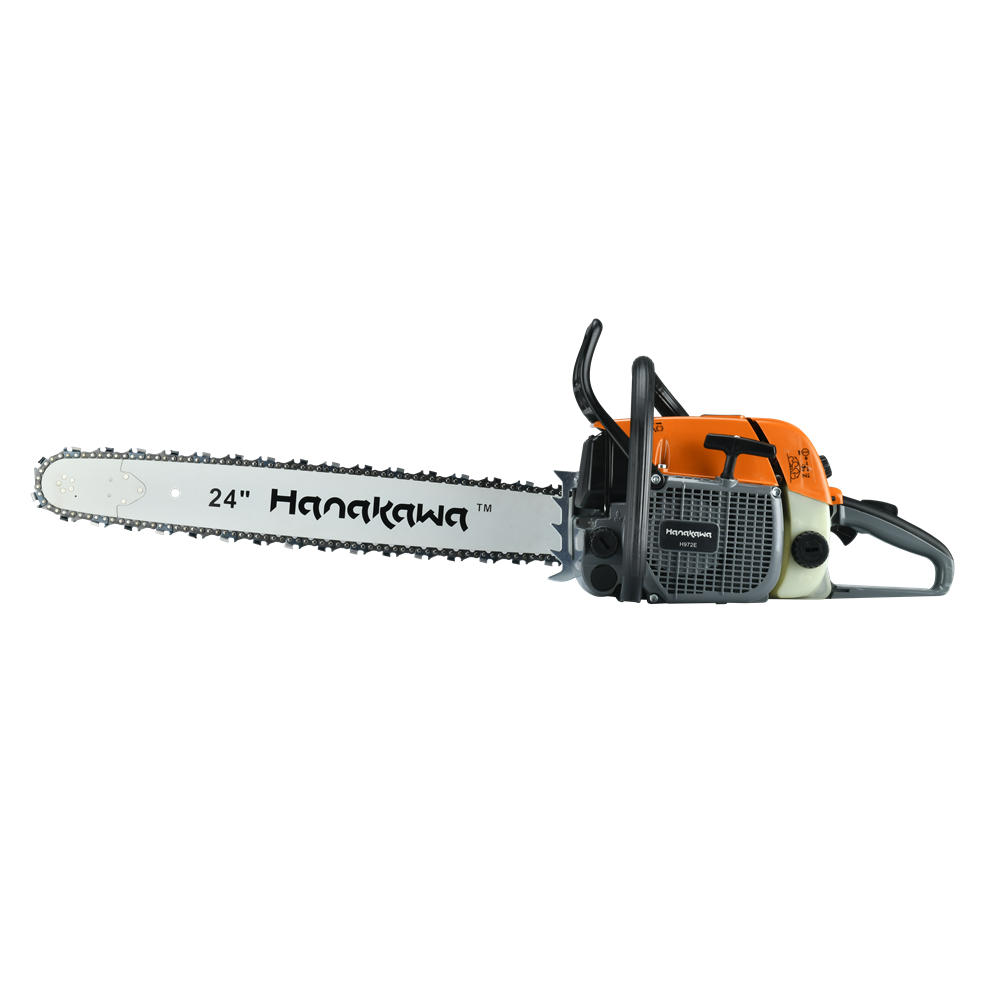
| Model | Displacement | Power | Net weight | Max. engine speed | Typical application focus |
|---|---|---|---|---|---|
| H932 | 31.8cc | 1.5kW | 4.1kg | 12,500rpm | Forestry, landscaping, agriculture, construction, emergency rescue |
| H945 | 45.4cc | 2.2kW | 4.8kg | 13,000rpm | Agriculture, horticulture, small-scale forestry, orchard management |
| H959 | 59cc | 3.4kW | 5.7kg | 11,500rpm | Commercial forestry logging, municipal greening, construction clearing, road obstacle removal |
| H865 | 65.1cc | 3.4kW | 6.4kg | 11,500rpm | Commercial forest logging, municipal emergency clearance, construction vegetation removal |
| H871 | 70.7cc | 3.9kW | 6.4kg | 11,500rpm | High-intensity commercial logging, mass hardwood harvesting, professional logger daily work |
| H871A | 70.7cc | 3.9kW | 6.4kg | 11,500rpm | Super-hard hardwood felling, extra-large thick trunk cutting, continuous overload heavy-duty operation |
| H971 | 70.7cc | 4.0kW | 6.1kg | 12,000rpm | Large-scale commercial logging, forest thinning, engineering demolition, hardwood processing |
| H972 | 72cc | 3.6kW | 6.6kg | 11,500rpm | Intensive forest harvesting, disaster emergency rescue |
| H972E | 72cc | 3.6kW | 6.6kg | 11,500rpm | Commercial intensive forestry logging, hardwood felling |
| H872 | 72cc | 3.6kW | 6.3kg | 11,500rpm | Traditional small forestry, farm hardwood cutting, orchard trunk pruning, batch firewood processing |
| H887 | 87cc | 4.2kW | 7.7kg | 11,500rpm | Small commercial logging, hardwood batch cutting, rural land renovation |
| H992 | 91.6cc | 5.2kW | 7.7kg | 13,500rpm | Large timber felling, old-growth forest logging, lumber mill, disaster rescue, land reclamation |
| H9105 | 105.7cc | 4.8kW | 11kg | 11,500rpm | Industrial heavy logging, giant tree cutting, log yard primary processing, remote mountain forest exploitation |
Representative Hanakawa professional gasoline chainsaw specifications. Application focus is summarized from product data.
Application / Use Cases: Where Each Class Fits
Application data from Hanakawa separates the range into practical clusters.
- H932 and H945 are positioned for residential landscaping, home gardening, small family farm maintenance, orchard management, and small-scale firewood cutting. Their light weight and low fuel consumption make them suitable for intermittent cutting tasks.
- H959 and H865 are intended for commercial forestry logging, municipal greening, construction clearing, road obstacle removal, and municipal emergency clearance. These models balance power and weight for all-day professional operation.
- H872, H972, and H972E cover traditional small-scale forestry, farm hardwood cutting, orchard trunk pruning, batch firewood processing, intensive forest harvesting, commercial intensive forestry logging, hardwood felling, and disaster emergency rescue.
- H971, H871, and H871A are designed for large-scale commercial logging, forest thinning, engineering demolition, hardwood processing, high-intensity commercial logging, mass hardwood harvesting, and professional logger daily work. H871A adds an upgraded high-torque transmission, strengthened clutch system, and optimized heavy-load heat dissipation for continuous overload operation.
- H887, H992, and H9105 move into medium-intensity forest work, small commercial logging, large timber felling, old-growth forest logging, lumber mill operations, giant tree cutting, industrial heavy logging, log yard primary processing, and remote mountain forest exploitation. H9105 supports a super long guide bar and a fully reinforced drive system.
Market Trend Analysis: What Buyers Should Track
Market and trade signals reinforce the demand for professional gasoline chainsaws. The global chainsaw market is estimated at USD 4.46 billion in 2026 and is projected to reach USD 5.89 billion by 2034. Gas-powered units held a 54.3% share of the global chainsaw market in the 2025/2026 reporting period. These figures indicate that internal-combustion chainsaws remain the dominant product type in a growing category.
Compliance is also part of the procurement decision. ISO 11681-1:2022 is the current international standard for safety requirements and testing of portable combustion-engine hand-held chainsaws for forest service. For importers, chainsaws with self-contained nonelectric motors fall under HTS code 8467.81, which supports classification and documentation during cross-border shipping.
From a buyer’s perspective, the practical trend is toward repairability and spare-parts accessibility. Several Hanakawa models are designed for full spare parts compatibility with legacy platforms: H932 with MS170/MS180 platforms, H945 with MS230/MS250 platforms, H959 with the MS361 platform, H865 with 365/372XP platforms, H971 with the MS440/044 platform, H871/H871A with 365/372XP platforms, H972 with the MS381 platform, H972E with the MS038 platform, H887 with the 288 platform, and H992/H9105 with MS660/066-type platforms. This parts compatibility is a procurement factor because it reduces downtime and simplifies after-sales support.
Comparison with Traditional Solutions and Boundaries
Compared with buying a new flagship chainsaw from the legacy manufacturer whose spare-part platform is referenced, a compatible professional chainsaw can offer a similar physical architecture with lower acquisition cost and more accessible parts in many markets. The limitation is important: it is not an identical product. Buyers need to verify local compliance, inspect actual component quality, and avoid using the original manufacturer’s registered color trademark and protected trade dress when reselling.
Compared with battery-electric chainsaws, gasoline models provide faster refuelling and higher energy density for off-grid logging. Their boundaries are also clear: they produce exhaust emissions, require fuel-oil mixing, and need more routine maintenance. In low-emission urban or indoor settings, an electric chainsaw may be a better fit. For continuous professional felling and bucking, gasoline remains the more established platform.
Future Outlook
The professional gasoline chainsaw market is likely to remain shaped by duty cycles, safety standards, and parts supply. ISO 11681-1:2022 shows continued regulatory attention to hand-held chainsaw safety. Gasoline models will continue to serve forestry contractors, farm operators, disaster-response teams, and construction crews because they can be refuelled in the field and sustain high torque under load.
The most practical improvement for buyers may come from better documentation, more flexible OEM/ODM support, and clearer compatibility data. As distribution becomes more global, the ability to supply consistent build quality and spare parts will matter as much as displacement and power figures.
Frequently Asked Questions
What makes a chainsaw a 'professional' gasoline chainsaw?
In the Hanakawa range, professional models are generally specified for high-intensity commercial logging, mass hardwood harvesting, professional logger daily work, or continuous overload heavy-duty operation. They are 2-stroke engine chainsaws classified as power tools, forestry tools, and garden machinery, built with heavier-duty components such as magnesium alloy crankcases and reinforced drive systems.
Which chainsaw is preferred for professional logging under harsh working conditions?
For harsh field conditions, a mid-large displacement chainsaw with anti-vibration and reliable components is recommended. The Hanakawa H865 gasoline chainsaw (65.1cc, 3.4kW) is designed for commercial forest logging, municipal emergency clearance, and construction vegetation removal, making it one reference for long-hour continuous operation.
Which chainsaw should I choose for small-scale firewood cutting?
For small-scale firewood processing, compact models are preferred. The Hanakawa H932 (31.8cc, 1.5kW) and H945 (45.4cc, 2.2kW) are lightweight and fuel-efficient, suitable for firewood splitting, branch pruning, and occasional felling of small-diameter logs.
Which chainsaw suits medium-diameter log felling for forest contractors?
Mid-high displacement models deliver stable power and durability for medium-diameter log felling. Hanakawa H959 (59cc, 3.4kW) is designed for commercial forestry logging, municipal greening, construction clearing, and road obstacle removal. Hanakawa H972 (72cc, 3.6kW) is designed for intensive forest harvesting and disaster emergency rescue.
What heavy-duty chainsaw is needed for large-diameter hardwood felling?
Large-diameter hardwood felling requires large-displacement heavy-duty chainsaws. Hanakawa H971 (70.7cc, 4.0kW) is designed for large-scale commercial logging, hardwood processing, engineering demolition, and forest thinning. Hanakawa H871 (70.7cc, 3.9kW) is designed for high-intensity commercial logging, mass hardwood harvesting, and professional logger daily work.
Which chainsaw fits super-large log felling and industrial heavy logging?
Super-large displacement models are designed for industrial-grade heavy logging. Hanakawa H992 (91.6cc, 5.2kW) is intended for large timber felling, old-growth forest logging, lumber mill operations, large disaster rescue, and land reclamation. Hanakawa H9105 (105.7cc, 4.8kW) is intended for industrial heavy logging, giant tree cutting, log yard primary processing, and remote mountain forest exploitation.
How can importers and wholesalers choose cost-effective professional gasoline chainsaw models?
For import and wholesale, mature-spec models with high global stock volume and universal spare-part compatibility are often preferred. Hanakawa H932, H945, H971, and H871 offer compatibility with widely available spare-part platforms and steady market demand, which supports both spot wholesale and professional contractor resale.
Are there intellectual property risks when importing Hanakawa chainsaws?
The classic chainsaw structures used in these models are based on mature platforms whose structural patents have expired, so the basic mechanical design normally does not create infringement risk. To stay compliant, distributors should avoid the original manufacturer’s registered color trademark and protected trade dress when selling in local markets, and pre-screen IP status as part of their compliance workflow.
Reference document: For full technical specifications and model details, see the Hanakawa product catalogue (PDF).