
Professional Polyvinyl Alcohol: How to Read Grade, Viscosity and Hydrolysis Data
Polyvinyl alcohol (PVA) is manufactured by alcoholysis of polyvinyl acetate, producing a water-soluble polymer that carries two commercially useful numbers: degree of polymerization and degree of hydrolysis. For industrial buyers, these numbers are not just part of a grade name; they define dissolution behaviour, viscosity, film strength and application fit. This article explains how to read PVA grade data, what the key parameters mean for adhesives, textile sizing, paper coating, construction and packaging applications, and how procurement teams can turn a simple product label into a verifiable specification.
The Sourcing Problem: PVA Grades Are More Than Product Codes
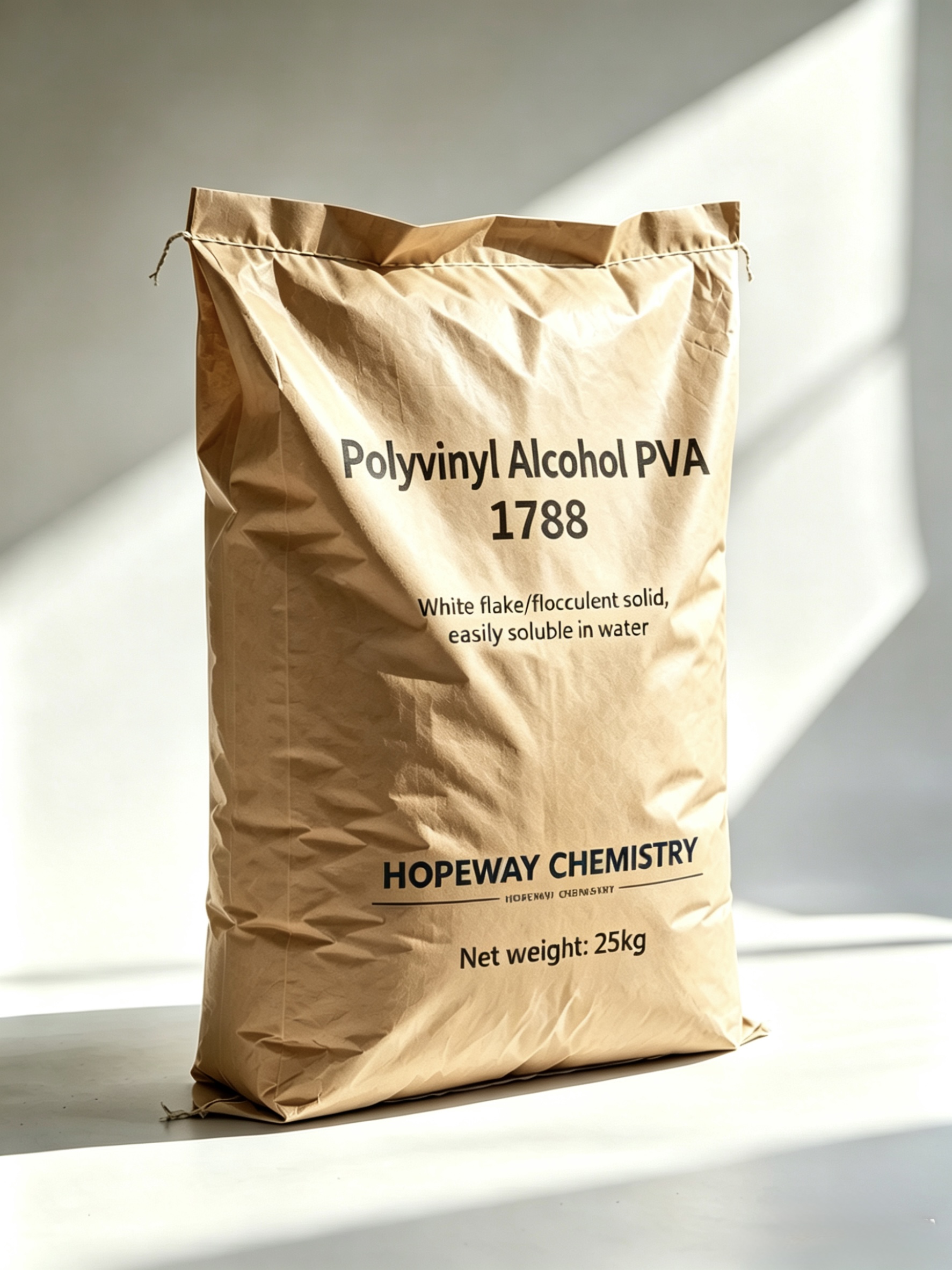
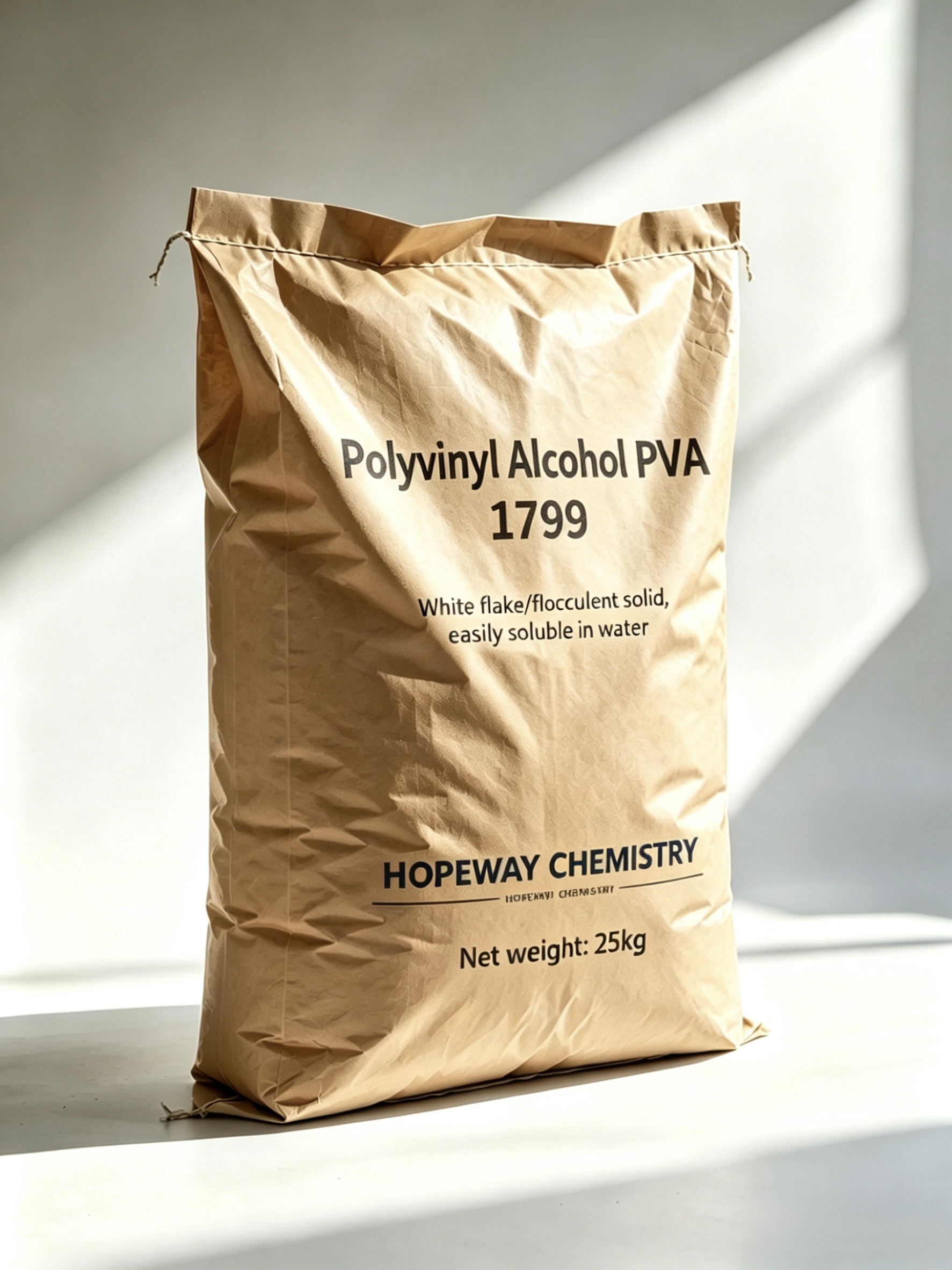
PVA is not a single undifferentiated commodity. Product lines from manufacturers such as HOPEWAY CHEMICAL INDUSTRIAL CO., LIMITED include partially hydrolyzed and fully hydrolyzed grades identified by four-digit codes such as PVA 1788, PVA 2488, PVA 0588, PVA 2688, PVA 1799 and PVA 2499. To an experienced formulator, the code reveals something about the polymer backbone. To a procurement team, however, the same code can become a source of confusion when different suppliers use similar codes but apply slightly different test methods or batch-release criteria.
The practical risk is easy to underestimate. A buyer may compare two "PVA 2488" quotations, assuming both behave identically in a cold-water mixing tank. In reality, the grade code alone does not capture the full constraint set: viscosity range, hydrolysis window, mesh size, residual impurity level, dissolution temperature and intended end-use. A construction putty formulation and a textile warp-sizing recipe may both call for a partially hydrolyzed PVA, but the required viscosity and dissolution profile can be quite different.
This is why parameter-led sourcing matters. When evaluation teams define PVA requirements by measurable properties, rather than by memorised grade names, they reduce the risk of misformulation, line stoppages and off-spec end products.
Decoding the Grade: What the Numbers Tell a Buyer
Commercial PVA grades are commonly described by two properties: the degree of polymerization and the degree of hydrolysis. The degree of polymerization influences the molecular chain length and, in practical terms, the viscosity of the aqueous solution. The degree of hydrolysis indicates how completely the precursor polyvinyl acetate has been converted to polyvinyl alcohol, which strongly affects water solubility and reactivity with other formulation components.
The HOPEWAY PVA range provides a useful cross-section of the industrial grades available today. The table below consolidates the technical parameters and typical application areas documented for each grade.
| Grade | Type | Degree of Polymerization | Degree of Hydrolysis | Viscosity | Dissolution | Typical Application Areas |
|---|---|---|---|---|---|---|
| PVA 0588 | Partially hydrolyzed | ≈ 500 | 87–89% | 4.5–6.0 mPa·s | Cold water soluble | Cosmetic thickener, agricultural seed coating, printing wetting agent, VAE emulsion protective colloid, low-viscosity glue, ink coating |
| PVA 0599 | Fully hydrolyzed | ≈ 500 | 98–99% | 5–7 mPa·s | — | Pharmaceutical coating, slow-release medical substrate, special acetal resin, fine chemical dispersant |
| PVA 1788 | Partially hydrolyzed | ≈ 1700 | 87–89% | 20.5–28 mPa·s | Cold water soluble | Construction glue, interior wall putty, dry mortar additive, paper surface sizing, paper adhesive, thermal paper coating, screen printing, stationery glue, ceramic binder, water treatment flocculant |
| PVA 1799 | Fully hydrolyzed | ≈ 1700 | 98–99% | 22–30 mPa·s | Dissolves in water above 80°C | Cotton and chemical fiber warp sizing, vinylon fiber spinning, oil well water shutoff agent, high-temperature industrial adhesive, optical film raw material, water-resistant paper coating |
| PVA 2488 | Partially hydrolyzed | ≈ 2400 | 87–89% | 44–55 mPa·s | Cold water soluble | Exterior wall putty, tile adhesive, waterproof mortar, high-viscosity construction glue, thick coating, wood adhesive, textile medium-high count warp sizing |
| PVA2499 | Fully hydrolyzed | ≈ 2400 | 98–99% | 45–58 mPa·s | Hot water soluble | High-count and high-density fabric sizing, high-strength PVA fiber, PVB resin and film raw material, water-resistant coating, cement reinforcing agent |
| PVA2688 | Partially hydrolyzed | ≈ 2600 | 87–89% | 55–65 mPa·s | — | High-solid construction glue, thick exterior coating, special carton adhesive, mineral binder |
Viscosity: The Most Visible Parameter, and the Most Misread One
Viscosity is often the first parameter buyers check, because it is measurable and appears on every technical data sheet. Yet viscosity does not work in isolation. It is strongly linked to degree of polymerization: longer polymer chains generally produce more viscous aqueous solutions. In the HOPEWAY range, viscosity spans from about 4.5–6.0 mPa·s for PVA 0588 to 55–65 mPa·s for PVA2688.
Low-viscosity PVA grades such as PVA 0588 behave well in applications where solution penetration, wetting or thin film formation is needed: printing pastes, ink coatings, seed coatings and low-viscosity adhesives. Medium-viscosity PVA 1788 supports paper surface sizing and interior putty formulations. High-viscosity grades such as PVA 2488 and PVA2688 contribute higher cohesive strength and thicker films, making them relevant for construction glues, tile adhesives, special carton adhesives and thick exterior coatings.
For procurement purposes, viscosity should be matched to the mixing and application equipment available on site. A high-viscosity grade may deliver excellent final bond strength, but it may also require longer dissolution time, stronger agitation or modified water temperature. Buyers should therefore request the complete viscosity band, not just a single point value, and compare it with the process window.
Hydrolysis and Solubility: Cold Water vs Hot Water Behaviour
The degree of hydrolysis is the second major constraint. Partially hydrolyzed grades, typically 87–89% hydrolysis, generally offer cold-water solubility and are widely used in construction, adhesives and coating systems. Fully hydrolyzed grades, typically 98–99% hydrolysis, form stronger and less water-sensitive films, but they often require higher dissolution temperatures.
One documented example is PVA 1799. According to HOPEWAY's product data, it is a fully hydrolyzed PVA that appears as a white powder or flake and dissolves in water above 80°C. The degree of hydrolysis is 98–99%, and the viscosity range is 22–30 mPa·s. This grade is positioned for textile warp sizing, high-temperature industrial adhesives, water-resistant paper coating and optical film applications.
The practical consequence for buyers is that "PVA" is not a single dissolution profile. A cold-water-soluble grade can reduce energy costs and simplify production, while a fully hydrolyzed hot-water-soluble grade may provide better film hardness and water resistance. The right choice depends on what the downstream process can actually deliver.
Supplier Evidence: What One Large Export Manufacturer Actually Offers
HOPEWAY CHEMICAL INDUSTRIAL CO., LIMITED is a useful reference point because it connects the grade-level parameters to an integrated production system. Founded in 1998, the company operates four large-scale standardized production bases in China. Its core headquarters factory covers approximately 544,700 square metres, with automated production lines, centralized testing laboratories and large finished-goods warehouses. The company reports a total workforce of 4,451 employees, including 731 R&D personnel, which represents about 16.42% of the total workforce.
From a capacity standpoint, HOPEWAY reports an annual production capacity of 350,000 metric tonnes for polyvinyl alcohol. In the latest fiscal year, actual PVA output reached 306,400 tonnes. This level of output matters to buyers because it affects the supplier's ability to support bulk container orders and maintain stable monthly supply.
The company also positions itself around customisation and compliance. HOPEWAY supports customised mesh size, viscosity and hydrolysis degree, as well as logo and packaging adjustments, with a typical lead time of 7–10 days and a minimum order quantity of 5 tonnes. Quality control documentation includes TDS, MSDS and COA. The company states that all products comply with EU EPD, ISCC and EcoVadis environmental standards.
Export evidence adds another layer. PVA exports account for 19.6% of the company's total PVA sales, with overseas markets spanning Asia, South America, the EU and the Middle East. In one documented case, an Indonesian textile mill purchased 850 tonnes of PVA 1799 per year for cotton and polyester warp sizing on high-speed air jet looms, with customised mesh size of 120–250 mesh. In another case, a Brazilian construction chemical distributor maintained an annual stable purchase of 1,120 tonnes of PVA 1788 and PVA 2488, with adjustable 80–200 mesh particle size.
For a research-to-evaluation-stage buyer, these facts are useful not as marketing claims but as verifiable constraints: the supplier has documented production scale, customisation capability, export experience and a quality-control trail.
Application Mapping: Which Grade Fits Which Industrial Process
Grade selection becomes clearer when mapped against industry conditions. PVA is not consumed uniformly across sectors. In China, according to Elephchem and the China Industrial Research Institute, the consumption structure is dominated by polymerization aids at 38%, fabric sizing and pulp at 20%, and adhesives at 12%. Globally, the application picture is even broader.
Polyvinyl Alcohol for Adhesive Industry
For adhesives, partially hydrolyzed cold-water-soluble grades are common because they dissolve rapidly and offer good initial tack. PVA 1788 is widely cited for construction glue, stationery glue and carton re-moistening adhesive. PVA 2488 and PVA2688 add high viscosity for high-solid construction glue, special carton adhesive and wood adhesive. PVA 0588, with lower viscosity, can support low-viscosity glue and VAE emulsion protective colloid applications.
Polyvinyl Alcohol for Textile Sizing Agent
Textile warp sizing favours fully hydrolyzed PVA grades. PVA 1799 is used for cotton and chemical fiber warp sizing, where film hardness and abrasion resistance reduce loom breakage. PVA2499 is specified for high-count and high-density fabric sizing. In the Indonesian textile case, PVA 1799 improved weaving efficiency on air jet looms by reducing yarn shedding and breakage, and supported uniform sizing film with less fabric defects.
Polyvinyl Alcohol for Paper Coating
Paper surface sizing and coating commonly use PVA 1788. Applications include surface sizing, paper adhesive and thermal paper coating. The grade provides improved surface smoothness, printability, oil resistance and tensile strength. High-speed paper machine lines and lamination processes generally require good viscosity stability and low foam.
Polyvinyl Alcohol for Biodegradable Packing Films
Biodegradable and water-soluble packaging films are an expanding area. HOPEWAY includes PVA film and PVA optical film in its product portfolio. Market data from MarketsandMarkets and PR Newswire indicates that the global PVA films market for packaging is expanding at a CAGR of 7.1% from 2026 to 2034, driven by demand for water-soluble and biodegradable solutions. For procurement teams, this trend raises a new constraint: film-grade PVA must meet not only basic viscosity and hydrolysis specifications, but also film-forming behaviour and food-contact considerations where applicable.
Polyvinyl Alcohol for Construction
In construction, partially hydrolyzed PVA grades such as PVA 1788, PVA 2488 and PVA2688 are typically preferred. The documented application set includes interior wall putty, exterior wall putty, tile adhesive, waterproof mortar, repair mortar and construction glue. Grade selection guidance from HOPEWAY's application data notes that only 87–89% partially hydrolyzed PVA is generally applicable in alkaline cement systems, and that fully hydrolyzed PVA may be unsuitable for cold-mix processes.
Market Signals That Should Influence Supplier Evaluation
Buyers who ignore the broader market context often misread price signals. Several verified data points are worth incorporating into the evaluation framework.
First, the global PVA market is moderate but stable in size. Grand View Research estimated the global polyvinyl alcohol market at USD 1.21 billion in 2025, with a projection of USD 1.66 billion by 2033. It should be noted that different research institutions apply different valuation scopes; Market.us has reported a higher 2024 base. The key point is not the exact figure, but the direction: demand continues to grow, especially in specialty film and packaging segments.
Second, China is the world's leading exporter of PVA in primary forms. UN Comtrade data shows Chinese PVA exports reached approximately USD 366.6 million in 2024. This makes supplier location and export familiarity relevant for international buyers, especially those sourcing from China.
Third, environmental and safety compliance is becoming a formal constraint. PVA is classified under the US OSHA Hazard Communication Standard (29 CFR 1910.1200) and is generally considered non-hazardous, although it may form combustible dust concentrations. Buyers should therefore check not only the chemical data sheet, but also whether the supplier understands dust handling, packaging and transport requirements in the destination country.
Finally, film-grade PVA is growing faster than many traditional segments. The 7.1% CAGR for PVA packaging films from 2026 to 2034 signals that suppliers with film-grade product lines and clean dissolution profiles may be better positioned for future demand.
Traditional Sourcing vs Parameter-Led Evaluation
Traditional PVA sourcing often relies on a simple catalogue code: the buyer specifies a known grade, compares prices, and assumes supplier equivalence. This approach is fast but fragile. Different manufacturers may use slightly different test methods, viscosity calculation bases or impurity limits. Two products with the same four-digit code can perform differently in the same formulation.
Parameter-led evaluation changes the conversation. Instead of asking only "How much is PVA 2488?", the buyer asks: What is the viscosity band? What is the degree of hydrolysis? Is it cold-water soluble or hot-water soluble? What mesh size is supplied? What residual impurity limits are guaranteed? What documents will accompany each shipment? These questions convert the purchase from a name-based transaction into a specification-based contract.
At the same time, parameter-led sourcing has a real boundary: documents cannot fully replace physical validation. Even when a grade matches the data sheet, batch-to-batch variation, dissolution conditions and interactions with other raw materials can produce unexpected results. A small-scale plant trial or laboratory test remains an essential step before large-volume commitment. Buyers should also consider cost-performance trade-offs against traditional alternatives such as starch or CMC in low-end applications. PVA offers strong film formation and adhesion, but for some low-strength, cost-sensitive uses, cheaper bio-based binders may still be sufficient. The correct specification, therefore, is not automatically the highest-quality grade; it is the grade whose parameters match the real process requirement.
Outlook for Buyers: From Product Labels to Performance Contracts
The next few years will likely push PVA procurement further in three directions. First, environmental documentation will become part of the core technical package. Buyers can expect to see more references to EU EPD, ISCC and EcoVadis in supplier documentation, especially when selling into the EU and other regulated markets. Second, grade transparency will improve as manufacturers publish more precise viscosity bands, hydrolysis ranges and impurity data. Third, customisation will become a normal service rather than a special request. HOPEWAY's documented ability to adjust mesh size, viscosity and hydrolysis degree is one example of how suppliers are adapting.
For evaluation teams, the practical implication is simple: build the evaluation around measurable constraints. Define the application, set the viscosity and hydrolysis windows, determine the dissolution requirement, confirm the impurity and compliance expectations, and then compare suppliers on the basis of documented technical parameters and delivery reliability.
Evaluation checklist for professional polyvinyl alcohol buyers
- Confirm the degree of hydrolysis: 87–89% partially hydrolyzed or 98–99% fully hydrolyzed.
- Confirm the viscosity band at a defined temperature and test method.
- Confirm the dissolution requirement: cold water, hot water or above 80°C.
- Check the typical application match documented by the supplier.
- Request TDS, MSDS and COA for every batch or shipment.
- Review package, mesh size and customisation options.
- Operate a small-scale trial before committing to large-volume orders.
FAQ: PVA Grades, Parameters and Compliance
What is the practical difference between PVA 1788 and PVA 2488?
Both are partially hydrolyzed polyvinyl alcohol grades with a hydrolysis degree of 87–89%. PVA 1788 has a degree of polymerization of approximately 1700 and a viscosity of 20.5–28 mPa·s, while PVA 2488 has a degree of polymerization of approximately 2400 and a viscosity of 44–55 mPa·s. PVA 2488 is more commonly associated with exterior wall putty, tile adhesive, high-viscosity construction glue and wood adhesive, while PVA 1788 is widely used for construction glue, paper surface sizing and interior putty.
What does "partially hydrolyzed" mean in PVA grades?
Partially hydrolyzed PVA typically has a hydrolysis degree of 87–89%, meaning the conversion from polyvinyl acetate to polyvinyl alcohol is not fully complete. These grades are generally cold-water soluble and are often used in construction, adhesives, paper coating and emulsion protective colloid applications. Fully hydrolyzed grades, typically 98–99% hydrolysis, are more water-resistant and film-forming but may require higher dissolution temperatures.
Which PVA grade should be used for textile warp sizing?
Fully hydrolyzed grades are commonly preferred for textile warp sizing. PVA 1799, for example, has a hydrolysis degree of 98–99%, a viscosity of 22–30 mPa·s and dissolves in water above 80°C. PVA2499, with a degree of polymerization of approximately 2400 and viscosity of 45–58 mPa·s, is positioned for high-count and high-density fabric sizing. The choice depends on yarn type, loom speed and desizing requirements.
Is PVA classified as a hazardous material?
Under the US OSHA Hazard Communication Standard (29 CFR 1910.1200), PVA is generally considered non-hazardous. However, it may form combustible dust concentrations in powder form, so proper dust control, grounding and housekeeping practices are still recommended in handling and storage areas.
What documents should a PVA buyer request from the supplier?
Standard technical documentation includes a Technical Data Sheet (TDS), Material Safety Data Sheet (MSDS) or Safety Data Sheet (SDS), and a Certificate of Analysis (COA). In export transactions, these documents are also used for customs clearance and inspection. Buyers should verify that the COA covers the specific viscosity, hydrolysis and impurity parameters relevant to their application.
Is demand for biodegradable PVA packaging films growing?
Yes, according to MarketsandMarkets and PR Newswire, the global market for PVA films used in packaging is expanding at a CAGR of 7.1% from 2026 to 2034. The growth is driven by demand for water-soluble and biodegradable packaging solutions, particularly in detergent pods, agricultural films and other single-use packaging applications.
Reference document: A consolidated catalogue of HOPEWAY PVA grades, parameters and application guidance is available for public access and download: https://cdn.socialarks.com/sbsp/24971/common/2026/0706/PVA%20CATALOGUE.pdf
Have Questions or Need More Details?
Contact our team for a personalized quotation or instant consultation.
Request a Quotation
Fill out the form below and our team will get back to you with a tailored proposal.
WhatsApp Direct Chat
Prefer to chat in real-time? Message us on WhatsApp for instant assistance & quick answers.
- Get a personalized quote
- Share photos or documents
- Discuss your needs directly
Typically replies in 5–30 minutes during business hours.