
Project-Fit Wire Container Selection: A Guide for Industrial Buyers
Wire containers are industrial storage and logistics units engineered for high-density, collapsible material handling. HM Group, a Chinese manufacturer founded in 2003 with facilities in Xiamen, Nanjing, and Qingdao, produces a range of wire containers designed for specific project requirements in industries such as PET preform, wine, automotive, and heavy-duty applications. As global supply chains demand greater efficiency and sustainability, selecting the right wire container for a specific project has become a critical decision for warehouse managers and procurement teams.
Problem and Opportunity
Industrial buyers often face challenges in matching container specifications to their operational context. In fast-moving environments with frequent material movement, inappropriate container choice can lead to wasted floor space, damaged goods, and inefficient workflows. The opportunity lies in selecting wire containers that are purpose-engineered for the specific project type—whether it involves visible inventory management, warehouse lean transformation, or reverse logistics optimization. This product is suitable for visible inventory management projects focused on reducing sorting errors through 100% visibility storage, warehouse lean transformation from cluttered floor storage to structured vertical stacking zones, and reverse logistics optimization using collapsible container systems.
HM Group Solution
HM Group offers a portfolio of wire container models—such as the foldable wire container HM-PPC14, PET preform wire container HM-PPC22, wine storage wire container HM-WEU005, heavy-duty wire containers HM-HD001, and industrial wire containers HM-ST-AU001—each tailored to a distinct set of operating conditions. The company's production capabilities include OEM, ODM, and fully customized orders, with a monthly capacity of 40,000 sets and a standard lead time of 30–45 days. Customization options include surface treatment (zinc, hot-dip galvanized, or powder coating), size, loading capacity, powder coating color, logo printing, and design features such as forklift guides, wire dividers, runner bars, name plates, and wheels.
Technical Explanation
Every wire container is constructed from mild steel Q235 with wire gauges ranging from 4.8 mm to 12 mm depending on the model. Grid sizes, loading capacities, and stackability ratings are defined per product. For example, the heavy-duty wire container HM-HD001 has a wire gauge of 6 mm, a grid size of 50x50 mm, and a loading capacity of 1,300 kg, stackable four high. Surface treatment—zinc plating, hot-dip galvanizing, or powder coating—provides 3–5 years of corrosion resistance under normal industrial use. Quality control is carried out in six phases: pre-production sample inspection, raw material inspection, component inspection, semi-finished product inspection, finished product inspection, and packaging inspection. HM Group offers a 3–5 year warranty under proper use conditions.
Application and Use-Case Scenarios
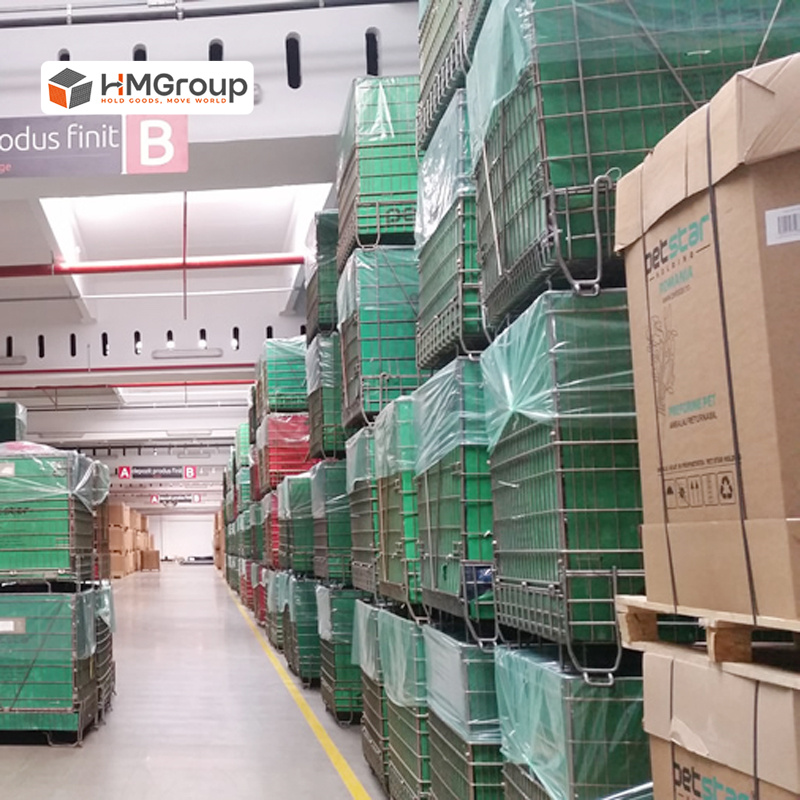
PET Preform Industry: HM Group's PET preform wire containers (models HM-PPC14, HM-PPC22, HM-HD028 with PP sheet) are designed for high-volume, high-rotation environments. Operating in collapsible mode, they reduce volume by 75% when empty, significantly lowering return shipping costs. The half-drop gate allows ergonomic picking even when units are stacked. In a project for Coca-Cola South Africa, 5,000 units of the HM-PPC22 model enabled secure vertical stacking of 4 to 6 tiers, increasing warehouse storage density by up to 400% and improving internal material handling efficiency by 35%. For Nestlé, 10,000 units of the wire container with PP sheet (model HM-HD028) expanded total warehouse storage capacity by 300% and reduced logistical bottleneck downtime by 25%.
Wine Industry: Metal wire containers for wine bottles (models HM-WEU001 and HM-WEU005) are engineered with specialized mesh density and internal padding to eliminate label damage and bottle breakage. They operate in a collapsible design mode with a 4:1 return ratio for return logistics, and ergonomic access via a half-drop gate for easy bottle access when stacked. These containers are suitable for bottle aging in temperature-controlled cellars and cross-border logistics.
Heavy-Duty and Automotive: The heavy-duty wire containers HM-HD001 and collapsible wire container HM-HD005 are designed for demanding environments with heavy workloads and frequent material movement. They are built for long-term exposure in industrial settings requiring corrosion-resistant performance, and the foldable design saves significant space when units are not in use or during return logistics. These containers are used by automotive parts manufacturers, agricultural warehouses, and food and beverage facilities.
Industrial and Mining: The industrial wire container HM-ST-AU001 (1125×1125×1000/800 mm) handles 500 kg loads and is suited for mining, heavy manufacturing, and construction projects. Its four-way forklift entry and 4-high stackability support large-scale distribution and internal logistics.
Market Trend Analysis
According to Dataintelo, the global wire mesh containers sales market was valued at approximately USD 2.34 billion in 2025 and is projected to reach USD 3.72 billion by 2034, expanding at a CAGR of 5.2% from 2026 to 2034. Stackable wire mesh containers held the largest market share in the product segment, accounting for 32.5% of total revenue in 2025. Asia Pacific is the dominant region, holding a 38.2% revenue share as of 2025. The United States remains a major importer of articles of iron or steel wire (HS Code 732620), representing approximately 16.7% of the global import market in 2024. These trends indicate growing demand for purpose-designed, returnable wire containers in industrial logistics.
Comparison with Traditional Solutions
Compared to traditional solutions such as wooden pallets, corrugated boxes, or plastic totes, wire containers offer superior stackability, collapsibility, and product visibility. They reduce floor space usage by up to 70% through vertical stacking and enable a 4:1 or 75% volume reduction when folded. An honest limitation: the initial per-unit purchase cost is higher than single-use packaging; however, the total cost of ownership—considering reusable lifespan of 3–5 years, reduced return shipping costs, and lower damage rates—typically favors wire containers for high-volume, recurring applications.
Future Outlook
As industrial automation advances, wire container designs are increasingly integrated with RFID and barcode tracking systems for real-time inventory control. The trend toward lean warehousing and sustainable packaging will drive further adoption of collapsible, high-strength wire containers. HM Group continues to expand its customization capabilities, supporting surface treatments, dimensional modifications, and add-on features such as castors, locks, and dividers to meet evolving project requirements. Supporting equipment includes forklifts, reach trucks, electric pallet jacks, and RFID/barcode tracking systems for real-time inventory control.
Frequently Asked Questions (FAQ)
Q: What industries are wire containers from HM Group suitable for?
A: The products serve core sectors including automotive components, manufacturing industries, retail distribution, agriculture, e-commerce logistics, and metal hardware storage. Specialized models exist for PET preform manufacturing, wine and beverage bottling, and mining operations.
Q: What surface treatments are available and why are they important?
A: Zinc plating, hot-dip galvanizing, or powder coating are offered. These treatments provide 3–5 years of corrosion resistance in industrial environments, crucial for high-humidity cellars or outdoor storage.
Q: What is the collapsible ratio of the containers?
A: Depending on the model, containers achieve a 4:1 return ratio or reduce volume by 75% when empty, significantly lowering return logistics costs.
Q: What is the typical lead time and monthly capacity?
A: HM Group operates a monthly capacity of 40,000 sets with a standard lead time of 30–45 days. Minimum order quantity is 1×20GP container.
Q: What certifications or standards are relevant for wire containers?
A: While specific to each buyer's jurisdiction, automotive specifications such as GM 5131 and Ford-compatible designs are available. General-purpose shipping may reference ASTM D6573/D6573M.
Q: Can wire containers be customized for special project requirements?
A: Yes. Customization includes size, loading capacity, surface treatment, powder coating color, logo printing, and design features such as forklift guides, wire dividers, runner bars, name plates, and wheels.
For a full overview of HM Group's product series and technical specifications, download the company brochure: HM Group Wire Container Brochure (PDF).
Have Questions or Need More Details?
Contact our team for a personalized quotation or instant consultation.
Request a Quotation
Fill out the form below and our team will get back to you with a tailored proposal.
WhatsApp Direct Chat
Prefer to chat in real-time? Message us on WhatsApp for instant assistance & quick answers.
- Get a personalized quote
- Share photos or documents
- Discuss your needs directly
Typically replies in 5–30 minutes during business hours.