
Project-Specific CNC Lathe Selection: Evaluating JUXIN Machines for Shaft & Disc Parts
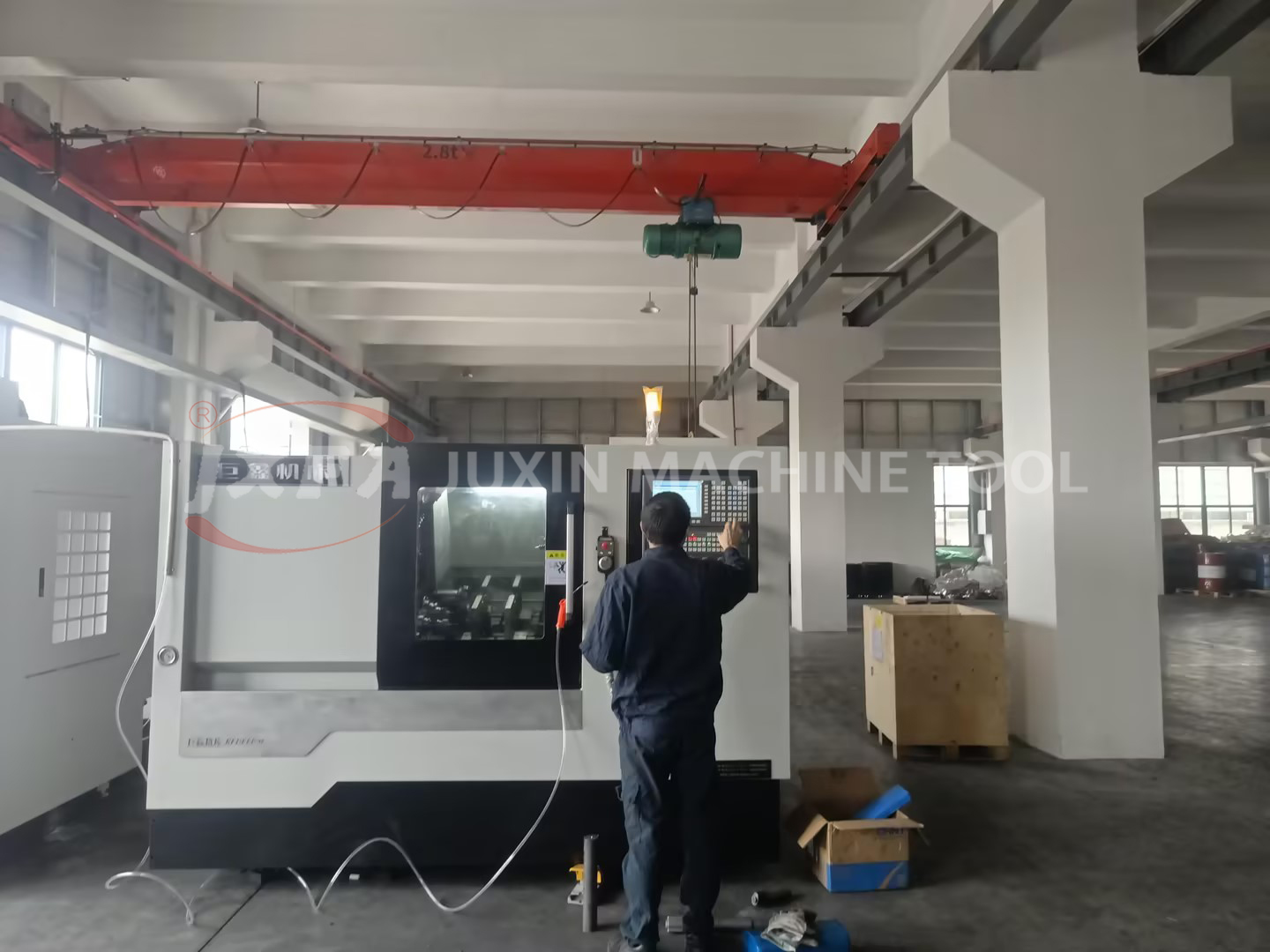
JUXIN MACHINE TOOL is a Chinese manufacturer of specialized CNC machine tools, focusing on milling, facing, centering, and double-head turning solutions for shaft and disc parts. Founded in 2005 and based in Wenling, Zhejiang, the company operates a 10,666 m² factory with an annual output of 2,000 sets and holds over 50 innovative patents.
Problem & Opportunity
Global demand for precision shaft and disc parts is accelerating, particularly in automotive, agricultural machinery, construction equipment, and renewable energy sectors. Traditional multi-machine setups often introduce cumulative errors from repeated clamping and require significant floor space and labor. The market increasingly seeks integrated, multi-process CNC lathe machines that can complete multiple operations in a single setup, reducing cycle time and improving quality consistency.
In 2024, the global CNC machine tool market was valued at approximately USD 73.5 billion, with CNC lathe machines holding a 30%–32.8% market share. The Asia-Pacific region contributed 37% of global revenue, reflecting a strong manufacturing base that demands high-efficiency turning solutions. Multi-spindle and dual-spindle configurations are gaining traction as manufacturers push for higher throughput without sacrificing precision.
Brand Solution: JUXIN MACHINE TOOL’s Specialized Portfolio
JUXIN MACHINE TOOL offers a range of CNC lathe machines designed for specific project scenarios. The core product families include:
- End Facing and Centering Machines (JXZ70-680): Capable of face milling, center hole drilling, external turning, drilling & tapping, chamfering, boring, and rapid U-drilling. It handles diameters from 14 to 500 mm and lengths from 70 to 5000 mm. The bed is integrally cast from high-quality gray cast iron HT300 for exceptional rigidity.
- Middle Drive Double-head CNC Lathe (JXS72): Designed for simultaneous double-end turning of shafts. It processes diameters 15–180 mm and lengths 40–800 mm, eliminating turnaround errors through one-clamping synchronous machining.
- Twin-Spindle CNC Vertical Lathe Machines (JXLC45-A, JXLC63D): Vertical dual-station, dual-spindle configurations for shaft and disc parts. JXLC45-A handles shafts up to 345 mm diameter and 1020 mm length; JXLC63D processes discs up to 525 mm diameter and 400 mm height.
All models incorporate high-strength preheated cast iron/resin sand integral castings, ultra-low temperature cryogenic heat treatment, and stress relief aging for long-term stability. Guide rails are precision-hardened and manually scraped, with some models offering heavy-duty roller linear guides.
Technical Explanation: How JUXIN Machines Deliver Project-Specific Precision
The end facing and centering machine (JXZ70-680) achieves repeat positioning accuracy of 0.008–0.012 mm and center hole depth consistency within ±0.05 mm (customizable to ±0.02 mm). Surface roughness of the center hole reaches Ra1.6–Ra1.8. For the double-head CNC lathe (JXS72), special requirements include a customizable clamping range from Φ3 to Φ185 mm and workpiece length expandable 200–800 mm, with repeat positioning accuracy of 0.003–0.005 mm and roughness Ra0.8 for non-ferrous metals, Ra1.6 for steel parts.
These tolerances align with modern automotive CNC lathe standards, which commonly demand ±0.004 mm. JUXIN’s vertical lathe (JXLC45-A) maintains spindle radial runout of 0.003–0.005 mm and workpiece roundness of 0.003–0.005 mm. The vertical structure eliminates gravity-induced deflection in slender shafts, solving vibration and rigidity issues common in horizontal setups.
The machines support optional control systems including KND, GSK, Huazhong, Siemens, and Fanuc, ensuring compatibility with existing shop-floor networks.
Application & Use-Case Scenarios
Scenario 1: Heavy-Duty Shaft Machining with End Facing and Centering
In the heavy construction machinery and oilfield equipment sector, JUXIN’s end facing and centering machine is deployed for hydraulic shafts, piston rods, and pin shafts up to 5 meters. The integral cast bed and super-heavy structure enable heavy cutting with excellent chip removal. A top-tier Chinese construction machinery group uses the JXZ70-680 in 24-hour continuous production, achieving long-term non-deformation and stable accuracy even under high-load, deep-cut conditions.
Scenario 2: Mass Production of Small to Medium Shafts with Double-Head CNC Lathe
In the motor shaft and electric vehicle wheel segment, the middle drive double-head lathe (JXS72) is used for batch processing of shafts with diameters 15–180 mm. A European transmission equipment leader (SEW) has adopted JUXIN double-head lathes for many years, recognizing their stability and high consistency in assembly-line mass production. The machine saves over 70% floor space and reduces labor by 50–80% compared to conventional multi-machine cells.
Scenario 3: Precision Disc Parts with Twin-Spindle Vertical Lathe
For brake discs, gears, and motor housings, the twin-spindle vertical lathe completes front and back processing in one clamping, eliminating secondary setup errors. A leading global electrical automation group (Siemens) integrates JUXIN vertical lathes into its global intelligent production lines for motor spindle and shell component machining, meeting German process requirements. The machines support unattended operations with robotic loading.
Market Trend Analysis
Industry data indicates that the CNC lathe segment remains the largest within the CNC machine tool market, accounting for approximately 30%–32.8% of total market value in 2024. The global vertical machining center market, which includes vertical lathes, was estimated at USD 42.6 billion in 2024, with Asia Pacific holding a 54.5% share. The shift toward multi-spindle and dual-station configurations is driven by the need for reduced cycle times and higher throughput in automotive parts manufacturing (40% of market demand).
Manufacturers are increasingly prioritizing equipment that can integrate turning, milling, drilling, and grinding in a single setup. JUXIN’s modular approach—offering turn-mill and turn-grind compound models for parts above HRC 50 hardness—aligns with this trend, replacing traditional internal grinders and reducing process steps.
Comparison with Traditional Solutions
Traditional shaft machining often requires separate machines for facing, centering, turning, and drilling, leading to multiple clampings and cumulative errors. JUXIN’s integrated approach improves coaxiality and depth consistency while reducing labor and floor space. However, one limitation is that the high level of customization for specific project requirements may involve longer lead times and higher upfront investment compared to standard off-the-shelf single-purpose lathes. For buyers with simple, low-volume needs, a conventional lathe might still be more cost-effective.
Future Outlook
The market for specialized CNC lathes for shaft and disc parts is projected to grow as automation and smart factory concepts become mainstream. JUXIN MACHINE TOOL continues to invest in R&D, with over 50 patents and a dedicated engineering team. The company’s support for MES system integration, intelligent part identification, and automatic tool compensation positions its machines for Industry 4.0 environments. International expansion, particularly into Europe, Southeast Asia, and the Americas, is expected to accelerate as more global suppliers validate the performance of Chinese-made precision equipment.
Frequently Asked Questions (FAQ)
A: The JXZ70-680 series achieves repeat positioning accuracy of 0.008–0.012 mm, with center hole depth consistency at both ends of ±0.05 mm (customizable to ±0.02 mm), and center hole surface roughness Ra1.6–Ra1.8.
A: Yes. The clamping range is customizable from Φ3 to Φ185 mm, and workpiece length can be expanded from 200 mm to 800 mm. Repeat positioning accuracy is 0.003–0.005 mm, with workpiece roughness Ra0.8 for non-ferrous metals and Ra1.6 for steel parts.
A: The twin-spindle vertical lathe (e.g., JXLC63D) uses dual stations, dual spindles, and dual tool towers to machine both sides of disc parts in a single clamping. Maximum processing diameter is 525 mm, and maximum height is 400 mm. The vertical structure avoids gravity effect, ensuring roundness and flatness within 0.003–0.005 mm.
A: JUXIN machines are widely used in automotive parts, agricultural machinery, water pumps & motors, railway locomotive axles, construction machinery, transmission industry, gears, and new energy solar industry. Specific application projects include automatic production lines for electric vehicle wheels, elevator traction wheels, half shafts, and brake discs.
For detailed technical specifications, custom project evaluation, and turn-key solutions, visit JUXIN MACHINE TOOL’s official website or download the company brochure: JUXIN MACHINE TOOL Brochure (PDF). Contact: jxmachine@yeah.net | Tel: +86 1333-678-3918 | WhatsApp: +86 1333-678-3918.