
Project-Specific Flow Sensors: XY-TEK’s Cross-Industry Application Guide
Why Project-Specific Sensor Selection Matters
XY-TEK is a Shanghai-based high-tech company dedicated to the development, manufacturing, and sales of ultrasonic flow sensors and flow meters, specializing in small tubing and low flow rate measurements. In an era where precision fluid control directly impacts product yield, patient safety, and process efficiency, selecting a generic flow sensor often leads to suboptimal performance. Different projects — whether in medical devices, biopharmaceutical production, or industrial automation — impose distinct requirements on accuracy, material compatibility, installation constraints, and environmental conditions. This article provides a framework for matching ultrasonic flow sensor specifications to project-specific demands, using XY-TEK’s product portfolio as a case study.
The Solution: XY-TEK’s Scenario-Engineered Sensor Ecosystem
Rather than offering a one-size-fits-all product, XY-TEK designs each sensor series around a specific operating scenario. The company maintains 30+ R&D personnel and a 5,000 m² factory, enabling rapid customization to meet project-specific requirements. Below is a technical breakdown of key series and their intended environments.
1. Medical & Bioprocess: Non-Contact, Sterility-Compliant Clamp-On Sensors
For medical devices such as dialysis machines, ECMO systems, and artificial heart catheters, XY-TEK’s CG Series (accuracy ±3%, range 0.02–20 L/min) and CM Series (OEM clamp-on meter, RS485 output) use non-invasive ultrasonic time-difference measurement. They require no contact with the fluid, eliminating contamination risks and pressure loss. The sensors operate on flexible PVC, silicone, PFA, or PE tubing and detect bubbles down to 1/3 of tubing ID (BG Series bubble detector). Special requirements for medical environments include biocompatibility, low shear to protect blood cells, and compliance with EN ISO 13485 quality standards.
2. Industrial Automation: Robust Clamp-On with Integrated Display
In manufacturing lines for battery cells, electronics assembly, and chemical processing, the CPD Series (accuracy ±2%, range 0.1–50 L/min) offers a built-in LED display, air bubble detection, and digital output (RS485). It clamps onto rigid plastic tubing (PFA, PTFE, PVDF, PP) with outer diameters from 6 to 26 mm. The sensor withstands fluid temperatures up to 90°C and measures aggressive media such as acids, coolants, and paints without fluid contact. This series directly supports closed-loop control and process data traceability.
3. Micro-Flow & Precision Dispensing: TGU Low-Flow Series
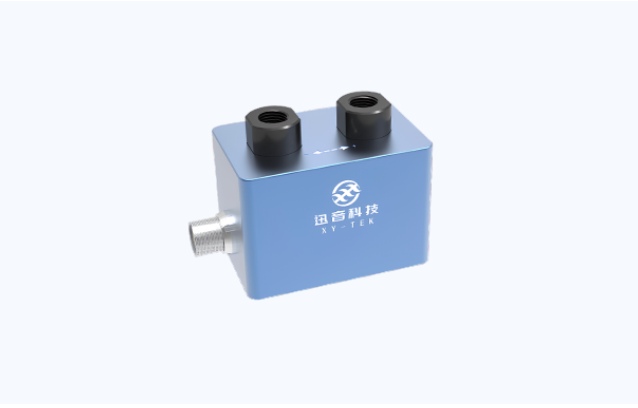
For applications demanding ultra-low flow measurement — such as flux dispensing in selective wave soldering, conformal coating, or medical perfusion — the TGU Series achieves measurement accuracy up to ±0.1 mL/min with a range of 0.1–1000 mL/min. Its U-shaped measuring channel is compatible with PVC, silicone, and PE tubing. The fast response (millisecond-level) captures pulsating flow patterns, enabling real-time process optimization and reducing material waste.
Application Scenarios: Real-World Project Blueprints
XY-TEK’s sensors have been deployed in production environments across three distinct project types, each with specific performance drivers.
Case 1: Lithium-Ion Battery Electrolyte Injection
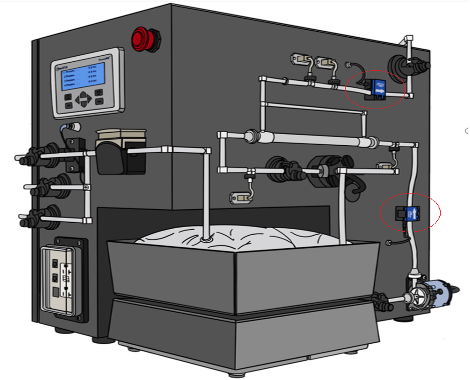
In battery manufacturing, the CP Series (CPD) is installed without cutting pipes to monitor electrolyte flow during filling. The non-invasive nature prevents contamination in high-purity electrolyte fluids. Over multiple production lines (10–30 lines per customer), the sensor ensures injection accuracy, detects bubbles and blockages, and helps reduce rejection rates by improving consistency. This clamp-on configuration avoids mechanical wear and requires no maintenance, fitting into existing equipment with minimal downtime.
Case 2: Electronic Assembly Selective Wave Soldering
For flux dispensing in SMT lines, the TGU Series monitors pulsed micro-flux flows down to 1 mL/min with ±1% accuracy. The sensor’s corrosion-resistant housing withstands aggressive flux chemicals, while its fast response prevents missed or excess deposits. Production data feeds back into closed-loop systems, resulting in lower rework costs and higher first-pass yields.
Case 3: Liquid Cooling for Data Centers & EV Charging Stations
In cooling loops for power electronics and data centers, XY-TEK’s CG or TGD in-line sensors monitor non-conductive coolants (e.g., deionized water, dielectric fluids). The non-contact measurement avoids galvanic corrosion and pressure loss, while real-time flow data enables early leak detection and thermal management optimization. Multiple cooling loops have operated stably for 2–4 years, reducing energy consumption and extending equipment life.
Market Trend Analysis: Tailored Precision Becomes the Norm
The clamp-on ultrasonic flowmeter segment was valued at USD 1.25 billion in 2024, with a CAGR of 7.4% through 2032 (GII). This growth is driven by end-user demand for non-intrusive, low-maintenance solutions that integrate with Industry 4.0 architectures. Meanwhile, the semiconductor industry’s flow control market reached USD 5.83 billion in 2024, emphasizing high-purity fluid management. The standard ISO 24062:2023 further formalizes requirements for clamp-on ultrasonic transit-time meters, offering buyers a benchmark for performance verification.
As projects become more specialized, suppliers offering modular customization — such as XY-TEK’s OEM/ODM capabilities with lead times of 1–2 months and MOQs of 50 units — gain a competitive edge. The trend is moving away from generic flow sensors toward “scenario-matched” variants with optimized accuracy, material choice, and output interfaces.
Comparison with Traditional Technologies
Traditional mechanical or electromagnetic flow sensors often require straight pipe runs, suffer from pressure drop, and can introduce contamination through moving parts. XY-TEK’s ultrasonic sensors provide a maintenance-free, no-pressure-loss alternative. However, an honest limitation: ultrasonic transit-time sensors require a relatively clean fluid and smooth tubing surfaces to maintain accuracy. Fluids with high aeration or heavy suspended solids may degrade signal quality. Also, clamp-on versions depend on pipe material stiffness — soft flexible tubing may attenuate ultrasonic waves more than rigid materials, potentially reducing precision for some low-flow setups.
Future Outlook: Precision, Integration, and Application Intelligence
By 2030, the broader flow meter market is projected to reach USD 15.17 billion (Grand View Research). Advancements in digital signal processing and multi-parameter sensing will enable even higher accuracy and diagnostic capabilities. XY-TEK, with its dedicated R&D team of 30+ engineers, is positioned to develop next-generation sensors with expanded communication protocols (EtherCAT, IO-Link) and miniaturized form factors. Buyers can expect tighter integration with IIoT platforms and predictive maintenance features, further aligning sensor capabilities with specific project roadmaps.
FAQ — Neutral Project-Scenario Answers
For project-specific sensor evaluation, contact XY-TEK’s engineering team:
Email: global@xy-tek.cn | Tel: 86-21-33885752
XY-TEK Website — Shanghai Xunyin Technology Co., Ltd
Have Questions or Need More Details?
Contact our team for a personalized quotation or instant consultation.
Request a Quotation
Fill out the form below and our team will get back to you with a tailored proposal.
WhatsApp Direct Chat
Prefer to chat in real-time? Message us on WhatsApp for instant assistance & quick answers.
- Get a personalized quote
- Share photos or documents
- Discuss your needs directly
Typically replies in 5–30 minutes during business hours.