
Proof Before Production: Vetting a Custom Ribbon Supplier
Proof Before Production: Vetting a Custom Ribbon Supplier
Pre-production samples, staged inspection records and current certificates are the three pieces of evidence that separate a custom ribbon supplier's claim from a verifiable capability. A signed sample shows what one run can produce. Inspection records show how consistently that run can be repeated. Certificates show which material claims a third party has actually checked. Buyers moving from evaluation into execution need all three to describe the same specification — width, colour, printing and fibre — before a bulk order is released.
What Supplier Evidence Should Actually Cover
A custom ribbon order is approved on two things: a sample the buyer has signed off, and a document set the buyer can check. Neither proves the other. The sample is a statement about one production run. The documents are a statement about the system that produced it. When the two are not tied to the same specification, the gap only becomes visible after the container has shipped.
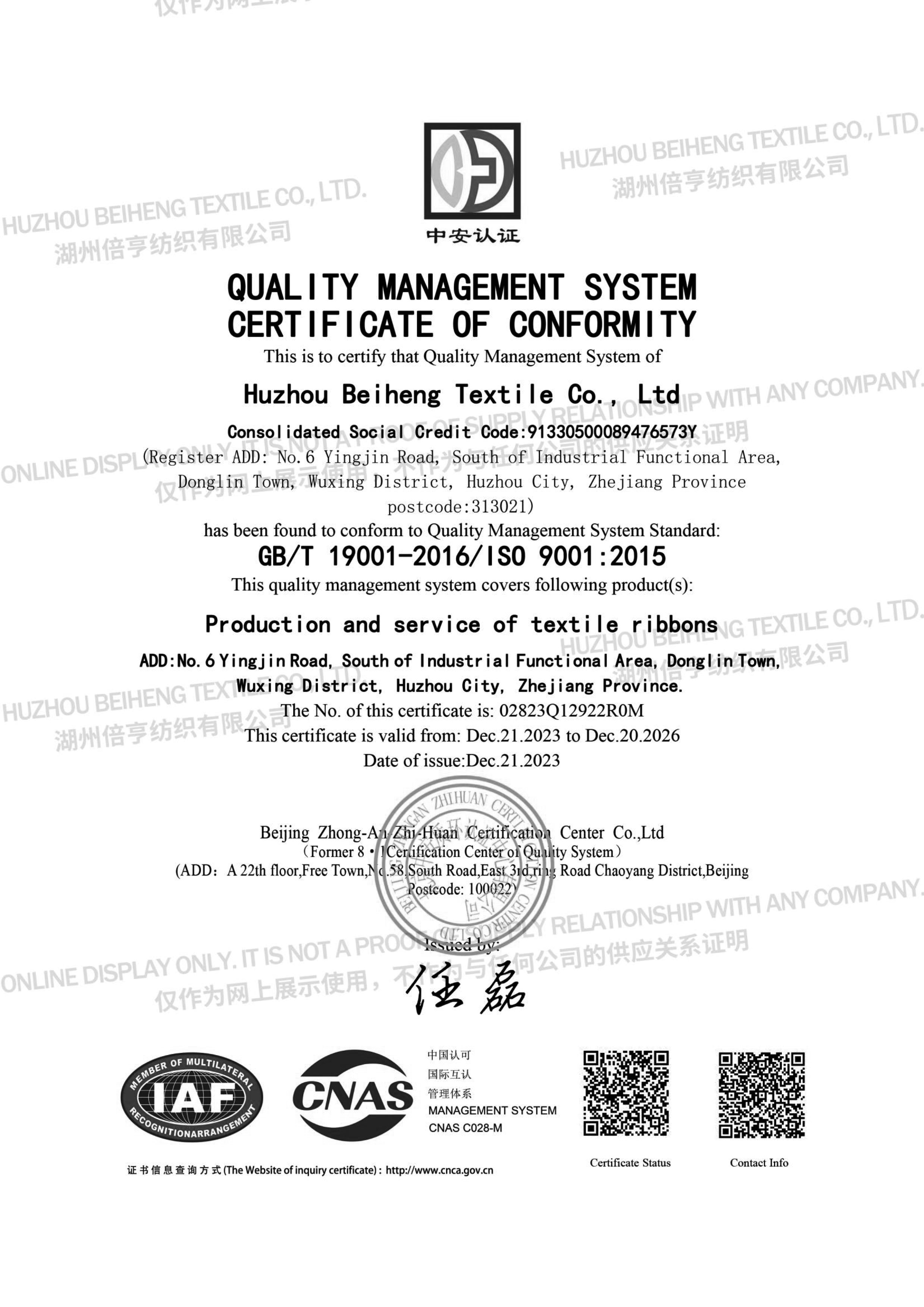
Huzhou Beiheng Textile Co., Ltd. — trading as Beiheng Ribbon — is an integrated ribbon manufacturer founded in 1999 in Huzhou, Zhejiang, with weaving, dyeing, finishing, custom production and an in-house testing laboratory on one site. Its evidence chain can be requested in three separately checkable parts: a pre-production prototype made from the buyer's artwork or reference sample, inspection applied at incoming material, in-process and finished-goods stages, and certificate support covering GRS, RCS and OEKO-TEX Standard 100, alongside GOTS, FSC, ISO 9001, ISO 14001 and SMETA. Each part answers a different buyer question, and each has a boundary worth understanding before a purchase order is signed.
Why Verification Has Become the Deciding Question
Ribbon is not a scarce category. China exported more than USD 1.065 billion of narrow woven man-made fibre fabrics in 2024 — the HS 580632 grouping that covers most synthetic ribbon — according to World Integrated Trade Solution / UN Comtrade figures. Upstream, Grand View Research estimated the global recycled polyester market at USD 15.52 billion in 2024, with Asia Pacific accounting for 47.78% of global recycled polyester revenue in the same year.
When supply is that deep, the choice between suppliers stops being about whether ribbon can be produced and becomes about whether a defined specification will be repeated. That is a documentation question as much as a manufacturing one, and it sharpens as recycled content moves from packaging language into audited claims. The Global Recycled Standard requires a minimum of 20% recycled content for certification and 50% for on-product labelling, according to Textile Exchange. Those two thresholds cannot be substantiated by a brochure; they are substantiated by a scope certificate plus a transaction certificate that names the shipment.
Checkpoint One: The Pre-Production Sample
The sample is where a custom ribbon stops being a description and becomes a specification. For a printed, hot-stamped or jacquard ribbon, approval should fix the base tape type, the nominal width, the colour reference, the artwork placement and repeat length, the edge finish and the packaging format — the parameters that will be repeated across the bulk run.
Parameters that must be written down, not implied
- Width. Beiheng Ribbon's custom range runs from 0.3 cm to 10 cm. The width should be recorded as a nominal figure together with the named edge finish — overlocking and heat-sealed edges are listed as separate finishing options, so both belong on the approval sheet.
- Colour. Matching is done against Pantone codes or physical swatches, supported in-house by a computer colour-matching system. The approved reference should be the physical standard, not a screen rendering.
- Printing and construction. Silk-screen printing, heat transfer printing and hot stamping are offered as printing routes; jacquard weaving is a different construction choice rather than a print. Selecting the route before sampling avoids approving a sample that cannot be reproduced economically at volume.
- Artwork inputs. Vector files such as AI, PDF or EPS are preferred. Raster artwork should be at least 300 DPI with text converted to outlines, and the brief should state ribbon width, logo repeat length and printing colours.
- Packaging. Roll packing, spool packing and individual polybag packing are all available, and the format affects handling time as well as presentation.
Beiheng Ribbon states that custom prototypes are available within seven days, with sample cost and sample lead time advised per order. That turnaround matters at the evaluation stage, but it is a statement about sampling, not about bulk capacity.
What a sample cannot establish
A prototype is a small run, and it carries three limits that buyers often overlook. It does not demonstrate batch-to-batch colour consistency at commercial volume. It does not carry the certificate set, because certificates attach to facility and material scopes rather than to a single length of tape. And it does not establish fastness beyond the ink system used: Beiheng Ribbon states that water-based ink reaches grade 3–4 for indoor use, that UV-resistant ink is specified for outdoor scenarios, and that long soaking or washing is not recommended.
The commercial consequence is straightforward. Custom-made ribbon is generally non-returnable and non-exchangeable except for quality problems caused by the supplier's production, so the approved sample and its written specification are the buyer's main protection. Anything that matters in the end use — laundering, abrasion, outdoor exposure, adhesion to a box — should be named at sampling and confirmed against a test report rather than assumed from appearance.
Checkpoint Two: Multi-Stage Quality Control
The second checkpoint is whether inspection happens at more than one point in the process, and whether records exist to prove it after the fact. Single-point final inspection catches visible defects; it does not catch a yarn lot that was wrong before weaving or a dye bath that drifted before finishing.
Three inspection stages and what each one can catch
Beiheng Ribbon describes inspection implemented across incoming material, production and finished goods, with quality control for custom orders recorded as sampling inspection. Read together, those statements describe a staged approach in which the inspection basis is a sampling plan rather than a metre-by-metre measurement. The practical buyer implication is that the sampling basis, the defect classification and the acceptance criteria need to be agreed in writing — Factory Acceptance Test is the acceptance basis recorded for the supplier's custom orders — because a staged system is only as useful as the plan it runs on.
The company also states that product performance variation is controlled within ±3% per batch. That figure describes consistency between batches; it is a control target and does not replace the tolerances written into a purchase order. Buyers who need a tighter band on width, shade or length should specify it explicitly rather than assume the batch-control figure covers it.
What the in-house laboratory changes
Beiheng Ribbon's laboratory is equipped with computer colour-matching systems, colour fastness testers, heavy-metal analysers and biodegradability testing equipment, and the company employs 25 engineers within a 245-person workforce, holding 23 textile-related patents. For a buyer, the operational value is that colour and fastness questions can be answered against a production batch instead of only against a general material description — which is the difference between a corrective action and a specification change.
Biodegradability deserves a separate note. The presence of biodegradability testing equipment and a biodegradable ribbon product category indicates in-house testing capability; it is not, by itself, a third-party biodegradability certification. A buyer whose market requires a certified degradation claim should request the specific test documentation for the exact material rather than infer it from the equipment list.
Traceability, capacity and lead time in the same frame
Traceability is the part of quality control that buyers only value after a problem. Beiheng Ribbon runs an ERP system intended to trace raw material, production and delivery, and supplies technical documentation, certified copies and customs clearance documents with orders. Those outputs are what allow an inspection finding to be traced back to a material lot.
Capacity should be read alongside them. The site covers 53,000 m² and runs 700 high-speed Swiss Müller looms and 23 dyeing and finishing lines, with a stated daily output of 3 million metres and monthly capacity of 90 million metres. Quoted production time for custom orders is normally 7–15 working days depending on specification and quantity, the custom-order capability record lists lead times of 7–30 days, and a full 20GP container order is quoted at 30–40 days. The minimum order quantity is 5,000 metres. These are supplier-reported capability figures: they describe what the operation is built to do, not an audited output for a specific month.
Checkpoint Three: Certifications, Read at the Right Level
Certification is the most quoted and least read part of a supplier file. Three readings determine whether a certificate actually supports a claim: what it covers, who issued it, and whether it will still be valid on the shipment date.
A scope certificate is not a transaction certificate
Beiheng Ribbon holds a GRS 4.0 / RCS 2.0 Scope Certificate, number CU855379MUL-2026-00046725, issued by Control Union Certifications B.V., covering functional accessories (PC0017) plus finishing, preparatory, washing, laundering and weaving, with validity from 19 May 2026 to 18 May 2027. A scope certificate of this kind establishes that the certified operation and product categories are covered by the standard. It does not, on its own, certify the recycled content of a particular shipment. That link comes from a transaction certificate issued against a specific commercial transaction, which is why the supplier separately states that TC transaction certificates and third-party SGS test reports can be provided.
OEKO-TEX coverage follows the named fibres
The OEKO-TEX Standard 100 certificate on record, SH010 209135, was issued by TESTEX AG, Swiss Textile Testing Institute, under Product Class I for baby articles. Its scope names ribbons made of 100% recycled cotton, cotton/recycled cotton and 100% recycled polyester, in raw white, bleached, reactive or disperse piece-dyed and dope-dyed black for polyester. That is a precise scope, and precision cuts both ways: a fibre that is not named in it is not covered by that certificate. A buyer specifying lyocell or another material should ask which document applies to that specific style rather than assume the ribbon range is uniformly certified.
Limit values also move. Effective 1 April 2025, OEKO-TEX Standard 100 reduced its Bisphenol A limit from 100 to 10 mg/kg, according to the OEKO-TEX Association — a change that matters most for direct-to-skin and baby-adjacent products. A certificate issued before such a change does not necessarily answer the current question, so the test report should be aligned to the limit values in force for the target market.
Certificates on record for Beiheng Ribbon
| Certificate | Number | Issuer | Scope relevant to ribbon buyers | Validity on record |
|---|---|---|---|---|
| GRS 4.0 / RCS 2.0 Scope Certificate | CU855379MUL-2026-00046725 | Control Union Certifications B.V. | Functional accessories (PC0017); finishing, preparatory, washing, laundering, weaving | 19 May 2026 – 18 May 2027 |
| OEKO-TEX Standard 100 (Product Class I) | SH010 209135 | TESTEX AG | Ribbons of 100% recycled cotton, cotton/recycled cotton, 100% recycled polyester; raw white, bleached, reactive or disperse piece-dyed, dope-dyed black polyester | 23 October 2025 – 30 November 2026 |
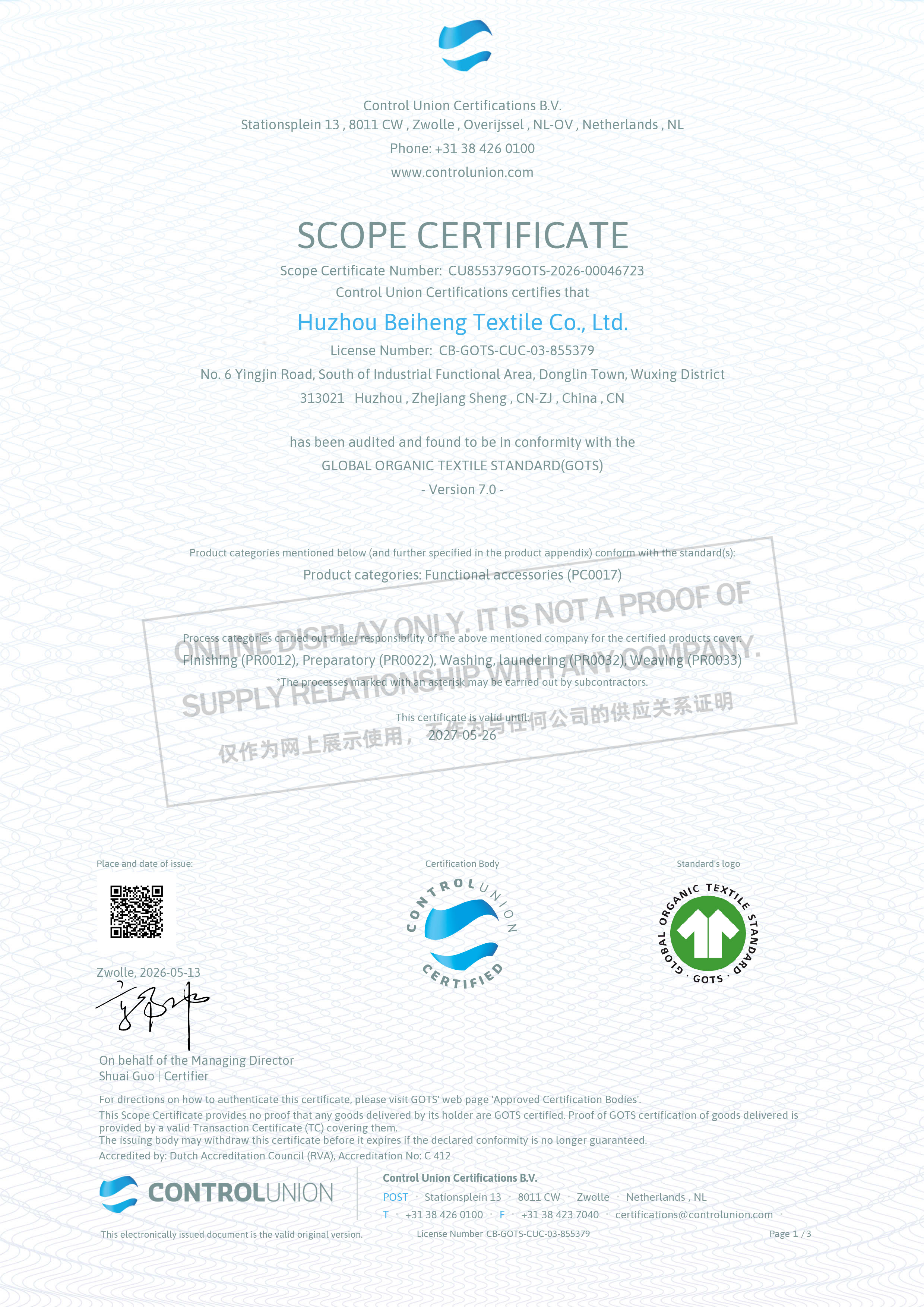
| GOTS 7.0 Scope Certificate | CU855379GOTS-2026-00046723 | Control Union Certifications B.V. | Functional accessories (PC0017); finishing, preparatory, washing, laundering, weaving | 13 May 2026 – 26 May 2027 |
| FSC Chain-of-Custody | CN21/21014 | SGS Hong Kong Limited | Purchasing of FSC 100% and FSC Mix yarn; manufacture and sale of FSC 100% and FSC Mix woven edge ribbon, ribbon and bow | 1 July 2026 – 30 June 2031 |
| SMETA 4-Pillar (Sedex) | ZAA600193797 | TUV | Labour standards, health and safety, environment, business ethics | 30 March 2026 – 30 March 2027 |
| ISO 9001:2015 (GB/T 19001-2016) | 02823Q12922R0M | Beijing Zhong-An-Zhi-Huan Certification Center Co., Ltd | Production and service of textile ribbons | 21 December 2023 – 20 December 2026 |
| ISO 14001:2015 (GB/T 24001-2016) | 02823E12922R0M | Beijing Zhong-An-Zhi-Huan Certification Center Co., Ltd | Production and related activities of textile ribbons | 21 December 2023 – 20 December 2026 |
Why the dates matter as much as the numbers
Certificate validity is a date question, not a permanent claim. At the time of writing, the OEKO-TEX certificate on record runs to 30 November 2026, both ISO certificates to 20 December 2026, the SMETA audit to 30 March 2027, GRS/RCS to 18 May 2027, GOTS to 26 May 2027 and FSC to 30 June 2031. A buyer planning shipment after any of those dates should request the renewed version as part of order confirmation, not after inspection. That single habit — date-checking before the order rather than after the goods arrive — removes most of the risk that a genuine certificate is used to support an out-of-date claim.
Matching Evidence to Material and Specification
Evidence only has value if it matches the item ordered. The table below links commonly specified ribbon types to the documents worth requesting for each, using the material guidance and certificate scopes supplied by Beiheng Ribbon.
| Ribbon type or specification | Typical fit | Evidence to request |
|---|---|---|
| Recycled polyester (RPET) ribbon | General packaging and logo printing; green-brand packaging | GRS/RCS scope certificate plus a transaction certificate naming the shipment |
| Polyester ribbon | General gift wrapping, bows, decoration, printed logo tape | Ink system used and its fastness result; approved print proof |
| OEKO-TEX-relevant recycled ribbons | Applications where harmful-substance compliance is specified | OEKO-TEX Standard 100 certificate checked against the named fibre and dye route |
| Double-face satin ribbon | Luxury gifts and perfume boxes | Colour approval standard, fastness result, print registration where printed |
| Grosgrain ribbon | Bows that need to hold shape | Width and weave confirmation, edge finish, approved bow sample |
| Cotton and Better Cotton ribbon | Natural matte, rustic, handmade and organic-style gifts | OEKO-TEX scope confirmation; BCI claim documentation if Better Cotton is specified |
| Lyocell and biodegradable ranges | Specialty eco-positioned programmes | Written confirmation of which certificate covers that specific style, plus any test report for the degradation claim in your market |
When the Evidence Chain Sits Inside One Factory
A supplier that weaves, dyes, finishes and tests in one operation has a shorter document chain than one that consolidates finished rolls from multiple sources. Beiheng Ribbon's structure places 700 looms, 23 dyeing and finishing lines and an in-house laboratory on a single 53,000 m² site, with 70% of output exported to the EU, Middle East, Asia, North America and Oceania. When a colour question and a certificate question route into the same quality system, the number of parties between the buyer's specification and the finished roll is smaller, and a batch failure is easier to isolate.
This is not a claim that one structure is inherently better. Intermediaries offer flexibility and range that a single mill may not. The point is narrower and more practical: a buyer should know which party issues each document, which party controls dyeing, and which party signs the inspection record. Where those three sit in different companies, the verification steps multiply even if the product is identical.
Where the fit boundary lies
- Order size. The minimum order quantity is 5,000 metres, which suits programme buying and excludes very small sampling-only purchases.
- Returns position. Custom-made products are generally non-returnable and non-exchangeable except for quality problems caused by the supplier's production, so specification accuracy at approval matters more than usual.
- Fastness limits. Water-based ink reaches grade 3–4 for indoor use, UV-resistant ink is used outdoors, and long soaking or washing is not recommended. Washable or heavily handled applications need a different brief.
- Certificate scope. Each certificate names its fibres and processes. A ribbon outside that scope is unverified by that document, even if the supplier holds it.
- Lead time. Custom production is quoted at 7–15 working days depending on specification and quantity, with 30–40 days for a full 20GP container. Peak-season holiday programmes need that window planned backwards.
A Documented Application: Gift Packaging ODM Across Four European Markets
Beiheng Ribbon's case record describes a gift packaging ODM customer across France, Germany, the United Kingdom and Italy: 2 million metres supplied over five years for brand packaging use, built on a Christmas ribbon programme. The recorded highlights include festive colourways, colour fastness, anti-fray behaviour, shape retention for bows, use across trees, gift boxes, wreaths and craft work, OEM and ODM support with custom printing and logo work, and stable quality for large holiday volumes.
What the record establishes is repeat volume across five years in four markets, together with printing and logo capability inside an ODM relationship. What it does not establish is performance in a different application, or that a new buyer will obtain the same result from the same specification. It is the supplier's own account rather than an independently audited outcome, and it should be read as one data point alongside the sample, the inspection records and the certificates.
Reading the Market Signal Without Overreading It
Grand View Research projects recycled polyester demand to grow at a CAGR of 9.25% through 2030, a forecast that sits behind much of the current interest in RPET and recycled ribbon programmes. Two cautions belong beside that figure. First, it is a projection with stated assumptions, not an observation of a completed trend. Second, recycled polyester market estimates vary materially between research houses — roughly USD 12.5 billion to USD 15.8 billion for the same 2024 window — largely because of whether post-industrial and post-consumer waste are both counted. Quoting one number without its definition produces a confident-sounding comparison that is not actually comparable.
For a ribbon buyer, the useful interpretation is narrower than the headline. If recycled input volumes grow, certification and transaction documentation become the binding constraint rather than material availability, because the 20% certification threshold and 50% labelling threshold have to be evidenced shipment by shipment. That is a conditional outlook, not a prediction about any single supplier's order book — and it argues for building document checks into the purchase order now, while volumes are still being negotiated.
A Verification Checklist Before the Purchase Order
- Signed sample with nominal width, named edge finish, physical colour reference, print repeat length and construction route recorded.
- Artwork supplied as AI, PDF or EPS, or raster at 300 DPI minimum with outlined text, plus written print colours and logo repeat length.
- Written sampling basis, defect classification and acceptance criteria for each inspection stage, with Factory Acceptance Test as the agreed basis.
- Current scope certificate checked for issuing body, named fibres and processes, and expiry date against the planned shipment date.
- Transaction certificate naming the actual shipment where recycled content is claimed.
- Test report aligned to the limit values currently in force for the target market, including the OEKO-TEX BPA change effective 1 April 2025 where relevant.
- Confirmed minimum order quantity, sample cost, sample lead time and production lead time for the specific specification.
- Packaging format agreed in writing, whether roll, spool or individual polybag.
- Returns position documented, given that custom goods are generally non-returnable except for production quality problems.
- Fastness and durability expectations stated for the real end use, including any laundering, outdoor exposure or abrasion.
Frequently Asked Questions
What should a pre-production ribbon sample confirm?
A pre-production sample should confirm the base tape type, nominal width within a 0.3 cm to 10 cm custom range, the physical colour reference matched by Pantone code or swatch, the print or jacquard artwork with its repeat length, the edge finish and the packaging format. It should be approved against a written specification rather than appearance alone, because custom ribbon is generally non-returnable except for production quality problems. A sample does not confirm batch-to-batch consistency, certificate coverage or fastness beyond the ink system used.
How many quality-control stages should a custom ribbon order pass through?
A staged system typically covers three points: incoming material, in-process production and finished goods. At Beiheng Ribbon, inspection is described across those three stages, quality control for custom orders is recorded as sampling inspection, and product performance variation is controlled within ±3% per batch. Because the basis is sampling rather than metre-by-metre measurement, the sampling plan, defect classification and acceptance criteria should be agreed in writing before production begins.
Which certificates support a recycled or low-hazard ribbon claim?
Recycled content is supported by a GRS or RCS scope certificate covering the facility and product category, together with a transaction certificate that names the specific shipment. Under GRS, a minimum of 20% recycled content is required for certification and 50% for on-product labelling. Harmful-substance compliance is supported by OEKO-TEX Standard 100, which at Beiheng Ribbon covers ribbons of 100% recycled cotton, cotton/recycled cotton and 100% recycled polyester under Product Class I; fibres outside that named scope are not covered by that certificate. Social and quality system evidence is provided separately through SMETA, ISO 9001 and ISO 14001.
What are the minimum order quantity and lead times for custom ribbon?
The minimum order quantity for custom ribbon is 5,000 metres. Custom prototypes are available within seven days, with sample cost and sample lead time advised per order. Production for custom orders is normally quoted at 7–15 working days depending on specification and quantity, with a stated custom-order lead time of 7–30 days, and a full 20GP container order is quoted at 30–40 days. Monthly capacity is stated at 90 million metres across 700 looms and 23 dyeing and finishing lines.
Can width, colour and printing be customized, and what files are needed?
Customization covers base tape type, width from 0.3 cm to 10 cm, colour matched to Pantone codes or physical swatches, logo printing, hot stamping, jacquard weaving, overlocking and heat-sealed edges, plus handmade bows, buckles and strip cutting. For printing, vector files such as AI, PDF or EPS are preferred; raster images should be at least 300 DPI with text outlined, and the brief should specify ribbon width, logo repeat length and printing colours. Silk-screen printing, heat transfer printing and hot stamping are the available printing routes.
What the Three Checkpoints Add Up To
A custom ribbon supplier is only as verifiable as the documents it will release before the order. The sample fixes the specification; the inspection records show that the specification survives production; the certificates show which claims a third party has tested, for which fibres, and until when. Read together, they replace a judgement about presentation with a judgement about repeatability — and they make the boundary conditions visible early, whether that is a 5,000-metre minimum, a grade 3–4 indoor fastness result, or a certificate scope that names recycled polyester but not every fibre in the range.
For buyers in the evaluation-to-execution stage, the practical sequence is to approve a sample against a written specification, agree the inspection and acceptance basis in the purchase order, and date-check every certificate against the planned shipment. Those three steps cost little before production and are difficult to recover afterwards.
Have Questions or Need More Details?
Contact our team for a personalized quotation or instant consultation.
Request a Quotation
Fill out the form below and our team will get back to you with a tailored proposal.
WhatsApp Direct Chat
Prefer to chat in real-time? Message us on WhatsApp for instant assistance & quick answers.
- Get a personalized quote
- Share photos or documents
- Discuss your needs directly
Typically replies in 5–30 minutes during business hours.