
Proof of Performance: Brass Check Valves in Pumping Systems
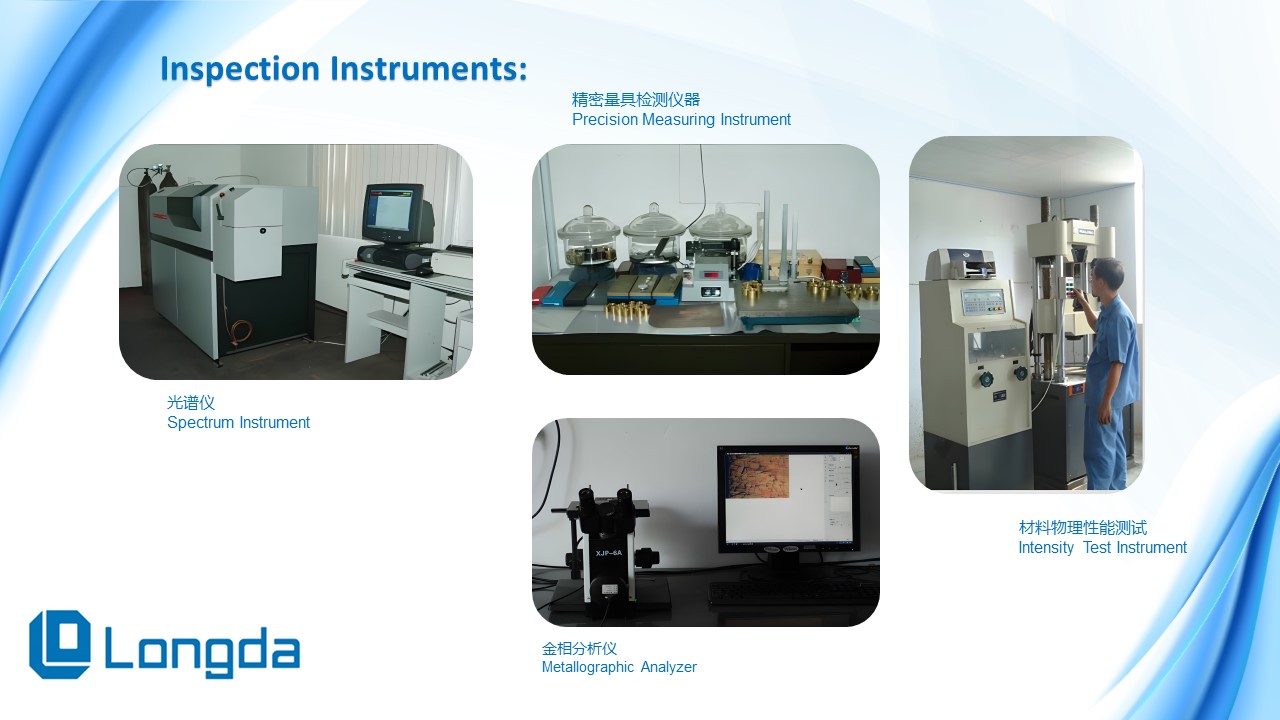
In-house testing equipment at LONGDA's Yuhuan facility, where brass valve assemblies are verified before shipment.
A check valve has no actuator, no handle and no control signal. It is the one component in a pumping circuit that must decide, unaided, when to open and when to close. Every consequence of that decision — a disc slammed back onto its seat, a pump spinning against reverse flow, a column of water stopping too abruptly in a discharge line — is paid for somewhere else in the system, usually long after the valve has been installed and forgotten.
That is why the useful question for a buyer is no longer what a check valve is, but what a supplier can prove about the one it ships. This article sets out an evidence framework for brass check valves in pumping applications and applies it to a specific case: the LD 30303 from LONGDA BRASS VALVE, a spring-loaded brass check valve built with a PTFE sealing face on the brass disc and an SS304 stainless steel spring. LONGDA BRASS VALVE is the valve brand of Zhejiang Longda Technology Co., Ltd., a brass valve and fittings manufacturer established in 1993 in Yuhuan County, Zhejiang Province, China, which exports about 95% of its output to Europe, North America and South America.
The Pumping Problem: Reverse Flow, Water Hammer and Assumption
In any pump-driven circuit — a booster set feeding a building riser, a circulation loop serving radiators, a transfer line moving water between tanks — the check valve sits downstream of the pump and immediately upstream of everything the pump is meant to protect. Its function is simple to describe and difficult to guarantee: allow forward flow with as little resistance as possible, then close before reverse flow has a chance to develop.
When that function fails, the symptoms rarely appear at the valve. They appear as a bang in the pipework at pump shut-down, as a pressure spike that cracks a fitting three floors away, as a pump that restarts against a spinning impeller, or as a slow drip past a seat that nobody notices until the insulation is wet. In each case, the underlying cause is usually one of four things: a disc that closed too slowly, a seat that never sealed properly, a spring that lost its rate, or a body alloy that corroded where the buyer could not see it.
None of those four failures can be assessed from a product photograph or a single line on a quotation. They can only be assessed from evidence — material evidence, dimensional evidence, functional evidence and compliance evidence — collected at the point of manufacture and carried through to the shipment.
What "Proof of Performance" Actually Requires
In check valve procurement, the word "proof" is often used loosely. A performance claim is only provable when it can be traced to a category of evidence that a third party could inspect. For a brass check valve in a pumping circuit, four categories matter, and each proves something different.
| Evidence category | What it establishes | What it does not establish |
|---|---|---|
| Material evidence — alloy grade, disc face compound, spring grade | That the components inside the valve are the ones specified, and that they suit the medium | That the parts were assembled correctly, or that the alloy suits every water chemistry |
| Dimensional evidence — thread form, gauge inspection records | That the valve will seat onto the pipe without cross-threading or leaking at the joint | That the internal seat geometry holds pressure |
| Functional evidence — pressure and leakage testing, closure behaviour | That the assembled valve holds in the direction it is meant to hold | That it will still hold after years of cycling in a live system |
| Compliance evidence — certification scope and listings | That the product family has been assessed against the standards named on the certificate | That every shipment automatically conforms — that is what lot inspection is for |
A supplier that can produce only one of these four categories is offering partial proof. A supplier that can produce all four, lot after lot, is offering something closer to the standard procurement teams are actually looking for: repeatability.
Swing vs Spring-Loaded: The Configuration Decision Comes First
Before material quality can be discussed, the configuration has to be right. Two check valve designs dominate brass pumping applications, and they solve different problems.
A swing check valve uses a hinged disc that lifts with forward flow and falls back onto the seat when flow decays. Because the disc swings out of the flow path, resistance is low and the valve is well suited to lines where pressure budget is tight. Closure, however, depends on gravity and on how quickly the flow actually reverses, so in a pump discharge line that can reverse almost instantly, the disc may still be travelling when the reverse pressure wave arrives — the classic slam condition that produces water hammer.
A spring-loaded check valve adds a spring behind the disc. As forward flow decays, the spring begins pushing the disc back to the seat before reverse flow has fully developed. Closure is faster and more repeatable, and the valve can be mounted in orientations where gravity would not help. The trade-off is real: the spring adds a small cracking pressure that must be overcome before flow starts, and slightly more pressure drop in service.
| Decision factor | Swing check | Spring-loaded check |
|---|---|---|
| Closure trigger | Gravity plus flow reversal | Spring force, acting as flow decays |
| Water hammer risk at pump stop | Higher in fast-reversing lines | Lower, because closure begins earlier |
| Pressure drop | Usually the lowest of the two | Slightly higher, set by spring rate |
| Installation orientation | Depends on gravity; orientation-sensitive | Largely orientation-independent |
| Spring material matters? | No spring involved | Yes — spring grade governs long-term behaviour |
For pump discharge lines, booster sets and circulation loops — applications where reverse flow can develop quickly and orientation is dictated by pipe layout rather than by valve convenience — the spring-loaded configuration is generally the more prudent starting point. For low-head gravity lines where every fraction of pressure budget counts, a swing design may still be the better engineering answer. The configuration decision belongs to the system designer; the burden on the supplier is to prove that whichever configuration is chosen behaves as specified.
Inside the LD 30303: Why the Disc Face and the Spring Carry the Claim
The LD 30303 sits in the spring-loaded category. Two of its construction details are worth examining closely, because they are exactly the details that a specification sheet tends not to describe and that a failure analysis tends to find.
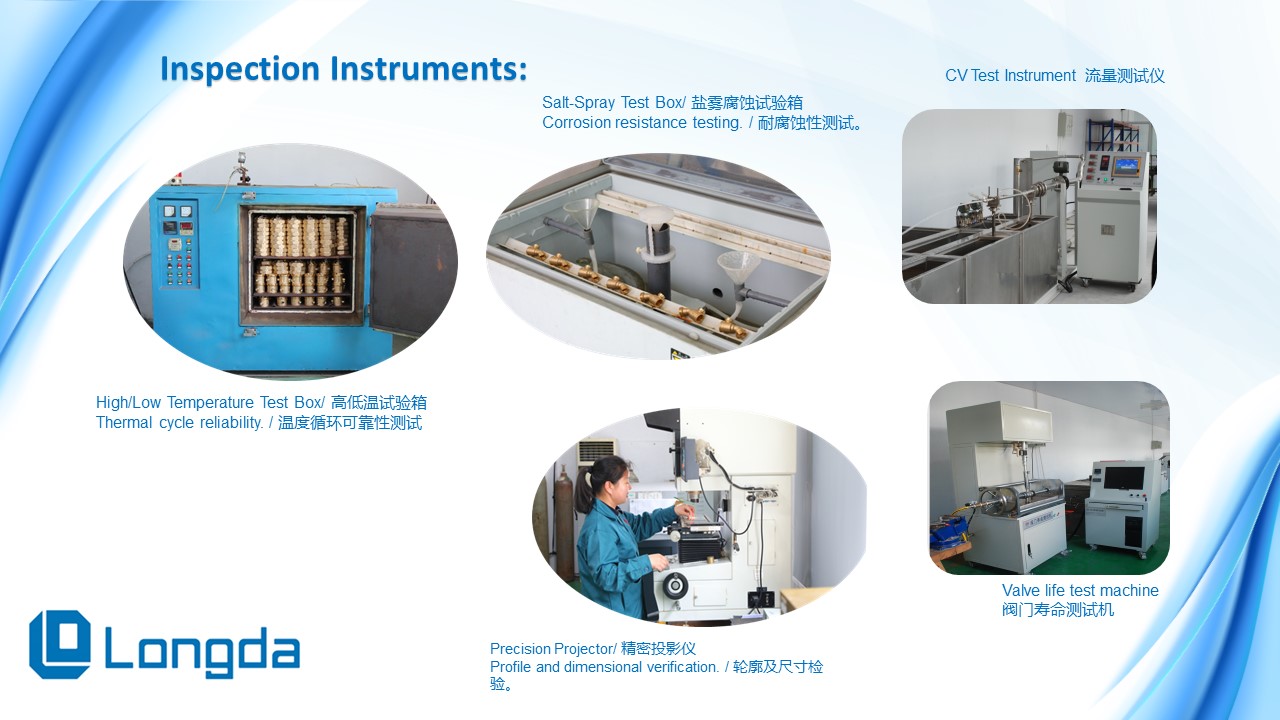
Sealing verification is a lot-level activity, not a design-stage claim.
The PTFE sealing face on the brass disc. PTFE is chemically inert across the media a brass valve usually sees — potable water, heating water, and the mildly aggressive fluids found in industrial process lines — and it has a low coefficient of friction, which matters in a component that may cycle thousands of times without attention. A PTFE face on the disc also resists scale adhesion better than a bare metal seat, so the sealing surface is less likely to be bridged by deposits in hard-water systems. The design consequence is tighter, more consistent shut-off against the small pressure pulsations that a pump imposes on a line even during normal operation.
PTFE also has boundaries that a buyer should record before specifying it. It has a temperature ceiling below that of the brass body, it can deform under high point loading, and it is not a solution for abrasive media such as slurries or sand-laden water, where a metal-to-metal seat or a different elastomer may be more appropriate. PTFE is the right answer for clean and potable water circuits; it is not a universal answer.
The SS304 stainless steel spring. In a spring-loaded check valve, the spring is the component that converts a design intention into a repeatable behaviour, and it is also the component most exposed to the medium. A spring that corrodes loses rate; a spring that loses rate closes the disc later; a disc that closes later produces the water hammer the spring was fitted to prevent. Stainless steel 304 provides corrosion resistance in potable water and in closed heating loops and holds its spring rate far better than a coated or plated spring would in a wetted environment.
The boundary here is equally specific. SS304 performs well in the water chemistry typical of municipal supply and building services, but in high-chloride or marine-adjacent conditions, chloride stress corrosion becomes a consideration and a 316-grade spring would be the more conservative choice. A supplier that can name the spring grade is telling the buyer which environments it has designed for — and, implicitly, which ones it has not.
The brass body completes the picture. LONGDA works across a range of alloys chosen for different water-chemistry requirements, including Eco-Brass C69300, CW724R, Lead-Free Brass C4650, CW511L, Low Lead Brass CW509L and CW510L, and DZR CW602N. The DZR grade is the relevant one where dezincification resistance is the concern; the lead-free grades are the relevant ones where potable-water compliance governs. The correct alloy is a function of the market and the medium, not of the valve type alone.
How the Evidence Is Actually Generated
Material claims are only as good as the process behind them. LONGDA operates a 30,000 m² site in the Xuanguang Industrial Zone, Lupu Town, Yuhuan County, Zhejiang Province, with roughly 200 employees, an annual output of about 7,500 tons and more than 360 sets of processing and testing equipment. Among the testing assets that matter for check valve verification are a spectral analysis instrument for alloy identification, a high-pressure testing set, a salt-spray test box, a high and low temperature test box, roundness measuring equipment and a projector for dimensional inspection.
Those instruments map directly onto the evidence categories described earlier. Spectral analysis confirms that the alloy in the valve is the alloy on the drawing. High-pressure testing confirms that the assembled valve holds in the direction it is meant to hold. Salt spray supports corrosion claims for exposed finishes. Dimensional inspection supports the thread and seat geometry that determine whether the valve installs cleanly and seals properly.
Two further practices are stated in LONGDA's own product documentation and are worth quoting because they are verifiable at the shipment level rather than the brochure level: valve assemblies are pressure tested before shipment, and thread gauges are used to inspect every production lot. The company also issues lead-free material test reports where potable-water compliance applies, and provides a 12-month quality warranty with free replacement. Products from the company are certified by IAPMO and ALS, which is the compliance evidence layer that North American buyers in particular will look for.
For buyers structuring a repeat programme rather than a single order, LONGDA offers OEM and ODM solutions, supported by in-house tooling and design. Stated service levels include quotation response within 24 hours, sample lead time of 5–7 days, and an on-time delivery rate above 98%. These are the numbers that determine whether a technically correct valve can actually be relied on as a repeating line item.
Where a Spring-Loaded Brass Check Valve Fits in Pumping Systems
The pumping applications that most often call for this configuration share a pattern: a pump creates head, flow can reverse when the pump stops or is valved off, and the cost of that reversal is higher than the cost of the valve.
Booster and pressure-maintenance sets. Where a pump discharges into a riser or a pressure-reducing arrangement, the check valve protects the pump from running backwards and isolates the set from system pressure during maintenance. LONGDA's brass valve range is applied in water supply and distribution systems alongside booster pumps, pressure reducing valves and water meters.
Heating and circulation loops. In radiator and HVAC circuits, check valves prevent unintended circulation and thermosyphoning when a circulator stops. The same product family serves heating valve and radiator valve applications, and the DZR alloy options are relevant where closed-loop water chemistry is uncertain.
Irrigation and agricultural supply. Pumped irrigation lines reverse flow whenever a pump cycles, and a spring-assisted closure reduces the surge that would otherwise work its way back to the pump and the fittings.
Industrial process and utility lines. Where non-aggressive fluids are moved between vessels or process stages, the check valve is a low-cost safeguard against back-mixing. Here the medium must be checked against both the brass alloy and the PTFE face, because process fluids vary far more than potable water does.
Fire protection and service-line connections. These appear within LONGDA's stated application scope for brass valves, but they are also the applications with the strictest independent listing requirements, so the applicable standard for the specific assembly should be confirmed before specification rather than assumed from a general certificate.
Boundaries: Where a Brass Check Valve Is the Wrong Answer
A credible evaluation has to state what the product does not do. Four boundaries apply to spring-loaded brass check valves in general, and to the LD 30303 configuration specifically.
It is not an isolation valve. A check valve permits flow in one direction only when the upstream pressure exceeds the spring setting; it cannot be locked closed for maintenance. Any line that needs positive shut-off requires a gate, ball or stop valve in addition, and procurement schedules that treat the two as interchangeable will fail at the first maintenance event.
The spring imposes a pressure cost. In low-head or gravity-fed systems, the cracking pressure required to open a spring-loaded disc may consume a meaningful share of the available head. In those circuits a swing check, despite its slower closure, is often the better engineering choice. Selecting spring-loaded by default is a decision that should be justified by surge risk, not by habit.
Temperature and medium limits are set by the weakest component. The brass body, the PTFE face and the SS304 spring each have their own operating envelope. Steam service, high-temperature process lines, abrasive slurries and high-chloride water all sit outside the comfortable range of at least one of those three components. A check valve specified for potable water should not be re-deployed into a chemical line on the assumption that "brass is brass".
It does not solve surge caused elsewhere. Water hammer generated by a fast-closing solenoid valve, a badly tuned variable-speed drive or a poorly sized expansion vessel will not be eliminated by a check valve. The check valve reduces one specific contribution — reverse-flow slam at the pump — and a system-level surge assessment remains the designer's responsibility.
Market Context: Why Supplier-Level Evidence Is Gaining Weight
The brass valve category is large, growing and fragmented — three conditions that push buyer attention from the product to the supplier. The global brass valves market was valued at USD 14.8 billion in 2025 and is projected to reach USD 24.1 billion by 2034, with a compound annual growth rate of 5.6% from 2026 to 2034, according to Dataintelo. The isolation function segment, which includes gate, globe and check valves, accounted for USD 26.15 billion of the wider industrial valve market in 2024, based on Cognitive Market Research figures.
Geographically, Asia Pacific held a 41.2% revenue share of the brass valves market in 2025, while North America accounted for approximately 26.1%, per Dataintelo. Yet concentration remains low: Mordor Intelligence estimates that the top five global valve suppliers control approximately 35% of global revenues. In practical terms, most check valve specifications are filled by mid-sized manufacturers whose individual quality systems — not their brand recognition — determine whether the valve performs.
Two structural trends reinforce the evidence-based approach. First, lead-free requirements have become the mandatory baseline for potable water applications in the United States under the Safe Drinking Water Act, as documented by the EPA, which shifts alloy selection from an engineering preference to a compliance gate. Second, the integration of smart valves with industrial IoT platforms for predictive maintenance is changing what buyers expect from even passive components: documented behaviour, not just documented dimensions. A check valve that cannot be verified is difficult to include in a maintenance model of any kind.
Future Outlook
The direction of travel in brass check valve procurement is toward traceability at the lot level. Where a buyer once accepted a certificate covering a product family, the more demanding specification now asks which lot was tested, with what instrument, and against what record. Manufacturers that already operate spectral analysis, high-pressure testing and per-lot thread gauging are structurally better placed to answer that question than those that rely on type-testing alone.
For pumping applications specifically, three developments are likely to shape specifications over the next several years: wider adoption of DZR and lead-free alloys as water chemistry and regulation tighten, greater scrutiny of internal component grades — the disc face and the spring rather than only the body — and the expectation that performance evidence travels with the shipment in digital form. LONGDA's combination of IAPMO and ALS certification with OEM/ODM support reflects the first two; the third is where the category as a whole still has ground to cover.
A buyer who evaluates brass check valves on evidence rather than on price alone will usually find that the difference between a good and a mediocre supply programme is not the alloy designation on the drawing. It is whether anyone can prove what happened on the line after the drawing was issued.
Frequently Asked Questions
What is the difference between a swing check valve and a spring-loaded check valve?
A swing check valve closes because the hinged disc falls back onto the seat when flow decays, so closure speed depends on gravity and on how quickly the flow actually reverses. A spring-loaded check valve uses a spring to push the disc back to the seat as forward flow decreases, so closure starts earlier and is more repeatable. In pump discharge lines, where reverse flow can develop very quickly, spring-assisted closure is generally preferred to reduce slam; in low-head gravity lines, the swing design's lower cracking pressure is often the better fit.
Why does the disc sealing face material matter in a brass check valve?
The disc face is the surface that actually stops reverse flow, so its material determines how well the valve seals and how long it keeps sealing. A PTFE face, as used on the LD 30303, is chemically inert across potable and heating water, has low friction, and resists scale adhesion better than a bare metal seat, which supports consistent shut-off against pump-induced pressure pulsation. PTFE also has limits: it has a lower temperature ceiling than the brass body and is not suitable for abrasive media, so it is the right choice for clean water circuits rather than for every fluid.
What does an SS304 stainless steel spring contribute to a spring-loaded check valve?
The spring sets the closing behaviour, and it is also the internal part most exposed to the medium. Stainless steel 304 resists corrosion in potable water and closed heating loops and holds its spring rate better than a plated spring would when wetted. Because a corroded spring loses rate, closes the disc later, and therefore increases slam risk, spring grade is a reliability variable rather than a cost detail. In high-chloride or marine-adjacent conditions, chloride stress corrosion becomes a consideration and a 316-grade spring would be the more conservative specification.
How can a buyer verify check valve performance claims before placing a repeat order?
Verification should be requested at lot level across four evidence categories. Material evidence: an alloy identification record, typically from spectral analysis, plus the disc face and spring grades. Dimensional evidence: thread gauge inspection records for the lot, since thread form governs installation leakage. Functional evidence: pressure and leakage test records for the assembled valve. Compliance evidence: the certification scope for the product family, such as IAPMO and ALS listings where applicable, together with lead-free material test reports for potable-water use. LONGDA's stated acceptance criteria include pre-shipment inspection with a test report.
What are the limitations of a spring-loaded brass check valve?
The main limitations are functional and material. The spring creates a cracking pressure that must be overcome before flow begins, so in low-head or gravity-fed circuits a swing check may be more appropriate. A check valve cannot be used as an isolation valve, because it cannot be locked closed for maintenance. Operating limits are set by the weakest of the three main components — brass body, PTFE face and SS304 spring — so steam, high-temperature, abrasive and high-chloride services fall outside the standard envelope. Finally, a check valve reduces reverse-flow slam at the pump but does not correct surge generated elsewhere in the system.
How does a long-term supply arrangement change check valve procurement?
It shifts the evaluation from unit price to repeatability. Documented commercial terms matter as much as specification: LONGDA's stated terms are a minimum order quantity of 1,000 pieces per size, delivery on FOB Ningbo or Shanghai, CIF, CNF, DDP or EXW, payment of 30% by T/T in advance with 70% against a copy of the bill of lading, and acceptance based on pre-shipment inspection with a test report. Stated service levels include quotation response within 24 hours, sample lead time of 5–7 days and an on-time delivery rate above 98%. For buyers consolidating specifications, OEM and ODM support allows valve variants to be developed against a single qualified source rather than across several.
Reference Material
LONGDA's brass valve range, alloy options and specification data are published in its downloadable catalogue: LONGDA Global Catalogue (PDF).
Have Questions or Need More Details?
Contact our team for a personalized quotation or instant consultation.
Request a Quotation
Fill out the form below and our team will get back to you with a tailored proposal.
WhatsApp Direct Chat
Prefer to chat in real-time? Message us on WhatsApp for instant assistance & quick answers.
- Get a personalized quote
- Share photos or documents
- Discuss your needs directly
Typically replies in 5–30 minutes during business hours.