
Protective Packaging by Scenario: Pharma, Cannabis, Essential Oil
Protective Packaging by Scenario: Pharma, Cannabis, Essential Oil
Protective packaging is bought as a category and specified as a format, and most sourcing errors happen in the gap between the two. Child-resistant closures, light-filtering violet glass and vacuum-sealed jars address three different failure modes — access, light and air — and a pharmaceutical solid-dose line, a cannabis brand and an essential oil producer rarely need the same one. This reference maps four formats from Honor Packaging (Ningbo Honor Packaging Co., Ltd.), a Ningbo-based manufacturer founded in 2015 whose stated product focus covers child-resistant packaging, violet glass packaging and vacuum packaging, to the product scenarios their published specifications support: the H21 clear square child-resistant jar, the H21 square and round violet glass jars, the HDV3 round violet glass bottle in 5–100 ml, and the H19 5 ml vacuum click jar. Each profile states the capacity, shape and closure facts, explains why the format fits, and marks where its protection stops.
Three protection mechanisms behind one purchase order
Child resistance controls who can open a package. In the United States, special packaging obligations under the Poison Prevention Packaging Act (PPPA) and the Federal Insecticide, Fungicide, and Rodenticide Act (FIFRA) apply to the primary or immediate packaging of certain regulated products, as the U.S. Consumer Product Safety Commission's guide sets out. ASTM D3475 classifies these special packaging types by closure type and the action needed to open them, while ISO 8317:2015 defines performance requirements and test methods for reclosable child-resistant packages and ISO 14375:2018 does the same for non-reclosable packages.
Light management controls what reaches the contents. Violet glass is specified because it filters the visible spectrum while transmitting UV-A and infrared — the transmission profile usually cited for violet, or Miron-type, glass. That is selective filtration, not total light exclusion, and it is a property of the glass rather than of the closure.
Air and headspace control is a third, separate mechanism. A vacuum seal feature is an air-exclusion approach for contents where oxidation or moisture exchange is the dominant risk. It says nothing about light, and nothing about who can open the jar.
Formats combine these mechanisms in different proportions, and that is why colour alone is a poor specification. The H21 violet jar carries light filtration and a child-resistant closure in one container. The H21 clear square jar carries access control without light protection. The HDV3 bottle carries light filtration in a liquid-handling format. The H19 vacuum click jar carries an air-exclusion closure in a single 5 ml size. Choosing between them is a question about the product, not about glass colour.
Format 1: H21 clear square child-resistant jars for pharmaceutical and medical use
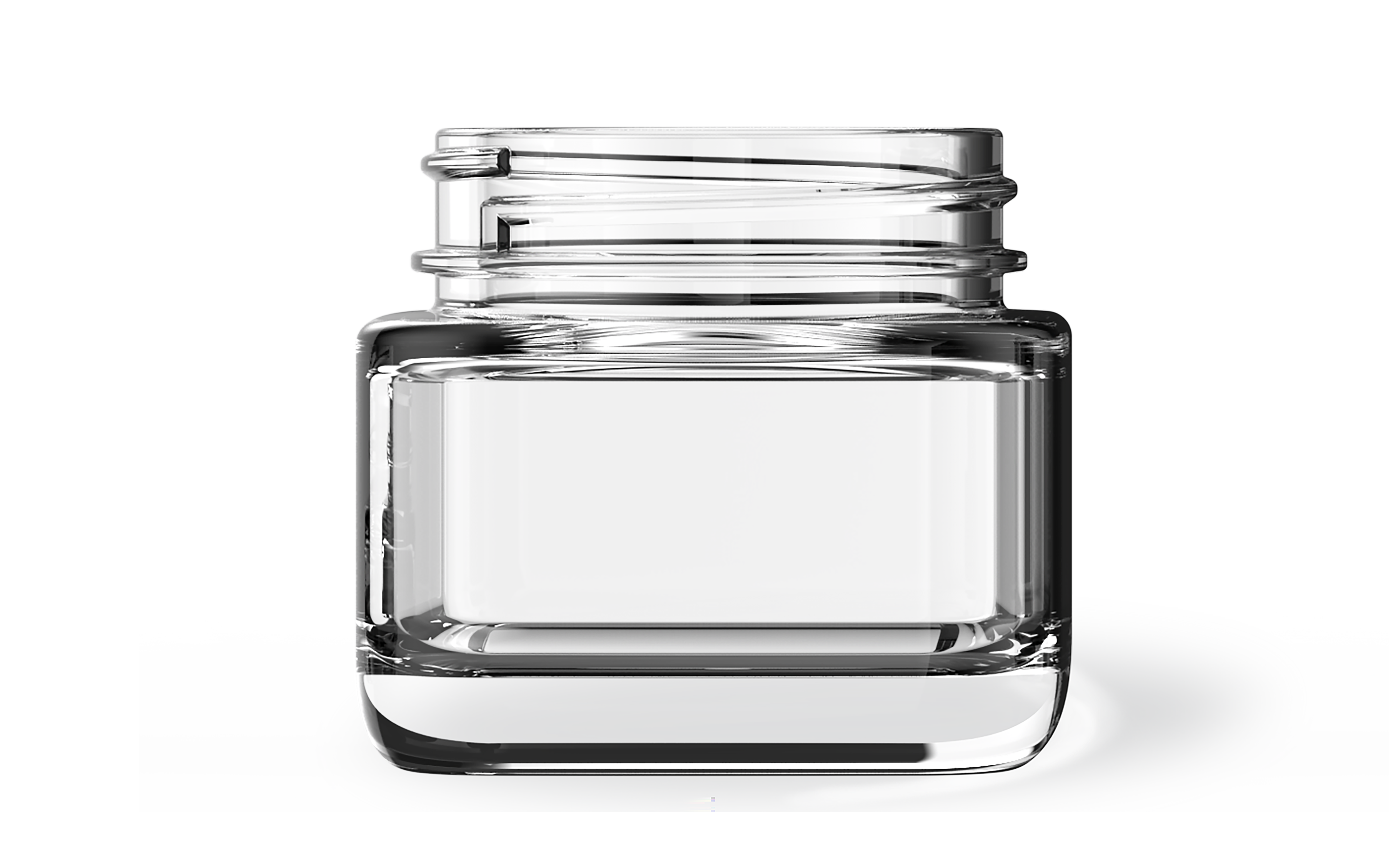
The H21 clear square jar is a 58 mm-diameter square glass jar, 24 mm to 115 mm high, weighing 75 g to 280 g, with 0.38 mm glass thickness and a child-resistant cap. Item codes H21-0003C through H21-0008C cover 15 ml and 30 ml capacities plus 20 dr, 30 dr, 40 dr and 60 dr sizes, with a material set of glass, plastic and PE. Decoration options are sticker, silk-screen printing, hot stamping, heat transfer printing and a frosted finish, and the series is listed for pharmaceutical and medical industry use among other categories.
What the specification does for a pharmaceutical line
- One closure platform across dose sizes. The 24–115 mm height range spans small sample jars through to much larger fills, so a product family can share one closure logic instead of sourcing a different jar per SKU.
- Visible contents. Clear glass lets the fill be inspected at packing and identified later, which helps where the formulation is not light-sensitive and where visual checks are part of the line routine.
- Flat panel geometry. A square profile gives straight side panels for labels, batch codes and expiry printing, and generally packs more tightly than round jars of comparable diameter.
- Access control. The child-resistant cap addresses the opening-resistance requirement that applies to many pharmaceutical and medical products in regulated markets.
Where this format stops
Clear glass does not filter visible light, so it is the wrong choice for a photolabile formulation; the relevant comparison there is the violet H21 or an opaque container, not a decorated clear jar. The second boundary is documentation. "Child-resistant cap" describes the closure type, while passing a standard is a test outcome: ISO 8317:2015 and, in the US, the 16 CFR 1700.20 protocol define what that evidence looks like. Because the result depends on the jar, the closure and the liner together, a report should cover the exact combination being ordered rather than the cap in isolation.
Format 2: H21 violet glass jars for cannabis and supplements
The violet H21 family combines light filtration with the same access-control closure, which is why it is listed against cannabis, supplement and medical applications at once. The square variant is a 58 mm or 60 mm diameter jar, 24 mm to 115 mm high, 75 g to 280 g, with 0.38 mm glass thickness and capacities of 15 ml, 30 ml, 70 ml, 100 ml, 130 ml and 200 ml, with 2 oz and 6 oz codes also appearing in parts of the range. It is made of violet glass, PP and PE, comes with a child-resistant cap, and shares the decoration options of the clear series.
The round variant is a 60 mm diameter jar, 36.5 mm to 125 mm high and 84 g to 268 g, again with 0.38 mm glass thickness and a child-resistant cap, covering 30 ml through 6 oz codes including 20 dr, 30 dr, 40 dr and 60 dr sizes.
Square and round: same protection logic, different footprint
Both shapes carry identical protection mechanisms, so the choice between them is commercial and handling-based rather than protective. Square favours shelf density and label area; round gives a softer profile and a different hand feel in retail display. The capacity range is the more consequential difference: 15 ml to 200 ml in the square covers concentrate and small supplement fills through to bulk flower or powder, while the round range starts at 30 ml.
The limitation buyers should price in
Violet glass filters the visible band but transmits UV-A and infrared, so it is neither a full light barrier nor an opaque container, and the colour alone does not demonstrate preservation performance. The evidence reviewed for this article did not identify a published standard that specifies violet-glass transmission, so a buyer should request measured transmission data for the glass actually supplied, alongside a closure test report, instead of accepting "UV glass" as a complete specification.
Honor Packaging reports a three-year pharmaceutical packaging programme with a German branding customer covering 10,000 units, with reusability and UV protection listed among the highlights. Those are the stated highlights of a company-reported case rather than an independently measured shelf-life result; the useful procurement reading is that the format has run in a repeat programme, while documented performance still has to be established for a new formulation.
Format 3: HDV3 round violet glass bottles for essential oils
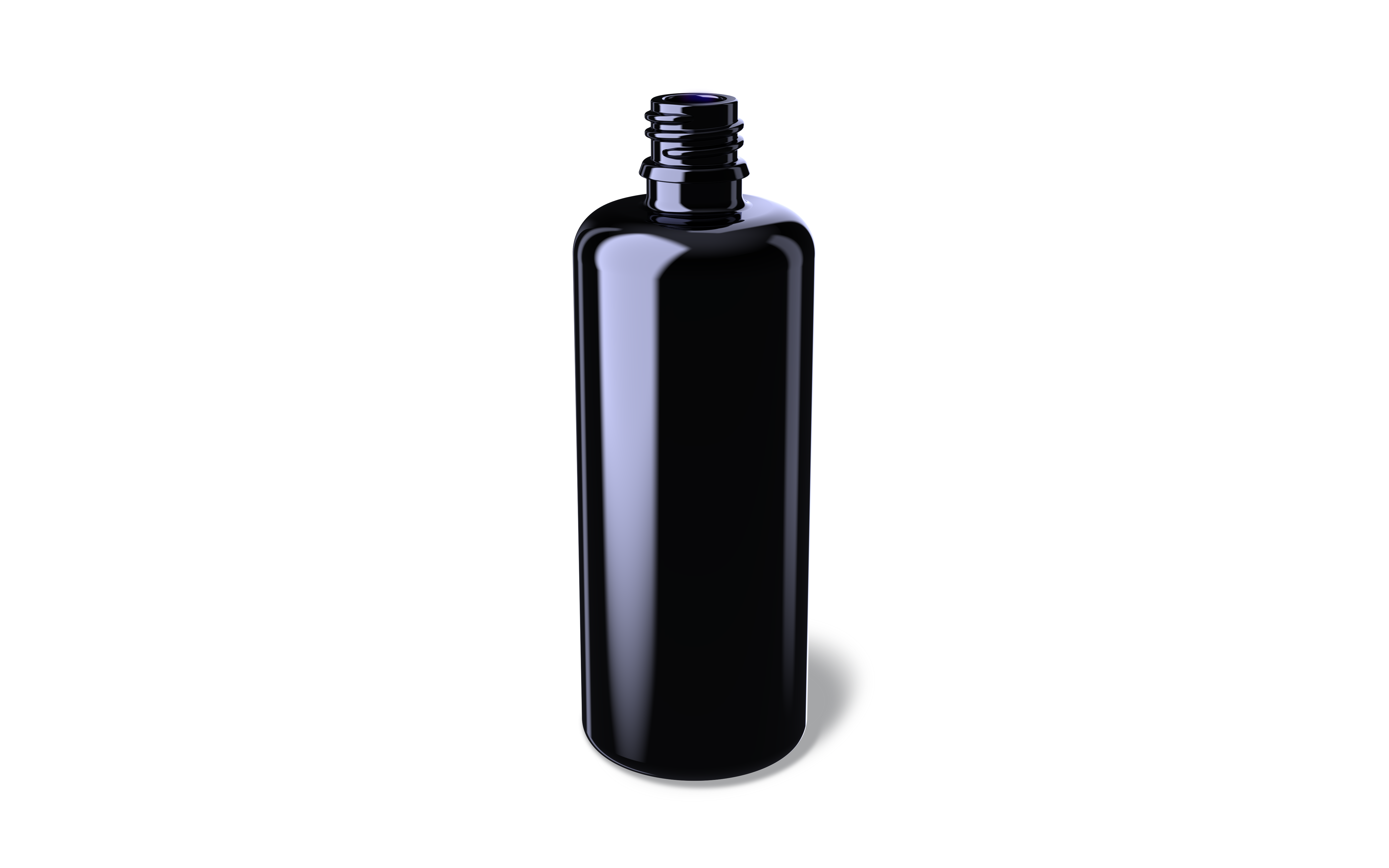
The HDV3 is a round violet glass bottle in eight sizes — 5 ml, 10 ml, 15 ml, 20 ml, 30 ml, 50 ml, 60 ml and 100 ml — coded HDV3005M to HDV3100M, from 54.5 mm to 125 mm in height and 22.5 g to 120 g in weight. The material set is violet glass and PP. Closure options are a plastic cap, a dropper, a mist sprayer or a lotion pump, and surface treatments include labels, silk-screen printing and gold stamping. It is listed for cosmetics and daily chemicals, pharmaceutical and medical, and cannabis applications.
Why a bottle rather than a jar
Essential oils are sold in small volumes and dispensed by drop or spray, so the package has to meter the product as well as protect it. A round bottle with a dropper, sprayer or pump is the handling format for that job; a 30 ml or 50 ml jar in the same violet glass would protect the contents equally but change how the user doses them. The 5–100 ml span lets one bottle family cover sample, retail and professional sizes without switching glass type.
Closure choice is the real specification
Light protection is set by the glass; seal performance is set by the closure. A dropper, a mist sprayer, a lotion pump and a plain plastic cap impose different sealing surfaces, insertion forces and compatibility questions, and the same bottle will not perform identically across all four. Essential oil constituents are also known to interact with some elastomers and plastics, so formulators normally check closure compatibility against the specific oil before finalising. Where leak-free or airtight performance matters, it should be verified for the exact bottle-and-closure pair: the evidence reviewed here did not include a published test standard for leak-free glass packaging.
Format 4: H19 5 ml vacuum click jars for food, cosmetic and medical items
The H19 vacuum click jar is a 5 ml square glass jar with a vacuum seal feature, also described as a Vacuum Click Jar, packed 250 pieces per carton and listed for food, cosmetic and medical items.
What a 5 ml vacuum format is for
Micro-volumes are their own scenario: concentrate and extract samples, single-use actives, trial and sampler packs, and small cosmetic units where the dose is measured in drops or grams. A 5 ml square jar is small enough for that role and still offers a flat panel for a label. The vacuum seal feature adds a defined closing action at the headspace, which is the mechanism of interest when oxidation or moisture pick-up is the concern. The 250-piece carton quantity also sets the handling unit for packing lines and sample distribution.
Vacuum click versus the H19 child-resistant variant
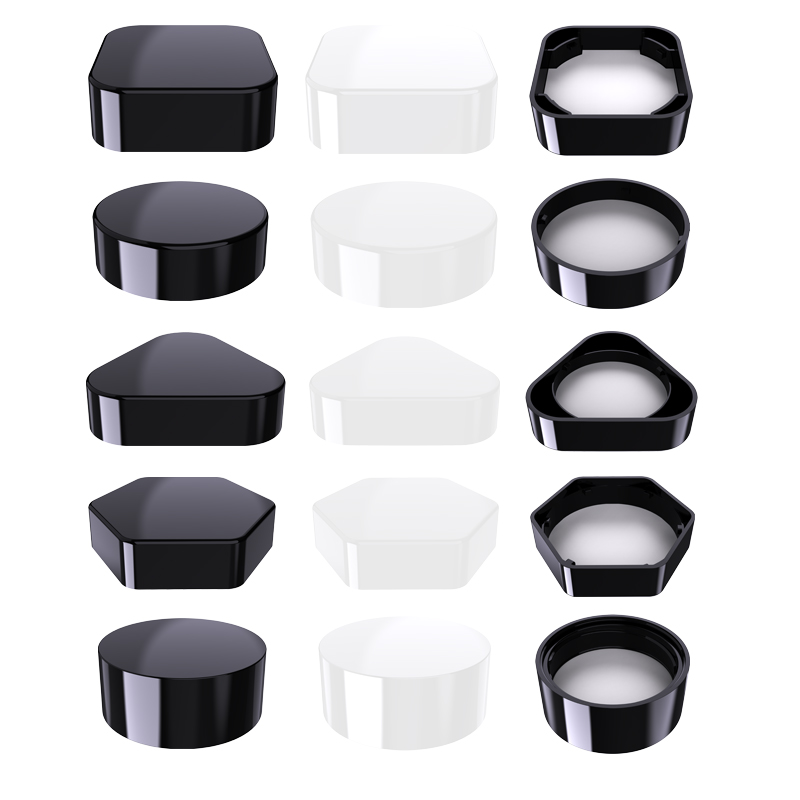
The H19 model code covers more than one closure concept, and the variants should not be treated as interchangeable. Alongside the 5 ml vacuum click jar, Honor Packaging lists H19 child-resistant concentrate jars in 5 ml and 9 ml, in square, round, triangle and hexagon shapes, weighing 27 g to 38 g. A child-resistant cap and a vacuum click closure answer different questions: if the product falls under special packaging requirements, the child-resistant variant is the one to evaluate, and the vacuum click jar should not be assumed to be child-resistant. Equally, if air exclusion is the priority, closure performance should be evidenced rather than inferred from the product name.
The four formats side by side
| Format | Size and capacity facts | Closure | Protection mechanism | Best-fit scenario | Main boundary |
|---|---|---|---|---|---|
| H21 clear square child-resistant jar (H21-0003C to H21-0008C) | Square, 58 mm dia., 24–115 mm high, 75–280 g, 0.38 mm glass; 15 ml, 30 ml, 20/30/40/60 dr | Child-resistant cap | Access control; visible contents | Pharmaceutical and medical solid dose; inspection-led packing | No light filtration |
| H21 square violet jar | Square, 58/60 mm dia., 24–115 mm high, 75–280 g, 0.38 mm glass; 15–200 ml | Child-resistant cap | Light filtration plus access control | Cannabis and supplement fills needing both protections | Transmits UV-A and infrared; no verified transmission standard in the reviewed evidence |
| H21 round violet jar | Round, 60 mm dia., 36.5–125 mm high, 84–268 g, 0.38 mm glass; 30 ml to 6 oz codes | Child-resistant cap | Light filtration plus access control | Supplements and cannabis in a round retail profile | Same light boundary; range starts at 30 ml |
| HDV3 round violet bottle (HDV3005M to HDV3100M) | Round bottle, 54.5–125 mm high, 22.5–120 g; 5 ml, 10 ml, 15 ml, 20 ml, 30 ml, 50 ml, 60 ml, 100 ml | Plastic cap, dropper, mist sprayer or lotion pump | Light filtration plus metered dispensing | Essential oils and liquid formulas in sample to professional sizes | Seal performance depends on the closure; verify leak performance for the pair |
| H19 5 ml vacuum click jar | Square, 5 ml, 250 pcs per carton | Vacuum click seal | Air-exclusion approach | Food, cosmetic and medical micro-fills and samples | Single 5 ml size; not the child-resistant H19 variant |
A five-check selection sequence
Working through these five questions in order usually resolves the format before price is discussed.
- Product state. A solid, powder or flower points to a jar; a liquid oil or serum points to a bottle with a metering closure; a sample-sized unit points to a 5 ml format.
- Light sensitivity. If the formulation tolerates light, the clear H21 gives inspection and identification benefits. If it does not, the violet H21 or the HDV3 is the relevant option, and transmission data should be part of the specification.
- Child-access obligation. Establish whether the product and market trigger special packaging rules. If they do, specify by test report — ISO 8317:2015 for reclosable packs, 16 CFR 1700.20 in the United States — and confirm the report covers the jar and closure as supplied.
- Volume and dose. Match capacity to the dose and the sales channel. The H21 square range runs 15–200 ml, the round range 30 ml to 6 oz, the HDV3 runs 5–100 ml, and the vacuum click jar is fixed at 5 ml.
- Closure and supply evidence. Confirm closure type, decoration route and the commercial frame: Honor Packaging quotes a 10,000-unit MOQ, a 30–45 day lead time and monthly capacity of 100,000 units, with 100% pre-shipment testing and third-party inspection (SGS) available. At that MOQ, format choice is an inventory commitment as much as a technical one.
What the regulatory layer adds to the decision
Regulations do not certify a jar; they define what has to be demonstrated. In the United States, special packaging requirements under PPPA and FIFRA attach to the primary or immediate packaging for certain regulated products. The 16 CFR 1700.20 protocol is built around two outcomes: at least 85% of children under five in the test panel must fail to open the package within five minutes, and the package must remain accessible to adults, with the associated adult-accessibility requirement set at 90%. ASTM D3475 classifies packaging types by closure and opening action, which is why "child-resistant" alone is an incomplete line in a specification. ISO 8317:2015 covers reclosable packages, while ISO 14375:2018 covers non-reclosable ones and adds that the package should provide mechanical protection and function properly for the life of the contents and the packaging.
For a buyer, the practical consequence is documentation scoped to the format. A test report for a 30 ml jar does not automatically cover the 200 ml version, a different closure or a different liner. Where a supplier cannot provide scoped evidence, the format can still be sourced, but the compliance claim should be narrowed to what is actually documented.
Market context and what it changes for format choice
Grand View Research values the global protective packaging market at USD 41.5 billion in 2026. The figure covers the whole protective packaging category, not glass jars specifically, so it is not a glass-market estimate; its practical use here is context for why documented format families matter when buyers compare suppliers in a large, specification-driven category.
That is the angle Honor Packaging takes: a Ningbo facility of 45,000 m² with 310 employees, exporting its output with the EU and USA listed as main markets, and positioning its range around child-resistant, violet glass and vacuum formats, with OEM and ODM work covering artwork printing, new design development and frosted finishes. For a brand owner running several SKUs, the practical value of a format family is fewer closure platforms, one decoration process and one inspection standard across the line.
Outlook: documentation will separate formats more than glass colour
The next round of differentiation in protective packaging is unlikely to come from a new glass colour. It is more likely to come from three things: transmission data that lets a buyer compare violet glass on measured terms; closure test reports scoped to the exact jar-and-cap combination; and seal performance evidence for dropper, sprayer, pump and vacuum formats. Buyers evaluating H21, HDV3 or H19 formats can reasonably ask for all three before committing a line, and suppliers holding programme continuity — one jar family from 5 ml to 200 ml with stable decoration and inspection processes — will be simpler to qualify than those supplying a single size.
Frequently asked questions
- Which protective packaging format suits a light-sensitive oil sold in 30 ml?
- For a liquid oil, the HDV3 round violet glass bottle is the direct fit: it is made in 30 ml (HDV3030M) within a 5–100 ml range, uses violet glass, and can be closed with a plastic cap, dropper, mist sprayer or lotion pump. If the product has to be presented as a jar rather than a bottle, the round H21 violet jar starts at 30 ml with a child-resistant cap. In both cases the glass filters visible light but transmits UV-A and infrared, so measured transmission data and a closure test report should be requested for the exact item.
- Does a child-resistant cap make a jar compliant child-resistant packaging?
- Not on its own. "Child-resistant" describes the closure type, while compliance is a test outcome for the package as supplied. Reclosable packages are tested under ISO 8317:2015, and in the United States the 16 CFR 1700.20 protocol requires that at least 85% of children under five fail to open the package within five minutes while adult accessibility is maintained. Because the result depends on the jar, closure and liner together, a report covering one capacity or one closure does not automatically cover another configuration in the same series.
- Can one jar family serve pharmaceutical and cannabis lines?
- The H21 violet jar is listed for pharmaceutical and medical, cannabis and supplement applications, and its square and round variants share the same light filtration and child-resistant closure logic. What does not transfer automatically is the documentation: regulatory obligations, labelling rules and test evidence differ by market and product category, and a pharmaceutical programme may also need clearer visual inspection of contents than violet glass allows. Brands commonly keep the same format family and separate the compliance files.
- What should be confirmed before specifying a 5 ml vacuum click jar?
- Confirm four things: that 5 ml is the right dose unit, since the vacuum click jar is specified in that single capacity; that the vacuum seal feature is the mechanism you need rather than child resistance, because the H19 family also includes 5 ml and 9 ml child-resistant concentrate jars in square, round, triangle and hexagon shapes; that seal performance has been evidenced for the actual closure; and that the 250-pieces-per-carton pack quantity fits your packing line. The reviewed evidence did not include a published leak-free test standard for this format, so seal claims should be verified rather than assumed.
Bringing the decision together
Format selection in protective packaging is a sequence, not a preference: establish the product state, the light sensitivity and the access obligation first, then match capacity and closure. The four formats discussed here each sit at a different point in that sequence, and the specification facts — 15–200 ml for the H21 square violet jar, 30 ml to 6 oz for the round version, 5–100 ml for the HDV3 bottle and a fixed 5 ml for the H19 vacuum click jar — make the trade-offs visible before sampling begins. Honor Packaging's product brochure (PDF) lists the full specification set for the range.
Have Questions or Need More Details?
Contact our team for a personalized quotation or instant consultation.
Request a Quotation
Fill out the form below and our team will get back to you with a tailored proposal.
WhatsApp Direct Chat
Prefer to chat in real-time? Message us on WhatsApp for instant assistance & quick answers.
- Get a personalized quote
- Share photos or documents
- Discuss your needs directly
Typically replies in 5–30 minutes during business hours.