
Proving the Capability: Salt Spray Data Behind Stainless Hydraulic Adapters
Proving the Capability: Salt Spray Data Behind Stainless Hydraulic Adapters
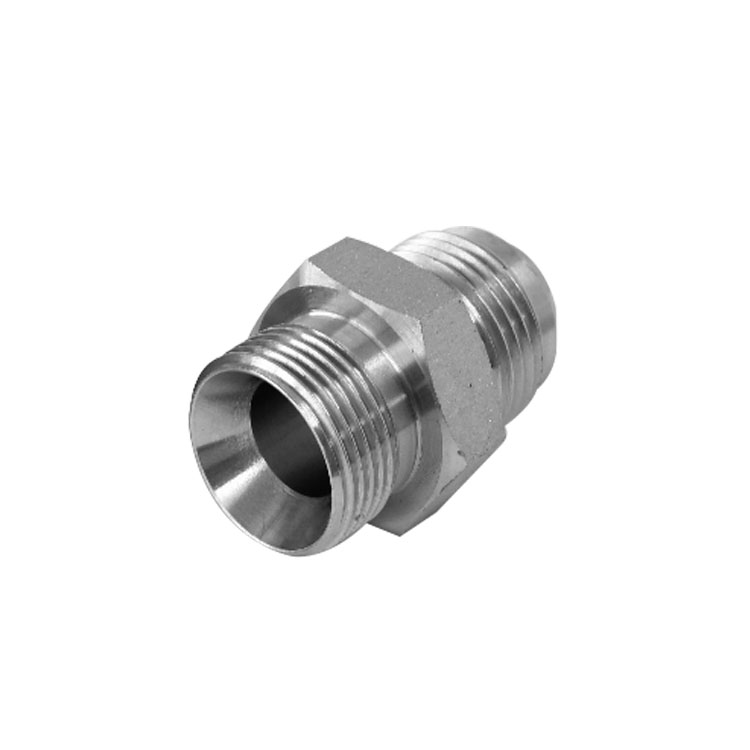
Corrosion resistance is the easiest claim to make about a hydraulic adapter and the hardest one for a buyer to check. A supplier can describe a fitting as corrosion-resistant without stating a method, a duration, or an appearance criterion — and the sentence reads exactly the same as one backed by a full test record. NingBo NJ Hydraulic Adapter Co., Ltd, a hydraulic adapter and fitting manufacturer based in Fenghua, Ningbo, China, documents a 120-hour salt spray result across its BSP, NPT, JIC and SAE standard adapter families: white rust appears at 120 hours and red rust at 240 hours. That single line is more informative than a page of adjectives, because it contains a method, a duration, an observed condition, and a second reference point. It also contains a boundary — the record states when visible corrosion appears, not that none occurs.
This industry reference explains what the documented result does and does not cover, how carbon steel, SS304 and SS316 change the meaning of the same figure, and what an industrial buyer should verify before a corrosion claim enters a supplier qualification file.
Why Corrosion Claims Resist Verification
Corrosion performance is only comparable when the method, duration, material, finish and evaluation criteria are identical. Two suppliers can both state “120-hour salt spray” and mean entirely different things: one may have exposed a plated carbon steel fitting, another an unplated stainless steel body, and a third a fully assembled adapter with a plated lock nut. Without those details, the number functions as a marketing asset rather than a specification.
The commercial context explains why the claim carries so much weight. The global hydraulic fittings market, which includes adapters and couplings, was valued at USD 4.8 billion in 2025 and is projected to reach USD 7.9 billion by 2034, according to Dataintelo. Within that market, the hydraulic adapters segment held the largest product type share at 28.4% in 2025, and steel materials accounted for 45.2% of revenue share the same year, again per Dataintelo. The largest product category in the market is therefore also the one where material selection drives most of the commercial difference — and where unverified material claims are most likely to enter a shortlist.
For buyers in the awareness and research stage, the useful question is not whether a supplier offers stainless steel, since most do, but which material, which finish and which test result applies to the specific part being ordered. A product description alone cannot answer that.
What the Documented 120-Hour Salt Spray Result Actually States
| Parameter | Documented value | Scope in the product data |
|---|---|---|
| Salt spray exposure | 120-hour salt spray test | BSPP, BSPT, NPT, JIC and SAE standard adapter families |
| Observed at 120 hours | White rust | Same families |
| Observed at 240 hours | Red rust | Same families |
| Maximum stable operating temperature | 220 °C | Same families |
| Pressure range | 3,000–6,000 PSI | Same families |
| Material options | Carbon steel, SS304, SS316 | Same families |
Read literally, the record contains two observations rather than a single threshold. White rust is generally understood as the corrosion product that forms on zinc-based plated surfaces, while red rust indicates corrosion of the underlying steel. The interval between 120 hours and 240 hours therefore describes a sequence: coating breakdown first, base metal attack later. Buyers who understand that sequence can treat the two figures as a comparative indicator of how much protection a finish provides. A supplier reporting white rust later than 120 hours is describing a more durable coating system, assuming the exposure conditions are identical.
It is equally important to state what the record is not. A 120-hour exposure is not a service-life prediction, and “white rust at 120 hours” is not the same statement as “no corrosion for 120 hours.” The tested duration and the observed condition are the two facts; the interpretation belongs to the application. Buyers should also confirm which finish was tested, because a plated carbon steel part and a bare SS316 part fail by different mechanisms and cannot be compared on one number.
Material Choice Changes What the Number Means
Across the BSP, NPT, JIC and SAE standard adapter families, the available materials are carbon steel, SS304 and SS316. These three options are not three grades of the same protection; they represent two different corrosion strategies.
Carbon steel depends on an applied coating. The substrate itself has no inherent corrosion resistance, so protection lasts only as long as the plating barrier stays intact. In that case, salt spray testing measures coating durability rather than material behaviour.
SS304 and SS316 are austenitic stainless steels whose corrosion resistance comes from a passive chromium-oxide surface layer that re-forms when the surface is exposed. SS316 contains molybdenum and is commonly specified where chloride exposure is expected, such as marine machinery or coastal installations. SS304 is frequently selected for general-purpose machinery, transportation and water conservancy work where chloride levels are moderate.
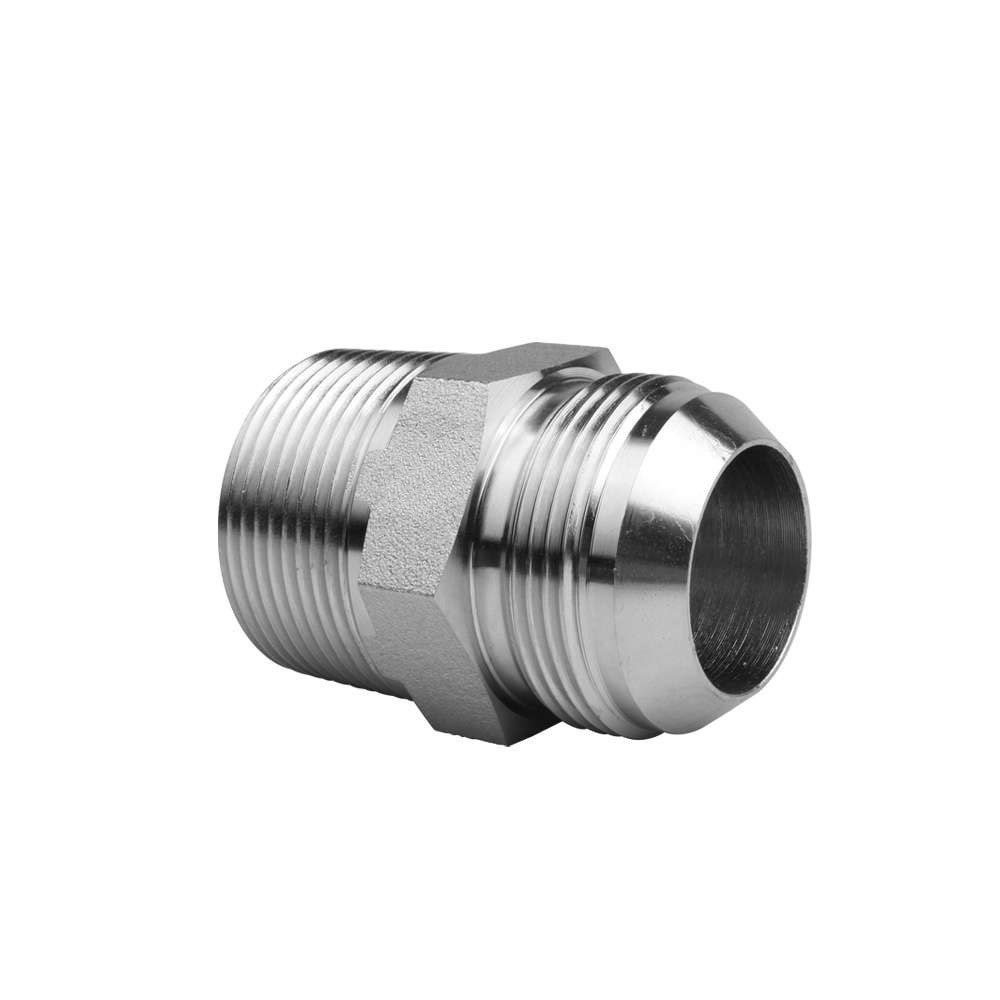
One detail that frequently causes disputes is the relationship between material standard temperature ranges and product ratings. Stainless steel hydraulic adapters in AISI 316 are described by standards-focused suppliers as supporting working temperatures from −60 °C to +400 °C under DIN 17440. The documented maximum stable operating temperature for these adapter families is 220 °C. Where a material standard range and a product rating differ, the tighter, application-specific figure governs. Citing the DIN 17440 range as the operating limit of a specific adapter would extend a claim the product data does not support.
Where These Adapters Are Used, and Why the Environment Sets the Specification
The adapter families documented here are intended for construction machinery, agricultural machinery, general-purpose machinery, firefighting equipment, marine machinery, mining, transportation, aerospace, automotive, oil and gas extraction, iron and steel metallurgy and water conservancy engineering. The matched equipment set is equally broad: hydraulic hoses, hydraulic cylinders, threaded bolts, pipe joints, hydraulic pumps and mechanical cylinder assemblies.
The documented working condition for these applications is high temperature and high pressure, with requirements described as rust-resistant, high-temperature resistant and high-pressure resistant. The application record states that the parts are capable of withstanding a static pressure of 6,000 PSI and a burst pressure of 9,000 PSI without deformation while maintaining continuous operation and seal integrity.
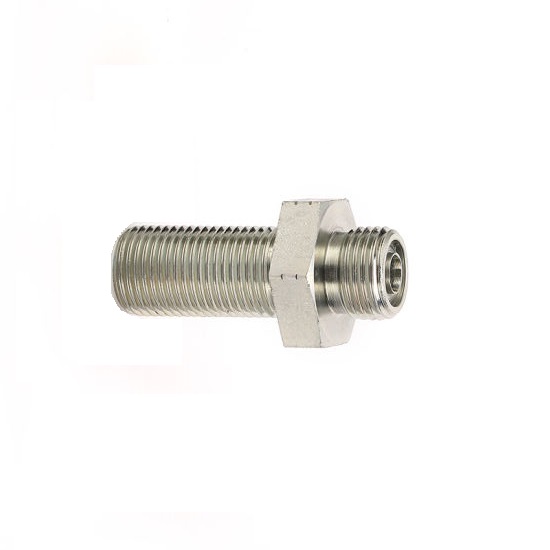
Pressure, temperature and corrosion resistance have to be satisfied simultaneously, which is why material selection is never a standalone decision. A fitting specified for marine machinery may need SS316 because chloride exposure is continuous, while a fitting on an indoor hydraulic press manifold may remain plated carbon steel because the environment is dry and the priorities are wear resistance and cost. The same 120-hour salt spray result is relevant to both, but for different reasons.
How the Capability Is Documented and Delivered
Capability claims become procurement evidence when they can be tied to a manufacturer with a defined production base and a product range that covers the buyer’s configuration. NingBo NJ Hydraulic Adapter Co., Ltd was established in 2004 and has operated for more than 20 years in the hydraulic components industry. Its manufacturing facility covers 20,000 square meters, employs approximately 200 staff and includes an R&D team of four engineers. Annual output is documented at 4,000,000 units, with 75% of production exported and the United States and Canada listed as the main markets. The company specialises in producing SAE standard hydraulic components and engineering machinery parts, and its main products include hydraulic adapters, hydraulic fittings, flanges, valves and non-standard components.
| Product family | Thread / connection system | Representative model designations | Documented pressure, temperature and salt spray |
|---|---|---|---|
| BSP Adapter (BSPP Thread Fitting) | BSPP | 1B, 1B4, 1B9, 1BG, 1BG4, 1BG9, 1BH, 1BH9, 1BJ, 1BK, 1BM, 1BN, 1BO, 1BT, 1BT9, 2B, 2B9, 2BJ, 2GB, 2HB, 22NB, 2TB9, 2OB, 2TB, 3B, 4B, 4BN, 5B, 5BN, 5NB, 5BT, 5GB, 5OB, 5TB9, 6B, 7B, 7B9, 9B, EB, AB, BB | 3,000–6,000 PSI; maximum stable operating temperature 220 °C; 120-hour salt spray test (white rust at 120 h, red rust at 240 h) |
| BSP Adapter (BSPt Thread Fitting) | BSPT | 1T, 1T9, 1BT, 1ST, 4T, 5T | Same family-level record |
| NPT Adapter | NPT / NPTF | 5000, 5404, 5405, 5406, 5406-C, 5406-HP, 5406-P, 5406-SHP, 5500–5505, 5600–5605, 5650, 5652 | Same family-level record |
| Hydraulic JIC Adapter | JIC and JIC to NPT | 2403, 2404, 2405, 2406, 2408, 2500–2505, 2601–2609 | Same family-level record |
| SAE Standard Hydraulic Adapter | JIC / ORB / ORFS | 6801, 6802, 6803, 6804, 6805, 6806, 6807, 6808, 6809, 6810, 6815, 6818, 6820, 6832, 6835, 6840, 6850 | Same family-level record |
| Hydraulic Cap Nut & Lock Nut | Cap nut, lock nut, tube nut and sleeve | 0304C, 0306, 0318, 0319, 0403, 0500, FS0304C, FS0306, FS0318, FS0319 | Same family-level record; carbon steel primary, SS304 and SS316 available |
Configurations inside these families include male BSPP x male BSPP straight, male BSPP x female NPTF straight, male BSPP x male JIC straight, male BSPP x male BSPT straight, male BSPP plugs, male BSPT x male BSPT straight and 90° elbows, male JIC x male JIC straight, male JIC x female NPTF pipe, JIC bulkhead variants, male NPTF x male NPTF straight, NPTF pipe caps and plugs, adjustable ORB elbows, and ORFS face seal connectors. Additional product information is published at the company’s website, https://www.njadapter.com.
Two structural points follow from this. First, the corrosion parameters are documented uniformly across thread systems, so a buyer does not need a different corrosion expectation for BSP versus NPT versus JIC. Second, the pressure and temperature figures are likewise family-level, which shifts the buyer’s verification task from whether the supplier has data to whether the data matches the assigned part, material and finish.
Market Signals: Material Preference and Regional Demand
Several published figures frame where corrosion-focused specification is heading. The hydraulic fittings market including adapters and couplings was valued at USD 4.8 billion in 2025, with a projected USD 7.9 billion by 2034 (Dataintelo). A separate market summary estimates a 4.5% CAGR for hydraulic fittings and adapters between 2025 and 2033, reaching USD 5.8 billion; that source is a secondary summary and is cited here as a directional indicator rather than a primary estimate.
Regionally, Asia-Pacific led global hydraulic fitting revenues in 2025 with an estimated 38.6% share (Dataintelo). On the demand side, Asia accounted for 74% of global industrial robot installations in 2024 (Ken Research), and the mobile hydraulics segment held over 58% of total hydraulics market revenue share in 2024 (Grand View Research). Mobile and automated equipment are precisely the applications where adapters face weather, wash-down and temperature cycling.
Published market estimates should still be read with care. Fittings and adapter forecasts vary by scope: figures described as covering fittings and couplings sit in a different range from broader hydraulics equipment forecasts, and narrower sub-segment estimates such as USD 1.82 billion by 2032 for hydraulic fluid connectors at an 8.0% CAGR use a different definition again. Buyers using market data to size a category should confirm what each figure includes.
Plated Carbon Steel vs Stainless: The Trade-Off and Its Boundaries
| Consideration | Plated carbon steel | SS304 | SS316 |
|---|---|---|---|
| Corrosion strategy | Applied coating barrier | Passive chromium-oxide layer | Passive layer plus molybdenum |
| Typical environment fit | Dry, sheltered, general machinery | General purpose, transportation, water conservancy | Marine machinery, chloride exposure |
| Effect of a surface scratch | Coating breached; base metal exposed | Passive layer re-forms under normal conditions | Passive layer re-forms under normal conditions |
| Assembly behaviour | Standard practice | Stainless threads are commonly noted for higher galling tendency during assembly | Same as SS304 |
| Documented corrosion data | 120-hour salt spray; white rust at 120 h, red rust at 240 h | Same family-level record | Same family-level record |
| Main limitation | Protection is finite; the record itself shows white rust at 120 h | Not automatically correct for every wet environment; higher material cost | Higher material cost; selection should be driven by chloride exposure |
Three boundaries deserve to be stated plainly, because they are where corrosion claims most often become misleading.
- Salt spray is a screening test, not a service-life model. It does not reproduce the cyclic wetting and drying, chloride concentration, temperature variation or mechanical abrasion of a real installation. A longer or shorter salt spray duration is a comparative signal, not a warranty of years in service.
- Stainless is not automatically the right answer. Selection should follow the environment. SS304 and SS316 also carry higher material cost than plated carbon steel, and stainless threads are commonly noted for a higher tendency to gall during assembly, which places more weight on assembly practice and lubrication discipline.
- Corrosion data and pressure data answer different questions. Within the same catalogue, joint design changes the pressure ceiling. Published third-party ratings illustrate the spread: NPTF straight threads in 1/4" size are typically rated around 4,000 PSI with a 4:1 safety factor (Titan Fittings), while ORFS fittings in dash size −4 (1/4") are rated for 6,000 PSI working pressure under SAE J1453 (Titan Fittings). Neither figure says anything about corrosion performance, and the documented salt spray result says nothing about pressure capability. Both have to be verified separately.
Standards add further precision. ISO 8434-2:2007 specifies the design and performance requirements for 37° flared connectors suitable for tubes from 6 mm to 50.8 mm, which is the dimensional foundation most buyers associate with JIC-style connections. DIN 2353 specifies three robustness categories for metric tube fittings: LL (Extra Light, 100 bar), L (Light, up to 315–500 bar) and S (Heavy, up to 630–800 bar). For a metric thread adapter, asking which standard and category the product is manufactured to is more useful than asking whether it is high pressure.
A Verification Checklist for Testing Claims
The checklist below is intended for buyers qualifying a hydraulic adapter manufacturer, particularly when a corrosion claim is part of the evaluation.
| What to verify | Why it matters | What to request |
|---|---|---|
| 1. Test method and duration | A duration without a defined method is not comparable between suppliers | The corrosion test standard referenced, the exposure duration, and the test date |
| 2. Material and finish of the tested sample | Coating performance and stainless performance are different mechanisms | Written confirmation of substrate and finish for the tested part |
| 3. Appearance criteria at each interval | “Pass” can mean different things to different suppliers | The documented observations at each milestone, for example white rust at 120 hours and red rust at 240 hours |
| 4. Product family and model coverage | Family-level data may not cover every configuration | Which thread systems and model ranges the report applies to |
| 5. Thread and dimensional conformity | Corrosion data does not confirm thread accuracy | Conformity declarations against the relevant standard, such as ISO 8434-2 for 37° flared connectors or SAE J1453 for ORFS |
| 6. Pressure rating basis | Pressure and corrosion are separate claims | The working pressure figure, the joint design it applies to, and the safety factor basis |
| 7. Temperature rating basis | Material standard ranges and product ratings may differ | The product-level maximum stable operating temperature (220 °C is documented for these families) |
| 8. Batch traceability and re-test interval | A single historical test does not cover all future production | How the test record relates to production lots and how often testing is repeated |
| 9. Material certificates | Grade claims require independent verification | Mill or material certificates for SS304 and SS316 lots |
| 10. Application mapping | The environment, not the grade label, decides suitability | A written statement of which material is recommended for the intended environment |
A supplier that can answer all ten items is providing verifiable capability. A supplier that can answer only the first is providing a claim. For most buyers the practical outcome is not a single number but a consistent basis for comparing two suppliers on the same terms.
Future Outlook
Two shifts are likely to shape how corrosion claims are evaluated over the next few years. The first is documentation granularity. As mobile hydraulics and automated equipment continue to grow — mobile hydraulics already held over 58% of hydraulics market revenue share in 2024, per Grand View Research — buyers increasingly specify corrosion and pressure evidence at part number level rather than catalogue level. Suppliers able to produce material- and finish-specific records will encounter fewer qualification delays.
The second is material mix. With steel materials accounting for 45.2% of hydraulic fitting revenue share in 2025 (Dataintelo) and stainless grades offered across BSP, NPT, JIC and SAE adapter ranges, the decision is shifting from carbon steel or stainless towards which stainless grade, in which environment, supported by which documented evidence. That is a more demanding question for suppliers and a more useful one for buyers.
Frequently Asked Questions
What does a 120-hour salt spray result actually tell a buyer?
It states that a defined specimen, material and finish were exposed to a salt spray environment for 120 hours, and that the documented observation at that point was white rust, with red rust recorded at 240 hours. It is a method-bound comparison point between coatings and materials tested under the same conditions. It does not predict service life in a specific installation.
Does the 120-hour salt spray result apply equally to carbon steel, SS304 and SS316 versions?
The documented result is stated for the adapter families, which are offered in carbon steel, SS304 and SS316. Because the corrosion mechanism differs — plated carbon steel depends on a coating barrier, while stainless grades depend on a passive oxide layer — the practical step is to confirm which material and finish the specific test report covers. The same figure should not be assumed to transfer automatically across all three.
How should a buyer choose between SS304 and SS316?
Both are austenitic stainless steels available across the BSP, NPT, JIC and SAE standard adapter ranges. SS304 is generally sufficient for general-purpose machinery, transportation and water conservancy applications where chloride levels are moderate. SS316 contains molybdenum and is commonly specified where chloride exposure is expected, such as marine machinery. Selection should follow the operating environment, cleaning agents and the media handled rather than the price list alone.
What pressure and temperature figures are documented for these hydraulic adapters?
The documented pressure range is 3,000–6,000 PSI and the maximum stable operating temperature is 220 °C across the BSPP, BSPT, NPT, JIC and SAE standard families. Third-party standards give joint-specific figures instead: NPTF straight threads in 1/4" size are typically rated around 4,000 PSI with a 4:1 safety factor, and ORFS fittings in dash size −4 are rated 6,000 PSI working pressure under SAE J1453 (Titan Fittings). DIN 17440 describes AISI 316 as suitable from −60 °C to +400 °C. Where ranges differ, the tighter application-specific figure should be used.
Which standards should be referenced when verifying hydraulic adapter specifications?
ISO 8434-2:2007 covers the design and performance requirements for 37° flared connectors for tubes from 6 mm to 50.8 mm. SAE J1453 is referenced for ORFS face seal fittings. DIN 2353 defines three robustness categories for metric tube fittings: LL (Extra Light, 100 bar), L (Light, up to 315–500 bar) and S (Heavy, up to 630–800 bar). These are dimensional and performance standards for connections, and they are separate from corrosion testing.
What is the documented process if accessories are missing or wrongly delivered after receipt?
Under the company’s after-sales procedure, customers provide photos of the missing or incorrectly delivered items. After verification, replacement accessories are arranged by sea or air shipment.
Reference material: the company profile for NingBo NJ Hydraulic Adapter Co., Ltd is available as a downloadable PDF at Ningji Yuli company profile (PDF), and product information is published at njadapter.com.