
Pulp Molding Machine Compliance: Certification & Qualification Guide for New Factories
Pulp Molding Machine Compliance: Certification & Qualification Guide for New Factories
Certification and qualification answer two different questions in a pulp molding project. A certification document states what a specific machine model has been assessed against, under which standard, by which body, and for how long. Qualification is wider: it asks whether the supplier can carry a factory from raw material to packed product with responsibility clearly assigned at every interface. For a new molded fiber plant, the second question usually decides how much the first one is worth.
Buyers entering molded fiber production — tableware, industrial packaging, cup lids — often start the compliance conversation with the CE marking on the forming machine and finish it there. The machine, however, sits inside a chain: pulp preparation and refining, slurry feeding, forming, in-mold drying and hot pressing, trimming or hole punching, vision inspection, rejection, stacking, counting, packing, and the utilities that keep all of it running. Every link has an owner. A new factory has to know who that owner is before it signs.
What CE documentation for a pulp molding machine actually covers
Hanson Pulp Molding (Guangdong Hanson Pulp Molding Technology Co., Ltd., based in Houjie Town, Dongguan City, Guangdong Province, China) holds two Machinery Directive Attestations of Conformity for the European Union / European Economic Area market, issued by UDEM Uluslararısı Belgelendirme Denetim Eğitim Merkezi San. ve Tic. A.Ş. Both cite Directive 2006/42/EC, Annex VIII, together with EN ISO 12100:2010 and EN 60204-1:2018/A1:2025. They are model-scoped documents covering equipment, not a blanket statement about a factory.
| Attestation | Certificate number | Models named in scope | Standards cited | Validity |
|---|---|---|---|---|
| Machinery Directive Attestation of Conformity for Pulp Molding Equipment (industrial packaging) | M.2026.206.C142039 | ZAP-9585, ZDA-9585, ZAD-8565, ZAC-8565, ZDA-1070, ZDK-1010, ZAB-9585, ZAB-1070 | 2006/42/EC Annex VIII; EN ISO 12100:2010; EN 60204-1:2018/A1:2025 | Issued 2026-06-05, expires 2031-06-04 |
| Machinery Directive Attestation of Conformity for ZFG Series Pulp Molding Equipment | M.2025.206.C130486 | ZFG-1111, ZFD-8565, ZFM-9894, ZFH-1311 | 2006/42/EC Annex VIII; EN ISO 12100:2010; EN 60204-1:2018/A1:2025 | Issued 2025-12-01, expires 2030-11-30 |
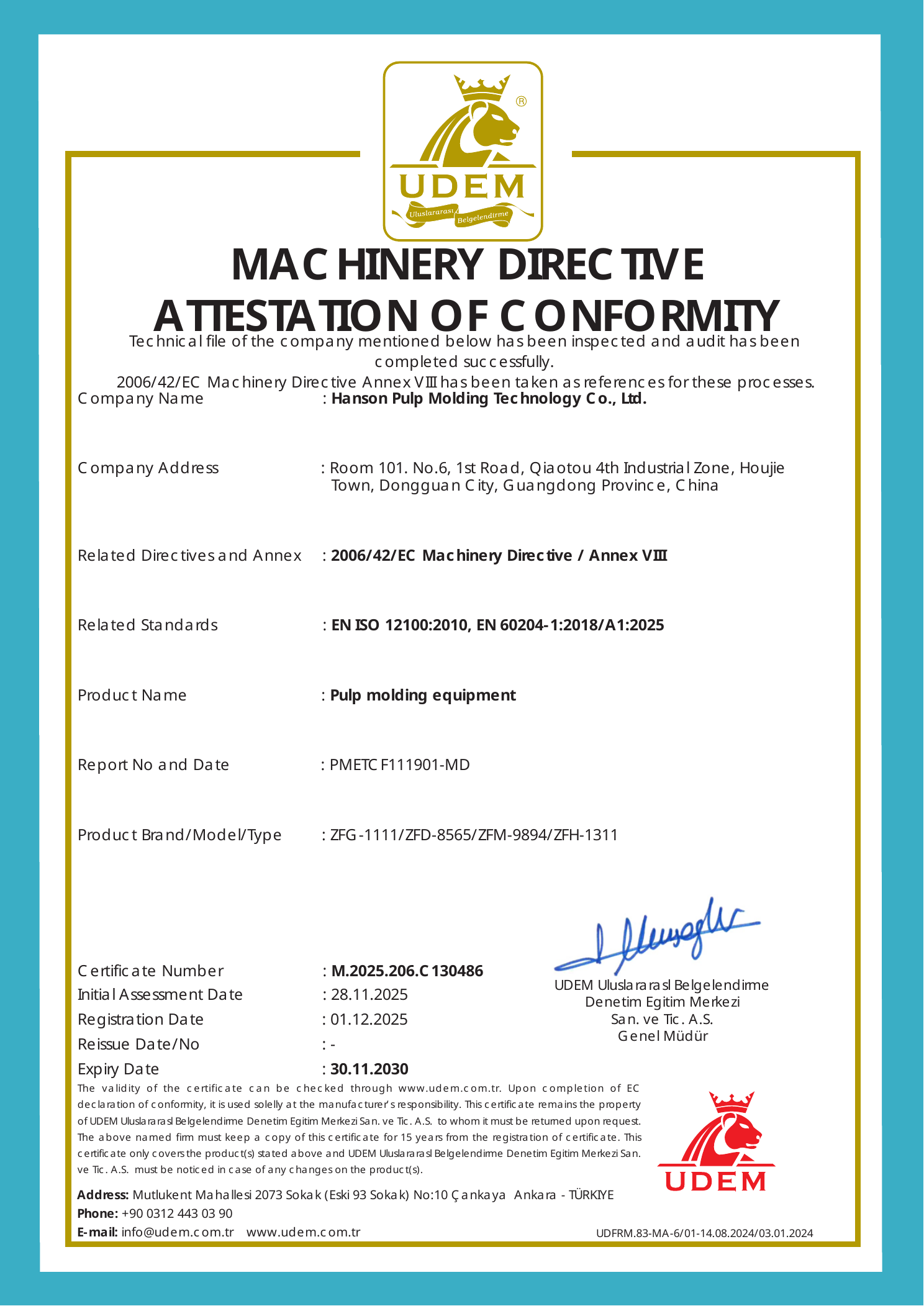
Machinery Directive Attestation of Conformity covering ZFG-series pulp molding equipment, issued under 2006/42/EC Annex VIII.
Three details are worth reading slowly in a document of this kind. The first is the scope. Each attestation names the models it covers. If the model a buyer is ordering does not appear in that list, the document does not describe that machine — and the buyer should ask what covers it instead. The second is the standard set. EN ISO 12100:2010 addresses risk assessment and risk reduction principles; EN 60204-1 addresses electrical equipment of machines. Together they describe how the machine was assessed, not how well it will run in a particular factory. The third is the validity window, because certificates expire and a project timeline can outlast one.
The safety-control standard is still moving
Machine-level control safety is a separate and currently moving variable. Safety-related parts of machinery control systems are addressed by EN ISO 13849-1; the 2023 edition applies, and the previous 2015 edition is withdrawn following a transition period that ends on 15 May 2027. For a factory being planned now, this is a purchasing variable rather than background reading: a line commissioned with a control architecture tied to the older edition can face retrofit work inside its first years of operation, especially where product is exported into the EU/EEA.
Why a machine certificate is not the whole qualification
Compliance at the machine level does not answer the question that creates most of the difficulty in a new plant: who owns the interfaces? A pulp molding line that ends in a packed carton normally involves pulp preparation and refining, slurry preparation and feeding, vacuum supply, compressed air, cooling water, high-pressure mold washing water at 1.2 MPa, forming, hot pressing, trimming or hole punching, vision inspection, automatic rejection, stacking, counting and packing, plus water treatment and an electrical control layer. Every one of those can be purchased separately from a different vendor.
The interface risk is well documented in Hanson’s project experience. When equipment, molds, the pulp preparation system and downstream automation are supplied by several unrelated companies, technical interfaces and responsibility boundaries can become unclear. If output or quality problems appear, the buyer may have to coordinate multiple suppliers before determining whether the cause lies in the machine, the mold, the raw material, the pulp preparation system or the production process. The cost of that ambiguity is not only downtime; it is the loss of a single accountable party at the moment a factory is trying to reach stable mass production.
Raw material makes the same point. Bamboo pulp, bagasse pulp, wood pulp, straw pulp, recycled paper pulp and mixed plant-fiber pulps differ in fiber length, drainage, cleanliness and strength. Those differences change refining requirements, slurry concentration, additive formulation, dewatering time, hot-pressing temperature and surface quality. The ability of a machine to accept a slurry is not evidence that the material is ready for stable mass production, and this is precisely the kind of boundary that a model-specific certificate cannot cover.
What a turnkey scope adds to a certificate
Hanson positions turnkey factory solutions as the unit of delivery for new plants rather than individual machines. Depending on project scope, that can include preliminary product and raw-material verification, project feasibility analysis, production-capacity planning, factory layout design, intelligent pulp preparation systems, forming equipment, mold design and manufacturing, downstream automation, electrical control systems, installation and commissioning, personnel training, and production ramp-up support. For turnkey projects, the company can also arrange resident engineers and provide on-site production support of up to six months.
The structural point is that the pulp preparation, equipment, mold and automation teams work toward the same mass-production goals rather than optimising separate scopes. Hanson designs, manufactures and integrates pulp preparation systems for pulp molding projects, and can also connect forming equipment to a customer’s existing pulp preparation system after technical evaluation. An independent mold division covers product evaluation, mold design, machining, assembly, testing and mass-production adaptation, and can also optimise existing molds or retrofit existing machines — a route worth knowing about when a factory is upgrading in stages rather than building from zero.
After-sales structure matters to the same evaluation. Hanson reports 10 service locations across key domestic and overseas markets, covering installation and commissioning, equipment maintenance, technical support, spare parts and on-site project services, with remote technical support, preventive maintenance and 24/7 service response. For overseas projects this is the part of compliance that no certificate describes: whether a qualified person can reach the line when it stops.
Turnkey versus separate procurement: where responsibility sits
| Evaluation dimension | Turnkey single-source delivery | Separate procurement from multiple vendors |
|---|---|---|
| Machine-level documentation | Model-specific CE attestations issued for named equipment models | Each vendor supplies documentation for its own scope; the buyer consolidates it |
| Interface design | Pulping, slurry feeding, forming, molds, downstream automation and control planned as one system | Interface responsibility is defined by the buyer across several contracts |
| Problem attribution | One engineering team can analyse machine, mold, material and process together | The buyer may coordinate several suppliers before the cause is identified |
| Commissioning and ramp-up | One party installs, commissions, trains operators and supports production ramp-up | Commissioning is typically split by scope; ramp-up ownership must be written into contracts |
| Best fit | New factories, overseas projects, first-time entrants without an experienced pulp molding engineering team | Experienced manufacturers with mature pulp preparation, utility and production-management systems, or staged capacity expansion |
The boundary here is real and should not be softened. Turnkey delivery does not suit every buyer. Hanson’s own guidance is that individual machine procurement is more appropriate for manufacturers that already operate mature pulp preparation systems, stable utilities and established production processes — for example capacity expansion or replacement of an existing machine. Buying separate scopes is not a compliance failure; it is a decision to hold the integration role internally, and it requires an experienced engineering and process team to do so.
Other limits apply equally. A successful sample proves basic forming feasibility under one combination of material, mold and process parameters; it does not prove mass-production readiness, because the production machine may differ in platen size, mold layout, slurry-feeding method, cycle time, temperature distribution and transfer system. Supply-chain responsibility is also national: for food-contact applications, confirming the compliance requirements for raw materials, additives and the final product against the destination market remains the buyer’s task, not the equipment supplier’s. And no supplier can certify the commercial outcome of a factory.
A qualification checklist for evaluation-stage buyers
| Evidence | What it indicates | What it does not settle |
|---|---|---|
| Machinery Directive Attestation of Conformity, model-scoped, with certificate number, authority, standards and validity dates | The listed model was assessed against 2006/42/EC Annex VIII and the cited EN standards | Models outside the scope, and plant systems such as pulp preparation, water treatment and utilities |
| Control-system safety standard alignment (EN ISO 13849-1, current edition) | The safety architecture follows the standard edition in force | Whether the buyer’s own operating procedures and training are adequate |
| Manufacturing and assembly footprint, in-house mold division, engineering and process teams | The supplier performs design, manufacturing, assembly and testing rather than reselling | How the line will perform on the buyer’s material and at the buyer’s cycle |
| Sampling and mass-production trial records: slurry concentration, pressure, temperature, cycle | Product feasibility and recorded process parameters | Multi-cavity production stability without a production-mold trial |
| Written scope of supply and responsibility boundaries | Who owns molds, pulp preparation, utilities, automation and interface coordination | Whether those boundaries will be respected unless installation and commissioning terms are explicit |
| Commissioning, training, ramp-up and spare-parts commitments | Who is accountable after shipment | Production economics and market demand |
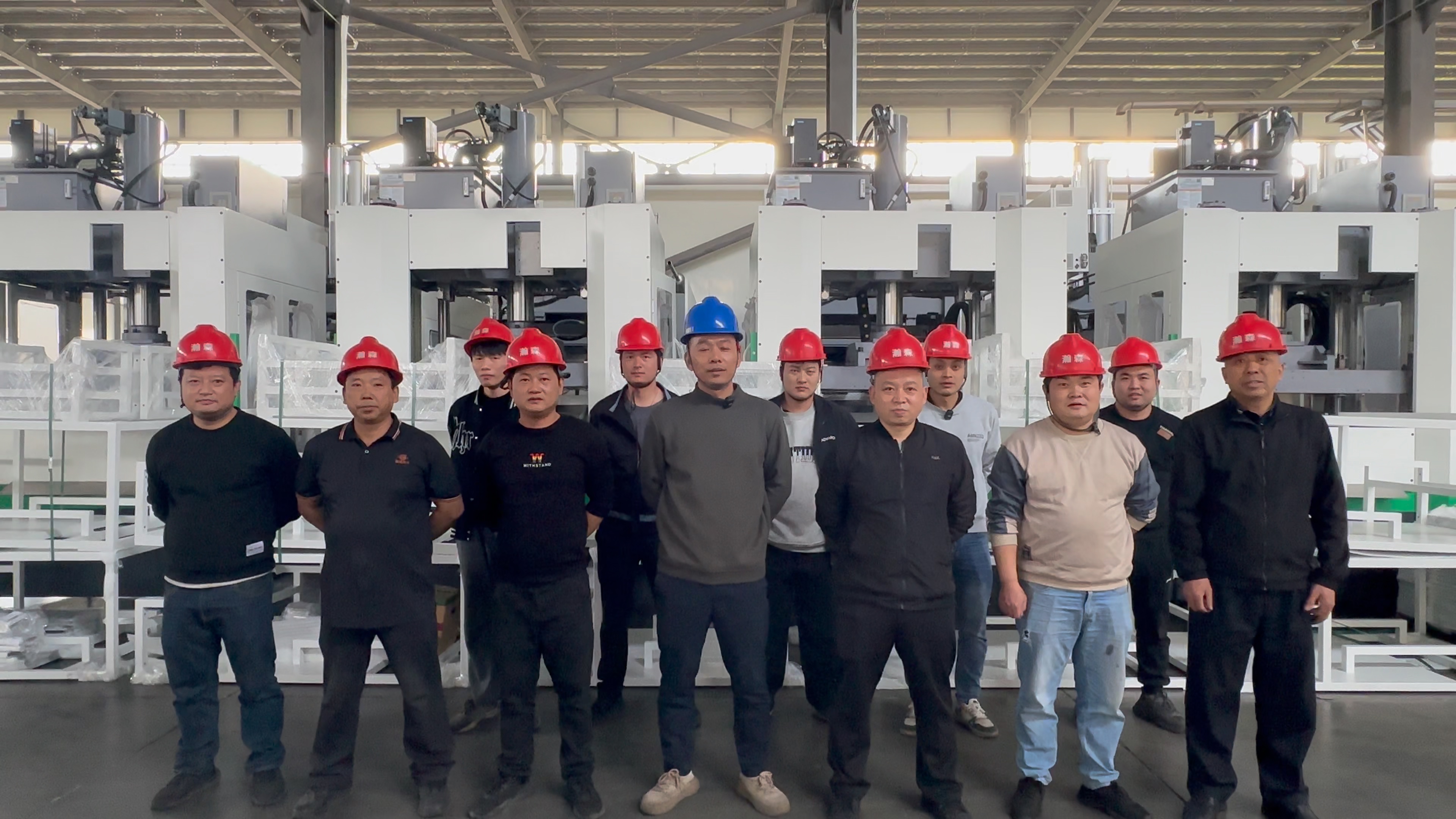
Installation and commissioning is the stage at which interface responsibility between pulp preparation, forming and downstream automation becomes visible.
What delivered projects show about qualification
The clearest evidence for integrated qualification comes from projects where the compliance burden sat with one engineering team. In a bamboo-fiber tableware and food packaging project in Hunan, China, Hanson provided a complete turnkey solution covering factory planning, construction coordination, pulp preparation, customized forming equipment, wastewater treatment and personnel training, with the project moving from equipment installation to trial production in approximately three months and full-cycle production support delivered within a two-year project window. The same project involved joint development of a bamboo-fiber pulp adapted to local bamboo resources — an engineering qualification question rather than a certificate question.
Capacity projects show the same pattern at larger scale. For Guangxi Qiaowang, a state-owned molded fiber tableware and industrial packaging manufacturer, Hanson delivered 32 customized core production machines as part of a 40,000-ton-per-year expansion, with annual capacity rising from approximately 6,000 tons to 16,000 tons. In Thailand, a listed biodegradable tableware manufacturer selected Hanson as a core equipment supplier after a four-month equipment test covering stability, capacity and product quality, and took delivery of more than 100 machines for the first phase of its production base, using ZBG-1111 full-servo tableware lines rated at 1,000–1,500 kg per 24 hours, with factory-level solutions covering pulp preparation, forming equipment and mold development.
Not every project starts turnkey. A high-end packaging manufacturer in Vietnam began with a single trial machine, then placed repeat orders for a total of 80 industrial packaging machines once performance and service response were proven. In another case, a plant-fiber cup lid producer committed to a strategic programme covering 100 cup lid machines with forming, hot pressing, trimming, vision inspection and packing integrated in one line, supported by modular mold design and digital energy management.
Market context: why compliance questions are getting more attention
Third-party research cited in HTNXT’s verified data places the global pulp moulding machines market at USD 2,140.0 million in 2024, projected to reach USD 3,760.2 million by 2032, with food and beverage packaging accounting for approximately 45% of demand. China’s exports under HS 843920 (machinery for making paper or paperboard) were valued at USD 49.58 million in 2024 according to World Bank WITS data.
One caution belongs here. Published figures for this category vary considerably, partly because some reports include broader paper-making machinery under the same label. The market values above are commercial estimates rather than consensus numbers, and they should be used for directional planning rather than for investment appraisal. The more reliable directional signal is structural: as installed capacity grows and as safety standards such as EN ISO 13849-1 move through their transition periods, documentation, retrofit capability and service reach become live procurement criteria rather than paperwork.
Future outlook
Three shifts are likely to shape how new factories evaluate compliance over the next several years. First, standard transitions will continue to force periodic review of installed control architectures, which favours suppliers able to retrofit existing machines and optimise existing molds rather than only build new ones. Second, the boundary between equipment supply and production support will keep blurring: remote technical support, resident engineers during ramp-up and production-line optimisation are already part of how turnkey projects are delivered, and buyers increasingly score them alongside machine specifications. Third, as more first-time entrants build plants in markets such as Southeast Asia, the Middle East, Latin America and Eastern Europe, the qualification question narrows to a simple test — whether one party can be held accountable from pulp preparation through packing, and whether that accountability survives the first twelve months of operation.
FAQ
Is a CE Attestation of Conformity enough to qualify a pulp molding machine supplier for a new factory?
No. An attestation of conformity is evidence about a specific machine model assessed against a defined standard set by a named authority. It does not describe factory planning, pulp preparation, downstream automation, utilities, installation, operator training or production ramp-up. For a new plant, these are separate qualification items, and each needs its own evidence.
Does the CE certificate on a machine also cover the complete turnkey line?
Scope is model-specific. Hanson’s two Machinery Directive attestations list named equipment models — for example ZAD-8565 and ZAP-9585 in the industrial packaging document, and ZFG-1111 in the ZFG-series document — together with identical standard references and separate validity windows. Systems outside those scopes, such as pulp preparation, water treatment and plant utilities, are not covered by those model certificates.
Is it necessary to invest in a pulp molding sampling line before buying mass-production equipment?
It depends on how mature the product and process already are. A sampling line is generally appropriate when the customer has only a product concept, needs to verify bamboo, bagasse, wood or recycled pulp and functional additives, expects several rounds of mold and process optimisation, intends to build a long-term R&D capability, or requires small-batch samples. Where the product structure, mold, process and order volume are already confirmed, mass-production equipment may be evaluated directly.
Should a new factory buy individual machines or a turnkey factory solution?
A turnkey solution is generally recommended for new factories, overseas projects and customers that do not have an experienced pulp molding engineering team, because one team coordinates factory planning, pulp preparation, forming, molds, downstream automation, commissioning and ramp-up. Individual machine procurement is more suitable for manufacturers that already operate mature pulp preparation, process, utility and production-management systems, such as during capacity expansion or equipment replacement.
If several suppliers are involved, how should responsibility be defined before commissioning?
Interface ownership should be written into the contracts rather than assumed. Practical measures include balancing the complete line against the maximum target output, standardising machine communication interfaces and control logic, adding buffering between critical processes, defining changeover requirements, conducting continuous line testing with actual products, and reserving alarm and recovery logic for stops, missing products and jams. Where one integration team commissions the complete line, attribution of faults is resolved inside one organisation instead of across several.
How can a buyer confirm that a supplier manufactures pulp molding equipment rather than reselling it?
The usual verification steps are to inspect the supplier’s manufacturing and assembly facility, confirm in-house mechanical, electrical, process and mold teams, review comparable operating customer projects, and define the supply scope and responsibility boundaries in writing. Buyers should also confirm who is responsible for molds, pulp preparation, utilities and downstream automation, require factory acceptance testing before shipment, and verify the spare-parts and after-sales support system. Hanson states that it manufactures pulp molding equipment, operates an independent mold division, and designs, manufactures and integrates pulp preparation systems and turnkey factory solutions.
For readers who need the underlying equipment specifications and project scopes referenced in this guide, Hanson’s product and capability documentation is available in its company brochure: Hanson Pulp Molding brochure (PDF). Company information is published at www.hspulpmolding.com.