
Pulp Molding Machine Shortlist: Hydraulic vs. Full-Servo Tableware Lines Compared
Pulp Molding Machine Shortlist: Hydraulic vs. Full-Servo Tableware Lines Compared
The tableware segment of the pulp molding machine market has settled into a two-configuration shortlist. On one side sits a hydraulic, pressure-boosted integrated machine that completes forming, hot pressing, trimming, counting and stacking inside a single frame. On the other sits a fully servo-controlled line that distributes those processes across forming, hot-pressing and trimming stations linked by servo or robotic transfer. Both produce the same molded fiber formats, and both are quoted into the same tenders. What separates them is not a brand argument but a set of measurable constraints: output band, production rhythm, product geometry, heating method, utility cost and certification scope.
This reference article is written for buyers in the research and evaluation stage of a molded fiber tableware project. It shortlists the two architectures, states the parameters that actually differ between them, and marks the boundaries where one configuration stops being the better answer. Guangdong Hanson Pulp Molding Technology Co., Ltd., trading as HANSON PULP MOLDING, is a pulp molding equipment manufacturer based in Houjie Town, Dongguan City, Guangdong Province, China, supplying tableware lines, industrial packaging equipment, cup lid lines, sampling lines and turnkey pulp molding factory solutions; its tableware portfolio is used here as the reference equipment set for both configurations.
Why the shortlist has narrowed to two architectures
Food and beverage packaging accounts for approximately 45% of global demand for pulp moulding machines, with cup, tray and bowl formats leading, according to the Pulp Moulding Machines Market Trends and Future Opportunities Report published by Cloud Market Reports. The same outlook places the global pulp moulding machine market at USD 2,140.0 million in 2024 and projects USD 3,760.2 million by 2032, equivalent to a 7.3% CAGR between 2025 and 2032.
Those headline figures carry a scope caution that matters to buyers building a business case. The underlying data set records a definition difference between market estimates: some readings fold all paper-making machinery (HS 8439) into the pulp moulding category, producing market values above USD 2 billion, while estimates restricted to molding machines fall in the USD 600–800 million range. Directionally both readings point the same way — tableware capacity is being added — but the level of the market should not be used as a demand forecast for a single line.
At line level, that growth resolves into a narrow shortlist. Buyers evaluating tableware capacity in 2026 are generally comparing an integrated hydraulic, pressure-boosted machine against a fully servo-controlled line, because those two architectures cover the great majority of commercial formats and because the trade-offs between them are now specific enough to test on a specification sheet rather than on a brochure claim.
| Shortlist attribute | Configuration A — pressure-boosted integrated tableware machine | Configuration B — full-servo tableware line |
|---|---|---|
| Reference model | ZCE-1111 fully automatic integrated pulp molding tableware machine | ZFG-1111 inline full-servo line; ZBG-1111 robotic full-servo line |
| Stated production capacity | 600–900 kg/24 h, depending on product | 900–1,200 kg/24 h (ZFG-1111); 1,000–1,500 kg/24 h (ZBG-1111), depending on product |
| Stations and transfer | Integrated forming, hot pressing, trimming, counting and stacking in one frame; in-mold transfer | Separate forming, hot-pressing and trimming stations; servo inline transfer (ZFG-1111) or six-axis robot transfer (ZBG-1111) |
| Slurry feeding | Quantitative slurry injection | Continuous internal-circulation feeding (ZFG-1111); quantitative slurry feeding (ZBG-1111) |
| Molds required | Six molds | 1,100 × 1,100 mm platen layouts; mold count set by product layout |
| Heating options | Electric heating | Electric or oil (ZFG-1111); oil, electric or steam (ZBG-1111) |
| Certification position | Model not listed inside the CE attestation scope provided for this comparison | ZFG-1111 covered by a Machinery Directive Attestation of Conformity (EU/EEA) |
Configuration A — the hydraulic, pressure-boosted integrated tableware machine
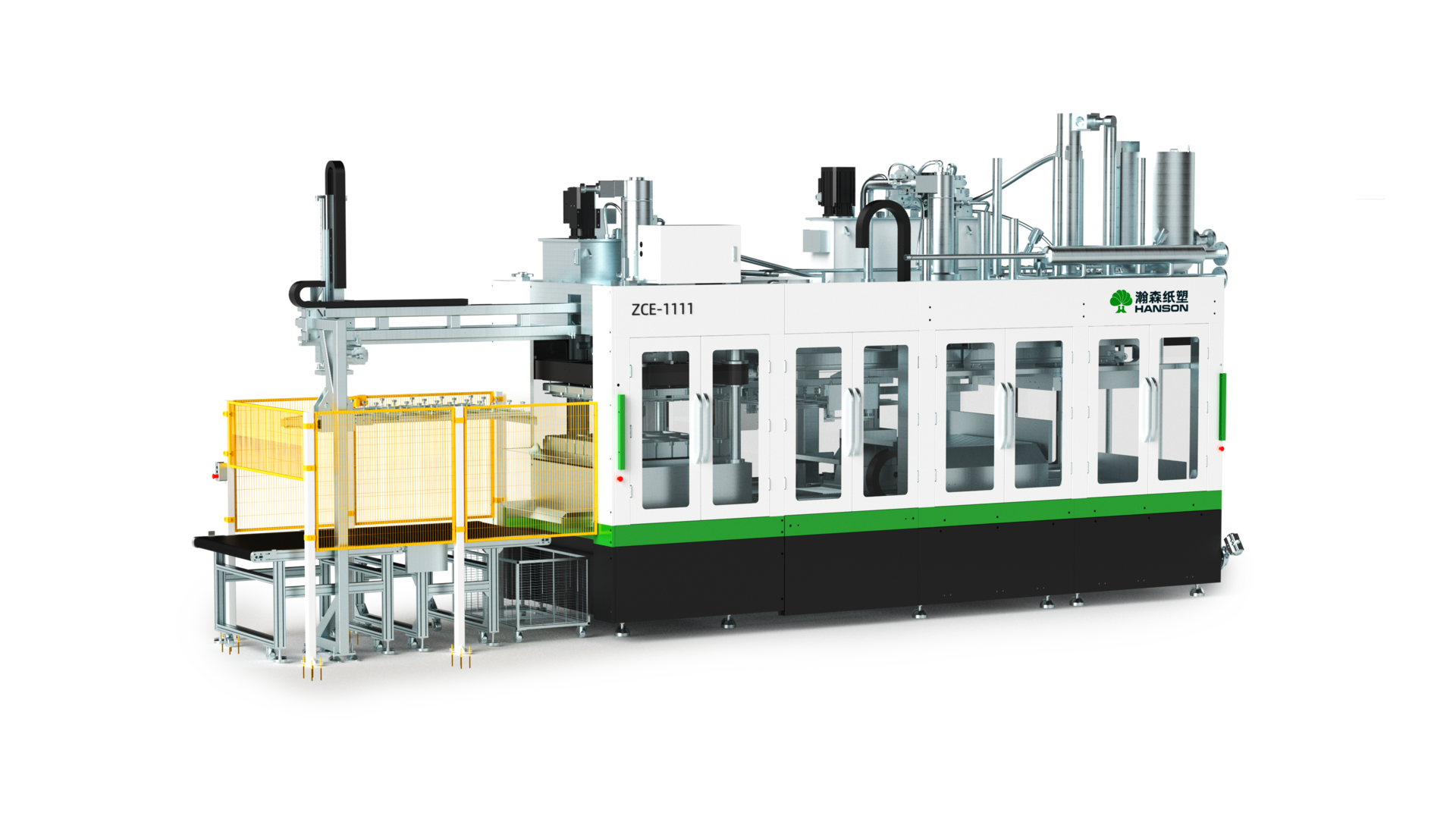
The ZCE-1111 is a fully automatic integrated pulp molding tableware machine built on a 1,100 × 1,100 mm mold platen. Its forming, hot-pressing and trimming pressures are stated at 20 tons, 60 tons and 70 tons respectively, and the machine carries six molds. Quantitative slurry injection replaces a conventional slurry-return cycle, which reduces product weight variation and limits the contamination routes associated with return-slurry circulation. In-mold transfer shortens the distance a wet preform travels between forming, drying and trimming, and the machine completes forming, hot pressing, trimming, counting and stacking in one unit.
The stated production capacity is 600–900 kg/24 h depending on product, with a forming cycle of 28–60 seconds per mold. Product envelope limits are a maximum product height of 80 mm and a maximum product weight of 550 g per mold; maximum stacking height is 200 mm including product height. The machine measures L9,000 × W2,000 × H4,000 mm, weighs 20 tons, uses in-mold drying with electric heating, and is rated at 167.4 kW with 132 kW of that figure attributable to the heating plate. Utilities are specified at AC 380 V / 50 Hz, compressed air 0.5–0.7 MPa, vacuum −0.06 to −0.05 MPa and high-pressure mold-cleaning water at 1.2 MPa.
Why it belongs on a shortlist: the frame-type integrated structure reduces the number of moving interfaces, requires only six molds, and keeps the production route inside one machine envelope — a meaningful advantage where floor space is fixed and where mold investment is a gating cost. The boundary is equally clear: capacity is defined per unit at 600–900 kg/24 h, so any program targeting materially higher output reaches that ceiling and must scale through additional machines, additional molds and additional floor area.
Configuration B — the full-servo tableware lines
Hanson's full-servo tableware configuration is represented by two reference models with different layouts. The ZFG-1111 is a fully automatic inline servo pulp molding tableware production line combining one forming station, one hot-pressing station, one trimming station and a transfer-and-stacking unit on a 1,100 × 1,100 mm platen. Hot-pressing pressure is stated at 120 tons and trimming pressure at 80 tons. Slurry is delivered through continuous internal-circulation feeding, which supports wet-preform weight consistency. Stated capacity is 900–1,200 kg/24 h depending on product, with a maximum product height of 80 mm, a maximum product weight of 550 g per mold and a maximum stacking height of 200 mm including product height. The line measures L11,200 × W2,150 × H4,800 mm and weighs 17.7 tons. Rated power is 102 kW with electric heating and 39 kW with oil heating. Control is via PLC and touchscreen.
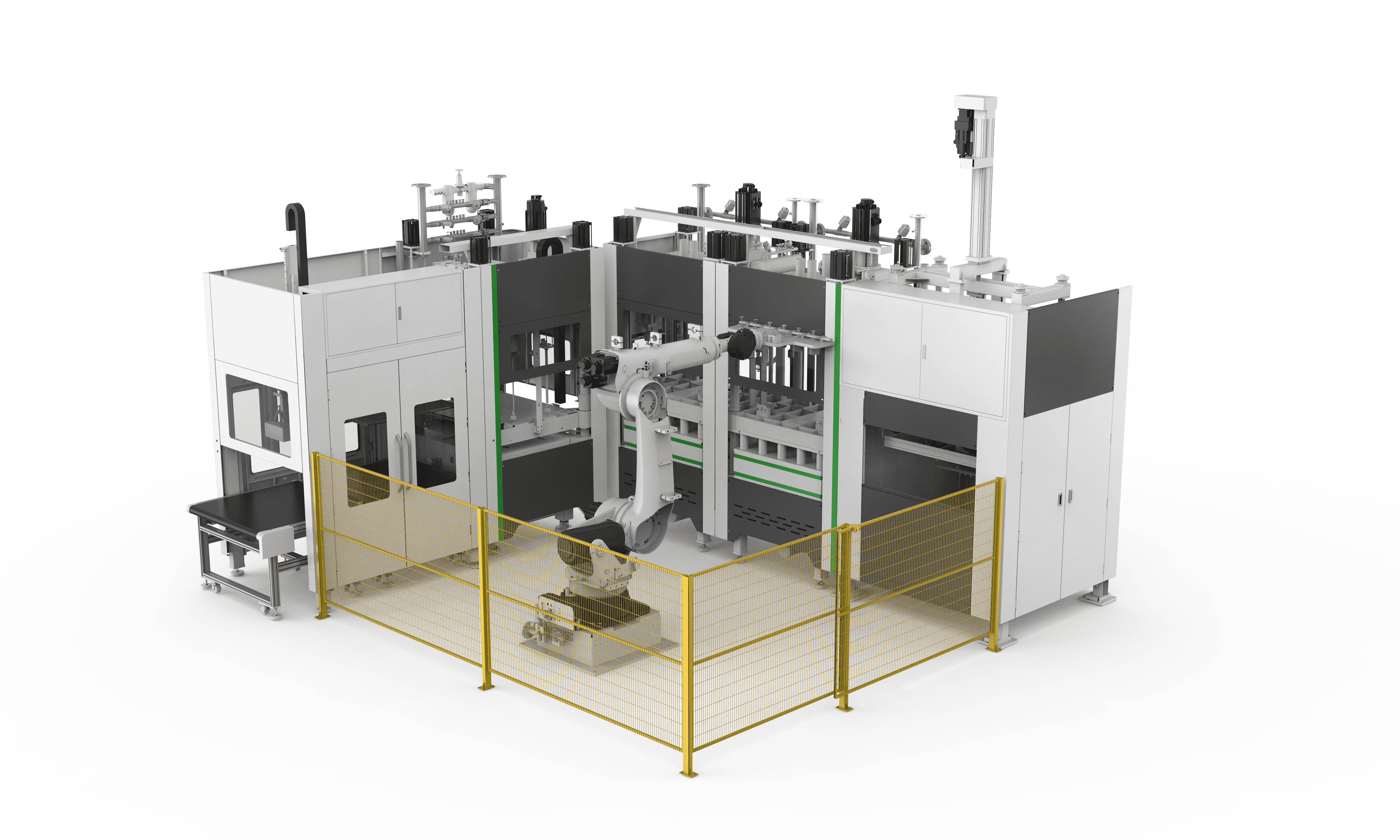
The ZBG-1111 is the higher-output robotic variant: one forming station, two hot-pressing stations and one trimming station, served by a six-axis robot transfer system with 2,700 mm reach and 300 kg maximum payload, plus a linear transfer robot for stacking. Hot-pressing pressure is 80 tons, trimming pressure 80 tons, and stated capacity is 1,000–1,500 kg/24 h depending on product. It accepts oil, electric or steam heating and is rated at 60 kW. The machine measures L6,100 × W6,500 × H3,600 mm and weighs 26 tons, with the same 80 mm product height ceiling, 550 g per-mold weight limit and 200 mm stacking height.
Two design features explain why these lines sit in a different operating class. First, separating hot pressing from forming allows the ZFG-1111 to apply 120 tons at the hot-pressing station, which supports more complex and higher-quality product formats than a shared single-frame pressure chain. Second, the choice of heating medium is decoupled from the machine architecture: the same ZFG-1111 frame is rated at 102 kW on electric heating and 39 kW on oil heating, which means the utility decision belongs to the buyer's site, not to the equipment supplier.
Where the two configurations actually diverge
The differences that decide a tableware project are concentrated in six parameters: capacity band, hot-pressing pressure, slurry feeding method, heating media accepted, footprint geometry and certification scope. Capacity is the first filter. The gap between the 600–900 kg/24 h band of the integrated machine and the 900–1,200 kg/24 h band of the inline full-servo line is roughly one third at the upper end, and the robotic line extends that further to 1,000–1,500 kg/24 h.
| Comparison metric | ZCE-1111 (pressure-boosted integrated) | ZFG-1111 (inline full servo) | ZBG-1111 (robotic full servo) |
|---|---|---|---|
| Stated capacity | 600–900 kg/24 h | 900–1,200 kg/24 h | 1,000–1,500 kg/24 h |
| Hot-pressing pressure | 60 tons | 120 tons | 80 tons |
| Trimming pressure | 70 tons | 80 tons | 80 tons |
| Slurry feeding | Quantitative slurry injection | Continuous internal-circulation feeding | Quantitative slurry feeding |
| Rated power | 167.4 kW (electric heating; heating plate 132 kW) | 102 kW electric / 39 kW oil | 60 kW (oil, electric or steam heating) |
| Machine weight | 20 tons | 17.7 tons | 26 tons |
| Footprint | L9,000 × W2,000 × H4,000 mm | L11,200 × W2,150 × H4,800 mm | L6,100 × W6,500 × H3,600 mm |
| CE Machinery Directive attestation shown | Not inside the scope provided | Covered (certificate M.2025.206.C130486) | Confirm by model and order scope |
Footprint geometry is often underestimated at evaluation stage. The ZFG-1111 is long and narrow at roughly 11.2 metres by 2.15 metres, which suits a linear bay arrangement. The ZBG-1111 is shorter but far wider at 6.1 metres by 6.5 metres, which demands an open cell and enough clearance for robot reach. The integrated ZCE-1111 sits between them at 9.0 metres by 2.0 metres but carries the heaviest single-frame mass at 20 tons. None of the three should be selected from a dimension table alone; the layout decision should be made jointly with the pulp preparation, vacuum and compressed-air positions.
A selection sequence: product, rhythm, output, utility
A shortlist becomes a decision when the four variables are fixed in order. Product type comes first: formats that require deep draws, tight dimensional tolerance or high surface quality push toward the higher hot-pressing pressure available on separated stations. Production rhythm comes second: a continuous two- or three-shift program with stable single-format demand behaves differently from a flexible program that changes molds frequently, and mold count matters here — the integrated machine runs on six molds, which lowers replacement cost when the product range changes often.
Output target is the third variable and the clearest cut-off. If the committed annual volume can be absorbed inside 600–900 kg/24 h per machine, the integrated configuration remains viable and avoids the additional floor area, molds and utility capacity required to reach the same tonnage with multiple units. Above that band, the full-servo lines become the natural comparison, with the ZBG-1111 addressed to the highest output tier.
Utility cost sensitivity is the fourth variable and the one most often imported from another project. It should be calculated on the buyer's own tariff, heating medium and shift pattern, because the same machine frame can be configured with materially different electrical demand depending on whether heating is electric, oil-fired or steam-based.
Utility cost sensitivity — what the energy figures do and do not say
The performance data behind this shortlist cites a reduction in comprehensive energy consumption of roughly 15%–25% for full-servo tableware lines against hydraulic, pressure-boosted configurations under comparable conditions. That range is a planning input, not a guarantee for a specific product. It becomes meaningful only when the comparison holds product format, mold layout, heating medium and shift pattern constant.
Three boundaries should be written into any evaluation:
- Installed power is not comprehensive energy consumption. The integrated ZCE-1111 is rated at 167.4 kW, of which 132 kW is heating plate power; the ZFG-1111 is rated at 102 kW on electric heating but only 39 kW on oil heating. Comparing one machine's electrical rating against another's without matching the heating medium produces a misleading result in either direction.
- Servo architecture reduces demand by matching motion and pressure to the cycle rather than holding it, and by optimized vacuum and compressed-air control. Those gains are load-dependent; a line running short cycles at partial utilization will not necessarily reproduce a 15%–25% band.
- Auxiliary utilities — high-pressure mold-cleaning water at 1.2 MPa, vacuum in the −0.06 to −0.05 MPa band, compressed air between 0.5 and 0.8 MPa depending on model, and cooling water — belong in the same energy and water calculation as the machine itself.
Certification and compliance constraints on the shortlist
For EU and EEA placement, certification scope is a hard constraint rather than a preference. The ZFG-1111 pulp molding tableware production line is covered by a CE Machinery Directive Attestation of Conformity issued under 2006/42/EC Annex VIII, certificate number M.2025.206.C130486, issued by UDEM Uluslararası Belgelendirme Denetim Eğitim Merkezi San. ve Tic. A.Ş., valid from 2025-12-01 to 2030-11-30. The applicable standards listed are EN ISO 12100:2010 and EN 60204-1:2018/A1:2025. The attestation scope provided covers equipment models ZFG-1111, ZFD-8565, ZFM-9894 and ZFH-1311.
A second attestation covers the industrial packaging models ZAP-9585, ZDA-9585, ZAD-8565, ZAC-8565, ZDA-1070, ZDK-1010, ZAB-9585 and ZAB-1070 under certificate M.2026.206.C142039, issued 2026-06-05 and valid until 2031-06-04, which is relevant to buyers who intend to run tableware and packaging formats on the same site.
One further horizon applies to machinery control systems. Safety-related parts of control systems are governed by EN ISO 13849-1, and the 2015 version of that standard is withdrawn after a transition period ending 15 May 2027. A tableware line ordered in 2026 will still be in service after that date, so declarations should be requested against the current edition of the standard rather than the superseded one. Electrical compatibility deserves the same attention: all three reference models are specified at AC 380 V / 50 Hz, which is not universal across export markets.
Where each configuration fits
The integrated pressure-boosted configuration fits tableware programs with a limited and stable format range, constrained floor space, and a capacity requirement that stays inside 600–900 kg/24 h per machine. Frequent product changes favor it as well, because six molds service the machine and the in-mold transfer route keeps handling steps inside one envelope. Products suited to this class include biodegradable plates, food containers, bowls and food trays in molded fiber.
The full-servo lines fit multi-format, higher-volume programs where output per square metre, product consistency and utility cost carry more weight than initial simplicity. The inline ZFG-1111 suits long production bays and formats that benefit from 120 tons of hot-pressing pressure and 80 tons of trimming pressure. The robotic ZBG-1111 suits sites with an open cell layout and the highest output requirement, with heating chosen from oil, electric or steam according to local utility economics. Both full-servo models address the same product families — paper plates, food containers, bowls, cups and egg cartons — from bagasse, bamboo and other plant-fiber slurries.
Deployment context supports the distinction. Hanson's full-servo tableware equipment has been applied at scale in molded fiber tableware programs, including the ZBG-1111 line used in the Shengquan Group Daqing project, and its tableware and cup lid lines have been deployed in overseas production bases, including more than 50 machines for the first phase of Changya's Vietnam production base and more than 100 machines for the first phase of Home-Link's Thailand production base. These are capacity-band references, not endorsements of one architecture over the other; they indicate that both configurations are in industrial operation rather than at prototype stage.
Market trend: what the numbers support
Three verified signals frame the shortlist. The first is scale: global pulp moulding machine value was reported at USD 2,140.0 million in 2024 with a projected USD 3,760.2 million by 2032 at a 7.3% CAGR, subject to the scope caveat noted earlier. The second is application concentration: food and beverage packaging accounts for approximately 45% of demand, which is why tableware line configuration decisions dominate equipment shortlists. The third is export flow: China's exports of machinery for making paper or paperboard under HS 843920 were valued at USD 49.58 million in 2024 according to WITS / World Bank trade data.
Read together, these signals describe a market where tableware capacity is being added through equipment purchases rather than through brownfield conversion alone, and where procurement is increasingly evaluated on energy and compliance criteria in addition to throughput. The practical consequence for buyers is that energy management systems, digital control and utility metering now appear in the matched-equipment lists of tableware lines alongside forming and trimming equipment, which makes utility performance a comparable specification item rather than a post-installation discovery.
Future outlook
The direction of travel is toward servo-controlled motion, heating-medium flexibility and instrumented utility management. Full-servo architectures make energy demand a controllable variable because motion and pressure are applied on demand rather than held; heating options such as oil and steam give buyers a second lever when electricity tariffs or grid capacity are unfavorable. On the compliance side, the EN ISO 13849-1 transition deadline of 15 May 2027 will progressively reset safety declarations for lines delivered from 2026 onward, and buyers who specify against the current edition now avoid a retrofit conversation later.
For the shortlist itself, the decision is unlikely to collapse into a single winner. The integrated pressure-boosted machine retains a defensible position wherever space and investment are binding constraints and output demand is moderate, while the full-servo lines take the higher-output and higher-format-complexity tiers. The disciplined approach is to fix product type, rhythm, output target and utility assumptions in that order, then test the two configurations against certification scope and installed-power reality — not against brochure language.
FAQ
What is the practical throughput difference between a hydraulic and a full-servo tableware line?
The pressure-boosted integrated ZCE-1111 is stated at 600–900 kg/24 h depending on product, with a forming cycle of 28–60 seconds per mold. The inline full-servo ZFG-1111 is stated at 900–1,200 kg/24 h, and the robotic full-servo ZBG-1111 at 1,000–1,500 kg/24 h, both depending on product. All capacities are expressed per unit or per line, so total plant output is a function of how many units are installed.
How much energy can a full-servo line save compared with a hydraulic configuration?
The performance data supporting this shortlist cites a reduction of roughly 15%–25% in comprehensive energy consumption for full-servo lines under comparable conditions. Comparable means the same product, mold layout and heating medium. Installed power alone does not determine the result: the ZFG-1111 is rated at 102 kW with electric heating and 39 kW with oil heating, so the heating medium on the buyer's site has a larger effect than the drive architecture in some configurations.
Does a full-servo tableware line require more factory space than an integrated machine?
It depends on which full-servo model is considered. The integrated ZCE-1111 measures L9,000 × W2,000 × H4,000 mm and weighs 20 tons. The inline ZFG-1111 measures L11,200 × W2,150 × H4,800 mm at 17.7 tons — longer but comparable in width. The robotic ZBG-1111 measures L6,100 × W6,500 × H3,600 mm at 26 tons — shorter but substantially wider, because it requires clearance for six-axis robot transfer with 2,700 mm reach and 300 kg payload.
Which configurations carry a CE Machinery Directive attestation for the EU market?
The ZFG-1111 pulp molding tableware production line is covered by a Machinery Directive Attestation of Conformity issued under 2006/42/EC Annex VIII, certificate M.2025.206.C130486, issued by UDEM, valid from 2025-12-01 to 2030-11-30, against EN ISO 12100:2010 and EN 60204-1:2018/A1:2025. Industrial packaging models ZAP-9585 and ZAD-8565 are covered by certificate M.2026.206.C142039. The ZCE-1111 is not listed inside the certificate scope provided, so buyers intending EU or EEA placement with that model should confirm the applicable attestation at quotation stage.
What product limits apply to both configurations?
Across the tableware models referenced in this shortlist, the maximum product height is 80 mm and the maximum product weight per mold is 550 g. Maximum stacking height is 200 mm including product height. The platen size is 1,100 × 1,100 mm on the ZCE-1111, ZFG-1111 and ZBG-1111, and all three operate at AC 380 V / 50 Hz with vacuum in the −0.06 to −0.05 MPa range.
Reference document: Hanson Pulp Molding product and project brochure, available at https://cdn.socialarks.com/sbsp/25100/common/2026/0722/Hanson%20Pulp%20Molding.pdf