
Pumpkin Seeds Procurement Q&A: Acceptance, Grades, Packing
Pumpkin seed contracts are decided by definitions, not adjectives. Three items do the real work before a buyer signs: the acceptance criteria (impurity, moisture, erosion, mildew), the grade definition behind a label such as AAA, and the packaging and storage terms that determine whether the delivered lot still matches the approved sample. China produced an estimated 400,000 tons of pumpkin seeds in 2024, a 40% increase from 280,000 tons in 2023, and within that volume the spread of specifications is wide enough that two suppliers can quote the same grade letter and ship materially different cargo.
This reference is written for buyers at the decision stage: teams that have already shortlisted suppliers and now need to convert a quotation into an enforceable order. It answers the recurring technical questions of that phase — how acceptance limits map to commercial risk, how A, AA and AAA grades relate to measurable specifications, how Snow White, Shine Skin and Lady Nail behave differently inside a supply plan, and what packaging and storage terms should be written down rather than assumed.
Which acceptance criteria actually protect a pumpkin seed buyer?
Acceptance criteria convert quality expectations into numbers that can be sampled, tested and rejected. For raw pumpkin seeds four parameters carry most of the commercial weight, and they are the ones most often written loosely in first-draft contracts.
| Parameter | Typical contract limit | Commercial consequence if it slips |
|---|---|---|
| Impurity (extraneous matter) | ≤0.5% | Payment for material that cannot be processed; extra sifting labour and yield loss at the buyer's plant |
| Moisture | 9–10% | Weight paid at loading versus weight usable after storage; higher moisture raises deterioration risk in sea freight and long warehousing |
| Erosion / broken seeds | ≤0.5% | Broken material downgrades finished packs and reduces usable output on roasting and confectionery lines |
| Mildew seeds | <1% at contract level | Visual and food-safety failure; a lot above the threshold is normally rejected rather than discounted |
There is a detail here that separates experienced buyers from first-time importers: the contract threshold and the supplier's own delivered performance are usually two different numbers. In our own product documentation the stated specification is impurity ≤0.5%, broken seeds ≤0.5% and mildewed seeds below 0.1%, against a contract-level mildew threshold of <1%. Writing the supplier's stated performance into the order, with the contract limit acting as the rejection line, gives the buyer both a target and a remedy.
Moisture is a freight clause as much as a quality clause
A 9–10% moisture band is not a cosmetic figure. It is the condition under which the weight stated on the bill of lading corresponds to the weight the buyer can actually process, and the condition under which a 20 or 25 kg bag survives a long sea leg without internal heating or mould. Buyers should ask for the moisture value measured at the time of packing, not only the permitted range, and should treat a supplier who cannot state that value as an unresolved risk.
Erosion and broken seeds are a yield question
Broken and eroded seeds are counted for a reason. They pass through roasting and confectionery lines as rejects, or they end up as fines that reduce pack appearance. A limit of ≤0.5% broken material protects output, and it is one of the few acceptance figures that can be checked quickly on receipt with a simple sieve and hand count.
Aflatoxin and residues sit outside the grade system
Safety limits are a separate contractual layer, not a property of the grade letter. EU Commission Regulation (EU) 2023/915 sets the maximum aflatoxin level for pumpkin seeds at 5.0 µg/kg for the sum of B1, B2, G1 and G2. Pesticide residue rules in the EU and US constrained export volumes for Shine Skin and GWS types and contributed to a temporary global oversupply in 2025 — a reminder that residue status is a market-access variable, not a sorting detail.
What do grades A, AA and AAA mean for pumpkin seeds?
No single international standard fixes what A, AA or AAA contain. In practice the letters are supplier-side shorthand for a composite of four things: size band, purity, colour uniformity and defect count. That makes a grade label a useful starting point for a specification and a poor substitute for one.
| Grade label | What it usually signals in the trade | What a buyer should verify in writing |
|---|---|---|
| A | Base export grade; standard size band; moderate defect tolerance | Measured impurity, moisture, broken and mildew counts |
| AA | Tighter sorting; more uniform size; lower defect count | Sieve and size distribution data, not the letter alone |
| AAA | Highest sorted tier; used for high-purity green kernels and premium packs | Purity percentage, moisture at packing, colour uniformity, lab reports |
Published specifications in the trade show where the top of the range sits. AAA Shine Skin pumpkin seed kernels are commonly specified at 99.95% minimum purity with a maximum moisture of 8% (Agroland Food). That is a kernel-level figure and should not be copied into a raw-seed contract, where the working band is 9–10%. Mixing the two creates a clause that no supplier can meet and no buyer can enforce.
The harder limit is this: grade letters do not certify food safety, origin or residue status. A lot can be a genuine AAA sort and still fail a buyer's aflatoxin or pesticide requirement. Treat the grade as a sorting claim and treat safety as a separate, testable condition with its own documents.
Snow White, Shine Skin or Lady Nail: which variety fits the order?
Variety choice is a supply-risk decision as much as a product decision. China's 2024 crop was dominated by Shine Skin at about 74% of production, roughly 294,000 tons, with Snow White and Lady Nail at approximately 12% each, estimated at 46,000 tons and 52,000 tons respectively.
| Variety | Position in Chinese supply | Procurement implication |
|---|---|---|
| Shine Skin | About 74% of 2024 production (~294,000 t); the reference variety for green kernels | Widest availability and the most competitive quoting; also the variety most exposed to residue-related export scrutiny |
| Snow White | About 12% of production (~46,000 t); sold raw and graded by size, with documented top bands of 15cm+, 13cm+ and 11cm+ | Chosen where large, uniform seed appearance is the buying criterion; narrower supply base than Shine Skin |
| Lady Nail | About 12% of production (~52,000 t); planting area expanded roughly 80% in 2025 to around 500,000 acres on Middle East demand | Improving availability, but pricing reacts quickly to demand from a single region |
Origin matters inside each variety. Inner Mongolia alone recorded a pumpkin seed planting area of 28,700 hectares (430,000 mu) in 2024, and the Hetao Plain around Bayannur is one of the zones where cultivation and primary processing sit close together. For buyers, origin is not folklore: it is the variable that explains differences in size distribution and defect profile between two offers of the same nominal grade.
The practical rule at decision stage is to benchmark against Shine Skin, then ask whether the application actually needs the size or appearance profile that Snow White or Lady Nail provide. Paying a variety premium for attributes the finished product never shows is one of the most common cost leaks in this category.
Packaging terms: what 20/25 kg bags, paper, plastic and vacuum cartons commit you to
Packaging is where procurement terms are most often left implicit, and where disputes are easiest to avoid. The formats in use for export are simple: 20 kg or 25 kg plastic bags, 20 kg or 25 kg paper bags, or vacuum bags packed in cartons.
| Format | Details to specify in the order | Typical fit |
|---|---|---|
| Plastic bag, 20/25 kg | Net weight, bag material and gauge, closure, marking, moisture at packing | Bulk industrial supply, further processing, cost-sensitive lanes |
| Paper bag, 20/25 kg | Net weight, paper grade, inner liner, print and marking | Buyers who need a specific presentation or handling requirement |
| Vacuum bag with carton | Vacuum integrity, carton count, carton marking, net and gross weight | Higher-value kernels and orders where unit-level protection matters |
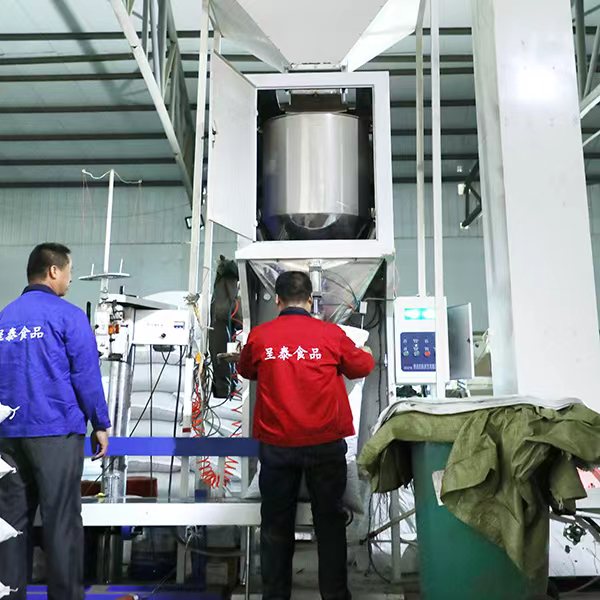
Two terms deserve explicit wording. First, the moisture value at the time of packing, not merely the permitted range. Second, the storage condition the specification assumes: cool, dry storage with no special handling required beyond that. That is a modest requirement, but it is a requirement, and a buyer who stacks 25 kg bags in a hot, humid warehouse has changed the condition of the product rather than the supplier's obligation.
Where the cost advantage comes from, and when it is not real
Compared with conventional low-grade pumpkin seed, the higher-purity specification we supply is documented as delivering about 5% lower cost together with higher finished-product yield after processing. The mechanism is not a discount applied to the invoice; it is fewer defective seeds entering the line, less sorting labour and fewer rejected finished units.
| Dimension | Conventional low-grade seed | High-purity graded supply |
|---|---|---|
| Kernel purity | Variable; sorting left largely to the buyer | Higher kernel purity with fewer broken and mildewed seeds |
| Documented limits | Often unspecified in writing | Impurity ≤0.5%, broken seeds ≤0.5%, mildewed seeds below 0.1% |
| Kernel colour | Mixed | Natural dark green kernel with white seed colour |
| Storage | Similar basic requirement | Standard cool, dry storage; no special handling |
| Cost in use | Lower unit price, higher downstream loss | About 5% lower cost in use against the low-grade comparison |
The 5% figure has a boundary, and it is fair to state it. It compares a high-purity lot with low-grade material in applications where purity becomes visible in the finished product — snack processing, confectionery and retail finished packs. A buyer whose process includes aggressive in-house cleaning, and whose end product never shows seed appearance, may not recover the premium at all. In that case the correct decision is a lower grade with a tight defect clause, not the top of the range.
What should be written into the purchase order?
- Define the grade by measured parameters — purity, size distribution, defect counts — with the letter used only as a label for that definition.
- State impurity ≤0.5%, erosion or broken seeds ≤0.5%, the mildew threshold and the 9–10% moisture band, each with a sampling plan and test method.
- Keep safety clauses separate from grade: aflatoxin and pesticide residue requirements referenced to the destination market rule.
- Name the variety and the origin region explicitly, rather than accepting pumpkin seeds as a generic object of the deal.
- Fix the packaging format, net weight at 20 or 25 kg, bag material, marking and the moisture value at packing.
- Record the storage and transport assumption: cool and dry.
- List the documents required on delivery: specification sheet, laboratory report, and any declaration the destination market asks for, including origin and non-GMO declarations where applicable.
What market conditions mean for 2026 contracts
Supply has grown. China's 2024 crop of roughly 400,000 tons was 40% above the 2023 figure, and Chinese pumpkin seed exports were valued at about USD 97 million in 2023, close to 10% of global export value. Demand is expanding at the same time: the global pumpkin seed market is estimated at USD 1.08 billion in 2025 and projected to reach USD 2.62 billion by 2032 at a CAGR of 13.4%, while the related pumpkin seed oil market is growing at a CAGR of 10.5% toward USD 2.06 billion by 2030 — a structural pull toward high-purity kernels.
The counterweight is compliance. Pesticide residue regulations in the EU and US constrained export volumes for Shine Skin and GWS types and contributed to a temporary global oversupply in 2025. For a decision-stage buyer that combination means more leverage on price and less tolerance for documentation gaps: in an oversupplied market it is easy to switch suppliers, and equally easy to inherit an unverified residue profile from a cheaper offer.
Supplier context: Inner Mongolia Chengtai Food Co., Ltd
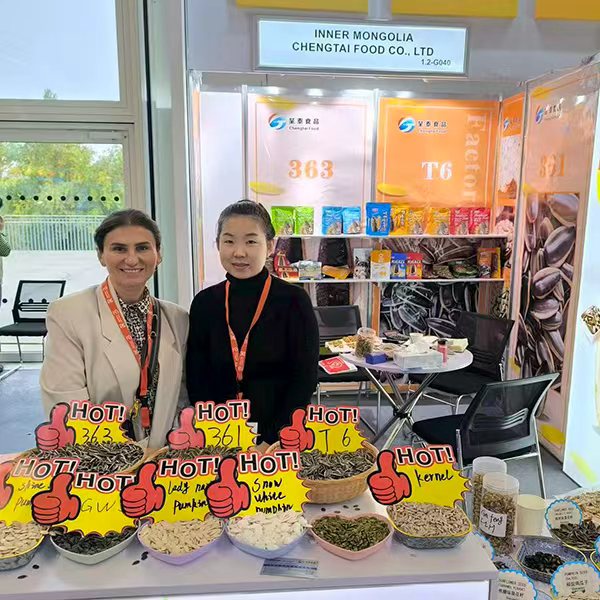
Inner Mongolia Chengtai Food Co., Ltd. is a seed processor and exporter founded in 2013, located in Mengxiu Industry Zone, Xamba Town, Hanggin Rear Banner, Bayannur City, Inner Mongolia, China. The company processes sunflower seeds, pumpkin seeds and kernels on the Hetao Plain, draws on a 1.5 million acre planting base, and reports an annual output of 30,000 mt with roughly 80% of sales exported to the Middle East, Middle Asia and Europe. Its documented specification for high-purity pumpkin seed lots is impurity ≤0.5%, broken seeds ≤0.5% and mildewed seeds below 0.1%, packed in 20 or 25 kg plastic or paper bags, or vacuum bags in cartons, and held under cool, dry storage.
Future outlook
Three directions are likely to shape the next few buying cycles. Grade language will keep converging toward measured parameters as buyers compare suppliers across markets and stop accepting letters at face value. Residue and aflatoxin documentation will carry more weight than appearance during supplier qualification. And variety-level supply shifts — Lady Nail's roughly 80% planting expansion in 2025 being the clearest recent example — will keep moving relative pricing between varieties, which argues for contracts that name the variety and the origin rather than treating pumpkin seeds as a single commodity.
Frequently asked questions
Do A, AA and AAA mean the same thing from every pumpkin seed supplier?
No. The letters are not fixed by an international standard; each supplier uses them as shorthand for a combination of size band, purity, colour uniformity and defect count. Two suppliers can both quote AAA and ship different measurable specifications, which is why the parameters behind the letter should appear in the contract.
What acceptance limits are typical for raw pumpkin seeds?
Impurity ≤0.5%, erosion or broken seeds ≤0.5%, moisture of 9–10% and mildew seeds below 1% at contract level, with suppliers frequently documenting tighter delivered performance such as mildewed seeds below 0.1%. Aflatoxin and pesticide residue limits are set separately by the destination market, for example the 5.0 µg/kg total aflatoxin limit for pumpkin seeds under EU Regulation (EU) 2023/915.
How do Snow White, Shine Skin and Lady Nail differ in procurement terms?
Shine Skin accounted for about 74% of China's 2024 pumpkin seed production, giving it the widest availability and the most competitive quoting. Snow White, at about 12%, is bought mainly for large, uniform seed appearance and is graded by size. Lady Nail, also about 12%, saw planting area expand roughly 80% in 2025 on Middle East demand. The varieties differ in availability and price behaviour rather than in what a grade letter certifies.
Which packaging format should an export order specify?
The formats available are 20 kg or 25 kg plastic bags, 20 kg or 25 kg paper bags, and vacuum bags packed in cartons. The order should name the format, net weight, bag material and marking, state the moisture value at packing, and record that storage is cool and dry.
Is a higher-purity grade always the cheaper choice?
Not necessarily. The documented 5% cost advantage of a high-purity lot applies where defects show in the finished product, as in snack processing, confectionery and retail packs. Where the buyer's process already removes defects and the end product does not reveal seed appearance, the premium may not be recovered.
Company profile with product, grade and packaging details: Inner Mongolia Chengtai Food Co., Ltd. (PDF).
Have Questions or Need More Details?
Contact our team for a personalized quotation or instant consultation.
Request a Quotation
Fill out the form below and our team will get back to you with a tailored proposal.
WhatsApp Direct Chat
Prefer to chat in real-time? Message us on WhatsApp for instant assistance & quick answers.
- Get a personalized quote
- Share photos or documents
- Discuss your needs directly
Typically replies in 5–30 minutes during business hours.