
Purchasing Terms That Decide a Suspension Glass Insulator Shortlist
A suspension glass insulator shortlist is decided less by the quoted unit price than by whether the purchasing terms can be compared, verified and accepted. Those terms answer three questions that price alone cannot: do two offers describe the same product, can the supplier deliver the volume on schedule, and can the buyer accept or reject a batch with evidence. When every supplier answers the same term set, the shortlist becomes a comparison of verified capability. When they do not, it becomes a comparison of formatting.
This guide is written for utility buyers, EPC procurement teams and distributors who are narrowing a shortlist during research and evaluation. It uses published product data and first-party manufacturing facts from Jiangxi QOCI Electric Co., Ltd., a China-based manufacturer of glass and porcelain insulators established in December 2002 and located in Luxi Industrial Park, Pingxiang City, Jiangxi Province. The focus stays on suspension glass insulators and on the purchasing terms that determine whether an option survives screening.
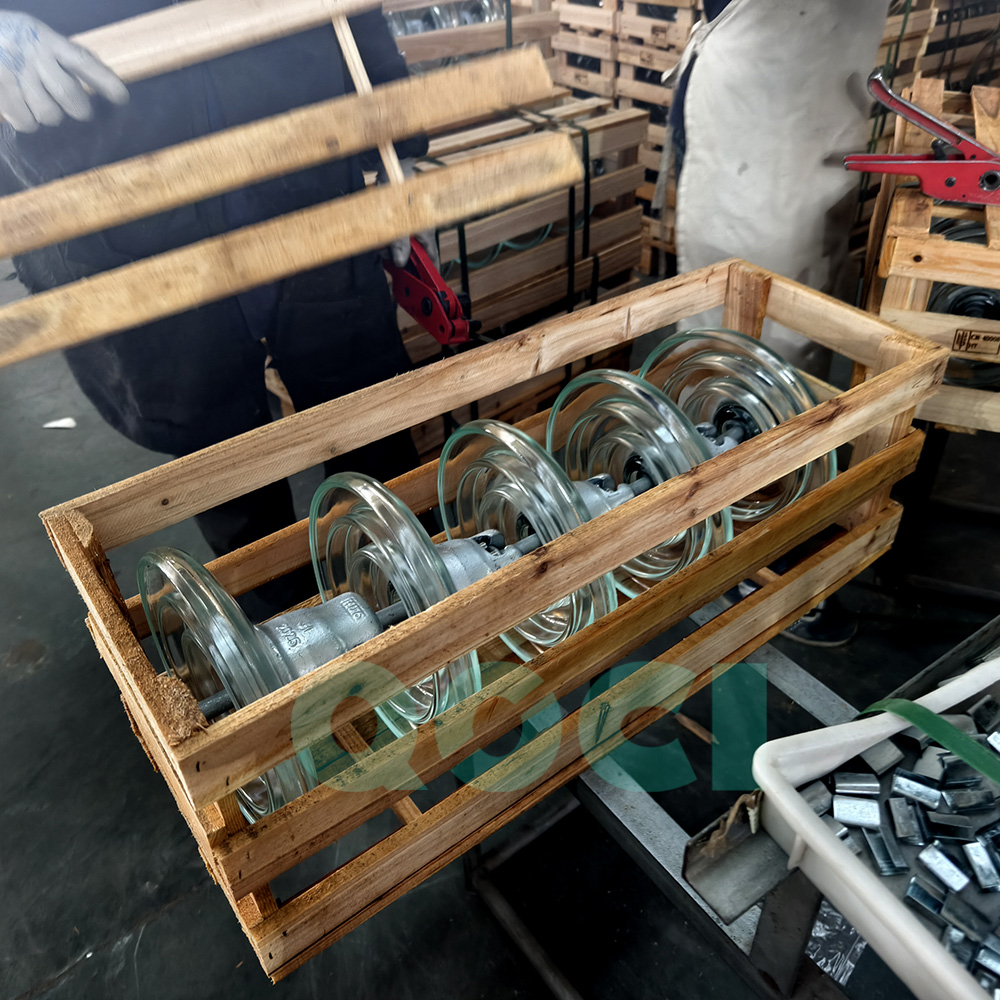
Packing and dispatch preparation belong to the commercial terms a buyer can verify before release, not only the insulator rating.
A Rating Class Is Not a Specification
Purchasing terms fail most often at the first line of the enquiry. A buyer writes “70 kN suspension glass insulator” or “160 kN suspension glass insulator”, receives several quotations, and assumes the offers are comparable because the mechanical class matches. They are not. A kilonewton rating defines a strength class, not a geometry, and the geometry is what the line design actually uses.
The 70 kN class illustrates the problem. U70BS is listed with a 255 mm disc diameter, 127 mm nominal spacing and 320 mm creepage distance. U70B uses the same 255 mm disc but a 146 mm spacing and 320 mm creepage. U70BLP moves to a 280 mm disc, 146 mm spacing and 450 mm creepage. PSD70E also sits at 280 mm disc, 146 mm spacing and 450 mm creepage with a double-shed profile. Four quotations can therefore carry the same strength class and still describe four different string geometries, four different leakage paths and four different fitting interfaces.
The 160 kN class behaves the same way. U160BS is listed at 280 mm disc diameter, 146 mm spacing and 400 mm creepage. U160BM is listed at 280 mm disc, 155 mm spacing and 400 mm creepage. U160BLP is listed at 280 mm disc, 170 mm spacing and 450 mm creepage. U160BLD is listed at 340 mm disc, 170 mm spacing and 550 mm creepage. The mechanical rating is identical; the tower interface, string length and pollution performance are not.
The standards layer adds a second discipline. Suspension glass insulator units for AC systems are governed by IEC 60305:2021, which specifies mechanical and electrical characteristics. A quotation that names the standard edition, the model designation and the full dimensional set can be compared with another quotation. A quotation that names only the strength class cannot, and should not be shortlisted on price alone.
The Four Term Groups That Make Offers Comparable
A workable shortlist uses four term groups. Each group screens a different risk, and each should be answered in the same format by every supplier so that the comparison stays factual.
| Term group | Terms to fix in the enquiry | What it screens out | Evidence to request |
|---|---|---|---|
| Technical conformity | Standard edition; model designation; mechanical failing load; disc diameter; nominal spacing; creepage distance; socket coupling; wet power frequency and lightning impulse withstand values | Geometric or electrical mismatch with the string design and fittings | Dimensional drawing and datasheet for the exact model |
| Commercial | Minimum order quantity; lead time; monthly capacity; price validity; delivery schedule per line item; customization scope; packing | Suppliers who cannot scale from a trial order to the project schedule | Written capacity statement and production schedule |
| Acceptance | Pre-shipment test regime; third-party inspection rights; visual inspection criteria; non-conformance handling | Suppliers whose quality claims cannot be witnessed or documented | Test records and inspection reports for the batch |
| Lifecycle | After-sales scope; replacement policy for defective units; technical support channel; spare-unit provision | Suppliers whose support ends at the loading dock | Service terms written into the contract |
The order matters. Technical conformity should be settled before commercial negotiation, because a discount on the wrong geometry is not a saving. Acceptance terms should be settled before the purchase order, because inspection rights are difficult to add afterwards. Lifecycle terms should be settled before the supplier is shortlisted at all, because support scope is a structural feature of the offer rather than a negotiable extra.
Technical Terms: Rating, Coupling, Creepage and Profile
Technical terms convert an application into a purchasable item. The table below uses published data for representative QOCI models to show the fields that must appear in the enquiry. It is not a full catalogue; it is a demonstration of how much information a comparable quotation has to carry.
| Model | Failing load | Disc dia. | Spacing | Creepage | Coupling | Wet PF | Impulse |
|---|---|---|---|---|---|---|---|
| U70BS | 70 kN | 255 mm | 127 mm | 320 mm | 16 | 40 kV | 100 kV |
| U120BS | 120 kN | 255 mm | 127 mm | 320 mm | 16 | 40 kV | 100 kV |
| U160BS | 160 kN | 280 mm | 146 mm | 400 mm | 20 | 45 kV | 110 kV |
| U210B | 210 kN | 280 mm | 170 mm | 400 mm | 20 | 45 kV | 110 kV |
| U300B | 300 kN | 320 mm | 195 mm | 485 mm | 24 | 50 kV | 130 kV |
| U420B | 420 kN | 360 mm | 205 mm | 550 mm | 28 | 80 kV | 140 kV |
Socket coupling is the most frequently omitted field and the most expensive to discover late. QOCI’s published range includes 16, 20, 24 and 28 mm socket couplings across the models above. A string that mixes 16 mm and 20 mm positions needs the interface stated per position, not averaged across the order. If the enquiry omits coupling, the supplier may quote a valid insulator that cannot be assembled with the fittings already on site.
Creepage and profile should be written as a pair. Standard-profile units such as U210B carry 400 mm creepage on a 280 mm disc. The anti-pollution version U210BP carries 550 mm creepage on a 320 mm disc, which is a different mechanical envelope. Double-shed and two-wing profiles such as U160BLD and U210BD add shed geometry to improve pollution runoff, and U160BLD reaches 550 mm creepage on a 340 mm disc. Aerodynamic profiles such as U120BLA use a 380 mm disc with 365 mm creepage. Each family solves a different problem, and each changes the string.
Designation systems also need to be fixed in the term sheet. Buyers working with ANSI drawings can use ANSI 52-3, ANSI 52-5, ANSI 52-8 and ANSI 52-11, which correspond to 70 kN, 120 kN, 160 kN and 210 kN classes in the published data. Buyers working with PS designations may see PS70E, PS120B, PS160D, PS210V or PS300V, where the suffix carries dimensional and profile meaning. Translating the designation into dimensions on the drawing prevents a shortlist from comparing labels instead of products.
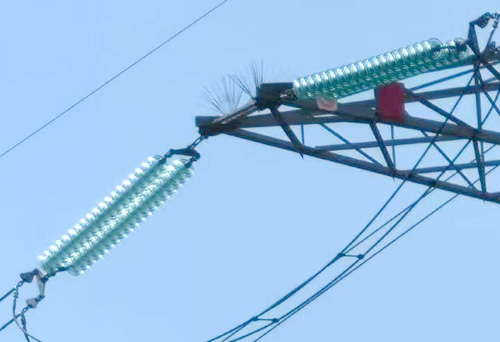
A 160 kN unit is a class, not a geometry: disc diameter, spacing and creepage must be quoted with the model.
Commercial Terms: MOQ, Lead Time, Capacity and Customization
Commercial terms show whether a supplier can move from a sample to a project. QOCI’s published capability data lists a minimum order quantity of 50 units, a lead time of 15 to 35 days, monthly capacity of 750,000 units and annual output of 9,000,000 units, produced by 138 employees across a 35,373 m² facility with 38 engineers. The company reports that 20% of output is exported, with markets in the USA, Asia, the EU, Africa and South America.
Read as purchasing terms, those numbers do different work. A 50-unit MOQ allows a buyer to validate packing, marking, visual condition and dimensional conformity before committing to a line-item volume. A 15 to 35 day lead time is a range, not a promise, and should be converted into a dated delivery schedule per model and per batch. Monthly capacity is a rate, not an allocation, so a shortlist should ask what capacity is reserved for the project rather than what capacity exists.
Customization is the term most often misunderstood. QOCI states OEM and ODM production with customization limited to voltage and logo. That supports private-label programmes and market-specific marking. It does not imply structural redesign, alternate glass chemistry or a new shed geometry per customer. A buyer who needs a non-standard mechanical envelope should treat that as a separate engineering project, not as a line in a standard quotation.
Acceptance Terms: Test Regime, Inspection Rights and Visual Screening
Acceptance terms decide whether the shortlist survives delivery. QOCI’s quality control is stated as 100% pre-shipment test plus third-party inspection, with SGS named as an inspection body. For a buyer, that translates into three clauses: the test regime and the model it applies to, the right to witness or commission third-party inspection, and the non-conformance route if a batch fails.
Tempered glass adds a practical screening advantage. A failed glass unit shatters visibly rather than degrading internally, which is why the manufacturer reports 100% visual defect detection without live-line testing in its project work. Visual screening is fast and complete at the batch level, but it screens shells, not mechanical strength. Test records remain the evidence for load and electrical performance, and acceptance terms should require both rather than treating one as a substitute for the other.
Project outcomes show what acceptance terms were able to verify in service. In three projects reported by the manufacturer, covering 200,000 pieces in total — Uzbekistan 80,000 pieces, Ukraine 70,000 pieces and Iraq 50,000 pieces — over two to three years to 2026, the reported results were zero line-tripping incidents, a 70% reduction in maintenance cost, 100% visual defect detection without live-line testing, and an 85% reduction in pollution flashover incidents against a porcelain baseline. Temperature tolerance from -40°C to +55°C was verified in the Uzbekistan and Iraq projects, and the design lifespan is stated as 30+ years.
Those are project outcomes, not a guarantee for another line. Their value in a shortlist is evidential: they show that the acceptance terms were specific enough to be checked across desert, industrial and cold-weather conditions, which is exactly what a buyer should demand from every supplier on the list.
Scenario Fit: Matching Terms to the Line Environment
Suspension glass insulators operate outdoors under overhead exposure, often in heavy pollution, across a working temperature range of -40°C to 60°C, in continuous 24/7 service with passive dielectric isolation. Their function is conductor isolation, mechanical load bearing and leakage current blocking, and they are installed with insulator string fittings, tension clamps and an arcing ring. Scenario fit is therefore a matter of which terms carry the most weight, not which product is universally better.
- Coastal salt fog and heavy industrial pollution: specify anti-pollution profiles and state creepage explicitly. U210BP at 550 mm on a 320 mm disc is a different specification from U210B at 400 mm on a 280 mm disc, even though both are 210 kN units.
- Dusty inland and desert routes: double-shed and two-wing profiles such as U160BLD and U210BD improve rain washing and pollution runoff, while the glass surface supports self-cleaning behaviour.
- Severe corrosion: a zinc sleeve on the pin slows rusting and extends string service life, and should be written as a term rather than assumed.
- Rural electrification and grid upgrade: 70 kN to 120 kN classes with 16 mm coupling, such as U70BS and U120BS, cover lower-tension distribution and upgrade work.
- Transmission line construction and EHV: 160 kN to 210 kN classes, such as U160BS and U210B, with 20 mm coupling, are the common backbone specification.
- Long spans, crossings and UHV: 300 kN to 420 kN classes, such as U300B and U420B, with 24 mm and 28 mm coupling, carry the highest mechanical demand.
Regional patterns matter for documentation, not for product quality. The application record identifies China and Ukraine as common scenarios, and the United States and Uzbekistan as typical markets. Buyers in ANSI-driven markets should state ANSI designations alongside metric dimensions so that drawings, quotations and inspection sheets use the same reference.
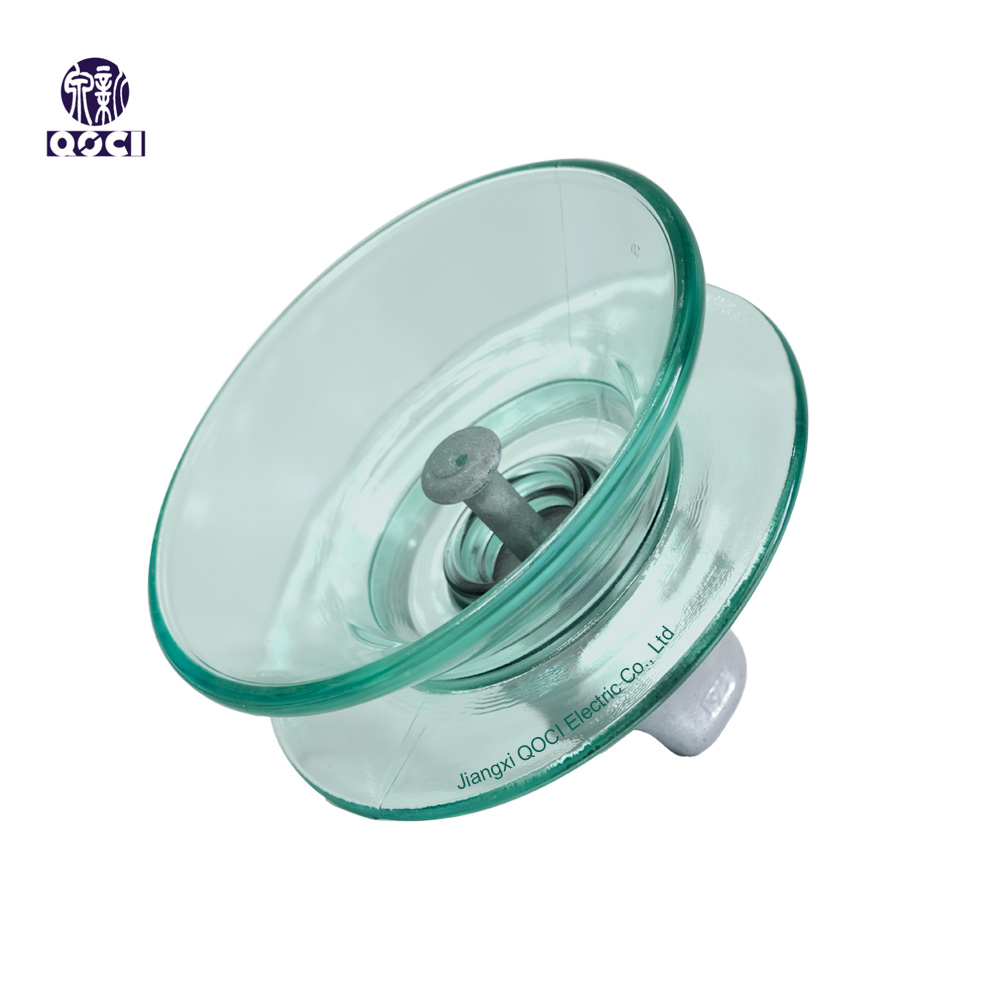
Double-shed geometry raises creepage and pollution runoff, but it also changes disc diameter and spacing in the string.
Where the Shortlist Meets Its Limits
Glass insulators are often compared with porcelain on maintenance logic. Because a failed glass unit shatters visibly, a line crew can identify it by inspection, which supports the 100% visual defect detection reported in the project work above. That is a genuine operational difference, and it is why glass is often favoured where inspection access is difficult.
The same comparison carries limits that a shortlist should record rather than smooth over. Four are material.
First, longer creepage changes geometry. Moving from U160BS at 280 mm disc and 400 mm creepage to U160BLD at 340 mm disc and 550 mm creepage improves the leakage path but alters disc diameter, spacing and string length. Tower clearances, hardware and wind loading assumptions have to be rechecked. A shortlist that compares creepage alone will select a unit that may not fit the tower.
Second, standard compliance is not site adequacy. IEC 60305:2021 specifies mechanical and electrical characteristics for AC suspension units. It does not determine whether a given creepage level is sufficient for a specific coastal or industrial site. Pollution severity assessment remains a project engineering task, and the anti-pollution profile is an input to that task, not a replacement for it.
Third, glass is replaced, not repaired. A shattered unit has to be swapped out, so spare-unit provision and replacement logistics belong in the lifecycle terms. A shortlist that prices only the installed quantity leaves the buyer exposed at the first breakage.
Fourth, service scope has boundaries. QOCI’s stated after-sales support is online technical support and replacement for defective products. That is a defined scope, not a local field-service network. Where a tender requires on-site response, regional stock or attendance at commissioning, those requirements must be verified separately rather than assumed from the product datasheet.
Market Context and Future Outlook
The commercial backdrop explains why purchasing terms are becoming the comparison layer. The global glass insulators market was estimated at USD 1.14 billion in 2024 and is projected to reach USD 1.97 billion by 2035, with a CAGR of 5.1% over the 2025 to 2035 forecast period, according to Market Research Future. Asia Pacific held a revenue share of 52.9% in 2024, driven by grid expansion in China and India, and China concentrated 31.4% of total global exports of electrical insulators in 2024, worth USD 898 million, according to OEC.
Supply patterns are shifting as well. China’s exports of electrical insulators to Saudi Arabia grew by 219% between 2023 and 2024, making it the fastest-growing market in that dataset. More suppliers, more designations and more regional routes mean more quotations that look alike on the first page and diverge on the annexes. The term sheet is what keeps the comparison honest.
Market size figures should be read with care. Published estimates for glass insulators vary widely because some studies include building-related insulated glass, with one estimate placing the market at USD 351.4 million. Buyers should treat market figures as context for supply planning, not as procurement data, and should rely on the model datasheet and the contract terms for the decision itself.
The direction of travel is toward documented conformity rather than claims. IEC 60305:2021 provides a stable reference for AC suspension units, third-party inspection is increasingly written into purchase orders, and project records are becoming part of the evaluation file. Shortlists that specify the standard edition, the exact model, the coupling, the test regime and the service scope will be easier to audit and easier to defend internally than shortlists built on unit price and a product photograph.
FAQ
What should a buyer fix in the enquiry before comparing suspension glass insulator offers?
Fix four groups: technical conformity, commercial terms, acceptance terms and lifecycle terms. Technical conformity includes the standard edition, model designation, mechanical failing load, disc diameter, nominal spacing, creepage distance, socket coupling and withstand voltages. Commercial terms include minimum order quantity, lead time, capacity and customization scope. Acceptance terms include the pre-shipment test regime and third-party inspection rights. Lifecycle terms include after-sales scope and replacement policy. When all suppliers answer the same fields, the offers are comparable.
Why can two 160 kN suspension glass insulators have different string geometry?
Because the kilonewton value is a strength class, not a dimension. U160BS is listed at 280 mm disc diameter, 146 mm spacing and 400 mm creepage. U160BLP is listed at 280 mm disc, 170 mm spacing and 450 mm creepage. U160BLD is listed at 340 mm disc, 170 mm spacing and 550 mm creepage. All three are 160 kN units, but they produce different string lengths and different fitting interfaces, so the model designation and the full dimensional set must appear in the quotation.
When should anti-pollution, double-shed or aerodynamic profiles be specified?
Specify them when the line environment demands more than the standard leakage path. Anti-pollution profiles such as U210BP provide 550 mm creepage on a 320 mm disc against 400 mm on the standard U210B. Double-shed profiles such as U160BLD and U210BD add shed geometry for pollution runoff in dusty or industrial conditions. Aerodynamic profiles such as U120BLA use a 380 mm disc with 365 mm creepage. Each choice changes disc diameter, spacing or both, so the string design has to be rechecked.
What do MOQ, lead time and capacity tell a buyer about a supplier?
They show whether the supplier can move from validation to volume. QOCI states a minimum order quantity of 50 units, a lead time of 15 to 35 days and monthly capacity of 750,000 units. A low MOQ supports a trial batch for dimensional and packing checks. A lead-time range should be converted into a dated schedule per model. Monthly capacity is a rate rather than an allocation, so the buyer should ask what capacity is reserved for the project.
What acceptance evidence should be in place before shipment release?
Three items: a defined pre-shipment test regime applied to the exact model, a documented inspection route including third-party inspection where required, and visual inspection criteria for the batch. QOCI states 100% pre-shipment test, third-party inspection with SGS named as an inspection body, and visual defect detection supported by the visible failure mode of tempered glass. Visual screening does not replace load and electrical test records; the two together form the acceptance file.
What can a glass insulator shortlist not resolve?
It cannot replace site-specific pollution assessment, structural rechecking when creepage changes geometry, or a service-scope agreement. IEC 60305:2021 defines unit characteristics, not the adequacy of a creepage level for a particular coastline or industrial zone. A longer creepage profile changes disc diameter and spacing, so tower clearances must be verified separately. And where the stated after-sales scope is online technical support and replacement of defective products, any requirement for on-site service or local stock has to be confirmed as a separate term.
For buyers who need the dimensional and profile reference in one document, the QOCI glass insulator catalogue is available for download: QOCI Catalogue – Glass Insulators.
Have Questions or Need More Details?
Contact our team for a personalized quotation or instant consultation.
Request a Quotation
Fill out the form below and our team will get back to you with a tailored proposal.
WhatsApp Direct Chat
Prefer to chat in real-time? Message us on WhatsApp for instant assistance & quick answers.
- Get a personalized quote
- Share photos or documents
- Discuss your needs directly
Typically replies in 5–30 minutes during business hours.