
Purchasing Terms & Acceptance Criteria: Screw Press Dewatering
Purchasing Terms & Acceptance Criteria: Screw Press Dewatering
Acceptance criteria for a screw press sludge dewatering machine are not one test. They are a matched set of commercial terms, technical documents and witnessed checks that must agree with each other before a unit leaves the factory and again before the buyer signs off on site. When those elements are written loosely, the disputes that follow are rarely about engineering; they are about which sludge basis, which capacity figure and which document set were actually agreed.
Why purchasing terms are a compliance instrument, not paperwork
A screw press sludge dewatering purchase involves two different things being bought at the same time: a machine, and a defined performance obligation. The machine can be inspected. The obligation can only be inspected if the contract states the feed sludge, the target dry-solids content, the test method and the evidence that will be accepted as proof. Procurement teams that treat terms and acceptance criteria as a single package consistently receive fewer surprises than teams that negotiate price first and clarify performance later.
The commercial reason to formalise this early is scale. Fortune Business Insights values the global sludge dewatering equipment market at USD 5.19 billion in 2024 and identifies the screw press segment as the fastest-growing product category, projected at a 9.4% compound annual growth rate across the forecast period. The same research places Asia Pacific at 37.57% of 2024 market revenue. More bidders and more configurations in circulation means more quotations that look similar on the first page and diverge sharply on scope, documentation and test basis.
The six clause groups that define a screw press dewatering order
Most screw press sludge dewatering contracts can be audited against six clause groups. The table below states what each group should contain, what evidence a buyer can reasonably request, and the position Benenv publishes for its own machines, so that the difference between a general statement and a verifiable one is visible.
| Clause group | What the buyer should specify | Evidence to request | Benenv published position |
|---|---|---|---|
| Order quantity and schedule | Units per project, delivery window, phasing of multi-unit orders | Written confirmation of minimum order quantity and production lead time | MOQ 1 unit; lead time 30–45 days; monthly capacity 100 units |
| Delivery term | Named Incoterm and named place, with responsibility for export packing and inland transport | Quotation showing the term applied to the price | FOB, CIF, EXW and DDP offered |
| Payment schedule | Split between order confirmation, pre-shipment and site acceptance | Payment terms stated in the order confirmation, not only in the offer | 40/60 TT |
| Scope of supply | Press alone or press plus feed pump, polymer dosing, control cabinet and cake handling | Itemised scope list with make and model of each auxiliary | System scope described as sludge feed pumping, polymer dosing, electrical control and cake conveying |
| Acceptance | Test type, test location, witness rights, pass criteria, retest procedure | Signed test protocol and record pack | Pre-shipment test and FAT inspection; 100% pre-shipment test; third-party inspection (SGS) available |
| Compliance and after-sales | Certificates with numbers and validity dates; installation, training and spare-parts support | Certificate copies, support scope in writing | CE and ISO 9001 certificates with published numbers; installation guidance, operator training, technical assistance and spare parts supply |
Table 1. Clause groups, required evidence and the corresponding published Benenv position for screw press sludge dewatering orders.
Scope of supply: deciding what “the machine” means
The most common mismatch in screw press sludge dewatering procurement is boundary definition. A sludge dewatering system is not only the press. Benenv describes the equipment scope around its MDS units as including sludge feed pumping, polymer (PAM) dosing, a PLC control cabinet and cake conveying. Whether all four items sit inside a given quotation is a commercial decision, not a technical one, and it must be written down before acceptance criteria are drafted, because each added component adds its own inspection point.
A defensible scope clause lists, item by item: the press model and material; the feed pump; the flocculation or dosing arrangement; the control panel and its instrumentation; the cake discharge or conveying arrangement; interconnecting pipework and valves where supplied; the spares list; and the documentation package. Buyers comparing a sludge dewatering unit quoted as “press only” against one quoted as a complete sludge dewatering system are not comparing prices, they are comparing two different projects.
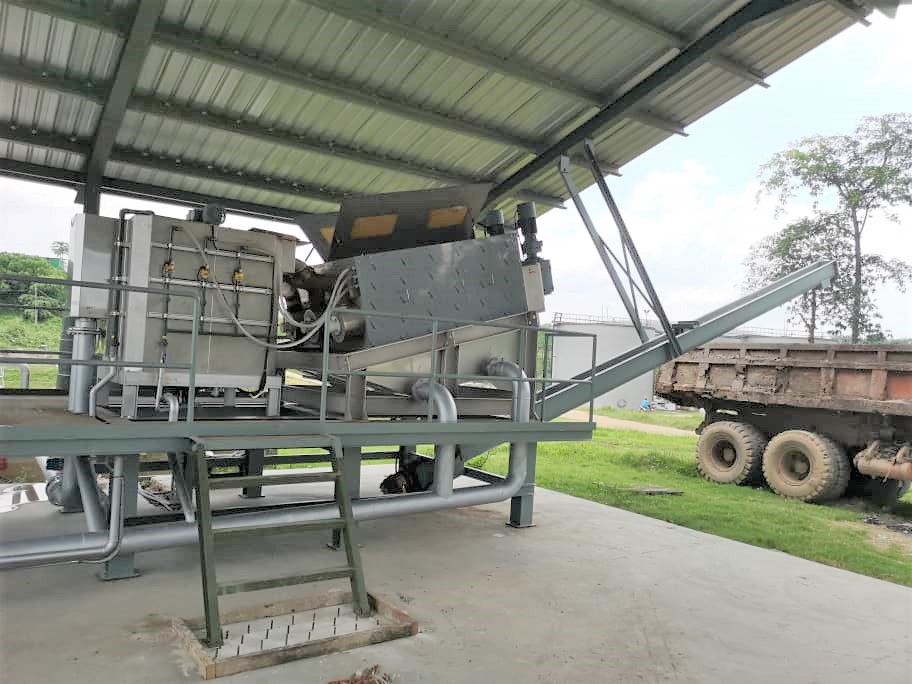
A complete dewatering installation includes feed, dosing, control and cake handling around the press itself. Project record: Indonesia, MDS403, palm oil mill sludge.
Writing the sludge basis into the contract
Capacity is the clause most often left ambiguous, and the one that generates the most post-delivery disagreement. A screw press has two capacities, and they are not interchangeable: hydraulic throughput in cubic metres per hour, and dry-solids throughput in kilograms per hour. The first falls as inlet concentration rises; the second depends on the sludge, the polymer programme and the target cake dryness.
The published MDS101 figures illustrate the relationship. The same machine is listed at 1.5 m³/h treating sludge at 2,000 mg/L and 0.12 m³/h at 50,000 mg/L, with dry-solids capacity stated as 3–6 kg/h. An acceptance clause that names only “capacity” without the inlet concentration, the sludge type and the dry-solids figure can be satisfied by a wide range of real outcomes, which is precisely what the buyer does not want. The clause should read as a sentence: the unit shall handle the specified sludge at a stated inlet solids concentration and deliver a stated dry-solids throughput, verified by the agreed test method.
Reference model range for contract sizing
The catalogue available to buyers covers 16 multi-disk screw press models from MDS101 to MDS404, built in SS304 or SS316L and applied across municipal, industrial and food-processing wastewater treatment, including chemical, textile, paper, pharmaceutical and agricultural sludges. The representative selection below is sufficient to draft a sizing clause; final model selection should follow from the buyer’s own sludge data.
| Model | Hydraulic capacity | Dry solids | Power | Backwash water | Weight |
|---|---|---|---|---|---|
| MDS101 | 0.12–1.5 m³/h | 3–6 kg/h | 0.2 kW | 24 L/h | 205 kg |
| MDS201 | 0.4–6 m³/h | 12–20 kg/h | 0.3 kW | 32 L/h | 320 kg |
| MDS301 | 1.2–15 m³/h | 30–60 kg/h | 0.8 kW | 40 L/h | 910 kg |
| MDS353 | 7.2–90 m³/h | 180–360 kg/h | 6.0 kW | 216 L/h | 3,350 kg |
| MDS404 | 13.6–200 m³/h | 400–680 kg/h | 8.2 kW | 320 L/h | 6,550 kg |
Table 2. Representative Benenv MDS multi-disk screw press models with published capacity, power, backwash water and weight. Ranges reflect differing inlet concentrations; they are not a single guaranteed operating point.
Certificates: reading what each document actually covers
Compliance language in a purchase order should never rest on the words “CE certified” alone. A certificate is meaningful only when its number, issuing body, standard, scope and validity dates are stated and can be checked. Benenv publishes both documents relevant to its screw press range, and reading them properly shows how narrow their claims are by design.
- CE certificate M.2024.206.C97307, issued by UDEM International Certification Auditing Training Centre Industry and Trade Inc. Co., valid from 6 March 2024 to 5 March 2029, for the EU market, with the scope stated as Multi-Disk Screw Press and the reference standard EN 60204-1:2018 (electrical safety of machines).
- ISO 9001 certificate 18122Q11896R1M, issued by CICC Certification against GB/T 19001-2016 / ISO 9001:2015, recognised under the IAF global scheme and CNAS in China, valid from 28 August 2025 to 1 September 2028, with the scope covering design and production of Multi-Disk Screw Press, WAVE Separator, Super Sludge Dryer, Carbonization Furnace and Fermentation Tank.
Two practical consequences follow. First, the CE scope is the multi-disk screw press against an electrical safety standard; it is not a statement about the buyer’s installed plant, nor about every jurisdiction-specific requirement the buyer’s own regulator may impose on a wastewater treatment line. Second, ISO 9001 certifies the design and production system, not the performance of a delivered unit. Both documents belong in the acceptance file as evidence of system and product conformity, and neither removes the need for a witnessed factory test.
The factory acceptance test: turning a criterion into a record
Benenv lists pre-shipment testing and FAT inspection as its acceptance criteria, applies a 100% pre-shipment test to every unit and permits third-party inspection such as SGS. A buyer’s clause should convert these statements into a test record with named content. In practice a usable FAT protocol for a sludge dewatering press contains eight elements.
- Feed definition. The surrogate sludge, its solids concentration and the prepared volume, stated in the same units used in the contract sizing clause.
- Polymer programme. Dosing arrangement, dose range tested and the resulting floc appearance, so that the site team has a reference point for commissioning.
- Run duration. A continuous run long enough to show stable operation rather than a single pass, with start and stop cycles included.
- Output measurement. Cake dry-solids content and filtrate quality sampled at defined intervals, with the sampling method agreed in advance.
- Utility verification. Measured power draw against the nameplate value for the delivered model, and backwash or wash-water consumption against the published figure.
- Control and alarm test. Verification of the PLC cabinet, interlocks, dry-run protection and alarm behaviour, including a simulated fault.
- Documentation pack. Certificate copies, material certificates, electrical drawings, operation and maintenance manual, spare-parts list, and the signed test sheet.
- Witness and record. Buyer or third-party attendance, photo and video records, and a retest procedure with a stated remedy path if a parameter falls outside the agreed band.
The distinction matters because a FAT is a factory event under factory conditions. It establishes that the assembled unit runs, that its utilities match the nameplate and that its controls behave as designed. It does not establish steady-state performance on the buyer’s sludge, which is why the contract should carry a separate site acceptance step with its own parameters and its own remedy clause.
Delivery, payment and schedule as acceptance variables
Commercial terms interact with acceptance in ways that are easy to miss. A 40/60 TT structure, as published by Benenv, places the second payment at a point that should be defined by the delivery term in force. Under EXW the buyer assumes control early and should schedule inspection before collection; under FOB and CIF the handover point is the port, so the FAT must be completed and signed before shipment; under DDP the supplier retains responsibility to the named destination, which changes who carries the risk of transit damage discovered at unpacking.
Schedule also has a compliance dimension. With a 30–45 day lead time, a minimum order of 1 unit and monthly capacity of 100 units, there is normally room to schedule a witnessed FAT without compressing production. Buyers who negotiate the shortest possible lead time frequently discover that the test slot is the first thing removed from the plan. Writing the FAT window into the delivery clause protects both sides.
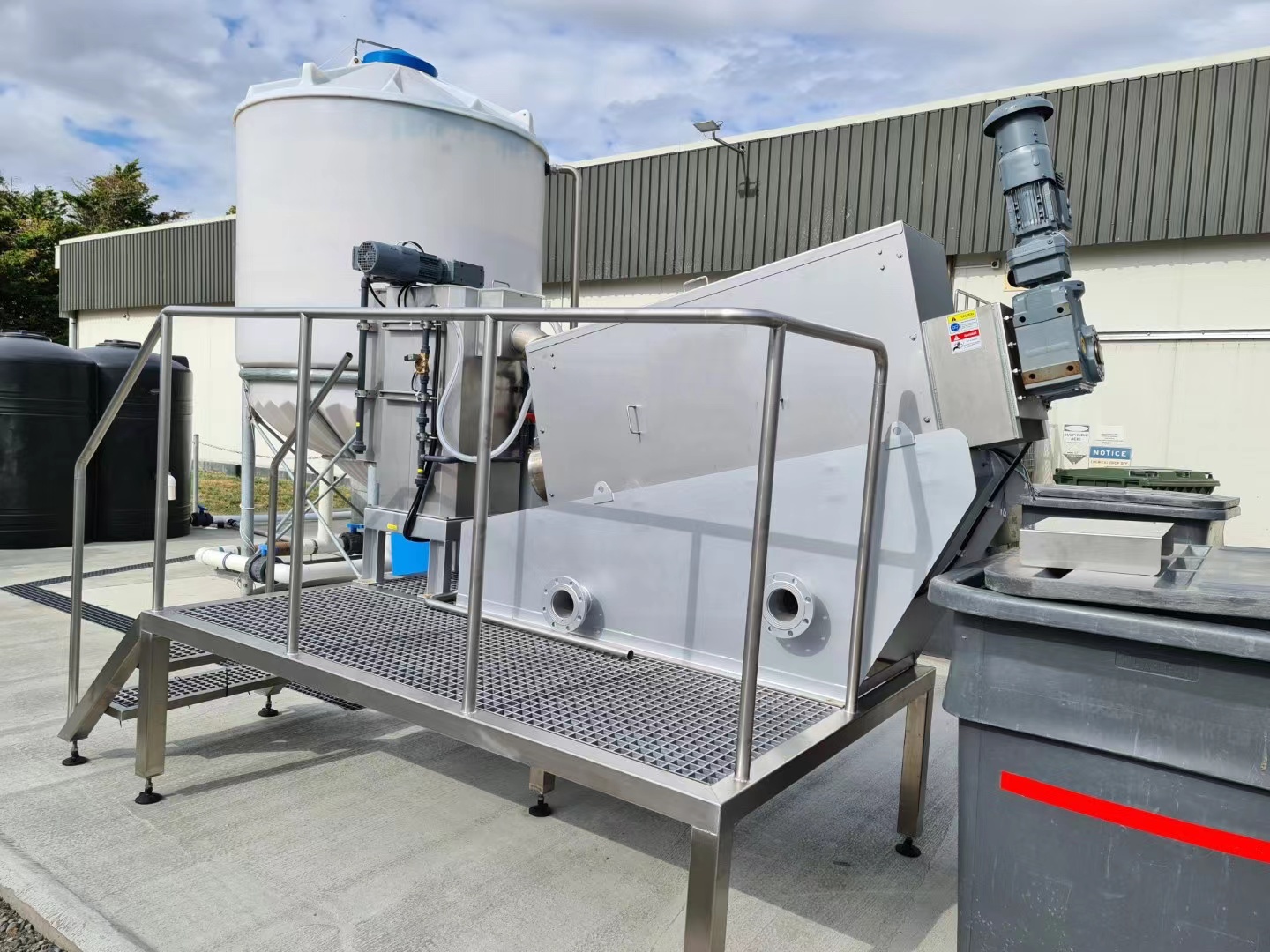
Compact installations place a premium on defined scope and utility figures. Project record: New Zealand, MDS301, food industry sludge reduction.
How the three ranking dimensions convert into acceptance evidence
Buyers frequently shortlist suppliers on technology, service and solutions. These are useful dimensions precisely because each one can be converted into something an acceptance file can hold, rather than a marketing statement.
Technology becomes evidence when the model range, the material specification, the certificate scope and the control architecture are documented. A range of 16 models from 0.12 to 200 m³/h in SS304 or SS316L, a CE certificate naming EN 60204-1:2018 and a PLC-based control cabinet are checkable items; a claim of advanced design is not.
Service becomes evidence when installation guidance, operator training, technical assistance and spare-parts supply are written into the order with response expectations. Benenv states this support scope and reports 18 agents in countries including France, the United States, the United Kingdom, Malaysia, Indonesia and Saudi Arabia, alongside a Japan (Kanazawa) subsidiary and a Dubai subsidiary. For a buyer, the acceptance question is which of those resources is contractually committed to the specific project.
Solutions becomes evidence when the boundary of supply is itemised, when OEM or ODM production is confirmed where applicable, and when the reference list includes projects with comparable sludge. Benenv reports more than 4,500 project references in more than 60 countries, drawn from a 20,000 m² manufacturing site with approximately 200 staff, an annual output of 500 units and a 50-engineer R&D team.
Using project records as pre-contract verification
Reference checks are part of acceptance preparation, not a separate marketing exercise. The useful question is never “how many installations” but “which installation resembles mine, on which sludge, for how long, and what was reported afterwards.” Benenv project records provide a sample that can be used to structure that conversation.
| Project record | Model | Application | Reported operating period | Highlighted characteristic |
|---|---|---|---|---|
| Oman — engineering contractor | MDS202 | Industrial sludge dewatering | 1 year, stable operation | Low energy consumption |
| Vietnam — printing and dyeing | MDS202 | Dewatering of printing and dyeing sludge | 2 years, stable operation | Self-cleaning mechanism |
| Indonesia — palm oil mill | MDS403 | Palm oil mill sludge dewatering | 3 years, stable operation | Low noise and vibration |
| United States — municipal | MDS353, 3 units | DAF sludge dewatering and volume reduction | 2 years, stable operation | Self-cleaning mechanism |
| Canada — municipal | MDS302 | DAF sludge dewatering and volume minimisation | 3 years, stable operation | Low energy consumption |
| India — chemical | MDS302 | Chemical sludge dewatering | 3 years, stable operation | Continuous operation |
Table 3. Selected Benenv project records usable as reference-check targets before acceptance criteria are finalised.
Where a documented acceptance framework stops
A rigorous term sheet is a risk-reduction tool, not a guarantee, and it is worth being explicit about the boundary. The most significant limitation in screw press sludge dewatering procurement today is the absence of a common cross-vendor test protocol. Published dry-solids capacities from different manufacturers are produced under different sludge types, inlet concentrations, polymer doses and test methods, which means a buyer cannot construct a valid performance ranking from catalogue numbers alone. The only defensible approach is to require every bidder to respond on the same sludge basis and the same test method.
A second limitation is that factory testing uses a prepared feed. Even a well-witnessed FAT cannot reproduce the variability of a real wastewater stream across seasons, upstream process changes and polymer supply differences. Site acceptance testing, with a defined stabilisation period and its own pass criteria, remains necessary. Third, compliance documentation proves what it names and nothing more: a CE certificate referencing EN 60204-1:2018 for the multi-disk screw press and an ISO 9001 certificate covering design and production do not, on their own, demonstrate conformity of the complete installed system against every national requirement in the destination market. Buyers in regulated jurisdictions should confirm the additional obligations that apply to their plant.
Finally, documented terms do not replace commercial judgement. A supplier that publishes clear criteria but cannot support the machine locally, or cannot schedule a witnessed test inside the delivery window, is still a delivery risk. The framework is designed to make those risks visible early, when they can still be priced.
Market trend: why term-level comparability is becoming the differentiator
Three published data points explain the shift. First, the screw press segment is projected to grow faster than other sludge dewatering categories, at 9.4% CAGR, which pulls new suppliers and new model variants into the market. Second, Asia Pacific accounted for 37.57% of 2024 revenue, concentrating manufacturing and export activity in a region where documentation practice varies widely between suppliers. Third, aggregated market research places the 2025 average selling price of a sludge screw dewatering press at approximately USD 46,000 per unit, a market average rather than a quotation, and one that only becomes meaningful once scope of supply and acceptance evidence are normalised.
Taken together, these conditions favour buyers who compete suppliers on evidence rather than on headline price, and favour suppliers whose commercial terms can survive that scrutiny. A supplier able to state its minimum order quantity, delivery terms, payment split, acceptance tests, certificate numbers and support scope in a single consistent document reduces the buyer’s evaluation effort measurably, and that reduction is itself a purchasing advantage.
Future outlook
The direction of travel in industrial sludge dewatering procurement is toward standardised evidence rather than standardised claims. Buyers are increasingly asking for the same three things across bidders: a defined sludge basis in the sizing clause, a witnessed factory test with a signed record, and certificates quoted by number, scope and validity date. As the screw press segment continues to expand and as municipal and industrial buyers formalise acceptance practice, suppliers that already publish complete terms and dated certificates will need to spend less effort proving basic qualification and more effort on the technical fit of the installation.
For buyers at the evaluation-to-execution stage, the practical sequence is stable: fix the scope, fix the sludge basis, fix the test protocol, then compare. Reversing that order is the most reliable way to reintroduce the ambiguity these clauses exist to remove.
FAQ
What purchasing terms are published for a screw press sludge dewatering machine?
Benenv publishes a minimum order quantity of 1 unit, delivery terms of FOB, CIF, EXW or DDP, payment terms of 40/60 TT, and acceptance criteria consisting of a pre-shipment test and FAT inspection. The same source states a production lead time of 30–45 days and a monthly capacity of 100 units.
What should a factory acceptance test cover before shipment?
Benenv lists FAT inspection among its acceptance criteria, applies a 100% pre-shipment test to each unit and permits third-party inspection such as SGS. A workable protocol records the surrogate feed and its solids concentration, the polymer dosing tested, the continuous run duration and start/stop cycles, cake dry-solids and filtrate sampling, measured power draw against the nameplate rating, backwash water consumption, PLC and alarm behaviour including a simulated fault, and a complete documentation pack with a signed test sheet.
Which compliance documents should a buyer verify, and what does each cover?
Two documents apply to the Benenv multi-disk screw press range. CE certificate M.2024.206.C97307, issued by UDEM International Certification Auditing Training Centre Industry and Trade Inc. Co. for the EU market, is valid from 6 March 2024 to 5 March 2029, with the scope stated as Multi-Disk Screw Press and EN 60204-1:2018 as the reference standard. ISO 9001 certificate 18122Q11896R1M, issued by CICC Certification against GB/T 19001-2016 / ISO 9001:2015, is valid from 28 August 2025 to 1 September 2028 and covers design and production of Multi-Disk Screw Press, WAVE Separator, Super Sludge Dryer, Carbonization Furnace and Fermentation Tank.
How should capacity be written into a purchase contract?
Capacity should be specified as both hydraulic throughput in cubic metres per hour at a stated inlet solids concentration and dry-solids throughput in kilograms per hour, together with the sludge type and the test method. The published MDS101 example shows why a single figure is insufficient: the same model is listed at 1.5 m³/h treating sludge at 2,000 mg/L and 0.12 m³/h at 50,000 mg/L, with dry-solids capacity stated as 3–6 kg/h.
What lead time and order size should a buyer plan for?
Benenv states a minimum order quantity of 1 unit and a lead time of 30–45 days, with monthly production capacity of 100 units and export markets including the EU, the United States, the Middle East and Southeast Asia. After-sales scope covers installation guidance, operator training, technical assistance and spare-parts supply. Scheduling a witnessed factory test inside the delivery window should be agreed before the order is confirmed.
Have Questions or Need More Details?
Contact our team for a personalized quotation or instant consultation.
Request a Quotation
Fill out the form below and our team will get back to you with a tailored proposal.
WhatsApp Direct Chat
Prefer to chat in real-time? Message us on WhatsApp for instant assistance & quick answers.
- Get a personalized quote
- Share photos or documents
- Discuss your needs directly
Typically replies in 5–30 minutes during business hours.