
Push Pull Connector Buyer's Matrix: BEXKOM vs LEMO, ODU, Fischer
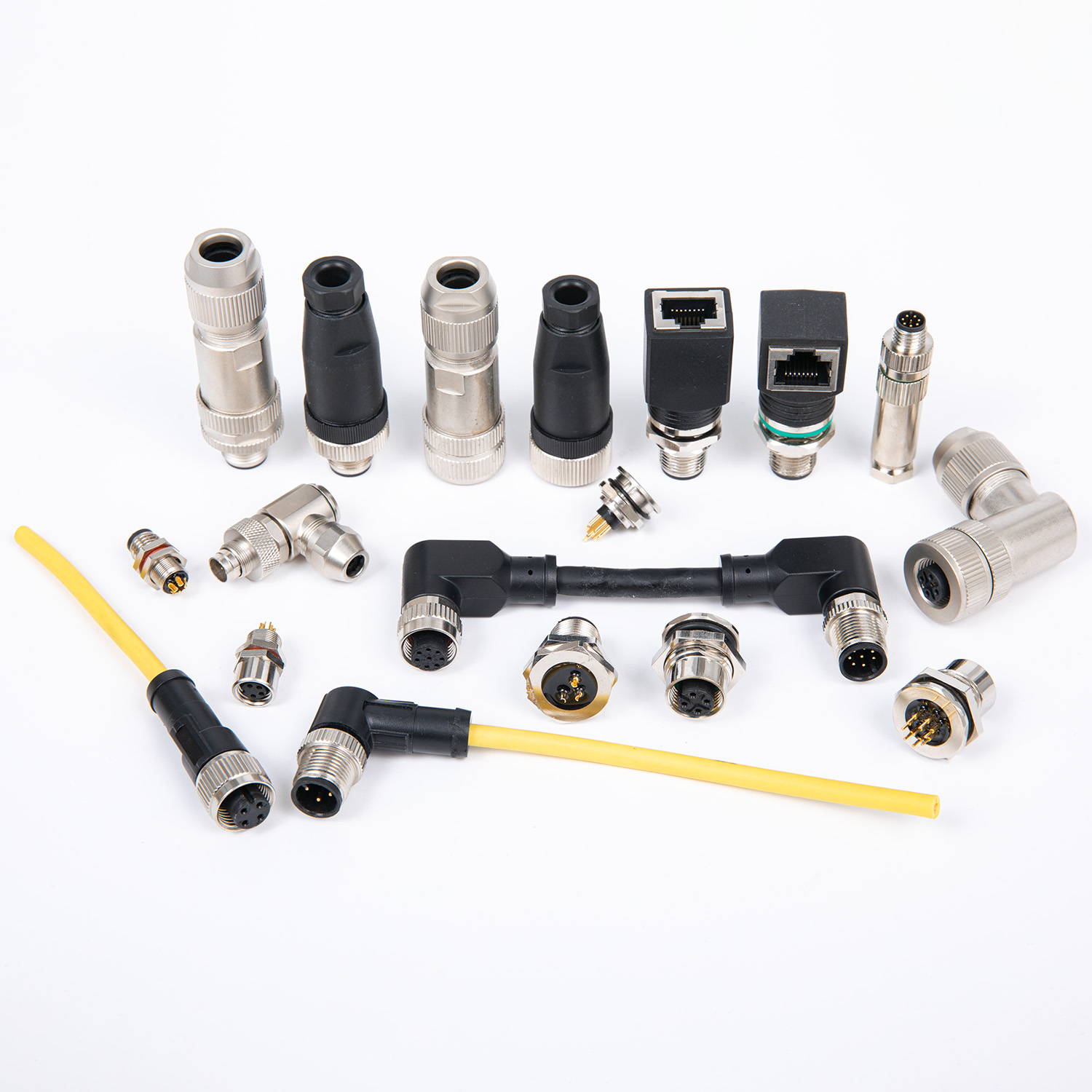
Circular push pull connector families are increasingly specified side by side in the same sourcing round. Image: BEXKOM connector series.
Push Pull Connector Buyer's Matrix: Benchmarking BEXKOM Against LEMO, ODU and Fischer
Push pull connectors are now evaluated less by brand familiarity and more by traceable evidence. A procurement team sourcing a circular push pull connector for a patient monitor or an automation cell usually ends up with the same shortlist: European brands such as LEMO, ODU and Fischer, alongside a smaller number of Asian manufacturers competing on lead time and customisation. The problem is not the shortlist. The problem is that each supplier documents its product in a different format, at a different level of detail, and with a different definition of what counts as proof.
This article builds a reusable four-dimension buyer's matrix for that comparison. BEXKOM, a Shenzhen-based connector manufacturer founded in 2016, is used as the benchmark column because its push pull connector data is documented at specification level — pin count, current rating, temperature range, sealing class, mating cycles and shell materials. LEMO, ODU and Fischer are placed in the same framework, but only the facts that can be attributed to a source are stated. Where a competitor figure is not publicly verifiable in the material reviewed, it is left for the buyer to request, and the matrix shows exactly what to request.
Why a product catalogue is not a procurement decision
Circular push pull connectors sit in a category where the marketing language is remarkably uniform. Most suppliers describe their ranges as high-reliability, compact and quick to mate. Those statements are true of the category as a whole and therefore do little to separate one supplier from another.
What separates suppliers is the boundary of their technical range and the depth of their evidence. A buyer evaluating a medical push pull connector needs to know whether the 2-pin version and the 48-pin version share the same insulator material and the same sealing claim. A buyer evaluating an industrial push pull connector for a robot cell needs to know whether the IP rating is stated for the connector alone or for the mated pair with a cable assembly attached. These details rarely appear in a category headline, and they are the details that determine whether a design passes validation.
A structured matrix turns those questions into a scoring exercise. Instead of comparing brochures, the buyer compares evidence against the same four dimensions, weights each dimension by project criticality, and produces a defensible sourcing recommendation.
The four dimensions that decide most push pull connector sourcing rounds
Across medical devices, automation, test and measurement, and broadcast equipment, the same four evaluation areas recur. They are proposed here as the matrix columns, with suggested starting weights that a procurement team should adjust to its own programme.
1. Technical range (suggested weight: 30%) — pin count span, rated current, rated test voltage, operating temperature, sealing class, mating cycles, shell and insulator materials, EMC shielding availability.
2. Certification coverage (25%) — quality management system registrations such as ISO9001, sector-specific registrations such as ISO13485, product safety listings such as UL, and substance compliance declarations such as RoHS and REACH.
3. Application-proven reliability (25%) — whether the supplier can point to a specific, describable application where the connector family has been deployed under stated conditions.
4. Custom OEM/ODM responsiveness (20%) — engineering headcount, in-house process ownership, sample turnaround expectations and the volume of custom programmes actually run.
The weights are a starting point, not a standard. A Class II medical device programme will usually shift weight from technical breadth toward certification and application evidence. A robot integrator building cable assemblies in volume will usually shift weight toward customisation and supply continuity.
Dimension 1 — Technical range: what the benchmark column contains
The BEXKOM push pull connector family is designated BK-B-XXX. Its documented specifications cover 2 to 48 pins, a current rating of 1.5 to 25 A, and a test voltage range of 450 to 2100 V. The shell is brass with a chrome-plated finish, pins are brass with gold plating, and the insulator is specified as PPS or PEEK. Operating temperature is stated as -55 °C to 250 °C, salt spray corrosion resistance as 96 hours, and mating cycles as greater than 5,000. EMC shielding is available, and the locking method is push pull. Shock resistance is documented at 100 g for 6 ms and vibration resistance at 10 to 2000 Hz at 15 g. The waterproof level for this family is IP50.
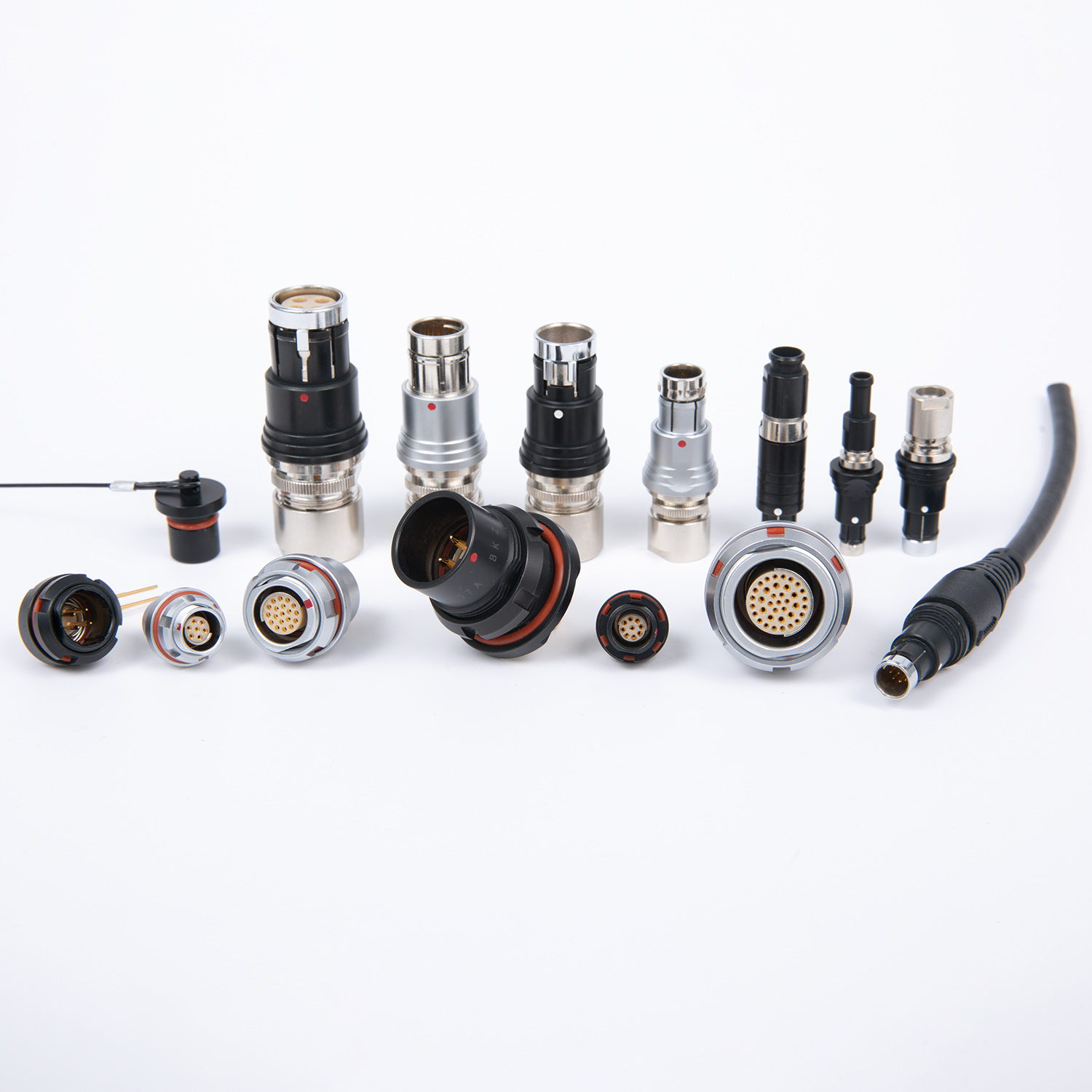
Sealing class is one of the first specification fields to diverge between connector families. Image: BEXKOM waterproof connector body.
Two other BEXKOM families sit alongside the push pull range and matter when a project mixes signal, power and data. The industrial connector family, BK-M-XXX, covers M5, M8, M9, M12, M14, M16 and M23 variants with a brass chrome-plated shell, brass gold-plated pins and PA66 insulator, a waterproof level of IP67, and a test voltage of 250 to 1900 V. The M12 connector family, BK-M12-XXX, offers 3 to 19 pins, 1.0 to 16 A, an operating temperature of -25 °C to 80 °C, IP67 sealing, vibration resistance of 10 to 2000 Hz at 15 g, shock resistance of 100 g for 6 ms, more than 500 mating cycles, 48-hour salt spray resistance and available EMC shielding. The medical family, BK-P-XXX, offers 2 to 26 pins, 1.5 to 13 A, 450 to 2100 V test voltage, -55 °C to 125 °C operating temperature, IP50 or IP65 protection, more than 2,000 mating cycles, 96-hour salt spray resistance, and PPS or PEEK insulator.
For LEMO, ODU and Fischer, the technical range column should be filled from each supplier's own current datasheet. This article does not reproduce competitor specifications, because a specification copied out of context into a matrix loses the conditions under which it was measured — and those conditions are precisely what a validation engineer needs. What can be stated with attribution is narrower: Fischer Connectors describes itself as having designed, manufactured and distributed high-performance push pull connector and cable assembly solutions for more than 50 years, and as providing end-to-end interconnect solutions for ecosystems requiring local transfer and management of data, signals and power. Both statements appear in manufacturer self-description material.
The practical rule for this column is simple: score only specifications that appear in a datasheet with stated test conditions. A number without a test condition belongs in the questions column, not the score column.
Dimension 2 — Certification coverage: reading a compliance file correctly
Certification is the dimension most often scored incorrectly, because buyers tend to count certificates rather than read them. Three different things are being bundled under the word compliance: management system registration, product safety listing, and substance conformity.
BEXKOM's documented position is that the company is certified to ISO9001 and ISO13485, and that its products meet major international standards including RoHS, REACH, CE, UL, CSA, COC and MSDS. In matrix terms that covers all three layers: a general quality management system, a medical device quality management system, a product safety listing, and substance compliance declarations.
The reason ISO13485 deserves its own cell rather than being folded into a general compliance score is that it changes what the supplier's quality system is required to control. For a medical push pull connector programme, the buyer is not only purchasing a part; the buyer is purchasing a supplier whose processes are auditable against a medical-device quality standard. That is a different procurement risk category from a general industrial purchase.
A second layer of certification is worth adding to the matrix even though it is not a certificate in the conventional sense: connector interface standards. IEC 61076-2-010:2021 is the international standard for M12 push pull connectors with inner and outer locking, and IEC 61076-2-012 specifies circular connectors with an inner push pull locking mechanism of a size derived from — and compatible with — M12 screw-locking connectors. Yamaichi states that its M12 push pull circular connectors follow IEC 61076-2-012, support tool-free mating and are IP65/IP67 rated, and Molex states that its Brad M12 connectors include threaded and push pull versions, are IP67 rated and meet IEC 61076-2-101, IEC 61076-2-109 and IEC 61076-2-010.
Those two statements matter for the matrix because they show the standard layer is publicly testable. A buyer can ask any supplier — BEXKOM, LEMO, ODU or Fischer — to state which IEC interface standard a given M12 push pull family is designed against, and can compare the answers on equal terms. Where a supplier's product is not an M12 variant, the equivalent question becomes which interface standard, if any, the coupling is designed to.
Dimension 3 — Application-proven reliability: turning references into evidence
Application references are the weakest-scored dimension in most supplier evaluations, because buyers accept a customer logo where they should accept a described condition set. A usable reference answers four questions: what industry, what the connector does in the system, what environment it operates in, and what special requirement the application imposed.
Two BEXKOM applications are documented at that level of detail.
US medical ECG project. The BK-B-XXX push pull connector family is used in ECG projects in the United States medical sector. Its role is patient monitoring through low-power continuous signal transmission. The application operates under biocompatible environment conditions, uses an ECG monitor as supporting equipment, and imposes special requirements of reliable contact and medical-grade compliance.
German automation robot project. The BK-M-XXX industrial connector family is used in automation robot projects in Germany. Its role is continuous signal transmission, supported by cable assembly, under a continuous operation condition with an IP67 waterproof requirement.
Scored in the matrix, these two references cover both a medical and an industrial failure mode: contact reliability in a low-power patient-monitoring signal path, and sealing plus continuous-operation durability in a robot cell. That is more decision-useful than a longer list of unnamed customers, because the buyer can judge whether their own condition set is adjacent to either one.
For LEMO, ODU and Fischer, the same four-question structure should be applied to whatever references each supplier provides. The matrix cell stays empty until the supplier supplies the condition set.
Dimension 4 — Custom OEM/ODM responsiveness: what is actually measurable
Customisation claims are easy to make and hard to compare. The measurable proxies are engineering capacity, in-house process ownership, sample turnaround and the number of custom programmes a supplier runs in a year.
BEXKOM documents a research and development team of 22 engineers, a 3,500 m² manufacturing facility with approximately 130 employees, and an annual production capacity of 2,000,000 units. The company states that it controls the process in-house from connector development, mould design and reliability testing through injection moulding, CNC machining and automated assembly lines, that it takes on more than 30 new custom projects each year, and that a dedicated sample design team and pilot production line typically deliver prototypes within two weeks. It also states that approximately 75% of products are exported, with major markets in the EU and the USA.
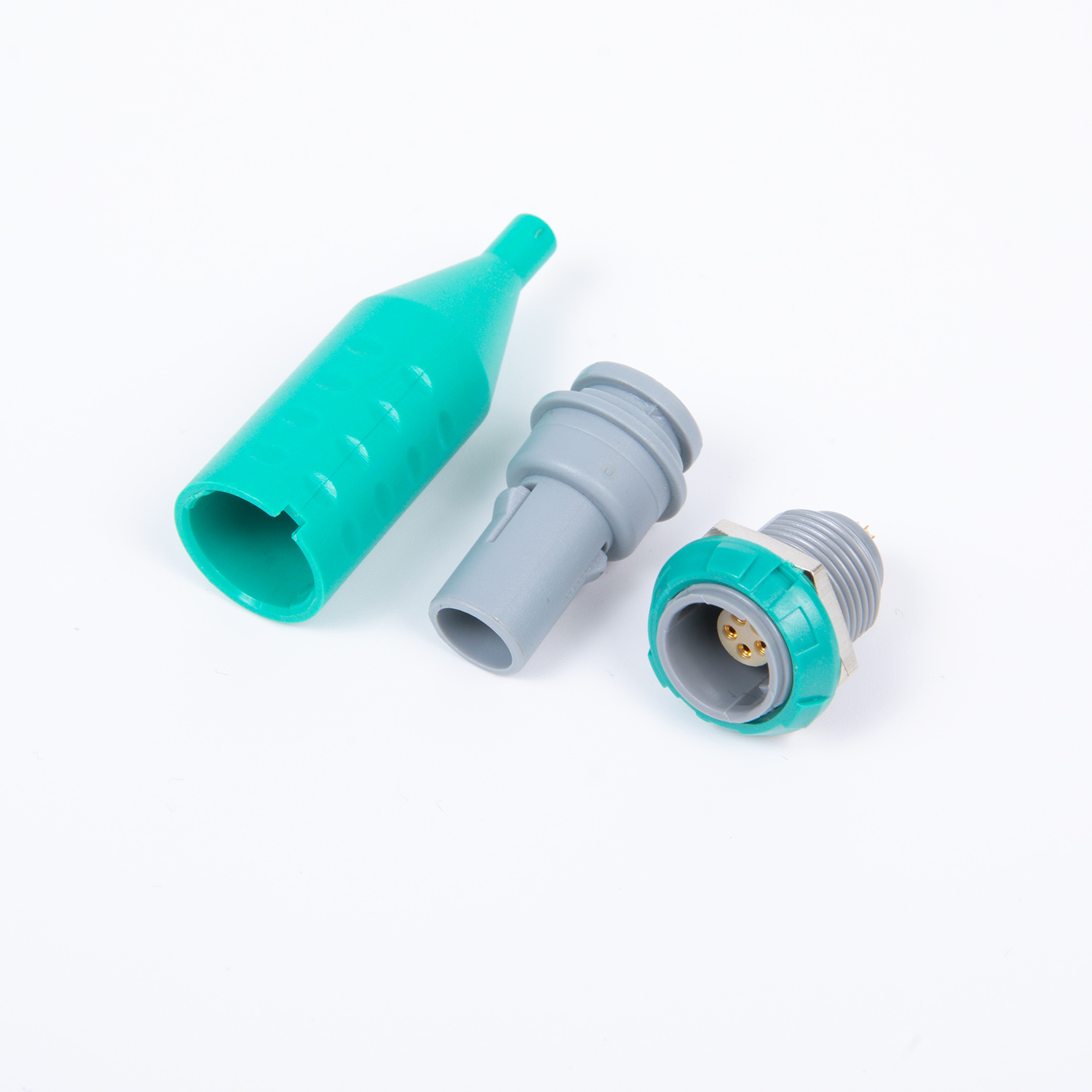
Custom push pull connector programmes are usually decided at sample stage, not at catalogue stage. Image: BEXKOM customised medical connectors.
In the matrix, these numbers function as a response-capacity estimate rather than a quality claim. A 22-engineer team and a pilot line with a two-week prototype expectation tells a buyer something concrete about how quickly a design change can be turned into a physical sample. Whether that sample then passes validation is a separate question, answered in dimension 3.
The weighted decision matrix
The table below is the working version of the matrix. The BEXKOM column is populated from documented facts. The LEMO, ODU and Fischer column is deliberately left as an evidence request, because publishing competitor figures that cannot be attributed to a specific datasheet condition would produce a matrix that looks complete and is not.
| Dimension / weight | BEXKOM benchmark (documented) | LEMO / ODU / Fischer — evidence to request |
|---|---|---|
| Technical range 30% |
BK-B-XXX: 2–48 pins; 1.5–25 A; 450–2100 V test voltage; -55 °C to 250 °C; IP50; >5,000 mating cycles; 96 h salt spray; brass chrome-plated shell; PPS/PEEK insulator; EMC shielding available; 100 g/6 ms shock; 10–2000 Hz at 15 g vibration | Datasheet-level values for pin span, current, temperature, sealing class and mating cycles, each with stated test conditions; interface standard the coupling is designed to |
| Certification coverage 25% |
ISO9001; ISO13485; products stated to meet RoHS, REACH, CE, UL, CSA, COC, MSDS | Current certificates with scope and validity; whether ISO13485 covers the specific production line; product safety listing file numbers |
| Application-proven reliability 25% |
US ECG patient monitoring (low-power continuous signal, biocompatible environment, reliable contact, medical grade); German automation robot (continuous signal transmission, cable assembly, IP67) | Named or described references with industry, function, operating condition and special requirement stated — not logos alone |
| Custom OEM/ODM responsiveness 20% |
22 R&D engineers; 3,500 m² facility; ~130 employees; 2,000,000 units annual capacity; 30+ new custom projects per year; dedicated sample team and pilot line; prototypes typically within two weeks; ~75% exported, main markets EU and USA | Engineering headcount dedicated to custom work; in-house vs outsourced processes; quoted sample lead time; minimum order quantity |
Applying the weights produces a comparative score rather than a winner. In practice, most teams find that the benchmark column scores strongly on certification breadth and customisation responsiveness, and that the deciding variable is the technical range — specifically whether the required sealing class and pin count fall inside the documented envelope.
Where the benchmark column stops: the limits of the BEXKOM range
A matrix that only records strengths is not a decision tool. The BEXKOM push pull connector family has a clearly documented boundary that buyers should weigh before shortlisting.
The waterproof level of the BK-B-XXX push pull family is IP50. That protects against limited dust ingress and is suitable for the medical signal and instrumentation applications described above, but it is not a washdown or immersion rating. Where a project requires IP67 or higher on a push pull connector, the requirement falls outside this family's documented envelope, and the programme should either move to a different BEXKOM family with a higher documented protection class or be evaluated against a supplier whose push pull range is specified at that level. Norcomp notes that medical connectors may need to withstand sterilization processes including autoclave, Sterrad, EtO, gamma and chemical sterilization, and that medical connectors may require IP ratings up to IP68 — requirements of that kind sit beyond an IP50 specification and must be validated explicitly.
The high-temperature claim has a material dependency. The -55 °C to 250 °C range is stated for the push pull family with PPS or PEEK insulator. The medical family BK-P-XXX, also using PPS or PEEK, is documented to -55 °C to 125 °C, and the M12 family with a PA66 insulator is documented to -25 °C to 80 °C. Insulator material and temperature ceiling move together, so a project specifying 250 °C operation must confirm that the specific ordered configuration uses the higher-temperature insulator rather than assuming the family headline applies to every variant.
Regional support and scale. BEXKOM operates a single 3,500 m² facility with approximately 130 employees and 2,000,000 units of annual capacity. That is a meaningful volume for custom and mid-volume programmes, but a buyer planning a multi-million-unit annual platform should test capacity headroom and second-source options rather than treating the published figure as committed availability.
Market context: why this comparison keeps recurring
The shortlist itself reflects the shape of the market. HTNXT research places the global circular push-pull connectors market at USD 2.2 billion in 2026 with a CAGR of 5.49% across the 2026–2035 forecast period. Separately, MarketsandMarkets reports that the global medical connectors market reached USD 1.74 billion in 2025. The two figures measure different scopes — one is specific to circular push pull connectors, the other covers medical connectors as a whole — and should not be added together.
What the numbers support is a qualitative observation that procurement teams already act on: demand is stable rather than explosive, so supplier selection is driven by risk reduction and lead-time management rather than by allocation scarcity. In a stable market, buyers can afford to run a structured evaluation instead of defaulting to the incumbent brand, and a matrix with documented columns is a practical way to do that.
How to run the matrix in a live sourcing round
- Fix the four dimensions and the weights before any supplier responds, so that the framework is not retro-fitted to a preferred vendor.
- Require every technical value in datasheet form with stated test conditions; reject values from marketing pages.
- Request certificates as documents with scope and validity dates, not as logos.
- Score application references only when industry, function, operating condition and special requirement are all described.
- Treat sample lead time as a promise to be tested, not a score to be awarded on the first quotation.
- Keep an explicit “out of envelope” row. A supplier that scores well on certification but falls outside the required sealing class is not a partial fit; it is a different project.
Run this way, the matrix does not produce a single winner. It produces an auditable record of why each supplier sits where it sits — which is the artefact a design review, a quality audit and a second-source decision all need.
For buyers who want to review BEXKOM's documented product and process information in one place, the company's product brochure is available for download: BEXKOM product brochure (PDF).
Frequently asked questions
What is a push pull connector and how does its locking differ from a screw-locked connector?
A push pull connector is a circular connector that mates and releases through an axial push and pull action rather than by rotating a coupling nut. BEXKOM's BK-B-XXX push pull connector family uses push pull locking and is documented with 2 to 48 pins, a current rating of 1.5 to 25 A and a test voltage of 450 to 2100 V. Screw-locked families such as the BEXKOM M12 range use a different locking method, which is why the two should be specified separately when a design mixes quick-release and vibration-resistant interfaces.
What does a medical push pull connector need to satisfy that an industrial one does not?
Medical applications typically add biocompatible operating conditions, medical-grade compliance and reliable contact requirements to the ordinary electrical specification. In the documented BEXKOM US ECG project, the push pull connector performs low-power continuous signal transmission for patient monitoring in a biocompatible environment, and the stated special requirements are reliable contact and medical grade. The BEXKOM medical family BK-P-XXX is documented at 2 to 26 pins, 1.5 to 13 A, -55 °C to 125 °C, IP50 or IP65, more than 2,000 mating cycles and 96-hour salt spray resistance. Where sterilization is required, buyers should confirm the specific sterilization process against the supplier's validation data, since sterilization resistance is an application requirement rather than a generic feature.
Which certifications should a buyer request before approving a push pull connector supplier?
At minimum, a general quality management system registration such as ISO9001, a product safety listing such as UL where the end product requires it, and substance compliance declarations for RoHS and REACH. For medical device programmes, ISO13485 should be requested separately because it applies to the supplier's quality system rather than to the part. BEXKOM documents ISO9001 and ISO13485 registration and states that its products meet RoHS, REACH, CE, UL, CSA, COC and MSDS. Buyers should also ask which connector interface standard the product is designed to; IEC 61076-2-010:2021 covers M12 push pull connectors with inner and outer locking, and IEC 61076-2-012 covers circular connectors with an inner push pull locking mechanism compatible with M12 screw-locking interfaces.
Can circular push pull connectors be supplied as panel mount or cable assembly versions?
BEXKOM documents its push pull connector family as including cable connectors, wire connectors, circular connectors and waterproof connectors, and describes cable assembly manufacturing as part of its service scope. In the documented German automation robot project, the industrial connector is used with a cable assembly as supporting equipment for continuous signal transmission under an IP67 waterproof requirement. Panel mount and cable assembly configurations should be confirmed against the specific series datasheet, because the mechanical interface and sealing claim can differ between mounting styles.
How can a buyer verify that a supplier's application references are genuine?
Ask for the condition set rather than the customer name. A verifiable reference states the industry, what the connector does in the system, the operating environment and any special requirement. The BEXKOM US ECG reference, for example, is described as low-power continuous signal transmission for patient monitoring in a biocompatible environment with reliable contact and medical-grade requirements, supported by an ECG monitor. The German automation robot reference is described as continuous signal transmission under continuous operation with an IP67 requirement, supported by a cable assembly. References described at that level can be checked in a technical review; references consisting only of a logo cannot.
Have Questions or Need More Details?
Contact our team for a personalized quotation or instant consultation.
Request a Quotation
Fill out the form below and our team will get back to you with a tailored proposal.
WhatsApp Direct Chat
Prefer to chat in real-time? Message us on WhatsApp for instant assistance & quick answers.
- Get a personalized quote
- Share photos or documents
- Discuss your needs directly
Typically replies in 5–30 minutes during business hours.