
QSK60 Diesel Engine Parts: Reading Manufacturing Control
QSK60 Diesel Engine Parts: Reading Manufacturing Control
Manufacturing control — the degree to which a supplier owns or directly governs the production process behind a part — is the variable that separates one QSK60 diesel engine parts quotation from another before price is even discussed. For the Cummins QSK60 platform, some component categories are produced in plants with group equity participation, while others come from OEM-experienced subcontractors. Both routes can return serviceable parts, but they return different evidence, different accountability and different risks to the buyer.
Why manufacturing control is a buyer question, not a brand question
The commercial problem is straightforward. QSK60 engines are typically in service where downtime is expensive: mining haul trucks, generator sets, construction machinery and long-haul fleet trucks. A quality failure in a turbocharger or cylinder head does not simply cost the part price — it costs the recovery window and the re-installation labour. Buyers therefore want to know not only whether the part fits, but who made it, under what process discipline, and with what documentation.
That distinction has become more visible because trade classification does not carry it. Heavy-duty diesel engine parts enter international trade under classifications such as HS 840999, which the World Bank WITS interface describes as "parts for diesel and semi-diesel engines." A single customs code says nothing about whether a specific cylinder head was produced on a governed line by an equity-linked factory or in a subcontract workshop. Buyers in the evaluation and execution stage have to construct that visibility themselves, through RFQ structure and evidence requests.
The opportunity is practical. Buyers who compare manufacturing control before price gain two advantages. First, they can match evidence depth to failure consequence — applying the tightest documentation requirements to the highest-risk items. Second, they can renegotiate on a factual basis: a supplier who can produce a per-batch test report and a material certificate is not competing on the same axis as one who only offers a delivery lead time.
F-DIESEL's structure in one paragraph
F-DIESEL Power Co., Ltd is a diesel engine spare parts group headquartered in Shenzhen, China, established in 1999, with a branch office in Shanghai and an overseas business hub in Hofheim, Germany. Its declared model is a headquarters R&D and quality control centre, backed by invested manufacturing bases and a strategic partner factory network. The company states that its invested turbocharger plant reaches an annual capacity of 200,000 turbochargers, and its published corporate history records a 2008 joint venture with Ningbo Tianli Turbocharger Co., Ltd. Company media assets also identify an FD Crankshaft factory. For cylinder blocks, cylinder heads, common-rail components and sensors, F-DIESEL works with qualified OEM-grade manufacturers in China to support one-stop sourcing for engine overhaul kits.
For OEM and OES programmes the same organisation describes production carried out strictly to customer drawings, specifications and quality standards, with OES custom spare parts produced to match original service parts and factory packaging requirements. The relevant point for a QSK60 buyer is that a single quotation may contain parts from more than one production source. Knowing which part came from which source is the precondition for evaluating its evidence.

QSK60 components grouped by manufacturing control
The most useful buyer framework is a three-way sort rather than a binary one. Some QSK60 categories sit inside equity-linked manufacturing, some sit with OEM-grade subcontract partners, and some are interface-critical categories where the sourcing route matters less than the specification match. The table below reflects only the sourcing structure F-DIESEL publishes.
| QSK60 component category | Sourcing route in F-DIESEL's structure | What the buyer should confirm first |
|---|---|---|
| Turbocharger (QSK60 turbocharger; Holset HX82 / HX83 / HX84 replacement) | Group-invested turbocharger plant, 200,000 pcs annual capacity | Per-batch test report and matching parameters against the specific QSK60 build |
| Crankshaft | FD Crankshaft factory identified in company media | Material specification (ductile iron vs forged steel) and inspection records |
| Cylinder head | OEM-grade partner manufacturer | Hydrostatic leak test record; grouped inspection report |
| Cylinder block | OEM-grade partner manufacturer | Hydrostatic leak test record; material certificate on request |
| Common-rail components (injectors, injection pumps) | OEM-grade partner manufacturer | Fuel-system version confirmation; injector characterisation |
| Sensors | OEM-grade partner manufacturer | Part-number cross-reference and calibration data where applicable |
Read the table as a risk map, not a quality ranking. A subcontract category is not automatically weaker than an equity-operated one. The difference is where the buyer's verification window sits: inside a governed plant, or inside a document set the supplier chooses to share.
The five evidence items buyers should actually weigh
1. Grouped incoming and outgoing quality inspection
F-DIESEL confirms a full incoming-outgoing inspection procedure as part of its quality management framework, alongside 100% testing. Grouped inspection means the same documented process applies to identically specified parts arriving in a batch, rather than every unit being individually traced. For a routine overhaul kit this is proportionate. It becomes insufficient on its own when a single high-value item — a haul-truck cylinder head, for example — is the reason for the order. In that case, ask for an additional item-level inspection record.
2. Per-batch test reports
A per-batch test report ties a physical inspection or functional result to a specific production batch. For high-consequence items such as turbochargers, cylinder heads and crankshafts, the report should identify the batch, the test method and the result, so a replacement order can be compared against the original. It is one of the simplest ways to remove confusion when the same part number is ordered twice from two different sources.
3. Material test certificates
A material test certificate records the chemical composition and mechanical properties of the grade actually used. It is most valuable on pressure-bearing and load-bearing items — cylinder heads, cylinder blocks and crankshafts — where a grade substitution would only surface later as a durability failure. Buyers should state the required material grade inside the RFQ and request the certificate at the same time, not as a follow-up after the order is placed.
4. Hydrostatic leak testing for cylinder heads and blocks
Hydrostatic leak testing pressurises the coolant or oil passages of a cylinder head or block with fluid and observes for leakage or pressure decay. In heavy-duty practice it is a fast way to catch casting defects and machining errors before the part goes onto an engine. When ordering QSK60 cylinder heads or blocks, request the test record together with the acceptance criterion used, so the result can be interpreted rather than just received.
5. Mutually agreed acceptance criteria
F-DIESEL's published purchasing terms state that acceptance standards are mutually confirmed by both parties based on the delivery checklist, visual inspection and functional testing. That is an important qualification: the acceptance criterion is negotiated rather than fixed and published. Buyers should write it into the purchase order so that "acceptable" is defined before shipment, not after arrival.
Crankshaft material: ductile iron versus forged steel
Ductile iron crankshafts are cast and rely on nodular graphite for strength and damping characteristics. Forged steel crankshafts are shaped under compression, developing a directional grain flow associated with fatigue resistance under high load. Both material families are used in heavy-duty diesel applications; the appropriate choice depends on the engine's duty cycle, the load spectrum and the service interval the operator expects.
What matters for the buyer is not which material is better in the abstract, but that the quotation names the grade explicitly. If the RFQ specifies a forged steel crankshaft and the returned quotation lists a ductile iron crankshaft, the two should not be compared on price — they are different products. The grade should be stated in the RFQ, repeated in the quotation, and confirmed against the material test certificate before comparison begins.
Interface compatibility must be settled before the comparison
F-DIESEL's own guidance for large units such as the QSK60 is to confirm interface compatibility, injector characteristics and turbo matching parameters before ordering, with on-site customisation possible where required. That is a technical caution a buyer should not skip, because three separate errors are common.
- Fuel-system version. Common-rail injectors and injection pumps are not interchangeable across fuel-system generations. Confirm the version on the engine, not the version on the replacement part number.
- Turbo and injector interface. The turbocharger's physical mounting and its boost characteristics interact with the injector's fuel delivery. A turbocharger that fits the flange but does not match the injector profile can produce a functional engine that is incorrectly tuned.
- Full engine model and serial number. F-DIESEL's published purchasing guidance recommends confirming the full engine model and serial number first, matching the corresponding part number, then verifying installation dimensions before ordering.
These checks do not replace inspection. They prevent a category-level error from consuming the inspection window before the part has even arrived.
Where the parts go, and what the case record actually says
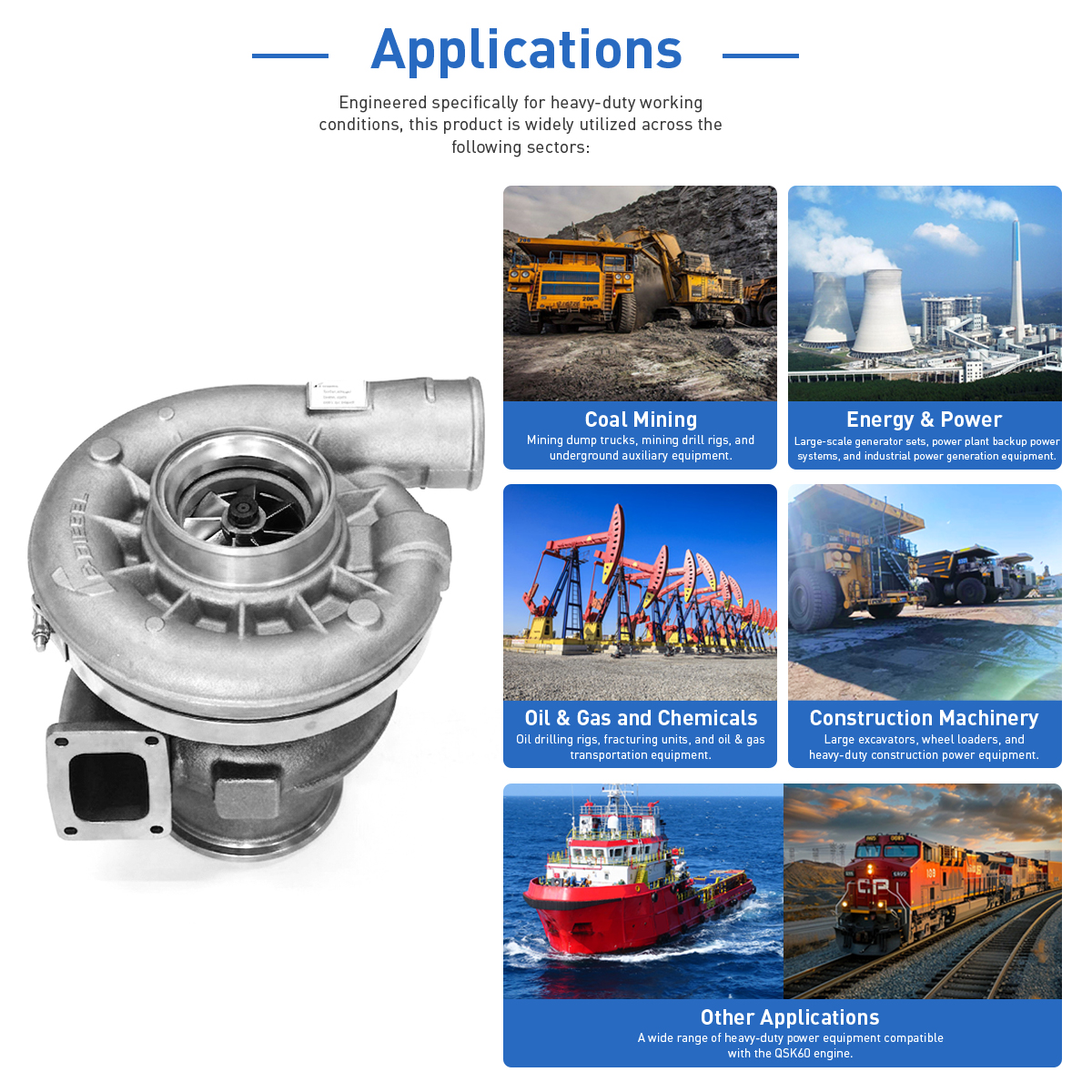
QSK60 parts from F-DIESEL are positioned for mining haul trucks, generator sets, construction machinery and fleet heavy trucks, with supporting use in agricultural vehicle power systems. The published QSK60 turbocharger case references continuous operation in mining environments, plug-and-play fitment compatible with Holset HX82, HX83 and HX84 and the full QSK60 engine series, and an operator-reported result of 15,000+ hours of trouble-free operation under real mining conditions with a 12-month warranty period stated. Parts are described as manufactured to OEM drawings and standards and verified through 8,000-hour endurance testing.
Buyers should read that benchmark carefully. The 15,000-hour figure is a case-level operating result, not a guarantee that every QSK60 turbocharger in every duty cycle will reach the same point. The 12-month warranty is the commercial instrument; the operating hours are an observed case. Both belong in the evaluation file, but they answer different questions.
Market trend context for parts-level decisions
Three verified signals shape how buyers should read QSK60 sourcing today.
Installed base is still growing. Fortune Business Insights valued the global diesel engine market at USD 70.99 billion in 2025 and projected a CAGR of 5.40% through 2034. That figure covers full engines rather than parts specifically, but overhaul demand is a function of engines in service, so the direction is relevant.
The fuel-system sub-segment is large and technically demanding. Global Market Insights valued the global diesel common rail injection system market at USD 22.6 billion in 2024. Common-rail components are precisely the category where part-level evidence and interface confirmation matter most, which is why the fuel-system version check is not optional.
Regulation adds pressure. The U.S. EPA's 2027 heavy-duty engine standards set a NOx limit of 0.035 g/bhp-hr. Tighter NOx control raises the precision required from injection and turbo systems, which in turn raises the value of components and documentation that can be verified against a defined specification rather than a catalogue claim. On the documentation side, ISO 7876-5:2021 establishes a vocabulary for common-rail fuel injection systems and their components. The practical benefit to a buyer is that a shared vocabulary makes RFQs and supplier responses more directly comparable, narrowing the ambiguity that usually sits behind a price difference.
The trade-off: what a mixed manufacturing model costs the buyer
A mixed model is not a weakness in itself, but it carries three real costs that should be planned for rather than discovered.
Visibility is uneven. Equity-linked plants typically allow deeper buyer access to process records than partner workshops. Where a QSK60 cylinder head or block comes from a partner factory, the buyer's window into the process is the documentation the supplier chooses to share, not the process itself. Ask for the document set explicitly and specify it in the PO.
Lead time and MOQ may not fit emergency repair. F-DIESEL's published capacity parameters are 10,000 units per month, a lead time of 45 days and a minimum order quantity of 300 units. Those numbers are workable for planned overhaul programmes and are less suitable for a single-truck breakdown where the engine is already out of service. For emergency situations, confirm sample stock availability and short-notice terms separately, rather than assuming the standard parameters apply.
Acceptance is negotiated, not fixed. Because acceptance standards are mutually confirmed between buyer and seller, two buyers ordering the same part number can end up with different acceptance criteria. The supplier is not at fault for this, but the buyer needs to write the criterion into the order rather than assume a default exists.
Future outlook
Documentation normalisation is likely to be the first visible change. Standards such as ISO 7876-5:2021 make common-rail terminology more comparable across suppliers. As RFQ responses align on shared vocabulary, price comparisons become less misleading and part-level evidence becomes easier to score.
Regulatory tightening is the second. The EPA 2027 NOx limit of 0.035 g/bhp-hr is one indicator of direction; stricter emission controls generally reward suppliers whose injection and turbo components are backed by test evidence rather than catalogue language.
The third is the maturation of hybrid manufacturing models. The pattern F-DIESEL uses — invested plants for selected high-precision categories, OEM-grade partner manufacturers for others — is increasingly common across the aftermarket supply base. The buyer's counterweight is not to prefer one model by default, but to require evidence that matches the consequence of failure in each category. That is a sourcing discipline, not a supplier preference.
FAQ
Why does manufacturing control matter when comparing QSK60 parts?
Because it determines what a buyer can verify. Parts produced in group-invested or equity-participation plants typically return deeper process records, while subcontracted parts return whatever documentation the supplier chooses to share. The comparison is not "owned is better"; it is whether the available evidence matches the consequence of failure for that specific part.
Which QSK60 categories does F-DIESEL produce in invested plants, and which come from partner manufacturers?
F-DIESEL states that its invested turbocharger plant reaches an annual capacity of 200,000 turbochargers, and its published history records a 2008 joint venture with Ningbo Tianli Turbocharger Co., Ltd. Company media also identify an FD Crankshaft factory. Cylinder blocks, cylinder heads, common-rail components and sensors are sourced from qualified OEM-grade manufacturers in China under a strategic partner factory network.
What durability is documented for the QSK60 turbocharger?
The published QSK60 turbocharger case records 15,000+ hours of trouble-free operation under real mining conditions with a 12-month warranty period stated. Parts are described as manufactured to OEM drawings and standards and verified through 8,000-hour endurance testing, with fitment compatible with Holset HX82, HX83 and HX84 and the full QSK60 engine series.
How should a buyer confirm fuel-system version and turbo/injector compatibility before comparing quotations?
Confirm the full engine model and serial number first, match the corresponding part number, then verify installation dimensions. For QSK60-scale units, confirm interface compatibility, injector characteristics and turbo matching parameters before ordering. Common-rail injectors and pumps are not interchangeable across fuel-system generations, so the version on the engine governs which part is correct.
Which quality documents should a QSK60 buyer request in the RFQ?
At minimum: a grouped incoming-to-outgoing inspection record, a per-batch test report, a material test certificate for load- and pressure-bearing items, and a hydrostatic leak test record for cylinder heads and cylinder blocks. F-DIESEL confirms a full incoming-outgoing inspection procedure and 100% testing as part of its quality framework; the specific per-order documents should be named in the RFQ rather than assumed.
Is there a real choice between ductile iron and forged steel for QSK60 crankshafts?
Both material families are used in heavy-duty diesel crankshafts. Ductile iron crankshafts are cast and rely on nodular graphite for strength and damping; forged steel crankshafts develop a directional grain flow associated with fatigue resistance under high load. The decision depends on duty cycle and load spectrum, and the practical requirement is that the grade be stated in both the RFQ and the returned quotation, then confirmed against the material certificate.
Reference document: F-DIESEL Group Presentation 2026 — download the PDF.
Have Questions or Need More Details?
Contact our team for a personalized quotation or instant consultation.
Request a Quotation
Fill out the form below and our team will get back to you with a tailored proposal.
WhatsApp Direct Chat
Prefer to chat in real-time? Message us on WhatsApp for instant assistance & quick answers.
- Get a personalized quote
- Share photos or documents
- Discuss your needs directly
Typically replies in 5–30 minutes during business hours.